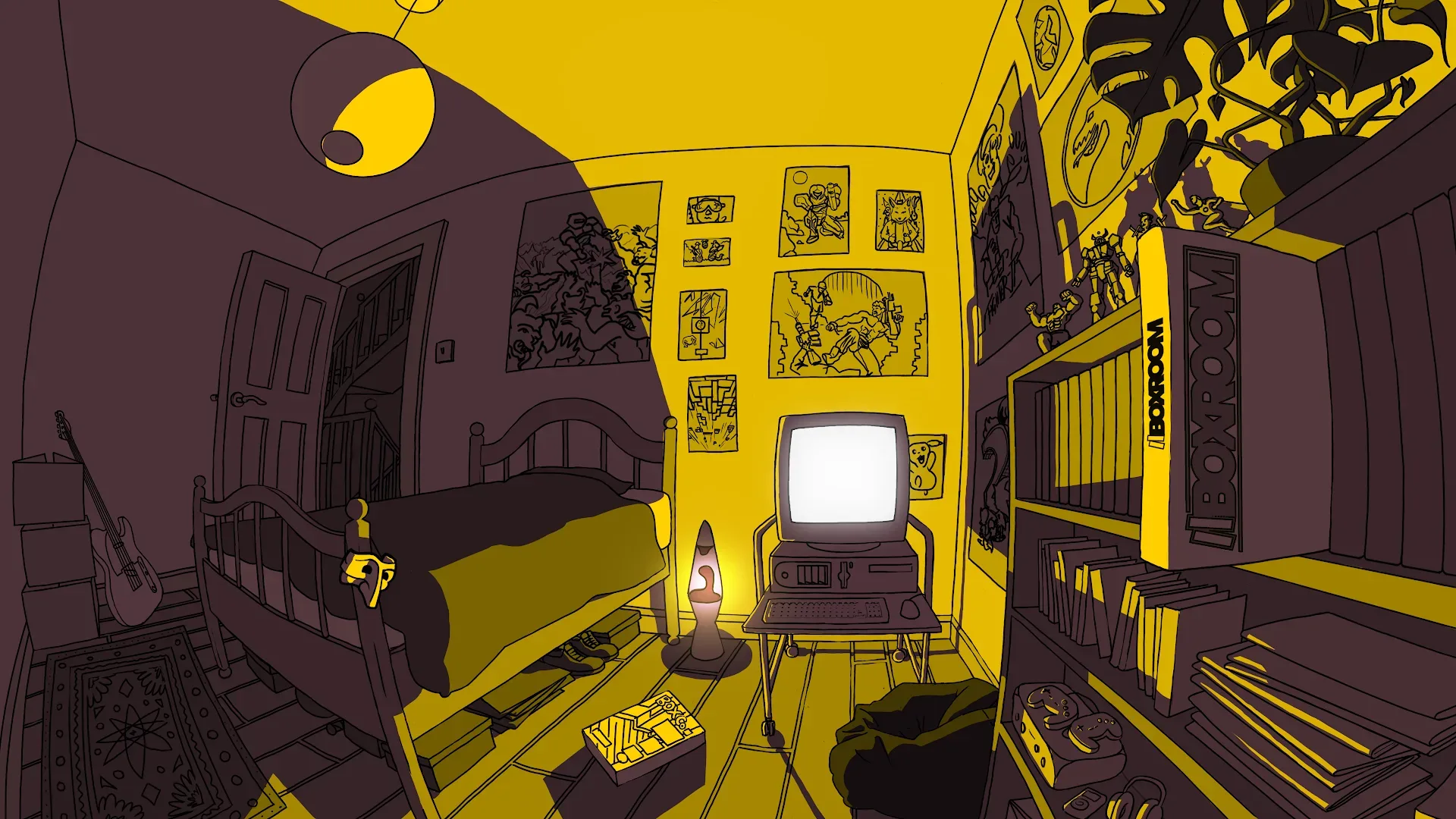
Pantaloon has released the Retail Update for BOXROOM, expanding the Early Access interior-design sandbox with tools and objects aimed at retail-themed creations. The central addition is a dedicated catalogue for building shops, arcades and cafés, giving players more purpose-built pieces for spaces that previously would have required broader decorative improvisation.
The update also puts a sharper focus on personal display spaces. New DVD and video boxes can be used to arrange a video collection, while custom disc and CD artwork allows players to tailor the look of individual media items. In-game televisions can now play users’ own videos, extending the degree to which a room can reflect its creator rather than only the game’s default assets.
BOXROOM is currently in Early Access, a development phase in which a game is available before its full 1.0 release and can continue receiving substantial additions, revisions and fixes. Pantaloon has set November 10 for BOXROOM’s 1.0 launch. At that point, its price is due to rise to $12.99 / £9.99 / €9.99, alongside regional equivalents.
Retail spaces get a dedicated design toolkit
The headline retail catalogue is significant because shops, arcades and cafés depend on visual organization as much as individual props. A convincing retail scene needs places to put stock, displays that read clearly at a glance, and an overall layout that suggests how people would move through it. Purpose-made items can make that process more direct than attempting to repurpose generic furnishings for every counter, shelf or display area.
Arcades and cafés are especially flexible themes within an interior-design sandbox. An arcade can be arranged as a dense, colorful room of entertainment machines and media displays, while a café can lean toward seating, service areas and a more relaxed atmosphere. Retail spaces meanwhile invite players to create specialty shops, compact storefronts or rooms centered on particular kinds of merchandise. The update does not prescribe a single type of business; instead, it supplies a wider visual vocabulary for inventing one.
The arrival of DVD and video boxes sits naturally alongside that premise. A media display can function as shop inventory, an archival-looking personal collection or background detail for a living room or entertainment space. Custom art for discs and CDs adds another layer: rather than merely placing media objects, players can alter the presentation of those objects.
What the media and TV options change
Custom disc and CD artwork is a form of asset personalization: altering the appearance of an object without necessarily changing how it functions. In a design-focused game, that distinction matters. The feature is not described as a music or video-management system; its stated purpose is visual customisation. It gives creators a way to make displayed media fit a chosen color scheme, fictional brand or room identity.
The option to play personal videos on BOXROOM’s in-game televisions similarly has an obvious decorative application. A TV no longer has to be a static screen or a fixed visual element. It can become part of the room’s intended mood, whether it is placed in an arcade, café, store display or home setting. The available information does not specify supported video formats, file-management methods, playback controls or any online-sharing feature, so those details remain unconfirmed.
These changes are useful because display objects often carry the storytelling weight in a designed room. A shelf full of unlabeled cases has a different effect from one whose discs and artwork have been individually styled. A television showing a chosen video can change the focus of a space without requiring the player to redesign its furniture or architecture. For players who approach BOXROOM as a scene-building tool, the update appears to broaden the small details that make a layout feel authored.
Shelving improvements target a common layout problem
Among the more practical additions is improved shelving behavior. Objects placed on the same shelf row can now face different directions. That may sound minor beside a full retail catalogue, but it addresses a key issue in spatial design: uniform orientation can make a collection look artificial.
Object orientation means the direction an item faces when it is positioned. On a shelf, a mixture of forward-facing, side-facing and angled items can help create the impression of real use, browsing or storage. Different directions may also make an arrangement more readable, depending on whether the creator wants viewers to see cover art, spines or the shape of the object itself.
This is particularly relevant to the update’s store-building theme. Retail shelves often need visual variation so products do not appear as a single rigid line. The same applies to personal media displays and arcade-adjacent décor. By allowing mixed facing directions on one row, BOXROOM gives players more control over density and presentation without requiring separate shelves or awkward workarounds.
Label customisation has also been expanded with additional font and color options. Labels can provide practical organization—identifying sections of a shop, for example—but they can also establish a room’s graphic identity. Fonts and colors shape tone quickly: a label is not only text, but also part of the decor. More choice here should pair effectively with the new retail assets and customizable media art.
Quality-of-life changes should make building less fiddly
The Retail Update includes several quality-of-life improvements. Newly spawned objects can face the player, and there is now an option to turn off dust particles. Neither changes the broad creative premise of BOXROOM, but both concern friction: the small repeated interruptions that can slow a building session.
Having an object face the player when it is spawned can reduce the immediate adjustment needed before placing it. In a game built around positioning items, a few saved rotations can add up when furnishing larger rooms or refining a display with many individual pieces. It is a straightforward usability change, but one suited to a toolkit where repeated placement is fundamental.
The dust-particle toggle gives users control over a visual effect. Particle effects are small animated elements used to convey atmosphere or activity. Dust can contribute to the feel of a space, but not every creator will want it visible in every design. An on/off option means that preference can be decided room by room or project by project rather than being imposed as a universal look.
More broadly, the update includes numerous fixes, tweaks and further items. Specific details for those additional changes have not been provided here, so players should not assume individual bug fixes or new objects beyond the listed features.
Mod creation receives an interface upgrade
Pantaloon has also improved BOXROOM’s mod-creation user interface. A mod, short for modification, is player-created material that alters or extends a game. The stated change is to the interface used for creating those mods, rather than a newly detailed mod feature set.
That distinction is worth keeping clear. An improved creation UI can make a process easier to navigate or more comfortable to use, but no further information has been given about what kinds of mods can be made, how they are shared or what technical changes sit behind the revised interface. Still, an update to the creation workflow fits an interior-design sandbox whose appeal rests on expanding the available possibilities for individual rooms.
Creator-friendly customization is a recurring value across games, even when the specific tools differ. For a separate example of how personalized setup can affect the play experience, controller remapping can be an important accessibility and comfort consideration. BOXROOM’s changes are about authoring spaces rather than control layouts, but the principle is similar: more usable options can let players shape an experience around their own preferences.
One more update is planned before version 1.0
The Retail Update is not the final Early Access patch. Another update is scheduled for October 22 and is set to add seasonal and festive content. No specific items or themes have been detailed, so it is not yet possible to say how large that update will be or whether it will introduce another specialized catalogue.
The sequence gives BOXROOM a clear run toward 1.0: retail-focused construction and customisation now, seasonal content planned next, then the full release on November 10. For existing players, the immediate practical takeaway is that shops, arcades, cafés, media displays and more finely arranged shelving are now part of the available design kit. For prospective players, the announced price increase makes the current Early Access period relevant, although no pre-1.0 price is stated here.
BOXROOM’s Retail Update is therefore less about a new gameplay objective than a wider set of creative building materials and finer controls over presentation. Its additions concentrate on the often-overlooked details that sell a room’s premise: what is on display, how it faces, what its label looks like, and what plays in the background.