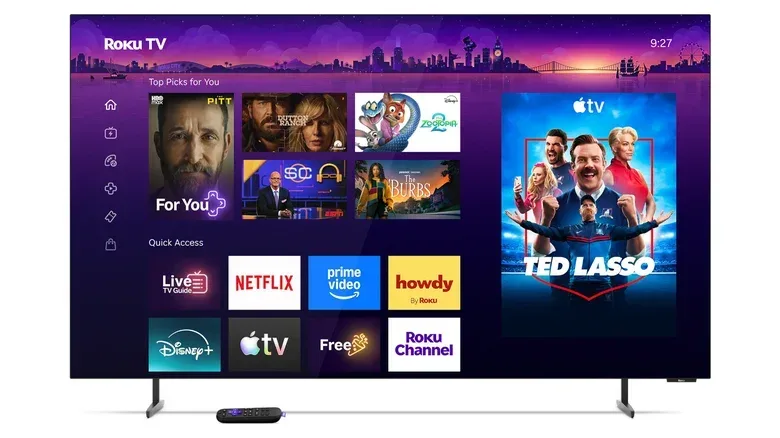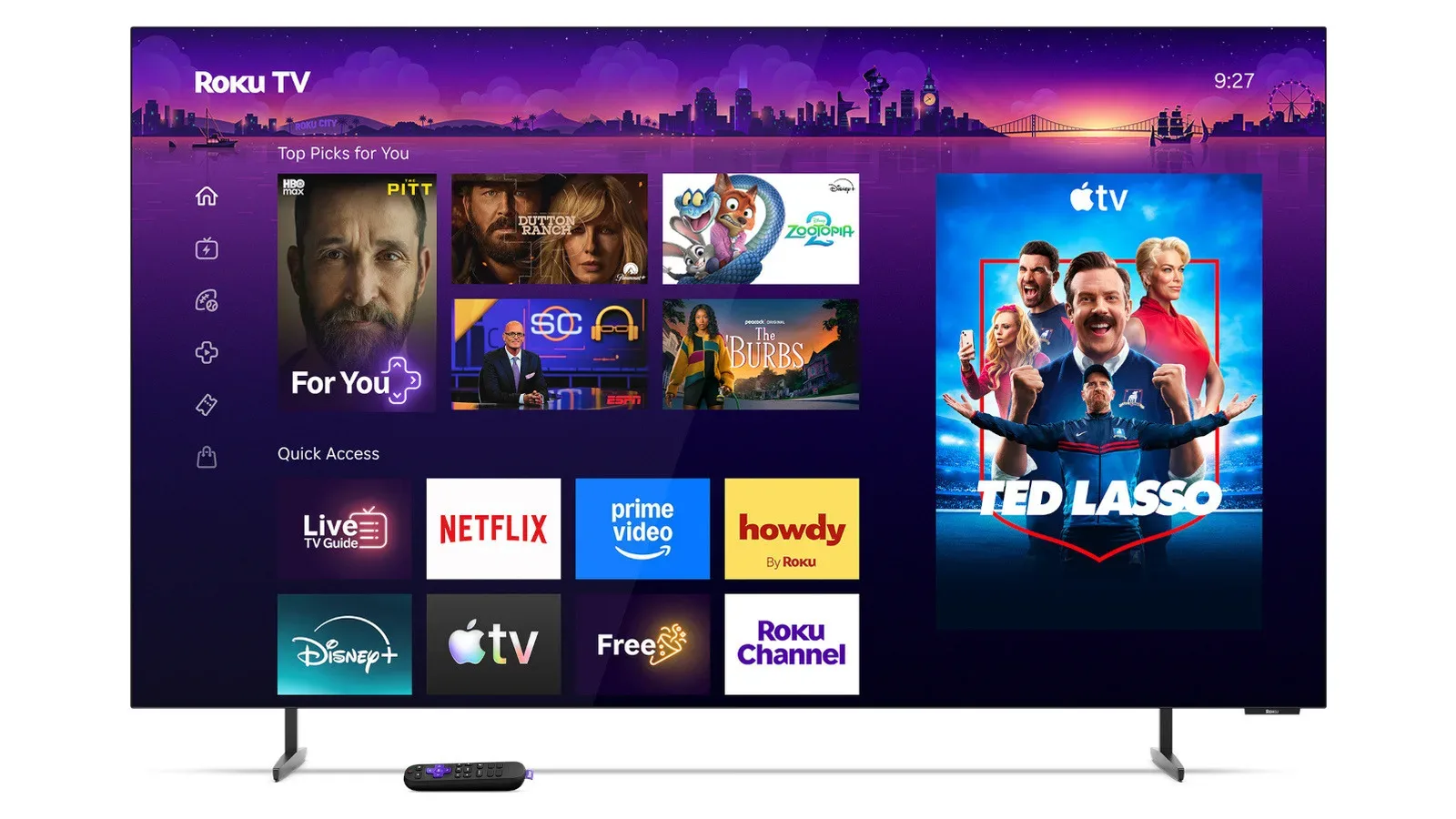
Roku’s Pro Series LX OLED televisions are now available exclusively on Amazon, arriving in 55-inch and 65-inch configurations at $1,300 and $1,600, respectively. The LX range sits above Roku’s standard Pro Series OLED models, which began at $999, and it makes a clear bid for people who want a Roku-powered screen that places more emphasis on high-end picture hardware and gaming-friendly motion performance.
For players, the headline specification is a 144Hz variable refresh rate, or VRR. Roku positions the Pro Series LX as its most advanced TV line so far, with the faster refresh ceiling marking a step up from the 120Hz VRR on its non-LX Pro Series sets. The new models also promise greater brightness, a broader color range and an advanced polarizer intended to cut down reflections. A rechargeable, hands-free voice remote is included as another distinction from the non-LX OLED range.
What the Pro Series LX adds over Roku’s other OLEDs
The difference between 120Hz and 144Hz is straightforward on paper: a 144Hz display can refresh its image up to 144 times per second, versus 120 times on the other Pro Series OLEDs. In gaming terms, that additional ceiling may be most relevant in rapid shooters, action games and titles with busy physics simulations, the types of games Roku specifically highlights for the LX line.
Refresh rate alone does not tell the full story, though. A television also needs its incoming video signal to support the relevant output rate before it can display it. The supplied specifications establish that the panel supports 144Hz VRR; they do not identify particular consoles, PCs, connections, resolution modes or game settings that can deliver a 144Hz signal. Buyers with a specific setup should therefore check the capabilities of that hardware and game separately rather than treating the TV’s maximum refresh rate as an automatic upgrade in every title.
Variable refresh rate is the other consequential part of that specification. Rather than operating at one fixed cadence all the time, a VRR display can adapt its refresh timing to the frame rate being sent by compatible hardware. The practical goal is smoother-looking motion when game performance varies. It is particularly relevant when the action gets demanding and a game does not produce frames at an entirely consistent rate.
That does not mean VRR creates extra frames or removes every performance issue. It is best understood as a display feature designed to keep the screen more closely in step with the output it receives. The quality of the game’s own performance, the capabilities of the connected machine and the supported settings still matter. But in a TV category where 120Hz is already a prominent gaming benchmark, Roku’s 144Hz figure gives the LX models a plainly differentiated position.
Why brightness and reflection control matter
Roku says the LX OLEDs are brighter than its non-LX OLEDs and offer a wider range of colors. Those are picture-quality improvements that are not limited to games. Brightness can affect how comfortably a screen is viewed in rooms with ambient light, while a wider color range describes a display’s ability to reproduce more colors. The available information does not provide measured brightness figures or color-coverage data, so the size of the improvement cannot be quantified here. It does establish that these are intended as premium distinctions within Roku’s OLED lineup.
The advanced polarizer is equally worth noting. A polarizer is a display layer that helps manage light. In this case, Roku says it reduces reflections on the screen. That can be meaningful for a living-room television, where windows, lamps and other light sources may be visible on a glossy display. Reducing reflections does not eliminate the effect of every bright light in a room, but it directly addresses one of the most familiar viewing obstacles for large TVs used outside a fully darkened space.
Put together, the brightness, broader color claim and reflection-reduction feature frame the Pro Series LX as more than a refresh-rate revision. The product’s stated focus is on maintaining a more vivid and less interrupted image across streaming, films and games, while the 144Hz VRR support specifically gives it stronger appeal to players who prioritize fast motion.
OLED, QLED and Roku’s move upmarket
Roku had offered more affordable QLED televisions for years before introducing its OLED lineup in September. The arrival of the Pro Series OLED established a higher-end option beginning at $999, while the Pro Series LX takes the company farther into premium pricing at $1,300 for the 55-inch model and $1,600 for the 65-inch version.
OLED, short for organic light-emitting diode, refers to a display technology in which the pixels emit light. QLED, meanwhile, is a label used for LCD-based televisions that use quantum dots to help produce color and brightness. Neither acronym independently tells a shopper everything about a TV’s performance, but the shift from Roku’s affordable QLED history to two tiers of OLED products is an important signal about where the company is expanding its hardware ambitions.
The $300 gap between the two LX sizes is also a practical consideration. The information provided identifies only the diagonal screen sizes and prices; it does not state that one version has a feature advantage over the other. On that basis, choosing between them is chiefly a question of screen size, room layout and budget rather than a documented performance tradeoff.
Roku’s software remains part of the package
Both Roku OLED lines run Roku OS and include the platform’s pre-loaded streaming apps. That makes the operating system a central part of the purchase rather than an add-on box or stick attached to a separate display. For shoppers already accustomed to Roku’s interface, the LX models combine a familiar streaming environment with more premium panel hardware.
The televisions also support Dolby Vision, HDR10+ and Dolby Atmos. Dolby Vision and HDR10+ are HDR, or high dynamic range, formats. HDR is designed to widen the range between dark and bright areas of an image and can also work alongside expanded color presentation when content and equipment support it. Dolby Atmos is an audio format associated with more immersive sound presentation. These support listings indicate compatibility, but they should not be read as a guarantee that every streaming title or connected device will use each format; that depends on the content and the rest of a viewer’s setup.
For a household that uses one screen for streaming and games, this mix may be the LX series’ strongest pitch. Its platform is built around Roku OS and streaming apps, while the panel adds 144Hz VRR and higher-end image claims that speak to gaming. It is not necessary to divide the TV’s identity into “movie model” or “gaming model”: Roku is presenting it as a living-room display intended to cover both jobs.
Design and remote upgrades
Roku says both its OLED ranges use a new exterior design with an ultra-thin metal bezel and a razor-thin upper half. That description speaks to the visible frame around the screen and the thinness of the TV’s top section. It does not provide complete cabinet dimensions or mounting details, but it indicates that the company is pairing its premium-panel push with a more upscale physical presentation.
The LX remote is more clearly differentiated. It has a rechargeable battery and hands-free voice capability, whereas those features are identified as differences from the non-LX lineup. A rechargeable remote can remove the routine need to replace disposable batteries. Hands-free voice control, meanwhile, is intended to let viewers use voice functions without having to hold down a button. Exact commands and the broader behavior of the feature are not detailed in the available information.
Those upgrades may not carry the same technical weight as 144Hz VRR, but they affect everyday use. Premium televisions are not only assessed when a game is running at full speed; they are also switched on, searched and navigated daily. Including a more feature-rich remote helps Roku make the LX designation feel like a whole-product upgrade rather than a specification added to an otherwise unchanged set.
Who the Pro Series LX is for
The Pro Series LX makes the most immediate sense for shoppers who want Roku OS built into a larger OLED display and who place real value on gaming motion support. The 144Hz VRR specification is its most concrete advantage over the regular Pro Series OLED’s 120Hz VRR, while the brighter display claim, wider color range and anti-reflection polarizer broaden its case for general viewing.
It is less useful to treat the “LX” badge as a universal recommendation without considering the price difference. Roku’s standard Pro Series OLED starts at $999, while the LX starts at $1,300. The premium therefore buys the stated display and remote upgrades, but individual buyers still need to decide whether their games, hardware, room lighting and viewing habits make those benefits meaningful.
There is also an unusually specific buying constraint: availability is exclusive to Amazon. That makes the retailer part of the product’s launch path, not simply one of several equivalent storefronts. Amazon’s entertainment footprint continues to overlap with gaming culture in other ways too, including its plans for a post-trilogy Mass Effect series, although that separate project has no stated connection to Roku’s TVs.
For now, the decision can be reduced to a few confirmed points: the Pro Series LX OLED is available in 55-inch and 65-inch models, costs $1,300 or $1,600, is sold exclusively through Amazon, runs Roku OS, supports Dolby Vision, HDR10+ and Dolby Atmos, and raises Roku’s VRR ceiling to 144Hz. The rest of the buying calculation is personal—especially whether a viewer’s space and gaming setup can take advantage of the upgrades that make the LX the company’s most advanced television range to date.
Shop the products
Check current price, model and availability at the retailer.