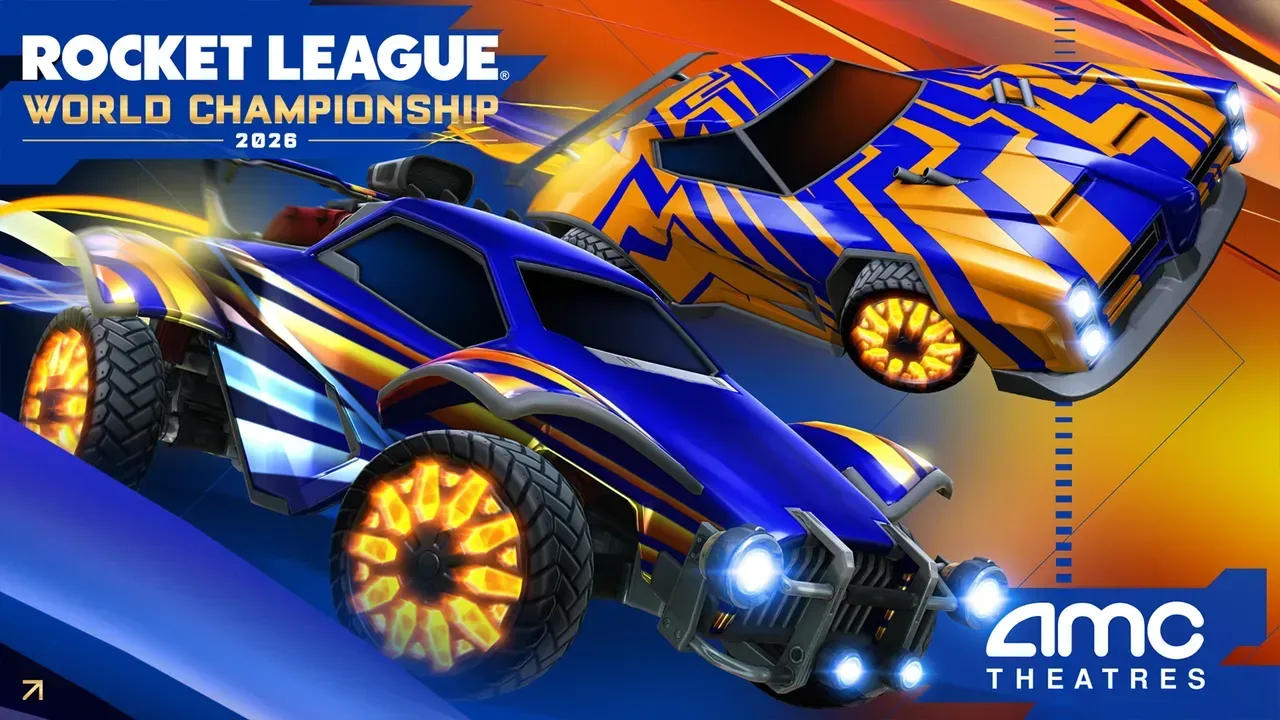
Rocket League’s biggest scheduled match day of 2026 is headed somewhere unusual for an esports final: the multiplex. The Rocket League World Championship Finals are set to be shown live at 50 participating AMC Theaters across the United States on Sunday, September 20, turning a competition normally watched through individual streams into a communal, giant-screen event.
The Finals will be played at Dickies Arena in Fort Worth, Texas. Twenty teams are slated to compete for a share of a $1.2 million prize pool, with $300,000 assigned to the winning side. The theater broadcast is expected to run for roughly eight hours, making this much more than a quick championship match or a highlight-reel screening. Fans attending should be prepared for a full-day esports program, complete with the lengthy build-up, series play and eventual crowning of the event’s 15th Rocket League world champion.
For a game whose central pitch can be summarized as “car soccer, except the cars have rocket boosters and seemingly no concern for the laws of physics,” a cinema is a fairly natural home. Rocket League’s best moments are instantly readable: a last-second equalizer, a save on the goal line, a soaring aerial touch that looks impossible until the replay proves otherwise. On a large screen, those split-second exchanges have room to feel like a sporting spectacle rather than another browser tab fighting for space beside a group chat.
A championship broadcast built for the big screen
The participating-theater count is limited to 50 locations, rather than a full nationwide rollout. That makes checking local participation especially important for anyone who wants to watch in person. Tickets are already on sale at participating theaters. Adult admission is listed at $19.49, or $22.18 when booked online.
Availability may vary by location, and the limited footprint means fans should not assume that the nearest AMC is included. The event is also expected to run about eight hours, an unusually substantial commitment for a theater visit. It is the kind of schedule that rewards planning ahead: confirm the venue, check the start time attached to that location’s listing, and remember that a championship broadcast does not operate on the neat runtime of a two-hour feature film.
That long duration is also part of what makes the experiment notable. A theater screening of an esports final is not simply a different display for the same match. It changes the social setting around the tournament. Online viewing makes it easy to keep a stream open while doing something else; a cinema seat, fellow supporters and a massive projection make it much harder to pretend that an overtime goal is background noise.
There is a natural parallel with traditional sports watch parties, but esports has its own rhythm. The crowd may react to mechanical precision, a defensive rotation, a clever kickoff or a play that develops so quickly that it takes the commentators and replay feed to fully untangle it. A room full of people following the same series can turn those details into a shared language. The snack-bar nachos may remain stubbornly analog, but the tension should be entirely digital.
Ticket codes preserve a familiar streaming perk
Watching competitive gaming online often comes with an extra incentive: platform drops, which reward viewers with in-game items or related bonuses for tuning in through a designated broadcast service. The in-theater format could have left attendees outside that system, but the planned AMC presentation includes a workaround.
Related coverage includes Rocket League World Championship Finals Head to 50 AMC Theaters Across the US.
Fans who attend will receive commemorative Rocket League tickets containing codes to redeem the viewer drops associated with watching the competition on Twitch. That detail matters because it recognizes a basic expectation of the modern esports audience. The ticket is not only proof that someone chose the cinema experience; it is also intended to keep that choice from costing them the digital rewards available to viewers at home.
The commemorative aspect gives the event a small collectible angle as well. It is not a claim that every ticket will become a prized artifact, nor does a code automatically transform cardstock into treasure. But physical mementos have a different appeal in a culture centered on live streams and time-limited cosmetics. A keepsake from a world championship viewed among other fans offers a tangible reminder of an event that otherwise exists mostly in servers, clips and memory.
The drop-code plan also illustrates how the theater presentation is being positioned: not as a replacement for the conventional broadcast, but as another way to take part in the same tournament. Online viewers retain the convenience of home viewing, while theatergoers receive the shared atmosphere and are still accounted for in the reward structure.
Why a cinema screening is a meaningful esports move
Competitive games have spent years proving that major finals can command the attention of huge remote audiences. Theater screenings test a separate question: can the excitement of a live game translate into a ticketed public occasion? The answer will depend on execution, local turnout and whether fans see real value in watching a stream away from home. Still, the appeal is easy to understand for supporters who already travel for conventions, tournaments or watch parties.
Rocket League is particularly suited to that challenge because a viewer does not need a graduate degree in bracketology to appreciate its visual drama. Cars fly. The ball moves at alarming speed. A single touch can change a series. At the same time, experienced fans have more than enough tactical depth to debate. That balance is useful in a public venue where devoted players and curious companions may be sitting a few seats apart.
The approach has precedent beyond Rocket League. League of Legends World Championship Finals held in Chengdu were screened in selected cinemas across Europe, the Middle East and Africa last year. Valorant Champions Paris Finals also reached certain cinema venues in the EMEA region. Those examples demonstrate that game publishers and exhibitors have already been exploring movie theaters as a destination for competitive-play audiences, particularly when an event has the scale and identity of a world final.
The U.S. Rocket League presentation adds another example to that developing playbook. Rather than asking fans merely to tune in, it gives them a place to gather around a single broadcast. That is not unlike the renewed attention paid to legacy competitive communities, where the history surrounding a game can be almost as animated as the matches themselves. Joking Joystick recently looked at that dynamic in the debate over a possible Street Fighter II Super Turbo rebalance, a reminder that spectatorship and community conversation remain inseparable in competitive games.
What attendees should know before September 20
The core details are straightforward, but they are worth keeping in one place for fans deciding whether the theater route is right for them:
- Date: Sunday, September 20, 2026.
- Venue for the live competition: Dickies Arena in Fort Worth, Texas.
- Theater presentation: 50 participating AMC Theaters in the United States.
- Field: 20 teams.
- Prize pool: $1.2 million total, including $300,000 for the champion.
- Expected broadcast length: approximately eight hours.
- Adult ticket price: $19.49, or $22.18 for online booking.
- Extra item: commemorative Rocket League tickets are set to include redemption codes for Twitch-viewer drops.
The most practical consideration is location. Because only selected theaters are involved, prospective attendees should use the participating-location information and ticket listings to verify that their local cinema is hosting the broadcast. They should also look closely at the showing details before booking, especially given the estimated eight-hour runtime and the possibility that popular locations may fill their available seats.
For everyone else, the event will still have the familiar digital dimension that has defined esports viewing for years. But for those near one of the 50 participating locations, September 20 offers a rarer proposition: watching Rocket League’s championship stakes unfold with a crowd, a theater screen and absolutely no danger of accidentally minimizing the final during overtime.