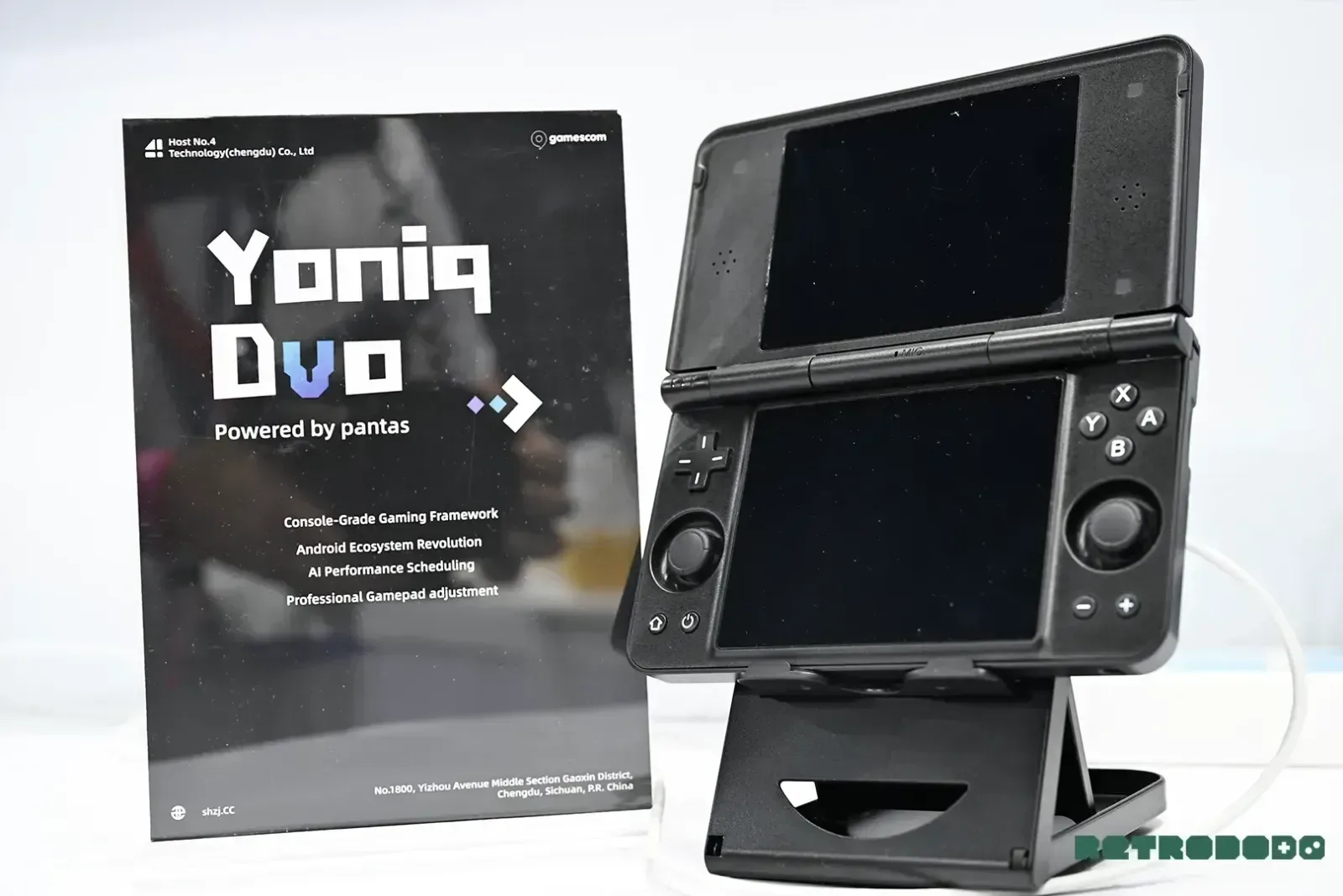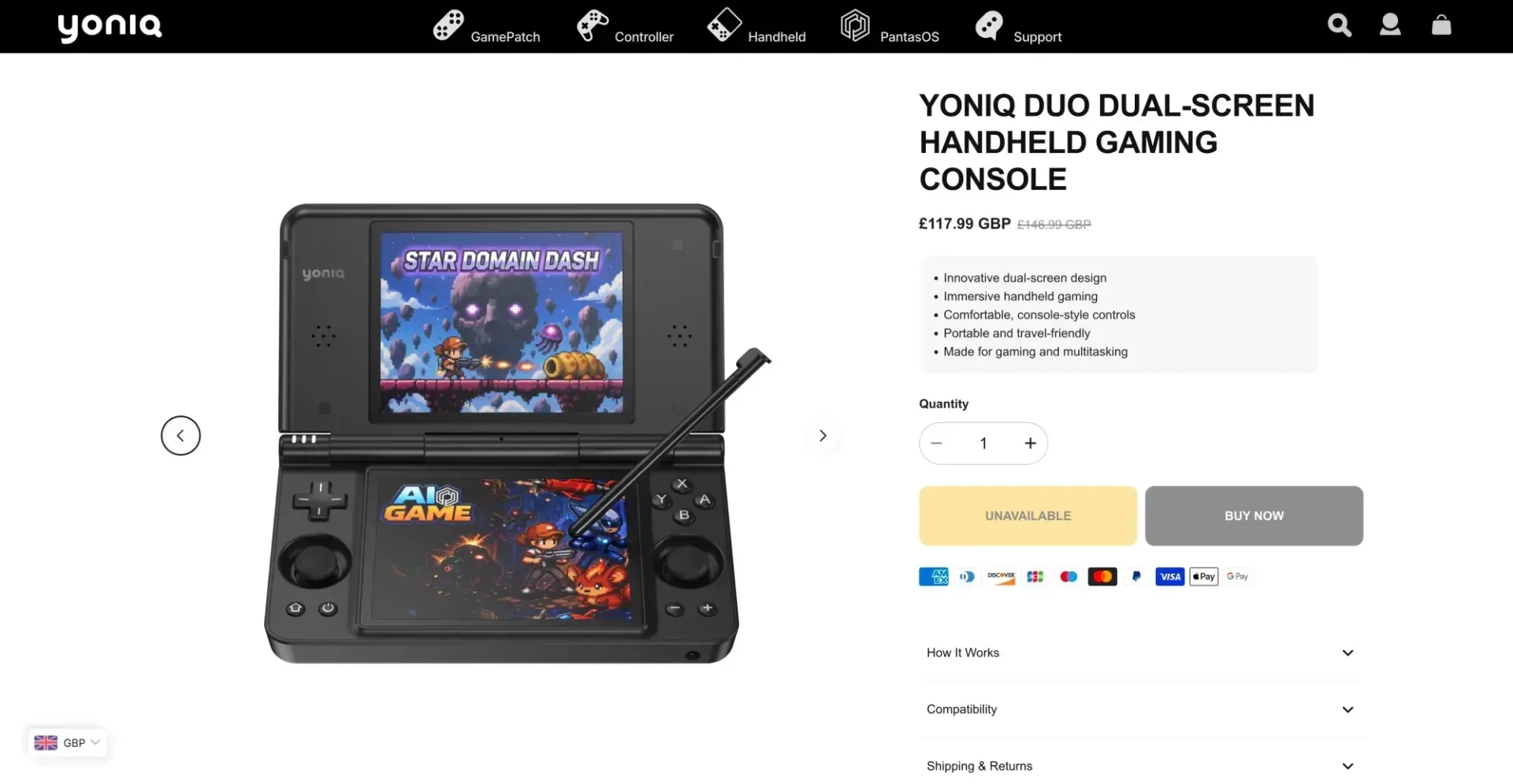
Yoniq’s Duo dual-screen handheld now has a visible product page, giving prospective buyers their clearest indication yet of its intended price while leaving almost every purchasing and technical question unanswered. The device was previously shown at Gamescom 2026, and the new web listing includes additional product images, a stated price of £117.99—presented as equivalent to $159.99—but no apparent way to place an order.
That makes the listing useful, but not definitive. The page shows a crossed-out £147/$199 figure alongside the lower amount, which suggests Yoniq may be preparing an early-order discount. However, there is no confirmed sale date, pre-order window, final specification sheet, or explicit explanation of the reduced price. Buyers should therefore treat £117.99/$159.99 as a displayed price rather than a fully confirmed launch offer.
A price appears before the buying details
The Duo’s listing is notable because it is the first visible pricing signal attached to the handheld. At the displayed £117.99/$159.99 figure, it would sit below the crossed-out £147/$199 amount by roughly £29/$40. That gap is substantial enough to matter for a handheld competing in an increasingly busy dual-screen field.
Still, the page itself provides reasons for caution. It reportedly contains copy associated with Yoniq’s older GamePatch product, including references to “no charging” and attaching a GamePatch. Those claims do not establish Duo features. They instead look like inherited placeholder material, meaning the page may be unfinished or may have gone live before its content received a full product-specific edit.
In practical terms, shoppers should not infer battery behavior, bundled accessories, compatibility, or any other specification from those stray references. A placeholder is pre-existing page text used while a product page is being assembled; it is not a reliable statement of the new product’s final design.
What the new images do show
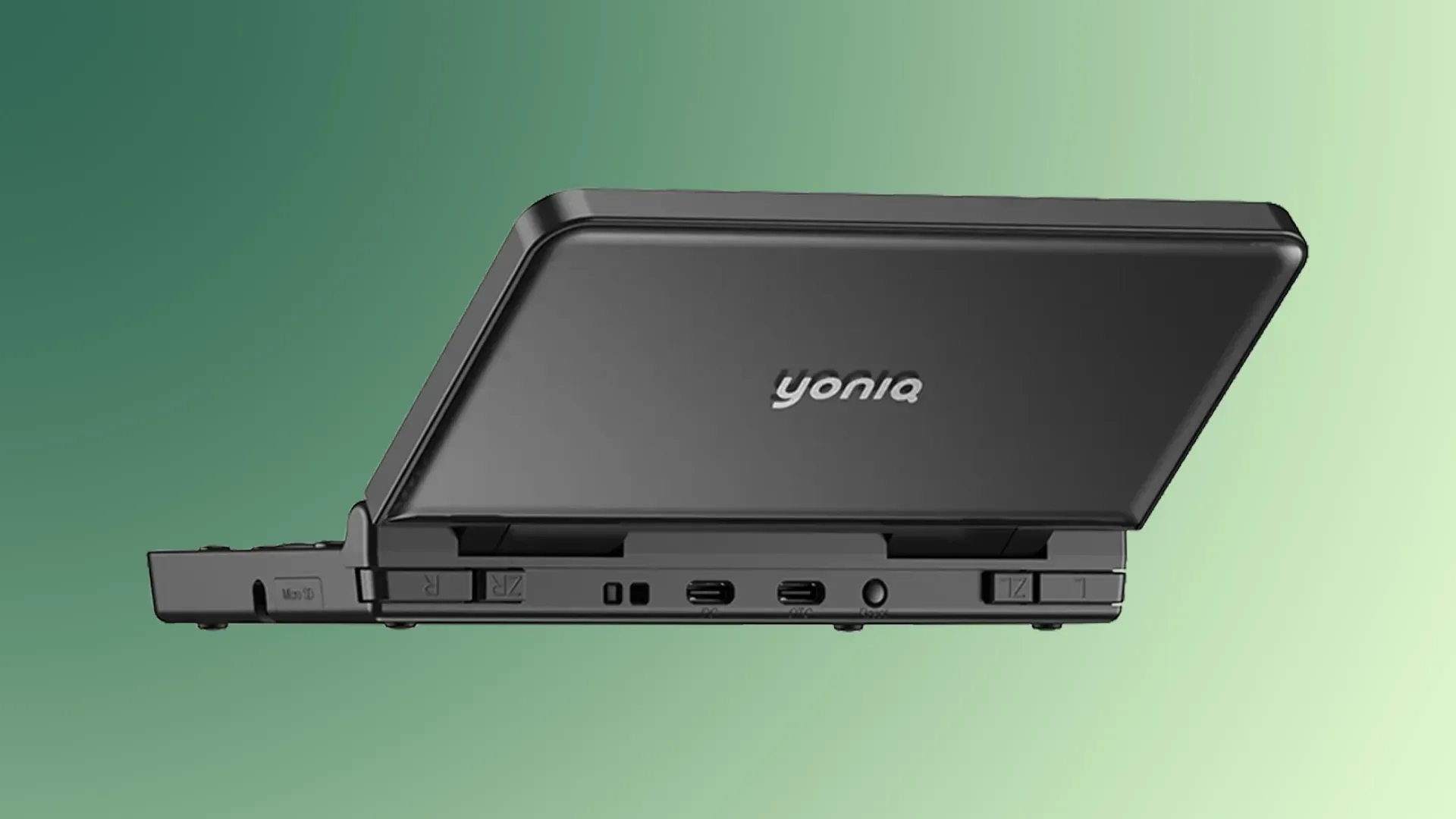
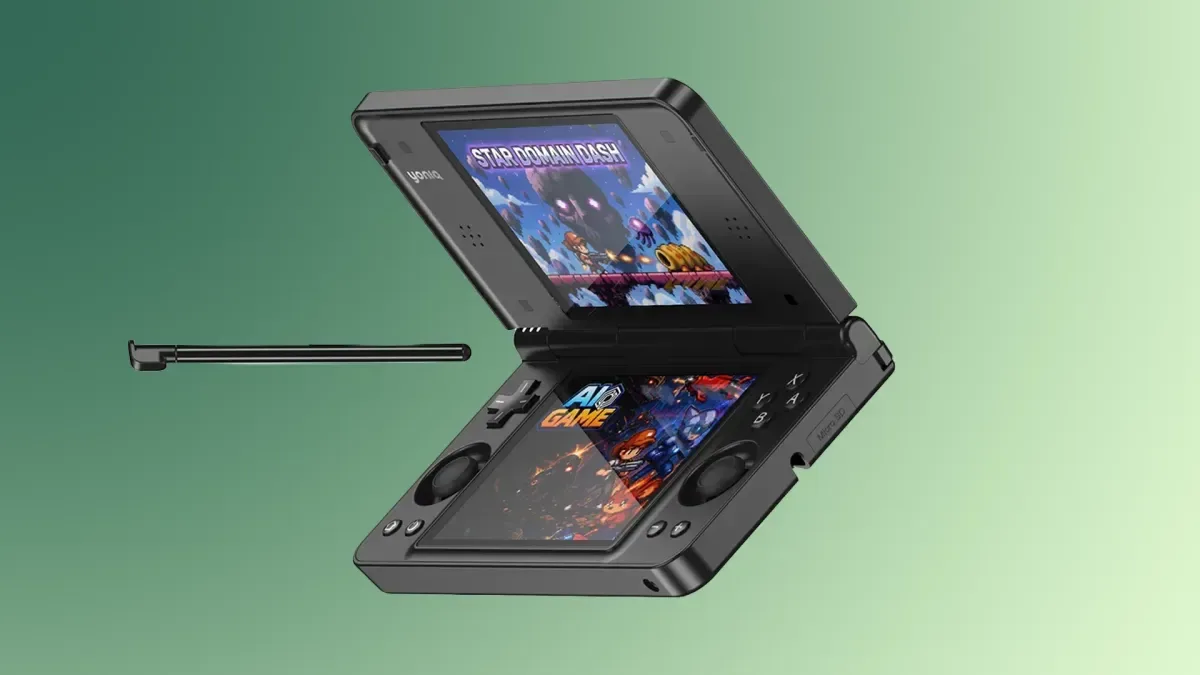
While the written information is thin, the fresh images provide a little more to work with. One rear view shows the Yoniq logo, shoulder buttons, two USB-C ports, and a stylus stored along the side of the handheld.
The stylus storage is a particularly relevant detail on a dual-screen device. A stylus is a pen-shaped input tool that can offer more precise control than a thumb or directional pad for interfaces designed around touch input. The visible dedicated slot means the Duo has an on-device place to keep it when not in use. That is a straightforward convenience feature, but it can also reduce the chance that a small accessory becomes separated from the system during travel.
The two USB-C ports are also plainly visible, but their roles have not been explained. USB-C describes the physical connector type, not automatically every feature supported through it. Without further official detail, it would be premature to assume how either port handles charging, data, display output, accessories, or other functions. The photos confirm the ports exist; they do not confirm their capabilities.
Yoniq’s background: experience claimed, direct-to-consumer brand still new
Yoniq presents itself as a new consumer-facing brand, while saying its team has prior involvement in developing and producing numerous handheld gaming devices and has access to experienced supply-chain and manufacturing resources in China. The company characterizes the Duo as its first effort to bring products directly to consumers under its own name.
That distinction matters. Product development and manufacturing experience can be valuable in the hardware business, where component sourcing, assembly, quality control, packaging, logistics, and repair arrangements all affect the buyer experience. But a direct-to-consumer brand also needs clear product information, dependable communication, and a well-maintained storefront. Those are separate jobs from designing or producing hardware.
Yoniq has acknowledged that its marketing operation is still being built and is less mature than its product and engineering side. That provides context for a sparse or imperfect page, but it does not resolve the uncertainty created by it. For consumers, the relevant outcome is simple: important information is still missing, so an informed purchase decision is not yet possible.
Why the timing is worth watching
The Duo is arriving into an active dual-screen handheld conversation. The ANBERNIC RG DS Plus is already out, while the Retroid Pocket Duo Lite is due this month. Yoniq’s product page also highlights one visible point of differentiation from the Retroid Pocket Duo: the Duo has a side-mounted stylus storage solution.
Competition does not automatically make any one device better, but it raises the importance of fundamentals. A new entrant will ultimately need to communicate what its hardware is, what it costs, when it can be bought, and how it differs from nearby alternatives. For the moment, Yoniq has supplied only pieces of that picture: a product name, a few physical design cues, an apparent pricing structure, and a broad “coming soon” indication.
The wider retro-handheld market has room for unusual form factors and dedicated controls, but enthusiasts tend to scrutinize the basics closely. Prospective owners will want to know the final hardware configuration, software approach, supported use cases, included accessories, ordering regions, warranty terms, and delivery timeline. None of those points are established by the current listing.
There is also a broader reason not to confuse visibility with availability. A web listing can indicate that a product team is preparing an announcement or store rollout, but it is not the same as an order page. Until Yoniq adds an actual purchasing route and more complete product details, the Duo remains a forthcoming handheld rather than a retail-ready one.
What to watch before committing
Anyone interested in the Yoniq Duo should look for a revised page or a formal update that answers the following questions directly:
- Is £117.99/$159.99 the final price? The crossed-out £147/$199 amount makes a promotional or early-order interpretation plausible, but it has not been confirmed.
- When do orders open? The current page does not provide a way to buy the Duo.
- Which listed text is final? References to the older GamePatch should be removed or clarified before they can be treated as Duo information.
- What do the two USB-C ports do? Their presence is visible; their specific functions are not established.
- What ships with the device? The image shows stylus storage, but the listing does not settle what is included in the box or how the stylus is supplied.
- What are the support and delivery terms? These are especially important for a brand making its first direct-to-consumer push.
None of that means the Duo is not real or not in development. It was shown at Gamescom 2026, and Yoniq’s own website now publicly presents it as coming soon. But it does mean that the sensible response to the page is interest tempered by patience. The design is becoming more visible, the likely price has surfaced, and the handheld’s market context is becoming clearer. The final purchase proposition is not there yet.
Another Yoniq device remains in the background
The Duo is not the only Yoniq hardware project to have been teased. The company also showed the Yoniq Portal at Gamescom. That makes the Duo listing feel like part of a broader attempt to establish Yoniq as a recognizable handheld brand rather than a one-device experiment.
For now, though, the Duo is the model with a public price attached. Its £117.99/$159.99 listing gives the market something concrete to discuss, even if the apparently unfinished page prevents that number from being treated as the whole story. As with other newly surfaced retro hardware, including the cartridge-focused releases covered in recent ModRetro Chromatic news, the details around ordering and delivery can be just as important as the device or software itself.
Yoniq now needs to turn an intriguing visual reveal into a complete consumer-facing launch: accurate copy, confirmed specifications, transparent terms, and a real route to purchase. Until then, the Duo is an interesting dual-screen contender with a visible stylus slot, dual USB-C ports, and an apparent early price—but still more questions than answers.