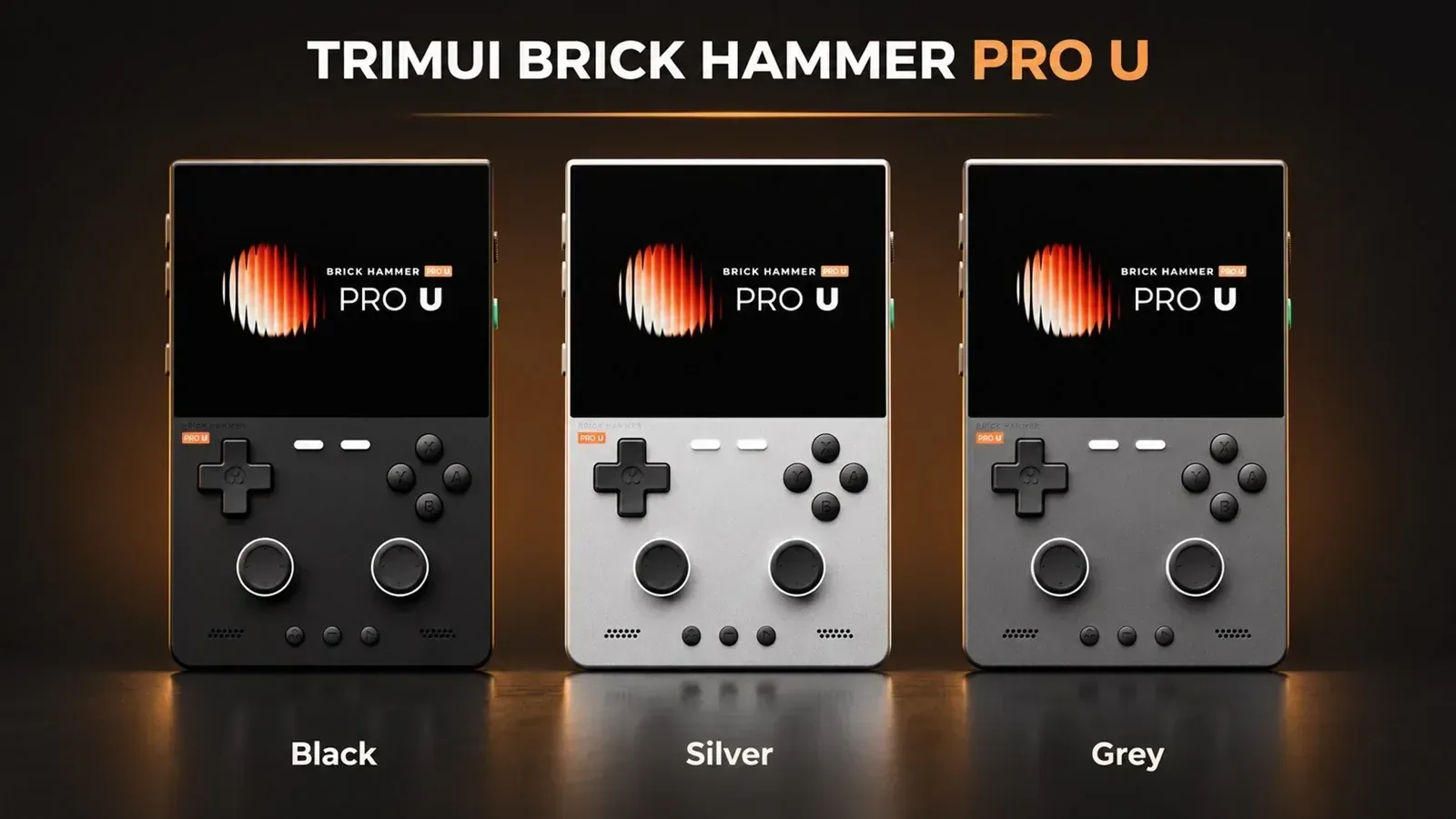
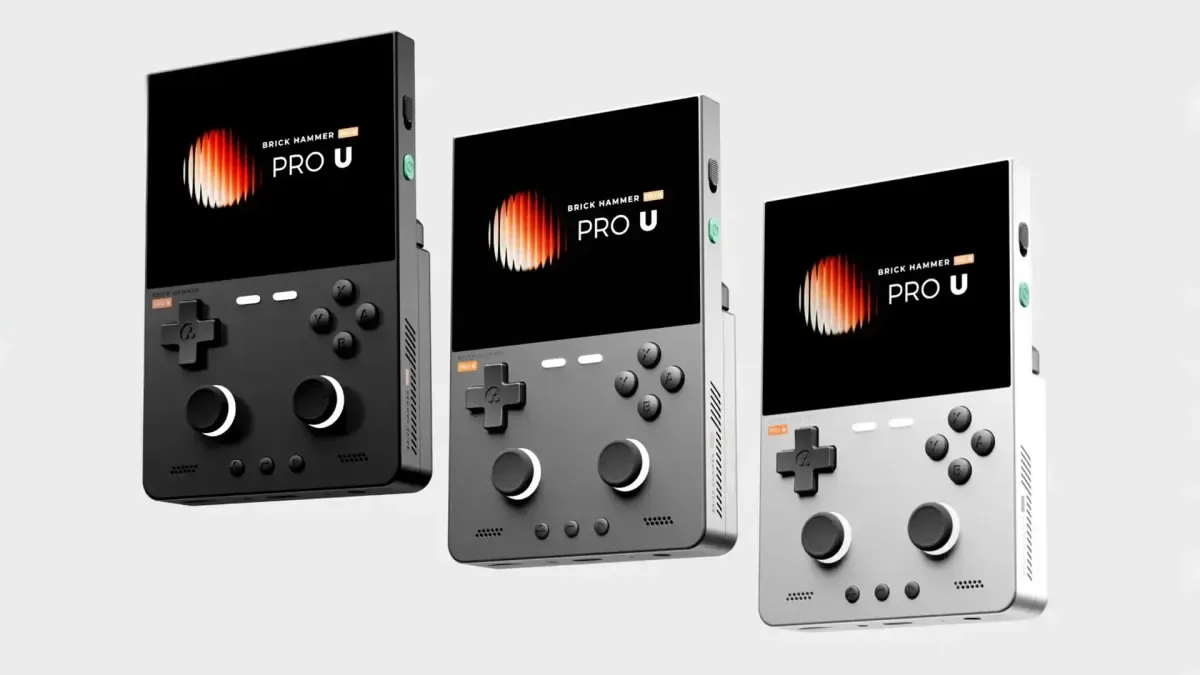
TRIMUI’s premium handheld, identified in the available specifications as the Brick Pro Hammer U, is now on sale for $249.95. The first production batch is limited to 3,000 units, making this a substantially different proposition from the company’s smaller, lower-cost handhelds: it pairs a solid metal shell and dual analog sticks with Android 15, 6GB of RAM and a Snapdragon G2 Gen 1 processor.
The device had been teased for roughly six months before reaching sale, with specifications emerging gradually rather than a firm launch date. Now that it is available through TRIMUI, the immediate question is not simply whether it looks like a premium retro handheld, but whether the higher-end internal hardware and Android-based approach can justify a price that moves well beyond entry-level emulation machines.
The key specifications
- CPU: Snapdragon G2 Gen 1 (SG6150)
- GPU: Adreno A21
- Memory: 6GB RAM
- Internal storage: 128GB
- Display: 3.95-inch IPS, 1024 x 768 resolution, 60Hz, 324 pixels per inch
- Operating system: Android 15
- Wireless: Wi-Fi and Bluetooth 5.1
- Battery: 5,000mAh
- Audio: 3.5mm headphone jack
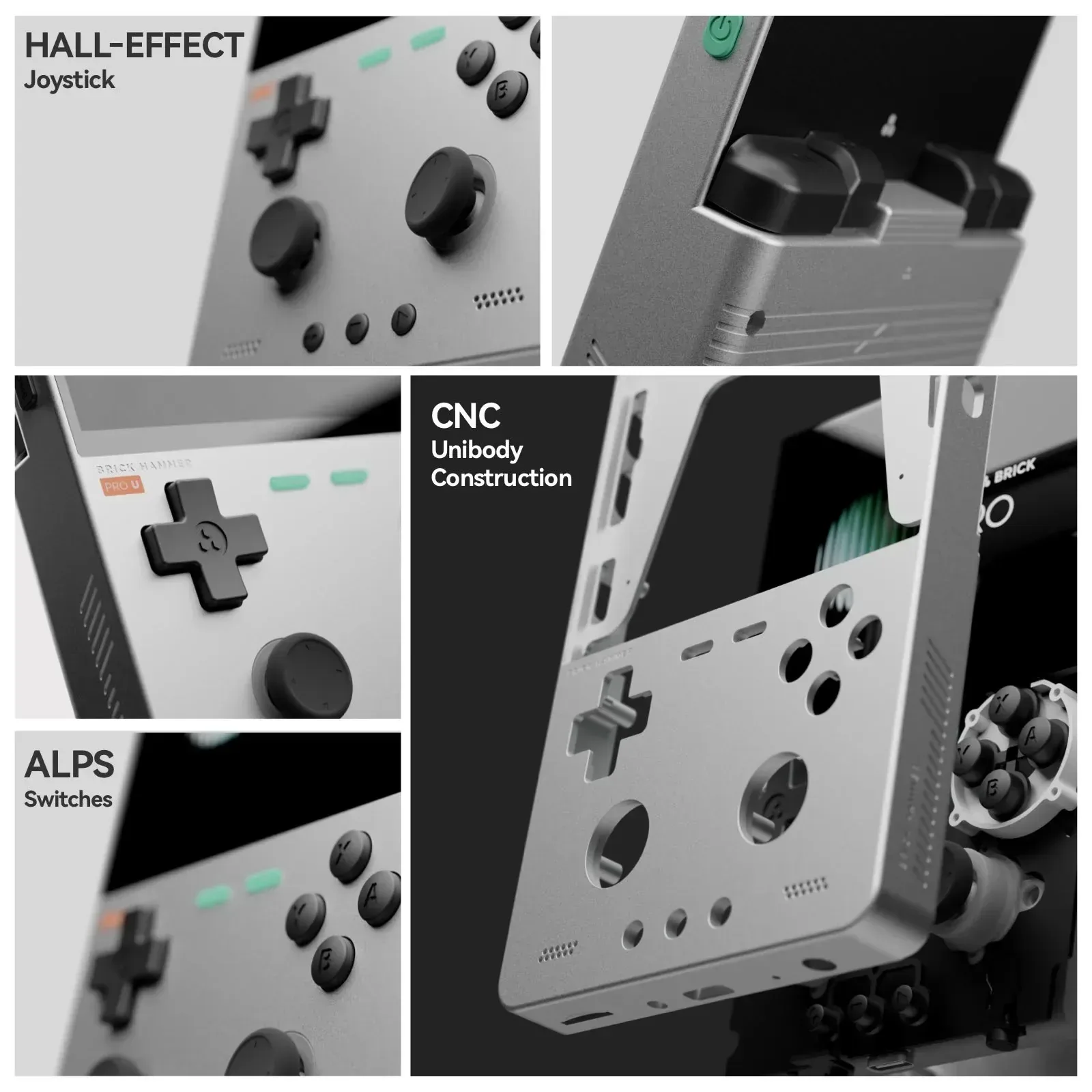
- Controls and construction: dual joysticks and a metal shell
It is a concise list, but it indicates a clear target. TRIMUI is trying to combine the compact, vertically oriented appeal associated with the Brick family with considerably stronger hardware, more flexible software and a metal body that positions the unit as a premium product rather than a basic retro-game player.
Why Android matters here
The biggest practical distinction between this model and TRIMUI’s cheaper, smaller siblings is the operating system. Those devices use Linux, while the Brick Pro Hammer U runs Android 15.
That shift does not automatically make one approach better than the other. Linux-focused handhelds can offer a streamlined experience built around a focused launcher and a curated set of emulators. Android, by contrast, is designed as a general-purpose app platform. On a gaming handheld, that creates the possibility of installing Android games, emulators and alternative launcher applications rather than being confined to a single software environment.
For prospective buyers, “frontend” is one term worth understanding. A frontend is the visual interface used to organize and launch games, emulators and libraries. It is effectively the layer that determines whether a large collection is easy to browse or a chore to navigate. The Brick Pro Hammer U’s Android foundation is positioned to work with Android emulation frontends including Socket and DigiBitPlay, which could give users more choice over how their device is organized.
That flexibility can be valuable, but it also means the final experience will depend on software setup, app support and user preference. The supplied information establishes Android 15 and names compatible-style frontend possibilities; it does not establish that every emulator, game or frontend will perform equally well on the device. Buyers should view Android as broader potential rather than a guarantee of frictionless use across every app.
Power is the central promise — not a tested result
TRIMUI’s use of the Snapdragon G2 Gen 1, 6GB of RAM and Adreno A21 graphics hardware is intended to put this handheld in a more demanding performance category. The stated expectation is that it should be capable of handling some PlayStation 2 titles, alongside GameCube, Dreamcast and PSP emulation.
Related coverage includes TRIMUI's Metal Brick Pro Hammer U Goes on Sale With Snapdragon G2 Power.
That wording matters. Emulation is the process of recreating another system’s hardware and software environment on a different machine. A device can be capable of running an emulator for a console without delivering identical results in every game from that console. Individual games can differ significantly in their demands, while emulator maturity, configuration, rendering resolution and software updates can all affect results.
In other words, PlayStation 2 potential is an important ambition for the Brick Pro Hammer U, but it is not the same as a verified compatibility list. No hands-on benchmark results, game-by-game testing, frame-rate data or tested settings have been provided here. It would be premature to treat PS2, GameCube, Dreamcast or PSP support as a blanket promise of perfect performance.
Still, the hardware positioning explains the $249.95 price. This is not pitched merely as a compact machine for older, less demanding libraries. Dual sticks also make sense for systems and games designed around analog control. Together, the processor, memory, Android software and controls point toward a handheld designed to reach further into the 3D era than a typical lower-priced retro device.
A display shaped for retro-game libraries
The 3.95-inch IPS screen has a 1024 x 768 resolution, a 60Hz refresh rate and 324PPI density. “IPS” refers to a display panel type commonly associated with wide viewing angles, while PPI means pixels per inch — a measure of pixel density rather than the total number of pixels alone.
The 4:3 resolution is particularly notable in a handheld aimed at classic gaming. Many older games and systems were designed around 4:3 imagery, so a 1024 x 768 panel maps naturally to that shape. This does not remove every display decision a player may encounter, since different platforms and games use different image formats, but the panel’s proportions are clearly aligned with the visual presentation of a broad selection of earlier game libraries.
A 60Hz display means the panel refreshes up to 60 times per second. It is a familiar target for a large amount of classic gaming material, though screen specification alone cannot prove input latency, brightness, color performance or how any individual game will look. Those are areas that require proper hands-on evaluation.
Metal construction is part of the value proposition
The Brick Pro Hammer U’s solid metal shell is not a minor design flourish. It is part of the product’s premium identity and separates it from TRIMUI’s less expensive smaller devices. Combined with dual joysticks and the larger screen, it frames the unit as a more substantial all-in-one machine rather than a pocket-focused companion for a narrower slice of retro platforms.
Material choice, however, is not a complete verdict on build quality. A metal shell can contribute to a more premium feel, but it does not alone answer questions about button feel, stick quality, ergonomics, weight, heat management or long-term durability. None of those traits should be assumed before detailed independent examination.
The included 5,000mAh battery, Wi-Fi, Bluetooth 5.1 and a 3.5mm headphone jack round out a specification set that emphasizes flexibility. Bluetooth creates an option for wireless accessories, Wi-Fi supports connected Android use, and the headphone jack retains a straightforward wired-audio route. Actual battery life remains unknown from the available information, because a capacity figure does not by itself reveal how long the handheld lasts under different workloads, brightness levels or emulators.
What the first 3,000 units mean for buyers
The first batch is capped at 3,000 pieces. That gives early availability a limited-run character, but it should not be mistaken for proof of permanent scarcity. The only confirmed detail is the size of this initial batch; there is no supplied information about subsequent manufacturing runs, regional allocation or restocks.
For anyone weighing a purchase, the sensible decision is to separate the confirmed hardware from the still-unanswered questions. Confirmed: a $249.95 Android 15 handheld with a 3.95-inch 1024 x 768 IPS display, Snapdragon G2 Gen 1, 6GB RAM, 128GB storage, 5,000mAh battery, metal construction and dual joysticks. Not yet established: detailed real-world battery endurance, ergonomics, thermals, software polish, controller behavior and consistent performance across the most demanding emulated platforms.
The timing also lands amid a broader period of attention on the games people will be playing next; our guide to five December 2026 games to watch offers a look at that wider release conversation. The Brick Pro Hammer U addresses a different need: a dedicated device for Android games and personal emulation setups, with a focus on higher-end hardware in a compact metal format.
TRIMUI has put forward an appealing on-paper package, especially for players who want an Android-based handheld rather than a Linux-only model. Its strongest claims will ultimately depend on the software experience and careful testing of demanding games. Until then, the Brick Pro Hammer U is best understood as an ambitious premium handheld with notable specifications and a limited first batch, rather than a device whose performance ceiling has already been conclusively demonstrated.