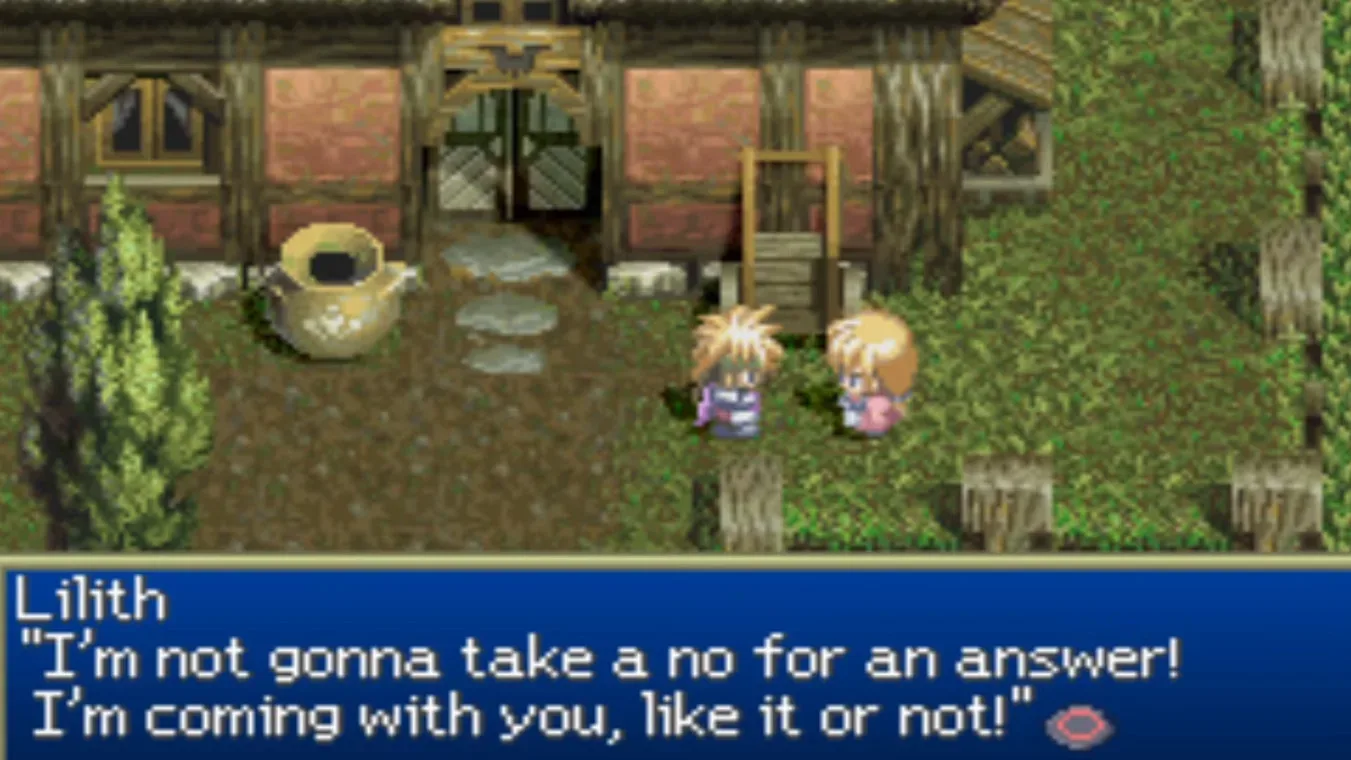
A PlayStation RPG secret that spent nearly three decades in the realm of rumor has crossed into documented fact: Lilith Aileron can be recruited in the original version of Tales of Destiny.
That matters because the game, released in Japan in December 1997, was long believed to have nine possible party members. Lilith—protagonist Stahn’s younger sister and a fighter who carries a frying pan—was known to exist as a playable character in the game’s code. Players had also added her with cheats, and she was known to be recruitable in the PlayStation 2 version. But a legitimate recruitment route in the original PS1 release had effectively been treated as absent or cut content.
Now, a route discovered and documented by longtime series fan Azekura has been independently corroborated by players using both the English and Japanese versions. It has also drawn an extraordinary response from Jun Toyoda, one of the game’s original producers, who acknowledged that Lilith’s implementation was meant to be cut and apologized for the bugs left in the first version.
The discovery is exciting not just because it changes a party roster count. It reveals how a feature can remain inside a finished game, survive in an incomplete state, and evade a community for years because the conditions needed to expose it are unusually opaque.
What has been confirmed—and what is still being tested
The core finding is firm: Lilith is legitimately recruitable in the original PS1 Tales of Destiny. The precise recipe for doing so is not yet locked down.
That distinction is important. A recruitment flag is, in simple terms, an internal game-state condition that tells the software a character is allowed to join. Complex RPG events can check several flags at once: conversations viewed, actions avoided, story progress reached, items held or purchased, and possibly other hidden conditions. If testers identify a successful sequence, it proves a route exists. It does not automatically prove every action in that sequence was necessary.
That is the stage the community is in now. Azekura’s documented route is a working reconstruction, while other players continue separating required steps from habits or incidental actions that happened to be part of a successful run.
The broad shape of the route is already striking. Players appear to need to complete the game while avoiding taking items from people’s homes and avoiding situations where party members scold them for straying from the intended direction or doing something they were not asked to do. Certain conversations must also happen at particular points. Near the end of the game, the player must purchase a specific item at a specific time and then speak to Lilith.
Related coverage includes Tales of Destiny Players Uncover a Hidden Lilith Recruitment Method Nearly 30 Years Later.
In other words, this is not a conventional late-game side quest with one obvious trigger. It seems to be an accumulation of behavior over an entire playthrough, with narrowly timed interactions at the end. That helps explain why even players who knew Lilith’s battle data was present had no clear way to activate her normally.
Why the secret remained buried
There are several reasons this discovery could have remained obscure for so long without requiring any grand mystery.
First, Tales of Destiny has had a limited modern footprint. It has not received a modern-console release, its PS2 ports remained Japan-only, and there has been no modern remake. A game that is difficult to revisit across current platforms naturally has a smaller pool of players repeatedly testing its obscure branches.
Second, Lilith’s status created a misleading but understandable assumption. Since she could be forced into the party using cheats, fans already knew the character was in the game. Since she was recruitable in the PS2 version, it was reasonable to suspect that the original PS1 release had once intended to do the same. Without a documented trigger, however, the most common conclusion was that the option had been removed late in development.
Third, the route’s apparent requirements are the opposite of the usual player behavior a discovery is built around. Taking a free item from a house, exploring an unintended path, or talking to optional characters at the wrong moment can feel trivial in an RPG. Few players would naturally think that a chain of such small choices across the whole adventure controlled an endgame party member.
There is also the archival problem. Some players believe the method may have been mentioned around the game’s original release, only to go poorly recorded in old forum discussions. A claim existing in a forgotten post is not the same as a reproducible, preserved guide. Verification requires other players to repeat it, compare results and establish which game versions behave the same way.
That collaborative work is exactly what gives the Lilith discovery more weight than a stray anecdote. The route has been reproduced across versions, and an original producer’s response provides unusually direct context for why such an odd, unstable feature could have remained in the shipped game.
The major catch: Lilith can break the original Japanese release
There is a serious warning attached to the triumph. In the original Japanese edition, recruiting Lilith can cause a softlock.
A softlock is a state in which the game is still running but progress is no longer possible. It is different from a crash, where the program stops outright, and different from an ordinary difficult battle or puzzle. Here, a necessary scene fails to play after Lilith joins, preventing the player from continuing normally.
That means this is not presently a secret to chase casually on an unsaved file. The reported workaround for the original Japanese release is version-specific: save before entering a town, shut down the game, then continue with the later “BEST” version. The later version can allow the game to proceed where the earliest release does not.
Players should treat that workaround as a preservation-minded precaution, not as an invitation to improvise. Before attempting the route, keep multiple saves, preserve one from before the late-game trigger, and make sure the exact game edition is known. The recruitment conditions themselves are still under examination, so a backup save is also the sensible way to avoid losing a long run if one assumed requirement turns out to be wrong.
The English and Japanese versions have both been part of the community corroboration, but version differences remain crucial. A method confirmed in one release should not be presumed identical in every edition unless it has been specifically retested. That is especially true when the historical explanation includes unfinished debugging and progression-blocking bugs.
An original producer explains the instability
Toyoda’s public response adds rare development-era clarity. He congratulated the players who found the means to recruit Lilith, while explaining that the first version of Destiny shipped with at least five major remaining bugs, including progression blockers, because there was not enough time for debugging. He also said Lilith’s features were supposed to be removed and apologized.
That statement makes the result easier to understand without making it any less remarkable. Lilith was not a modern fan modification and not merely a cheat-created novelty. Her recruitment path appears to be leftover functionality that reached the retail game despite the plan to cut it, complete with a failure state that the earlier release cannot properly handle.
It also puts the level of the newly discovered recruit in perspective. Lilith arrives at level 6, despite joining near the end of a game where the existing party will be at far higher levels. That makes her less like a finely tuned endgame reward and more like a feature whose implementation was never fully finished or balanced for ordinary play.
For players, that means the immediate appeal is historical and mechanical rather than practical. Recruiting her is a chance to see a real branch of the original software that was hidden in plain sight, not necessarily the most efficient route to a stronger final party.
Why this is bigger than one old RPG trick
The Lilith find is a reminder that a game’s public reputation is not always its complete technical record. Especially in older releases, unused dialogue, playable character data, event flags and unfinished sequences can survive in ways that are not visible through normal play. Sometimes they are truly inaccessible. Sometimes, as here, they can be reached through a chain of conditions no guide ever cleanly captured.
It is also a useful case for careful language around “cut content.” A character being available through cheats does not prove an intended retail path exists. Conversely, an unstable and poorly documented retail path does not mean a feature was polished enough to be considered fully supported. Lilith occupies the fascinating space between those categories: functional enough to recruit, but apparently not sufficiently finished to survive the original release without problems.
For RPG fans, party composition often shapes the memories attached to a game as strongly as its plot. The enduring pull of characters and choices is part of why discussions of role-playing series remain lively long after the credits; Joking Joystick’s look at Dragon Age’s defining moments explores that continuing relationship between party-driven stories and players’ attachment to their worlds. Lilith’s case is different, but it carries a similarly potent idea: a character thought excluded from the original adventure was there all along.
The discovery should not yet be flattened into a definitive step-by-step guide. The full condition list remains a live research question, and the earliest Japanese version’s softlock makes accuracy especially important. But the central result is no longer a playground myth: the original PS1 Tales of Destiny has a tenth legitimate party member, and players finally know how to invite her in.