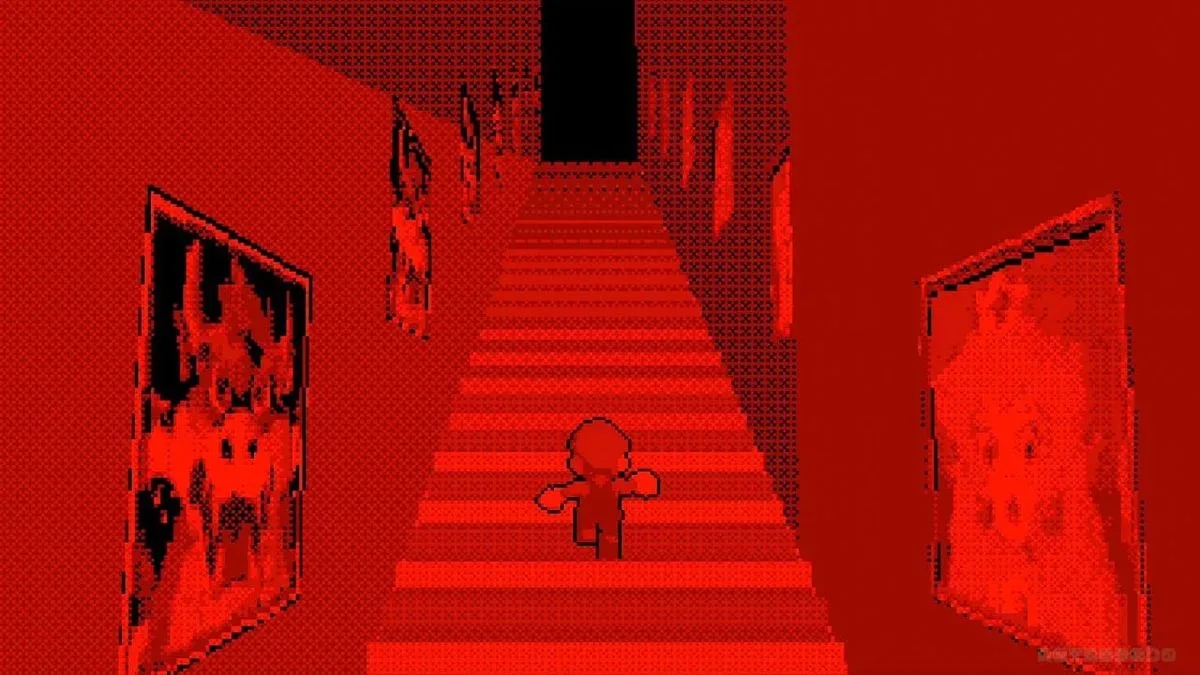
Super Mario 64 appears to be taking an experimental trip to Virtual Boy hardware territory—or at least to that system’s unmistakable visual language. A clip shared by developer Mochi64 shows Mario performing the famous backwards long jump on the Endless Stairs, rendered in the red, stereoscopic-looking style closely associated with Nintendo’s headset-like 1990s machine.
That is an intriguing proof of concept, but it is important not to mistake a striking clip for a finished conversion. Only a small amount of footage has been shown. There is no confirmed indication of how much of the game currently runs, whether every course and feature is planned, whether it targets original hardware, or whether a public build will be released. For now, the clearest description is a Virtual Boy-oriented Super Mario 64 project in progress, rather than a completed full port.
What the footage actually establishes
The visible sequence centers on one of Super Mario 64’s most persistent quirks: Mario moving backwards up the castle’s Endless Stairs through the backwards long jump. In the original game, players can build up backwards speed by repeatedly long-jumping while facing a slope or staircase. Under the right conditions, that speed can carry Mario through the Endless Stairs check, letting him reach the upper area before collecting the number of Power Stars normally required.
The new angle is not merely that the movement exploit is present. It is that the sequence is presented with the red display effect people associate with Virtual Boy software, alongside an apparent depth treatment described as “Real 3D.” Seeing a decades-old Nintendo 64 glitch retain its strange momentum in a dramatically different visual format is exactly the sort of technical oddity that makes fan-port experiments compelling.
The clip does not establish that the entire game is playable, that the project includes every level, or that compatibility and performance match the Nintendo 64 original. It does, however, provide an unusually recognizable demonstration: if Mario, the castle staircase, the backwards long jump, and the unusual visual presentation all read immediately, the prototype has communicated its idea very efficiently.
The backwards long jump, explained
A backwards long jump—often shortened to BLJ—is a movement exploit in Super Mario 64. The name describes the input and direction: Mario performs long jumps while travelling backwards. On suitable geometry, repeated jumps can cause backwards velocity to increase beyond what players would achieve through ordinary movement.
For the Endless Stairs, that matters because the staircase is intended to prevent progress until the player has earned enough Power Stars. The exploit is famous because it turns a progression barrier into a physics and momentum problem. Rather than meeting the intended requirement, the player accumulates speed and forces their way beyond the point where the staircase is meant to hold them back.
It is a useful test scene for a project like this because it places several systems in view at once:
Related coverage includes Super Mario 64 Is Making an Experimental Leap to Virtual Boy.
- Player movement: Mario’s long-jump behavior and backwards momentum need to feel coherent.
- Collision: The stairs must interact with Mario in a way that permits the recognizable exploit.
- Level behavior: The Endless Stairs sequence has to behave sufficiently like the familiar castle version for the moment to make sense.
- Rendering: The red, depth-oriented presentation has to keep the scene legible while Mario moves rapidly.
That does not make the clip a comprehensive benchmark for the entire game. It does make it a clever choice. The BLJ is instantly identifiable to people who know Super Mario 64, and it is much more revealing than a static menu or a brief walk around a simple room.
Why the Virtual Boy presentation is the point
The Virtual Boy is remembered as much for its display identity as for its games: a highly distinctive red visual output viewed through a dedicated visor. In this project, that look changes the emotional texture of Super Mario 64. Bright, colorful castle interiors and Mario’s familiar silhouette become a sharp, limited-color image with a far more experimental feel.
Stereoscopic 3D means presenting slightly different views to each eye to create an impression of depth. The available footage is described as using Real 3D, but its technical implementation and level of completeness have not been detailed. It is therefore safest to say that the clip aims for a depth-enhanced Virtual Boy-style presentation, not to make broader claims about its renderer, hardware support, or visual modes.
Even that limited information points to the central challenge. A Super Mario 64 port is not only about getting Mario moving. The game’s environments, camera, platforming distances and busy 3D spaces were designed around their original presentation. Converting that experience into a red, visor-based 3D format means readability becomes especially important. A player needs to distinguish platforms, walls, slopes, hazards and Mario’s movement while looking at a highly stylized image.
There is also a practical reason to temper excitement with caution. The footage shown so far is a single, memorable passage. It cannot answer broader questions about sustained comfort, camera behavior across varied courses, interface presentation, save handling, audio, controller support, or how the rest of the game might translate. Those are not criticisms of the work shown; they are simply details that a short showcase cannot settle.
Why a small prototype can still matter
Projects built around improbable hardware combinations often attract attention because they ask a simple question: can this particular game be made to appear in a place it was never expected to be? Super Mario 64 is especially suited to that fascination. Its movement, locations and glitches have remained legible and recognizable for years, so even a few seconds of altered presentation can invite close scrutiny.
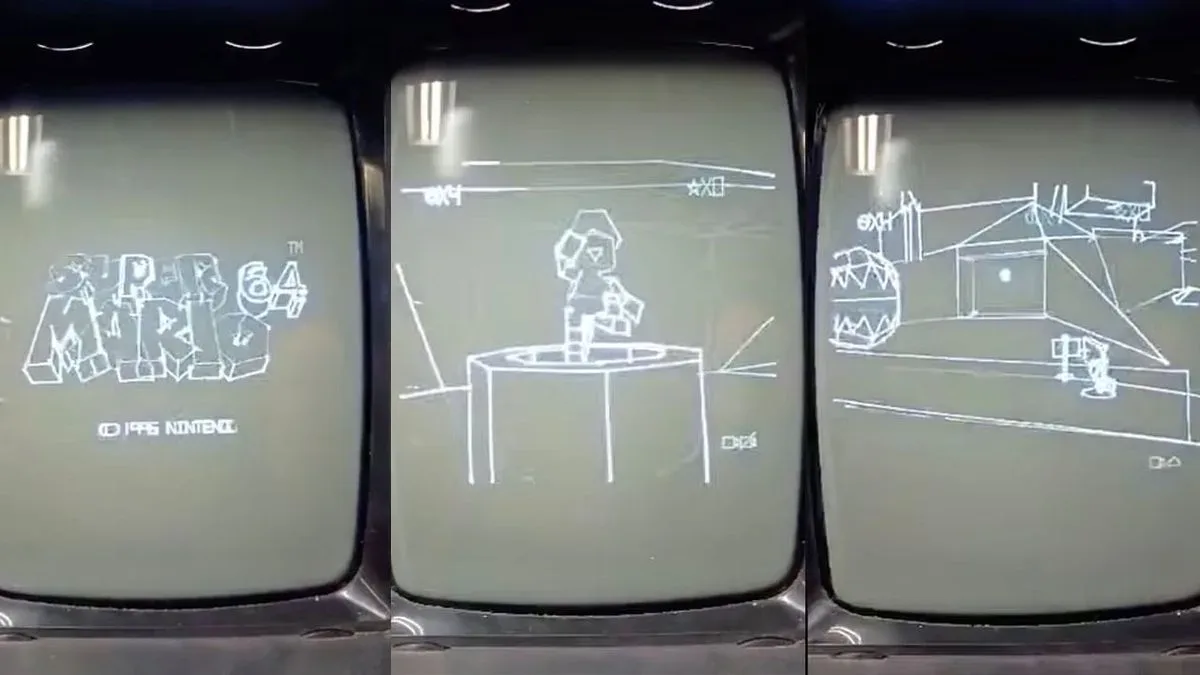
This is also part of a wider appetite for seeing well-known games adapted to technically unusual settings. A separate Super Mario 64 effort has recently been associated with the Vectrex, another platform with major limitations relative to Nintendo 64-era 3D games. The projects are not interchangeable, and the currently visible Virtual Boy work should not be treated as evidence of a complete port. Still, together they illustrate why Mario’s first 3D adventure remains a recurring target for experimental development.
For retro-game fans, the appeal is not only novelty. Experimental ports can expose what makes an original game feel like itself. If an adaptation preserves Mario’s acceleration, jumps, collision oddities and memorable spaces, people recognize it quickly—even after the colors, display format and surrounding technology have changed. Conversely, any mismatch in those foundations becomes immediately noticeable because Super Mario 64’s behavior is so widely familiar.
What remains unknown about Mochi64’s work
Mochi64 is identified as the developer behind the project, but the currently available material leaves several major questions unanswered. No completion percentage has been confirmed. There is no confirmed statement that the work will become a full-game port. Nor is there enough footage to identify its intended destination with confidence, whether that is original Virtual Boy hardware, a compatible environment, an emulator-focused build, or another setup.
There is also speculation that Claude may have been used to help begin the project, based on Mochi64’s other social posts. That remains unverified in scope. It should not be presented as a confirmed account of the project’s development process or as evidence that a particular portion of the code, art, conversion or tooling came from AI. If the developer clarifies that point later, it will be more meaningful to distinguish between assistance with planning or code and the actual technical work needed to produce a functioning build.
The uncertainty matters because retro-port clips can represent very different things. A video may show an early rendering experiment, a single playable scene, an in-progress engine, a modified build, or a nearly complete conversion. Without further material or a detailed explanation from the developer, the responsible reading is narrow: the visible staircase sequence exists, and it looks very promising as a demonstration.
What to watch for next
Future footage could make the project easier to evaluate without requiring anyone to overstate what it is today. Particularly useful updates would include more than one castle sequence, outdoor courses, camera-heavy areas, ordinary platforming, menus, and examples of how the depth effect behaves in varied environments. A clearer explanation of the target platform and whether a release is intended would answer the biggest practical questions.
It would also help to see whether the red presentation is a fixed aesthetic layer or part of a broader stereoscopic design. These are different goals. A Virtual Boy-style palette can be visually evocative on its own; a depth-focused adaptation also has to consider how distinct layers of scenery are perceived and how the game remains clear during rapid movement.
For the moment, the backwards long jump is enough to make the experiment memorable. It takes one of Super Mario 64’s best-known rule-breaking moments and drops it into a format that already feels like an alternate-reality Nintendo artifact. The best response is enthusiasm with the brakes on: admire the clip, recognize the technical curiosity behind it, and wait for Mochi64 to show how far the project actually goes.
Players interested in other retro-focused projects and the practical side of using games across devices may also want to read about 1Retro’s effort to synchronize emulator saves across devices.