Retroid’s listed Black Friday promotions span much of its current Pocket handheld range, with savings from $10 to $50 depending on the model and memory configuration. The standout on sheer discount size is the Retroid Pocket Duo Lite with 4GB RAM and 64GB storage, listed at $99 after a $50 reduction from $149 using BFSAVE$50.
Most of the remaining offers use either BFSAVE$10 or BFSAVE$20. The Pocket Classic drops to $79, while the standard Pocket Duo falls to $249. Retroid’s Pocket Nova options, Pocket 6 configurations, and Pocket 5 are also included.
These are straightforward price reductions rather than a bundle promotion: the supplied code determines the final listed price for each eligible configuration. For people weighing several handhelds, that makes the important comparison less about the discount label and more about the specific model, RAM and storage combination being considered.
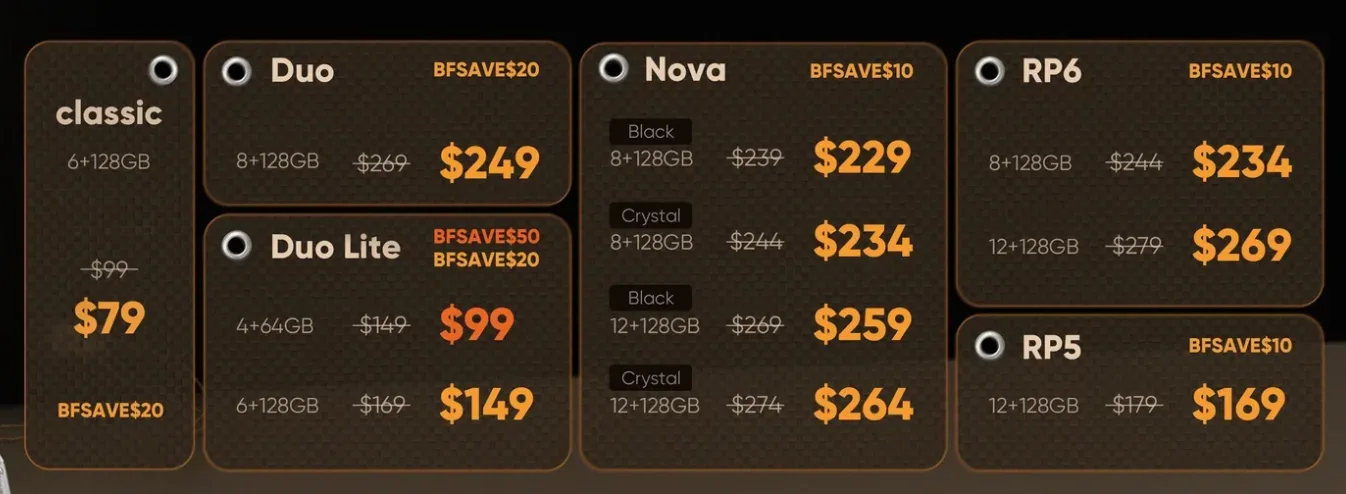
Retroid Black Friday prices and codes
- Retroid Pocket Classic (6GB/128GB): $79, down from $99. Code: BFSAVE$20.
- Retroid Pocket Duo (8GB/128GB): $249, down from $269. Code: BFSAVE$20.
- Retroid Pocket Duo Lite (4GB/64GB): $99, down from $149. Code: BFSAVE$50.
- Retroid Pocket Duo Lite (6GB/128GB): $149, down from $169. Code: BFSAVE$20.
- Retroid Pocket Nova, Black (8GB/128GB): $229, down from $239. Code: BFSAVE$10.
- Retroid Pocket Nova, Crystal (8GB/128GB): $234, down from $244. Code: BFSAVE$10.
- Retroid Pocket Nova, Black (12GB/128GB): $259, down from $269. Code: BFSAVE$10.
- Retroid Pocket Nova, Crystal (12GB/128GB): $264, down from $274. Code: BFSAVE$10.
- Retroid Pocket 6 (8GB/128GB): $234, down from $244. Code: BFSAVE$10.
- Retroid Pocket 6 (12GB/128GB): $269, down from $279. Code: BFSAVE$10.
- Retroid Pocket 5 (12GB/128GB): $169, down from $179. Code: BFSAVE$10.
The largest discount is not automatically the best fit
There is a meaningful difference between a deal’s cash saving and its final cost. The $50 cut on the entry Pocket Duo Lite is the biggest reduction in this set, and it changes the starting price more dramatically than any other listed offer. Yet it is also attached to the lowest listed memory and storage configuration: 4GB of RAM and 64GB of storage.
RAM, or random-access memory, is working memory used while software is running. Storage is the built-in space reserved for the operating system, applications and user files. Those figures are not performance ratings by themselves, and the supplied details do not establish how any of these handhelds perform with particular games or software. Still, they are concrete configuration differences buyers should notice before treating two similarly named models as equivalent.
The second Duo Lite option costs $149 after its $20 code, but raises the listed configuration to 6GB/128GB. That is a $50 difference in final price versus the discounted 4GB/64GB Duo Lite. Anyone choosing between them is therefore making a direct budget-versus-capacity decision, not simply deciding whether the $50 deal is “better.”
How the lineup separates by price
At the low end, the Pocket Classic is listed at $79 after discount, narrowly undercutting the $99 Pocket Duo Lite. The Pocket 5 occupies a distinct middle point at $169. The remaining listed devices begin at $229: the Pocket Nova at $229 or $234 depending on color in its 8GB/128GB version, and the Pocket 6 at $234 for 8GB/128GB.
At the top of the supplied list, the 12GB/128GB Pocket Nova in Crystal is $264, while the 12GB/128GB Pocket 6 is $269. The standard Pocket Duo, configured with 8GB/128GB, is listed at $249. Those close final prices make configuration labels especially worth reading carefully. A buyer should not assume that a higher price within this cluster means more RAM, because the listed product names and configurations differ.
Related coverage includes Retroid Announces Black Friday Discounts Across Pocket Handheld Lineup.
Color can change the Nova’s listed price
The Pocket Nova is the clearest example of a detail that could be easy to miss while scrolling a sale page. With the same listed 8GB/128GB configuration, Black is $229 and Crystal is $234. With 12GB/128GB, Black is $259 and Crystal is $264. In both cases, the supplied prices put Crystal $5 above Black after the same $10 discount.
That does not establish a reason for the difference, and none should be assumed. It does mean color is not purely a cosmetic choice within these particular listings: it changes the advertised checkout target by $5.
What the discount percentages look like
Calculating the reductions against the stated original prices adds useful context. The $50 cut on the 4GB/64GB Pocket Duo Lite is roughly 33% off its $149 original price. The Pocket Classic’s $20 reduction from $99 is about 20%. The other $20 offers—on the Pocket Duo and the higher-spec Pocket Duo Lite—are each roughly 7% and 12% respectively.
The $10 offers are smaller in percentage terms. They are about 4% off on the Nova and Pocket 6 models listed at $239 to $279, and about 6% off on the Pocket 5, which falls from $179 to $169. That does not make them unimportant, but it helps clarify the structure of the promotion: it heavily favors the lowest Duo Lite configuration, gives the Pocket Classic a comparatively strong reduction, and applies modest cuts to the rest of the range.
The sale’s clearest value proposition is simple: the Pocket Duo Lite 4GB/64GB receives the deepest price cut, while the wider lineup receives smaller reductions that preserve close spacing between models.
A practical way to compare the offers
- Start with the final price, not the amount saved. A $10 code can still put a particular model outside a budget, while a smaller advertised percentage may be enough to make another configuration viable.
- Match the exact configuration. “Pocket Duo Lite,” “Pocket Nova,” and “Pocket 6” each appear in more than one RAM/storage version. Compare the full model name and configuration, not only the family name.
- For the Nova, check the color line item. Black and Crystal are separately priced in the supplied offers, despite matching RAM and storage within each tier.
- Use the precise code shown for that deal. The codes include dollar signs—BFSAVE$10, BFSAVE$20 and BFSAVE$50—so entering the code exactly as listed matters.
- Confirm the displayed total and promotion conditions before paying. The supplied deal information identifies prices and codes, but does not specify an end time, regional eligibility, stock status, shipping costs, taxes, or whether discounts can be combined. Those details can affect the true purchase total.
What is and is not established by these listings
The available information supports a clear price comparison, but it does not answer every buying question. It identifies the stated original price, discounted price, code, color where relevant, and RAM/storage configuration. It does not provide technical specifications beyond those memory figures, feature breakdowns, game compatibility claims, battery information, screen details, software support, or an end date for the promotion.
That boundary matters with portable gaming hardware. A discount can be a useful trigger for someone who has already chosen a model, but it is not evidence that one device is technically superior to another. The Pocket Classic at $79, for example, is the least expensive item listed, while the Pocket Duo Lite has the strongest price reduction. Those are separate facts, and neither one alone determines which handheld is right for every player.
More broadly, Black Friday pricing across consumer tech can be easy to read as a race for the biggest percentage off. A more grounded reading is to treat these as a set of distinct offers. The Pocket Classic provides the lowest listed entry price. The 4GB/64GB Duo Lite supplies the biggest raw and proportional cut. The Pocket 5 lands at $169. The Nova, Pocket 6 and standard Duo form a higher-priced group with discounts ranging from $10 to $20.
For shoppers already comparing seasonal promotions, our roundup of Black Friday power deals offers a separate look at how sale-event savings can vary sharply by product category. In Retroid’s case, the useful takeaway is narrower: compare the exact Pocket variant first, then treat the code as a final price adjustment rather than the whole story.