October sale season is arriving with a familiar retro-gaming dilemma: buy the hardware that solves a problem now, or wait in hope that Black Friday takes another chunk off the price. The answer is not simply “wait.” A convincing discount is only useful if the item is compatible with the machine on the shelf, the final checkout total stays sensible, and an upgraded successor or rival product does not immediately make the purchase look awkward.
That is especially true in retro gaming, where a shopping list can mix emulation handhelds, original-console controllers, wireless receivers, storage accessories and video scalers. These categories have very different practical purposes. A small Linux handheld is one route to playing supported game libraries on the move; an N64-style Bluetooth pad needs additional hardware before it can talk to an original Nintendo 64; and a PS2 HDMI solution can be the difference between merely getting an image on a modern television and getting one that is stable enough to enjoy.
Several early October listings provide a useful snapshot of where the value questions are. Prices can change, stock can disappear, and a sale badge is not proof of a deal. Still, the listings make the bigger choice clearer: identify the bottleneck in a retro setup first, then judge the price and the compromises.
Start with a need, not the event calendar
The October sales window sits close enough to Black Friday to encourage endless hesitation. There is a legitimate case for waiting when a product is not discounted, when the existing setup works, or when a buyer is deciding between models that serve the same role. But delay has costs too. Clearance hardware can sell through, and an apparent future discount is never guaranteed.
A more grounded approach is to sort potential purchases into three groups:
- Immediate fixes: hardware that addresses a real current issue, such as connecting a PlayStation 2 to a newer display or replacing an unusable controller.
- Good-enough replacements: outgoing handhelds and accessories that meet a buyer’s actual performance target despite newer options existing.
- Nice-to-haves: additional controllers, novelty handhelds and aesthetic alternatives that are easiest to defer until a genuinely compelling price appears.
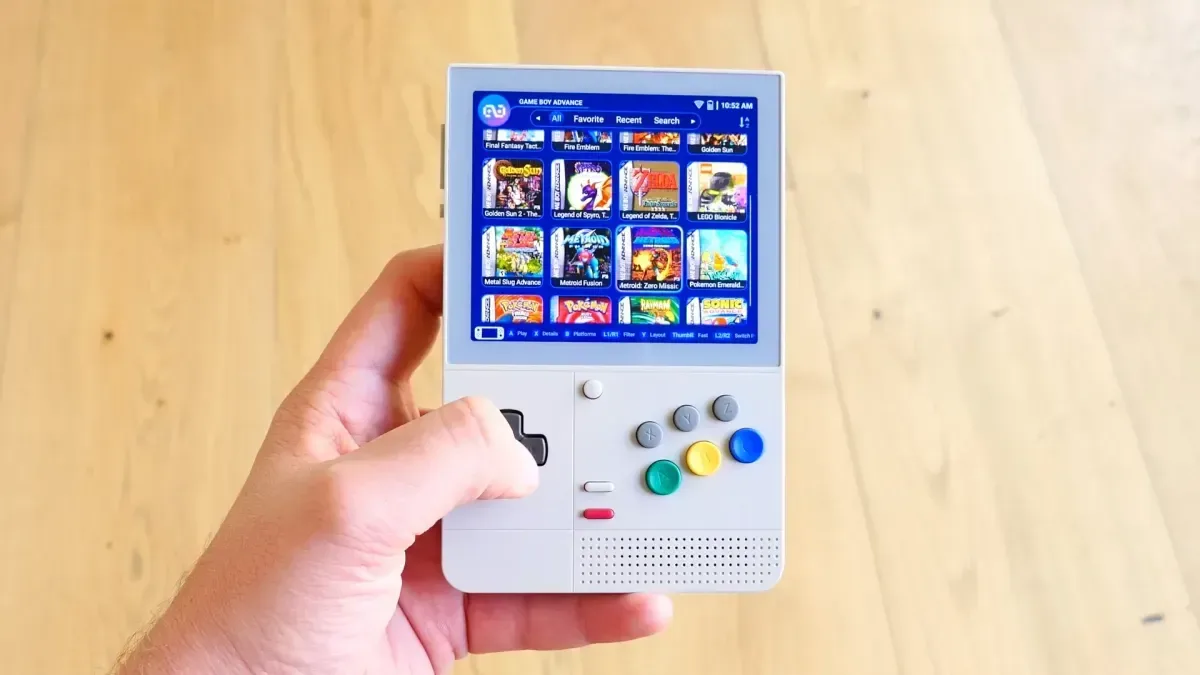
This matters because a new model does not automatically erase the old one. Retroid has introduced the Pocket 6 and is discontinuing the Pocket 5, with the earlier model listed at $219 after a $30 reduction from its original price. The Pocket 5 is positioned as an AMOLED-equipped emulation handheld for systems before Wii U. For someone whose target is that generation range, the outgoing device may still be the relevant one. For someone shopping primarily to own the newest model or seeking performance beyond that scope, its clearance status alone is not a reason to jump.
The key term here is emulation: software reproduces the behavior of older gaming hardware on a newer device. A handheld’s value therefore depends not just on its processor or screen, but on which systems a person intends to run and how much setup they are prepared to do. Paying more for specifications outside that personal target can be needless; paying less for a device that misses it can be false economy.
Portable options span radically different use cases
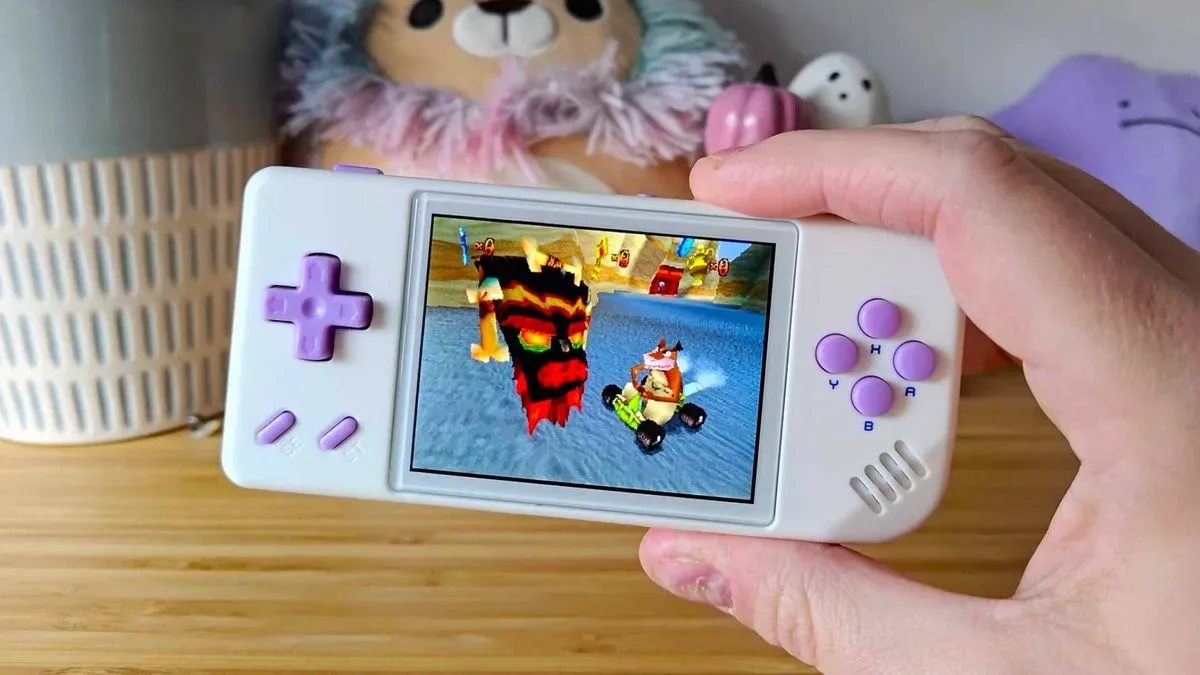
At the smaller and simpler end, the Anbernic RG28XX is listed at $42.99. It is described as a tiny Linux handheld shaped in the spirit of a Game Boy Micro, with the intended scope including Game Boy, SNES, Mega Drive and lightweight PlayStation games. The qualifier “lightweight” matters. It signals that prospective buyers should not treat this as a blanket promise for the whole PlayStation library or as a substitute for a more powerful portable.
Related coverage includes October Big Deal Days Retro Gaming Deals: What to Watch Before Black Friday.
That limitation is not a defect when it matches the job. Pocketability and a low price can be more important than chasing every system. The RG28XX listing is also roughly below commonly seen $47 options, although it has not returned to the sub-$40 level some bargain hunters may be watching for. That creates a straightforward choice: $42.99 may be reasonable for a buyer who specifically wants a miniature handheld now, while a buyer whose firm threshold is under $40 has a clear reason to hold off.
The Atari GameStation Go is a very different proposition at $119.99. Its stated $179.99 MSRP puts that price at 33% lower, and it is also described as $40 below a standard Amazon price. Rather than asking the owner to build a library or configure an emulation-focused device, it bundles more than 200 games along with a keypad and paddle controls for classic 1980s play. Those inputs are central to its identity. A keypad or paddle is not generic controller decoration; each is a control method associated with specific styles of older software. Buyers interested in that all-in-one angle may see real convenience, while players wanting broad access to multiple console generations should not assume this is designed for the same mission as the Retroid or Anbernic handhelds.
Evercade’s Super Pocket Rare Edition occupies another niche. It is a budget handheld associated with Banjo-Kazooie and is currently listed at $69.99, the same price as its siblings. That makes it difficult to describe as a major sale on the available information. A move below $60 would be much more meaningful against its present positioning, but until then it is best judged as a themed portable at its listed price, not a must-buy October bargain.
Controllers: the receiver and connection type are part of the price
Controllers are where deal comparisons can go especially wrong, because the advertised cost may exclude the thing required to make the pad work with a chosen console. The grey 8Bitdo N64 Bluetooth controller, with its multicolored buttons, is listed at $34.99 after a stated 22% reduction. That is under $35, but original Nintendo 64 use requires an additional Retro Receiver or another compatible adapter. The controller price is therefore not the entire project cost for an original-hardware player.
A Bluetooth controller communicates wirelessly over Bluetooth, a broadly supported wireless standard. A receiver is the companion device that lets a console without native Bluetooth accept that connection. Compatibility should be confirmed for the exact console, controller and receiver combination before purchase. The right-looking pad can otherwise become a very stylish object with nowhere useful to send its button presses.
The same principle explains the appeal of the Gulikit Elves 2 Pro bundle at $35.93. The package includes the Goku 2 Wireless Adapter, described as enabling a connection to systems with latency below 3ms. Latency is the delay between an input and the resulting action. In older games—where timing around jumps, shots and menus can be immediate—a low-latency connection is an important consideration. The Elves 2 Pro itself uses Bluetooth, which may be less ideal for a DIY emulation setup; the included adapter is what gives this particular bundle its practical twist.
The Retro Fighters Hunter sits in another category again. Listed at $59.59 and not currently discounted, it includes a 2.4GHz dongle intended for the original Xbox plus a USB adapter for modern machines. A dongle is a small wireless receiver. Here, the controller’s stated appeal is its direct original-Xbox focus and flexibility with newer hardware, not a sale price. Its translucent green styling makes it an aesthetic alternative for people attracted to early-2000s hardware looks, but prospective buyers have a solid reason to wait if that look is the only urgency.
Phone-focused Game Boy-style controllers are also worth treating as separate designs rather than interchangeable accessories. The GameSir Pocket Taco is listed at $34.99 and has standalone Bluetooth functionality, while the USB-C-only 8Bitdo FlipPad is listed at $29.99. Bluetooth potentially gives the Pocket Taco a broader range of uses; USB-C-only operation defines a more direct, narrower connection. Aspirational price points of below $30 for the Pocket Taco and below $20 for the FlipPad would make the distinction more compelling, but neither threshold is represented by the current listings.
A PS2 refresh is about video, saves and input—not one miracle adapter
Modernizing a PlayStation 2 setup is often a combination of several smaller decisions. The greatest trap is assuming that any cheap HDMI adapter automatically produces a good image. HDMI is simply a digital connection standard. It can carry the picture to a contemporary television, but it does not by itself solve how the console’s older signals are processed.
The GBS-Control, often shortened to GBS-C, is listed at $89.90 and is positioned specifically as a PS2-focused HDMI upscaler. An upscaler takes a lower-resolution video signal and outputs it at a higher resolution; this unit can scale RGB signals from supported retro consoles to 1080p. More importantly for PS2 use, it is described as addressing the shaky deinterlacing seen with many cheaper adapters.
Deinterlacing is the processing required when an interlaced video signal is displayed on a modern progressive display. If that process is poor, motion can look unstable or jagged. The GBS-C is not presented as the universal HDMI answer for every retro system, which is a helpful constraint rather than a shortcoming. Its value is strongest for a buyer whose priority is a PS2 on a newer display and who wants an approach intended to deal with that specific image issue.
Storage is the other half of the PS2 story. The PSxMemCard Gen 2, listed at $37.99, uses an SD card and is said to support up to 60,000 virtual PS1 memory cards and up to 8,000 virtual PS2 cards. These are substantial capacity claims, but the more useful way to understand the product is organization: an SD-based system can reduce reliance on a pile of physical cards while separating save data into many virtual cards.
It also comes with FreeMcBoot preinstalled, described as supporting backups, homebrew and region-lock bypassing. Homebrew refers to software made outside a console platform’s official commercial releases. Region locks are restrictions that can limit software or hardware use by geographic market. Anyone considering these capabilities should understand the relevant laws and platform rules, and should not mistake the product’s technical functions for a blanket authorization to use material they do not have the right to use.
A compact PS2 upgrade plan could therefore involve a video solution, a storage solution and a controller solution, each chosen for a distinct reason. The available component listings include an 8Bitdo Retro Receiver at $24.99, the PSXMemCard at $39.99, a Retro Fighters Defender at $54.95, and the GBS-C at $89.90. That list is a useful starting point, not a mandatory bundle. People satisfied with wired pads do not need a receiver; people already managing saves comfortably may not need SD-based storage. Buying every accessory because it appears on a starter list is an excellent way to build a more expensive pile of unopened boxes.
Marketplace caution is part of retro deal hunting
Price hunting beyond major retailers can be worthwhile, particularly for Anbernic portables and retro accessories, but the displayed item price is only one number. Check delivery costs, expected delivery times and the seller before committing. A low headline price can lose its advantage once shipping and delays are considered. In some cases, the higher-priced option with clearer delivery expectations will be the better overall purchase.
The same restraint applies to October event branding. Not every worthwhile reduction receives a dramatic label, and not every special-event label represents the best price. Compare the live listing against the product’s stated MSRP or usual observed price where that information is available, add any required receiver or adapter, and decide whether the hardware addresses a present need. Compact gaming buyers weighing more modern hardware may also want to consider the recent Mini PC deal landscape, since a portable and a small living-room computer solve very different problems.
The practical October verdict is measured. The GameStation Go’s $119.99 listing, the $34.99 8Bitdo N64 pad with its extra receiver requirement, the $42.99 RG28XX, the outgoing $219 Retroid Pocket 5, and PS2-oriented accessories all offer concrete points of comparison. None removes the need to check compatibility, all-in cost and whether waiting serves a real purpose. Retro hardware is at its best when the purchase completes a setup rather than merely completing a checkout.
Shop the products
Check current price, model and availability at the retailer.