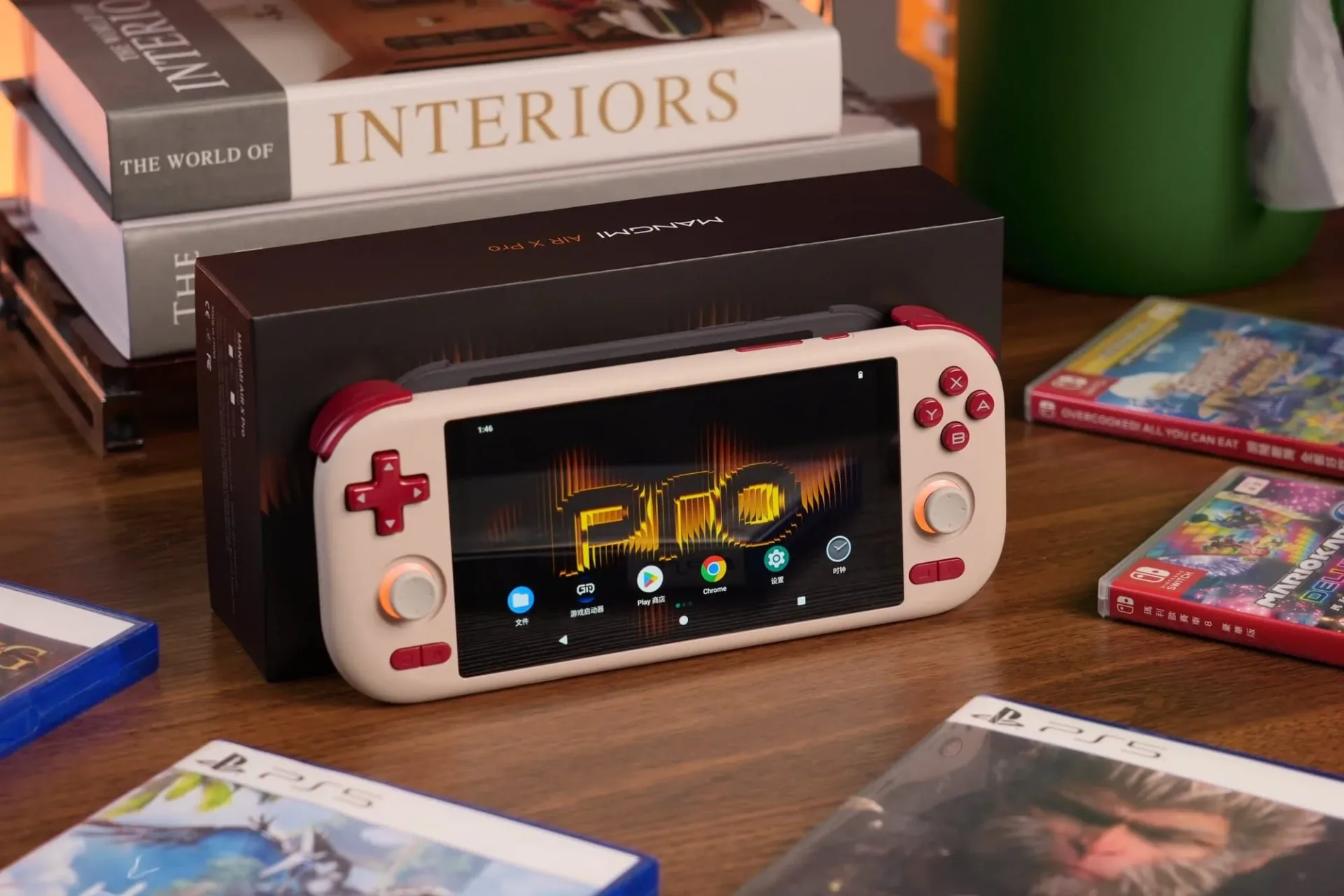
Mangmi has shared a fuller hardware picture for the Air X Pro, its upcoming horizontal Android handheld. The new model keeps the compact, cream-and-red design language of the Air X while substantially changing the internal platform: Qualcomm’s Snapdragon 865 is paired with 8GB of LPDDR4X memory, 128GB of UFS 3.1 storage and active cooling.
That specification list makes the Air X Pro a more ambitious device than a basic retro machine. The previous Air X was notable for reaching some PlayStation 2 emulation in a budget-focused format, but the Pro’s hardware suggests Mangmi is targeting more consistent performance in that demanding generation. That is a promising direction rather than a guarantee, though. No per-game compatibility results, settings guidance, price or release date have been provided.
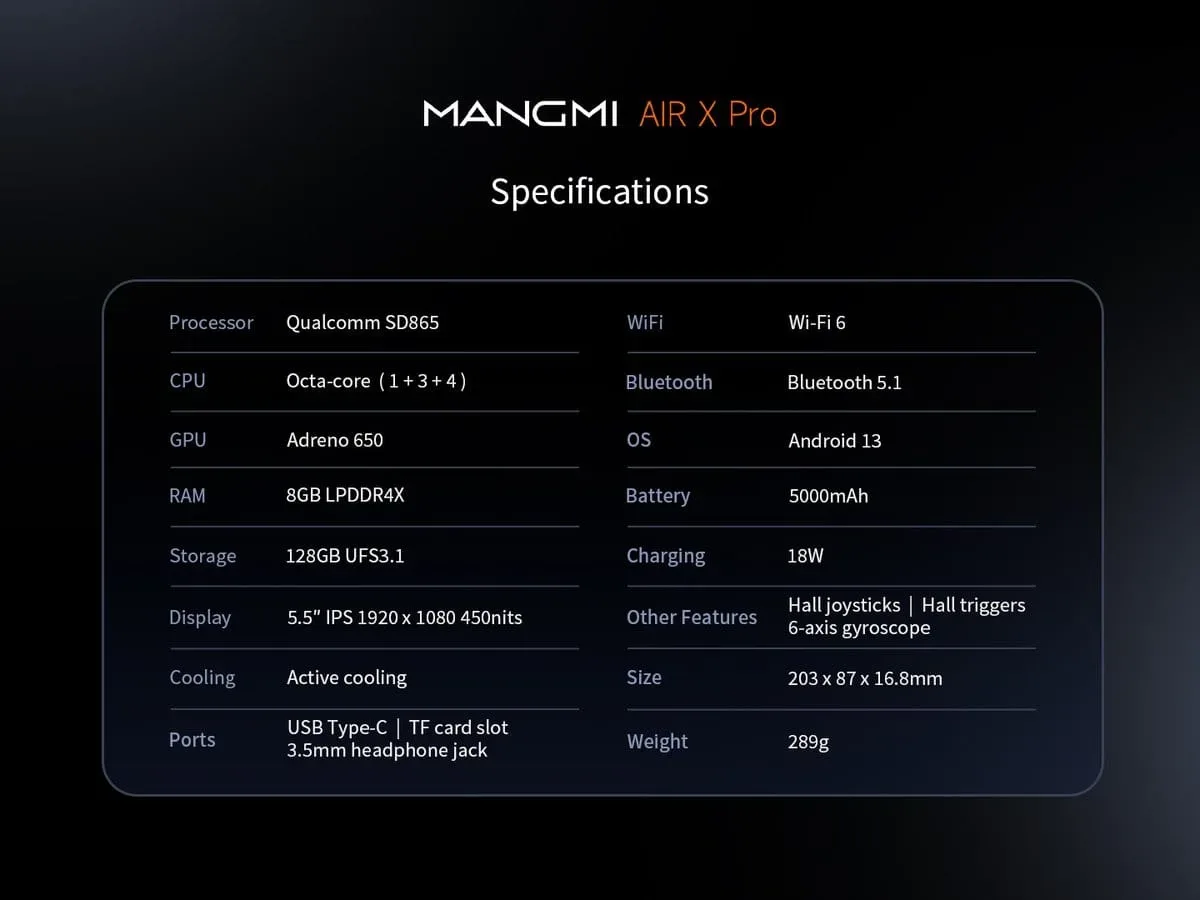
Mangmi Air X Pro specifications at a glance
- Processor: Qualcomm Snapdragon 865
- Graphics: Adreno 650 GPU
- Memory: 8GB LPDDR4X RAM
- Internal storage: 128GB UFS 3.1
- Display: 5.5-inch IPS panel, 1,920 x 1,080 resolution, 450 nits
- Cooling: Active cooling
- Operating system: Android 13
- Battery: 5,000mAh with 18W charging
- Controls: Hall-effect joysticks, Hall-effect triggers and a six-axis gyroscope
- Wireless: Wi-Fi 6 and Bluetooth 5.1
- Connections: USB Type-C, TF card slot and 3.5mm headphone jack
- Dimensions: 203 x 87 x 16.8mm
- Weight: 289g
A familiar chassis, with a more cohesive colour treatment
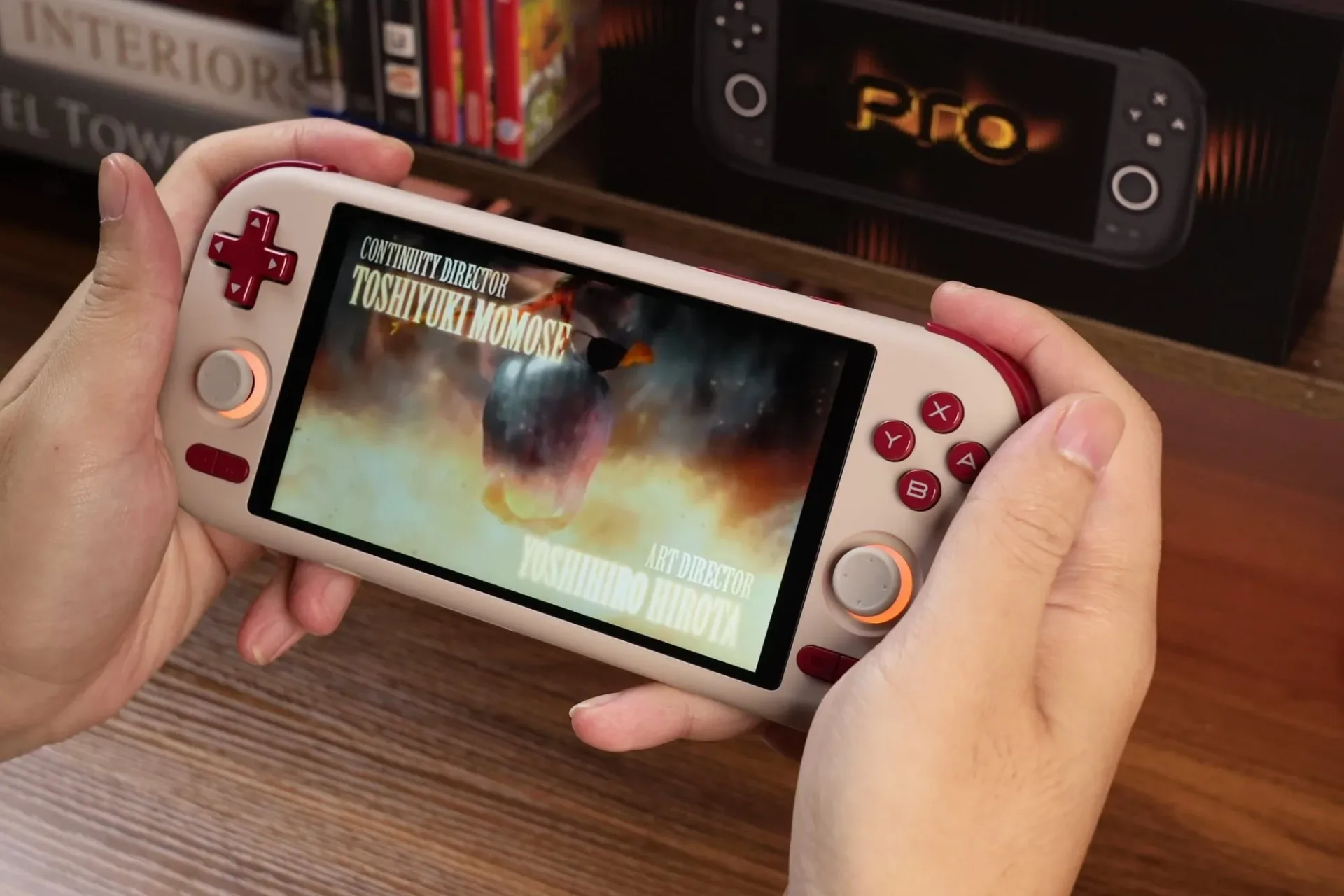
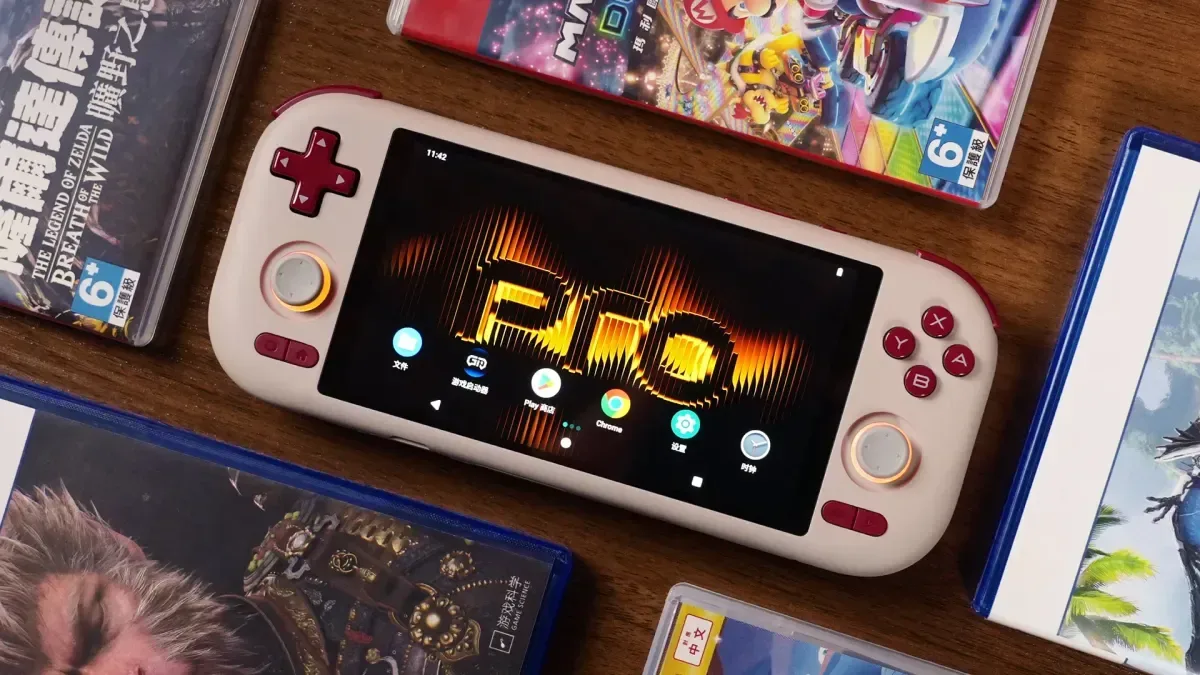
Official images show that Mangmi has not radically reworked the shape of the Air X. The Pro remains a wide, compact handheld with its screen centered between the controls, a layout intended to keep the device easy to carry while retaining a conventional gamepad-style grip position.
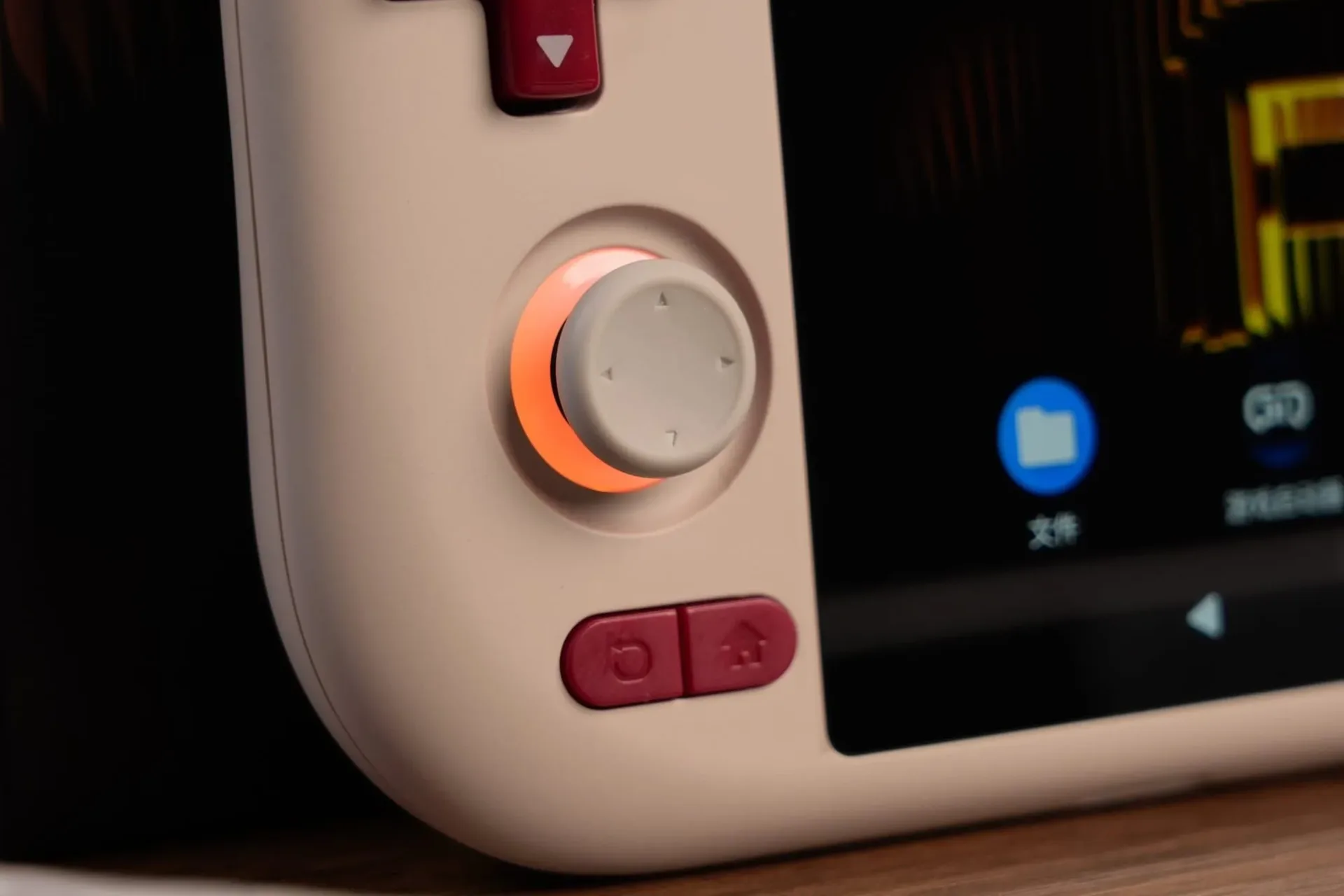
The visual adjustments are small but deliberate. It retains an off-white shell and deep red face buttons, framing the 5.5-inch display. The analogue sticks are now cream rather than black, while the D-pad and menu controls have also moved to red. Both sticks retain LED backlighting. It is a restrained revision, but one that makes the front of the handheld look more coordinated than a simple component swap would suggest.
At 203mm wide and 289g, the Air X Pro is neither a tiny keychain-style retro gadget nor a full-size portable PC. Its dimensions put the emphasis on a portable horizontal format that can accommodate a 5.5-inch screen and full controls without turning into a bag-only device. The 16.8mm thickness is also relevant: cooling hardware and a 5,000mAh battery have to fit somewhere, and Mangmi appears to be balancing that hardware against a relatively slim profile.
Why the Snapdragon 865 is the important part
The headline component is the Snapdragon 865 system-on-chip, backed by Adreno 650 graphics. A system-on-chip, often shortened to SoC, combines core processing, graphics and other mobile-device functions into a single package. In an Android handheld, it has a major influence on which emulators are viable, how demanding a game can be, and whether the device has enough performance margin to maintain speed under load.
The Air X Pro’s combination is broadly comparable on paper to the Retroid Pocket 5, another handheld built around the Snapdragon 865, 8GB of memory, a 5,000mAh battery and a 5.5-inch 1080p display. That comparison explains why PlayStation 2 emulation is the immediate point of interest. It does not establish identical real-world results: handheld performance also depends on cooling behavior, software configuration, emulator versions, display output choices and the game itself.
PlayStation 2 emulation is a useful benchmark because it is considerably more complicated than merely reading a game file. The handheld must reproduce the behavior of older console hardware through software, while translating the work to a modern mobile processor and GPU. Some games can require more performance than others, and compatibility can vary between titles even on the same device. For prospective buyers, “PS2-capable” should therefore be read as a category of expected use rather than a promise that every game will run perfectly with the same setup.
Related coverage includes Mangmi Air X Pro revealed with Snapdragon 865 and a 1080p screen.
Mangmi’s active cooling is meaningful in this context. Active cooling generally means a fan is used to move heat away from internal components. Sustained emulation can create enough heat for a mobile chip to lower its operating speed in order to manage temperatures, a behavior commonly called thermal throttling. Cooling cannot solve every software or compatibility issue, but it may help a handheld hold its intended performance longer than a passively cooled design under extended load.
Display, storage and controls are set up for Android flexibility
The 5.5-inch IPS display has a 1,920 x 1,080 resolution and a stated brightness of 450 nits. IPS is a screen technology typically valued for viewing angles and color consistency. A 1080p panel gives Android games, streaming interfaces and emulators a sharp native canvas, though higher resolution alone does not make older games run better. In emulation, rendering at higher internal resolutions can increase graphical clarity, but it also increases the work requested from the hardware.
Its 128GB of UFS 3.1 internal storage is complemented by a TF card slot. TF, or TransFlash, is the naming commonly used for the microSD-sized expandable-storage format. This split is practical for an Android handheld: internal storage can hold the operating system and applications, while a removable card gives owners room to organize their own media and legitimate game backups. The card slot also means storage capacity is not permanently fixed at the 128GB included inside the unit.
Hall-effect inputs are another notable part of the specification. Hall-effect sticks and triggers use magnetic sensing rather than the direct physical contact used by many conventional analogue components. The practical appeal is reduced dependence on rubbing electrical contacts as the control moves, which is intended to help limit drift and wear concerns. It is an encouraging feature on paper, although durability is something that becomes clear only with long-term use.
The six-axis gyroscope adds motion sensing, while the dedicated 3.5mm headphone jack preserves a simple wired audio option alongside Bluetooth 5.1. Wi-Fi 6 is also listed, a useful inclusion for downloads, wireless networking and Android-based services. USB Type-C handles the wired connection and charging duties, with the battery rated at 5,000mAh and charging listed at 18W.
What buyers should wait to learn
The Air X Pro’s parts list is unusually specific, but the most consequential purchasing details remain absent. Mangmi has not supplied a price or a release date. The eventual price is especially important because the appeal of the original Air X was closely tied to offering capable emulation hardware at a low cost. A Snapdragon 865, active cooling, 8GB of RAM and 128GB of UFS 3.1 storage define the Pro as a substantial upgrade, but they do not by themselves reveal where it will sit among competing Android handhelds.
There are also unanswered practical questions that specifications cannot resolve: fan noise, heat at the grips, battery life under sustained emulation, software polish, the quality of the D-pad and buttons, and the consistency of performance across individual PlayStation 2 games. Those are not minor details for a device pitched toward systems at the upper end of what compact Android handhelds attempt.
For now, the most grounded takeaway is that Mangmi is preserving the Air X’s portable horizontal identity while moving to a platform with materially stronger expectations for demanding emulation. The component choices place PlayStation 2 performance squarely at the center of the conversation, but the best-case claim should stay conditional until the handheld is available and tested across a broad game library. Anyone comparing the fast-moving Android handheld market can also see how manufacturers are experimenting with form factors in ANBERNIC’s vertical Android handheld approach.