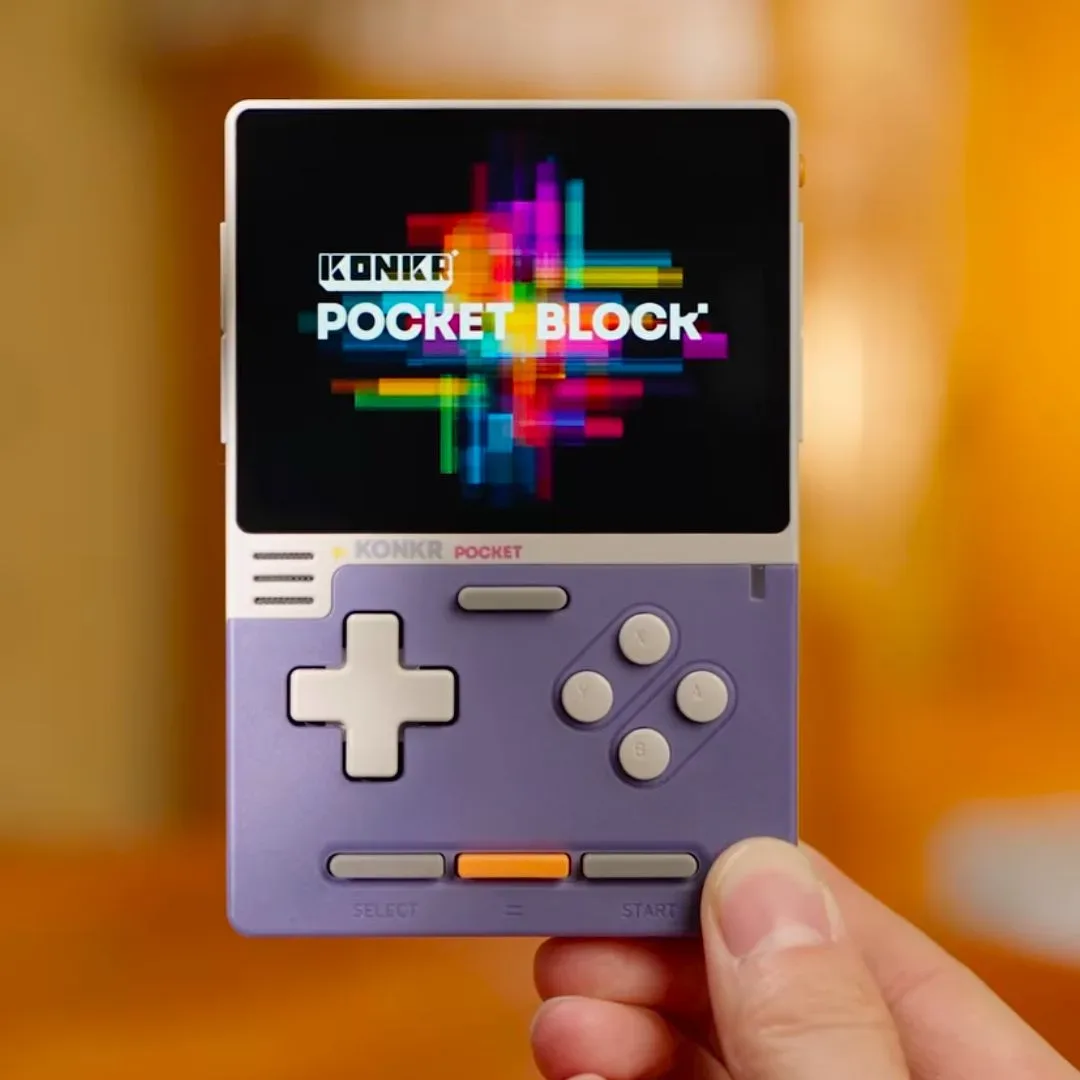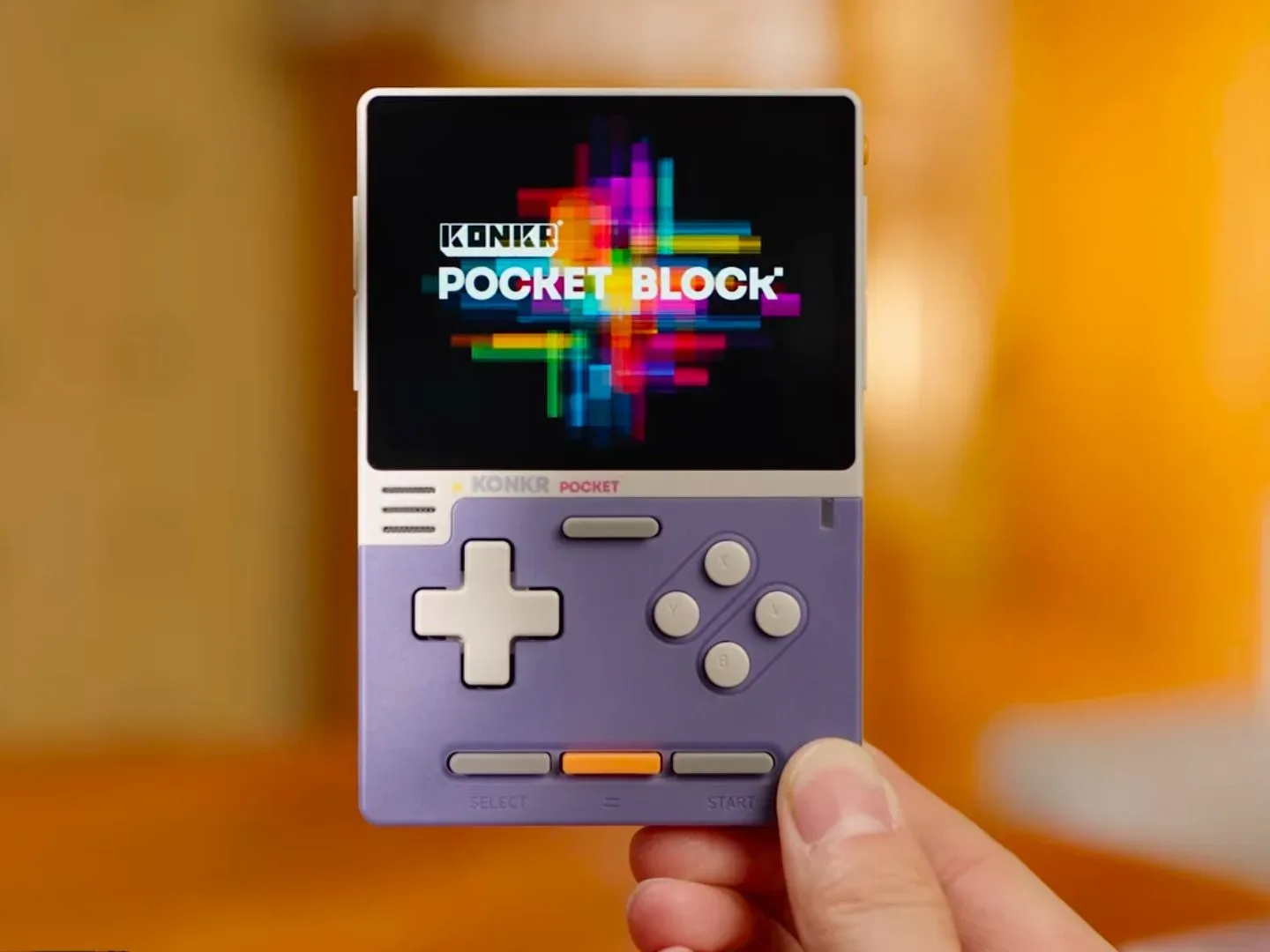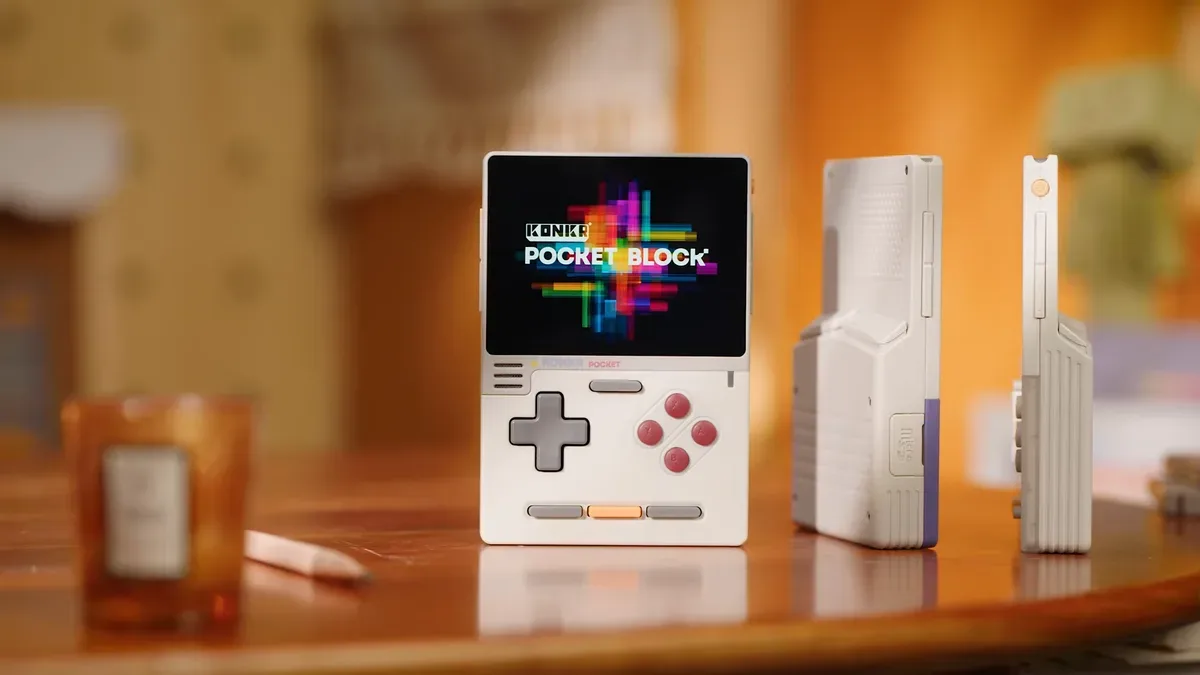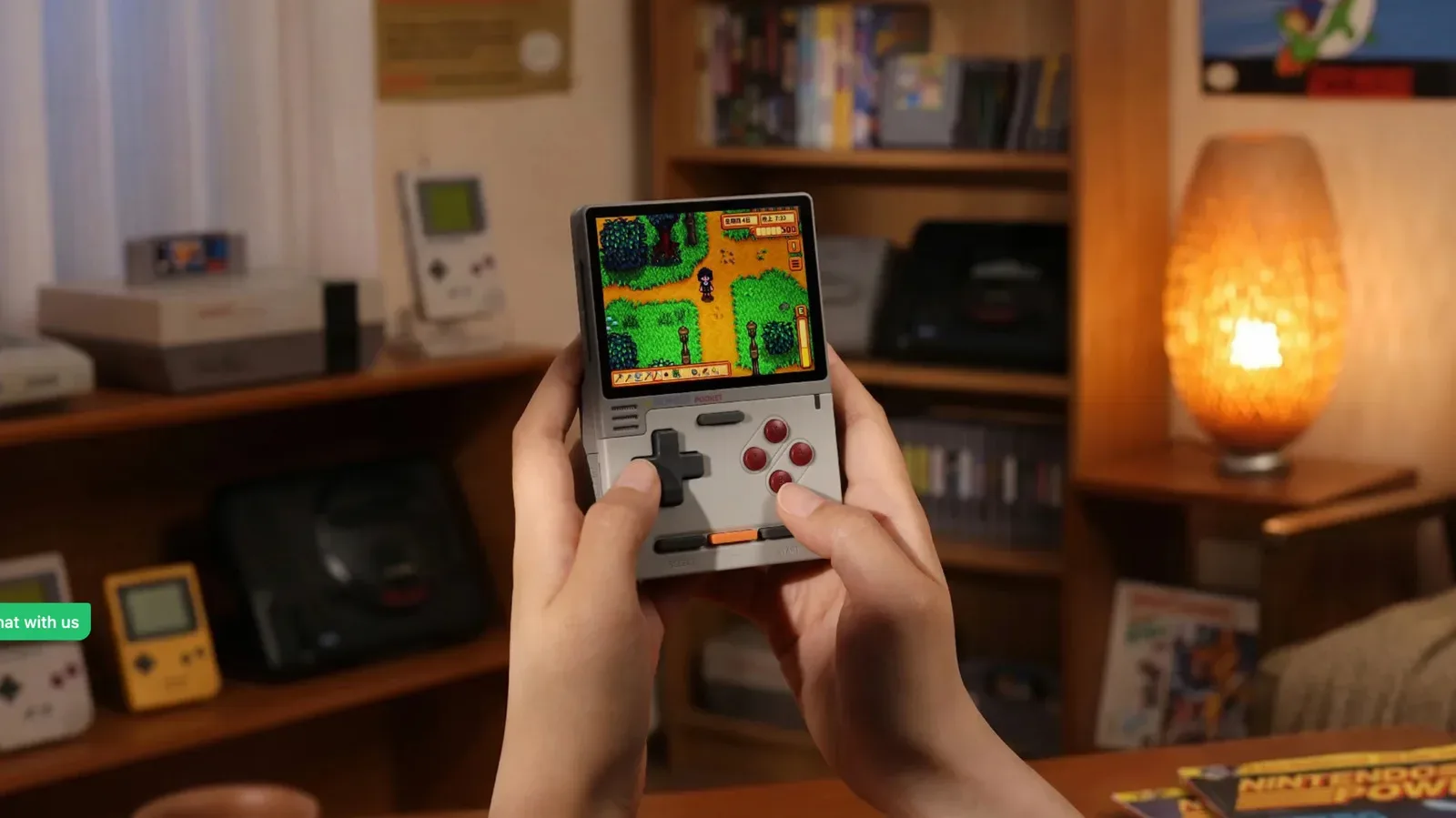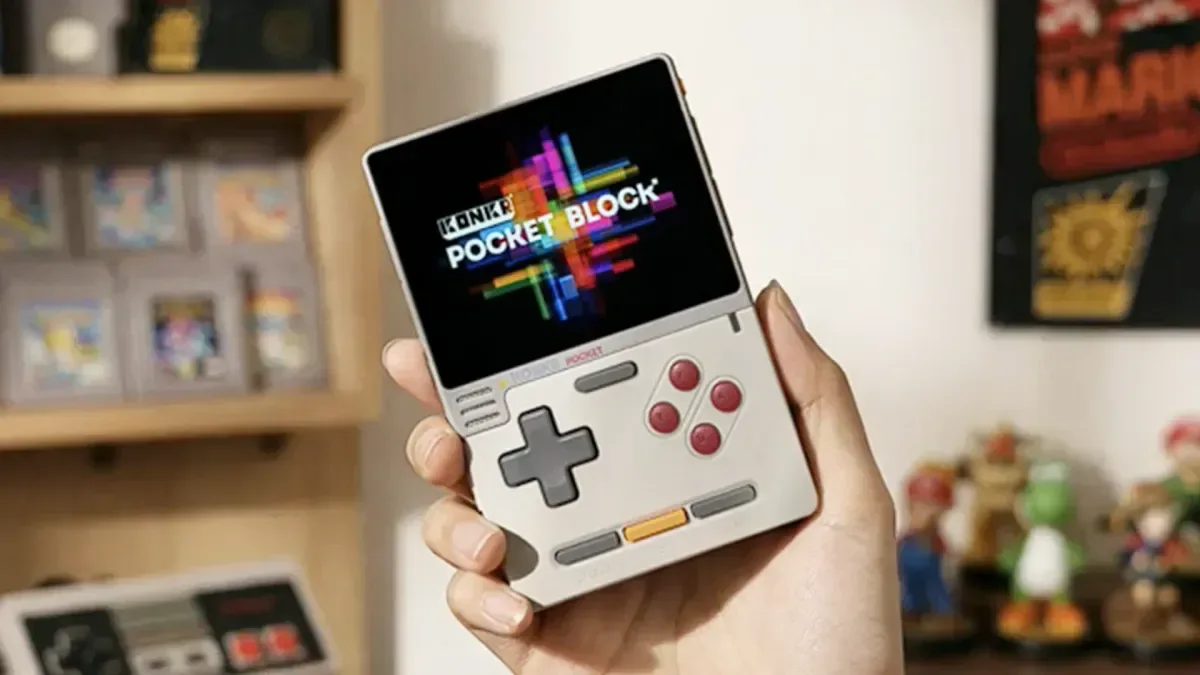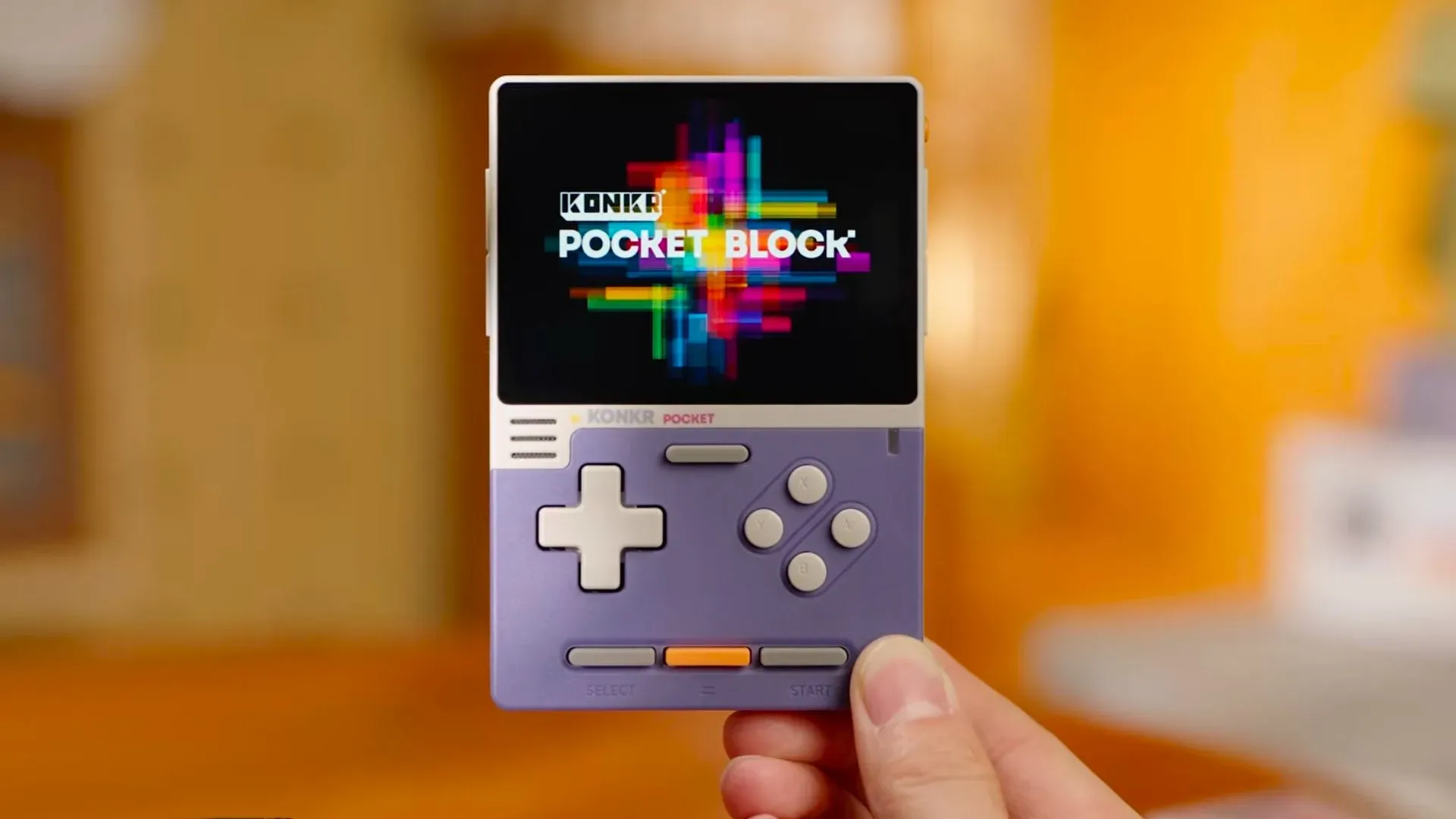
Ayaneo’s Konkr Pocket Block has launched with a starting price of $79, putting the compact Android handheld into a fiercely competitive corner of the retro-gaming market. The headline is not merely the price, though. The latest launch material frames the device as a vertical pocket handheld for games and leans into its “retro cyber” look, while the artificial-intelligence language that dominated its May reveal is notably absent.
That shift is likely to be welcome news for players who just want a small machine for their legally obtained retro-game libraries rather than another gadget trying to turn every button press into an AI keynote. The Pocket Block still has a potential AI-focused broadcast ahead in October, so the subject has not disappeared entirely. But at launch, the practical details are doing the talking: a MediaTek Helio G85 chip, a 3.33-inch 960 x 720 display, and a tall, Game Boy Pocket-adjacent shape measuring 113.2 x 77.4mm.
A low entry price with a more ambitious specification
The base Konkr Pocket Block configuration combines the Helio G85 with 2GB of RAM and 32GB of storage for $79. A $99 version raises those figures to 3GB of RAM and 64GB of storage. That creates a straightforward choice: the cheaper model is the entry point, while the upgraded version offers more room for an Android installation, apps, front ends, game files, saves, and the other housekeeping that arrives with using a more flexible handheld platform.
RAM, or random-access memory, is the short-term workspace used while apps and games run. More of it can help with multitasking and heavier software, but it is not a magic performance switch. Storage is the longer-term space for the operating system and files. Neither specification alone establishes how every emulator or game will behave; software configuration, the emulator itself, and the demands of the emulated hardware all matter.
The Helio G85 is the part that makes the Pocket Block more interesting than a basic Game Boy-style device designed solely around the earliest cartridge eras. Ayaneo’s stated component selection suggests a handheld intended to cover a wider span of systems than original Game Boy and Game Boy Advance games, while the display resolution gives it a noticeably sharper canvas than the tiny, lower-resolution screens common in the most inexpensive vertical handhelds.
For perspective, the Anbernic RG35XX Plus is positioned as a close rival at $59.97, while another inexpensive option, the RG28XX, uses a dual-core Mali-G31 GPU and is already capable of handling Game Boy, GBA, and some PlayStation games. The Pocket Block’s extra cost is therefore not just paying for a familiar silhouette. Its appeal rests on whether that Helio G85 platform, higher-resolution screen, and Android foundation produce a more capable and pleasant all-round portable.
The screen may be the Pocket Block’s clearest everyday advantage
Ayaneo lists a 3.33-inch display at 960 x 720. Those numbers matter because resolution refers to how many pixels a panel contains: 960 pixels across and 720 pixels down in this case. A higher-resolution display cannot automatically improve an old game’s original artwork, but it can give menus, interface elements, emulator overlays, and scaling options more room to breathe.
It may also be particularly useful for systems beyond monochrome Game Boy titles. A device with this specification is not necessarily limited to recreating the visual conditions of the original hardware. Players may prefer cleaner scaling, alternative aspect-ratio settings, shader effects, or system menus that are easier to read. At the same time, display preference is personal. Some retro players value a screen that closely echoes an original handheld’s proportions or pixel density, while others prioritize a larger, sharper panel in a pocket-friendly body.
Related coverage includes Ayaneo's Konkr Pocket Block Launches at $79 With Retro Gaming in Focus.
The Pocket Block’s vertical form is clearly part of the proposition. It recalls the broad design language of the Game Boy Pocket but uses a much more screen-forward face and two-tone styling. That familiar layout has been a staple of the retro handheld scene for years because it is compact and immediately legible: screen above controls, simple handheld ergonomics, no mystery about what the device is trying to evoke. The distinguishing question is whether its modern internals make it feel like more than another case of nostalgia wrapped around a modest chipset.
PSP claims are promising, not a substitute for testing
Ayaneo chief executive Arthur Zhang has said during a launch livestream that the Pocket Block can play PSP games. It is an appealing claim because PSP emulation is a meaningful step above the early handheld and 16-bit libraries associated with many low-cost devices. Yet it should be treated as a performance target rather than a blanket guarantee for the entire platform.
Emulation is software reproducing the behavior of one computing system on another. In this case, an Android handheld runs an emulator which attempts to reproduce a legacy console closely enough for compatible games to function. Results can vary by title and by settings. A game may work well at native resolution but struggle once rendering resolution is raised; another may need specific emulator settings; some may run differently after software updates.
Native resolution here means the game is rendered at roughly the resolution used by the original PSP, rather than being internally rendered at a higher resolution for a sharper image. Native-resolution PSP emulation is a more modest benchmark than demanding higher-resolution rendering. It is still useful information for a $79 machine, but it does not establish frame-rate behavior across the full PSP library.
That distinction is important for prospective buyers. There is a real difference between “it can launch PSP games,” “it plays selected PSP games,” and “it delivers full-speed performance throughout most of the library.” The available information supports the first claim from Ayaneo and makes the second plausible in at least some circumstances. It does not yet prove the third. Until independent testing covers a range of games and configurations, shoppers should avoid treating PSP support as a universal promise.
The same caution applies to any attempt to rank the Pocket Block against rivals before broader testing. Specifications give useful clues, but handheld experience is shaped by controls, software stability, thermal behavior, display quality, battery behavior, and how straightforward it is to configure an emulator. A spec sheet can establish potential; it cannot settle every practical question.
Why the missing AI messaging matters
When the Konkr Pocket Block was introduced in May, Ayaneo positioned it as the world’s first AI-powered handheld. The current launch presentation does not repeat that emphasis. Instead, its language is centered on the physical design and conventional handheld-gaming purpose. That is a significant tonal adjustment even if an October broadcast is still expected to address AI.
The resistance is easy to understand. In a retro scene built around preservation, accuracy, hardware tinkering, fan projects, and carefully maintained software, “AI-powered” does not tell players much by itself. It raises immediate practical questions: What feature is being added? Does it affect performance, privacy, battery use, software support, or price? Can it be ignored? Is it useful when the core job is launching games and running emulators?
There is also a cultural element. Some parts of the retro community have objected to AI entering decompilation-related projects, and AI-generated imagery has created its own layer of noise around depictions of vintage displays and setups. In that environment, an unspecified AI label can feel less like a benefit and more like an unnecessary distraction from the fundamentals: hardware quality, software support, controls, and accurate gameplay.
For the Pocket Block, the restrained launch wording is arguably the smarter approach. A budget handheld does not need a futuristic slogan to justify itself if its price and specifications offer a useful capability tier. If Ayaneo eventually explains a concrete AI feature, players can judge that feature on its own merits. Until then, the more relevant questions are familiar ones: how well it performs, how simple it is to use, and whether it earns a place among devices designed for old games.
A crowded market is splitting into specific niches
The Pocket Block arrives during a busy period for affordable handhelds, where companies are increasingly targeting particular use cases rather than offering one generic retro device. Ayaneo’s Konkr Pocket Advance is aimed at Game Boy Advance fans. Anbernic’s updated RG DS Plus is directed toward Nintendo DS players, while Retroid’s Pocket Duo also occupies the dual-screen space.
That specialization is useful because it forces buyers to begin with the games they actually expect to play. Someone mostly interested in Game Boy and GBA libraries may prioritize portability, a vertical layout, and screen preference. A Nintendo DS-focused buyer may care much more about dual screens. A player hoping to explore PlayStation Portable games will want clearer evidence of sustained performance and emulator compatibility rather than relying only on a marketing headline.
The Pocket Block appears to be trying to bridge several of those interests at once: a classic vertical form factor, an Android operating system, a high-resolution compact display, and a chipset that could reach past the earliest consoles. If it meets the PSP expectations attached to its hardware, it could be unusually compelling at its base price. If it is chiefly a Game Boy-to-PlayStation machine with occasional PSP successes, it may still be a reasonable value, but the buying calculation becomes more dependent on its screen and form factor.
Retro gaming remains lively precisely because old software keeps finding new contexts, from original hardware to FPGA systems, modern collections, and compact emulation handhelds. The recent discovery of a new Metal Gear Solid 2 speedrunning skip is a reminder that decades-old games can still generate new technical conversations. Devices such as the Pocket Block are part of that broader ecosystem, but their value ultimately comes down to making those games accessible and enjoyable without getting in the way.
For now, Ayaneo has put a potentially capable vertical Android handheld on the table at $79. The hardware and screen make it worth watching, the 3GB/64GB configuration offers a clearer route for those wanting extra headroom, and the reduced prominence of AI marketing keeps the focus on the part that matters. The unresolved piece is performance: especially whether the Pocket Block can consistently make good on the PSP potential associated with the Helio G85.
Shop the products
Check current price, model and availability at the retailer.