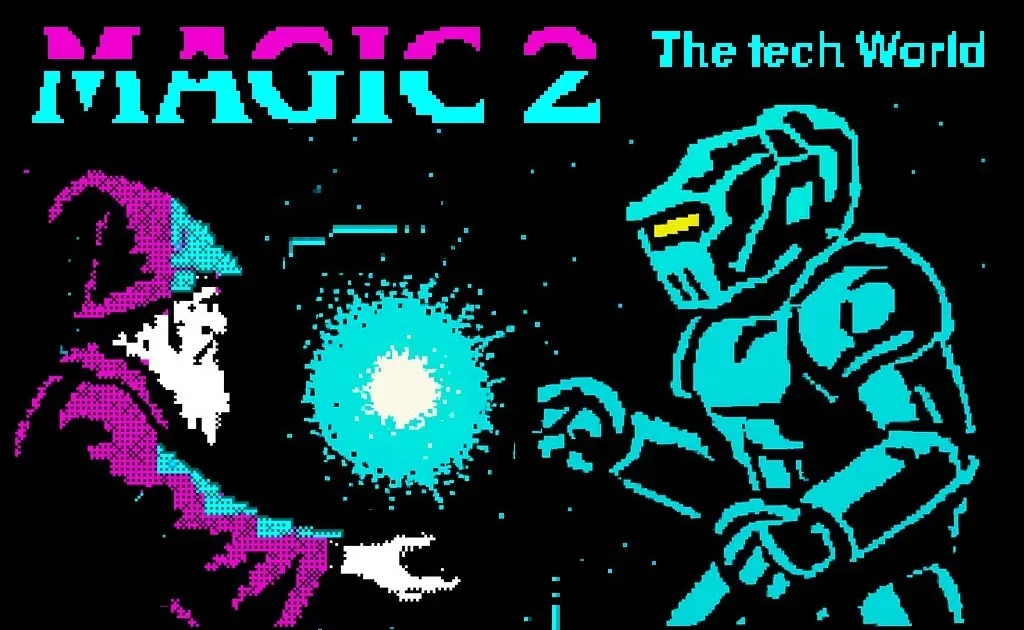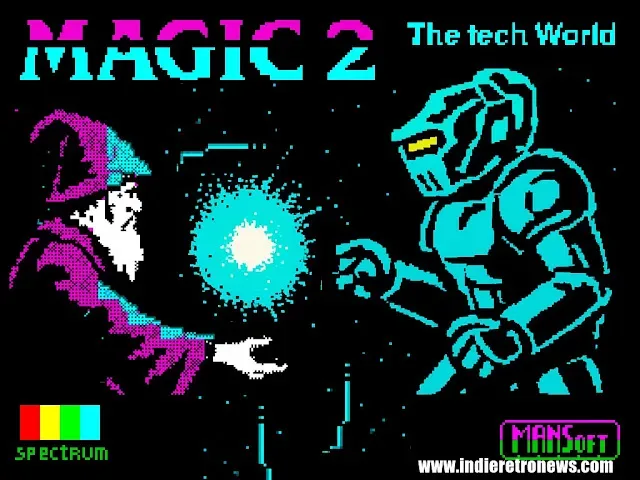
Mansoft is bringing the accident-prone wizard Mordebruk back for MAGIC 2: The Tech World, a platformer for the ZX Spectrum 48K. This time, the problem is not merely another troublesome spell. A magical mishap has left Mordebruk stranded in a strange temporal dimension shaped by advanced technology, with no access to his usual scroll-based spells and no obvious route home.
The escape plan is pleasingly concrete: recover four components needed to reconstruct a portal device. Players must search for a monitor, a gear, an energy collector, and a software cassette tape. Only by locating the full set can Mordebruk hope to rebuild his way out of the futuristic labyrinth.
A platformer where attacking has a cost
MAGIC 2’s core tension comes from the relationship between Mordebruk’s defensive magic and his survival meters. Casting a defensive spell does not simply consume a spell stock or impose a short cooldown. Each use drains both magic and life energy. That makes every cast a consequential choice: a threat may be removed or avoided in the immediate moment, but the price is a smaller margin for error later in the run.
In conventional terms, resource management means deciding when a limited reserve is worth spending. Here, the system is especially severe because the resource used for defense is connected to the character’s vitality. A defensive decision can therefore solve one problem while making Mordebruk more vulnerable to the next hazard. The game’s challenge is not framed solely around reflexes, even though the layout includes hazards intended to test them. It is also about restraint, route awareness, and knowing when not to press the magical panic button.
That setup should give the four-item search more weight than a simple scavenger hunt. The monitor, gear, energy collector, and cassette tape are not described as optional extras; they are critical pieces of the portal device. Exploring dangerous rooms to reach them also creates opportunities to find replenishing power-ups, but exploration itself carries risk. A player who pushes into an unfamiliar section may gain the resources needed for a difficult passage, or lose precious life getting there.
Mordebruk’s problem is bigger than a missing spellbook
The premise puts a classic fantasy character in a deliberately contrasting setting. Mordebruk is a wizard, but his destination is a technologically advanced temporal dimension full of futuristic anomalies. His objective is equally tech-oriented: a portal reconstruction project involving a display, mechanical part, energy hardware, and software on cassette.
The cassette tape is an especially fitting detail for a Spectrum game. It establishes the portal’s required software as a physical component inside the fiction, while also echoing the storage medium closely associated with the platform. The game does not need to explain how a magical portal and a cassette fit together for the central idea to land: Mordebruk’s escape requires him to work with unfamiliar technology rather than relying on his normal magical toolkit.
That absence of usual scroll spells matters. It places the wizard in a situation where his established means of solving trouble are unavailable, while the defensive magic he does retain must be treated carefully. The result is a protagonist who is not simply powerful by default. Mordebruk has tools, but they are expensive to use, and the dimension around him asks him to navigate its technological dangers on their terms.
Power-ups are part of the route, not just a reward
Power-ups scattered through the game restore Mordebruk’s magic and life energy. In a platformer with hazardous environments, that can change how players evaluate a route. A pickup is more than a score-like reward: it can be the difference between being able to defend against danger later and having to attempt a section with depleted reserves.
There are two distinct meters to keep in mind:
- Magic: the energy available for Mordebruk’s defensive spells.
- Life energy: the vital reserve also reduced when those defensive spells are cast.
Because spells draw from both, restoring either or both resources has strategic value. The supplied details do not specify the exact power-up types, their locations, or the numerical size of their refill effects. What is clear is that gathering them is part of surviving the game’s challenging structure, not a detached completionist activity.
For players, the practical implication is to pay attention to what a detour offers before treating it as wasted time. A dangerous side route may lead to a portal component, a vital refill, or both. Conversely, spending too much energy to secure a refill could leave the player in a worse position than before. That trade-off is where the platforming and resource systems meet.
What “challenging” means in this particular adventure
MAGIC 2 is described as very challenging, and its available details point to several overlapping forms of difficulty. First, there are the environmental hazards that demand quick reactions. Second, the game asks players to explore a labyrinthine setting rather than simply move through a plainly stated linear objective. Third, the spell system introduces attrition: defensive actions reduce the reserves needed to stay alive.
Those layers can make a retry-based platformer feel less about raw speed and more about building knowledge. Learning a hazard pattern is useful, but so is learning where replenishment sits, which routes lead toward required components, and which dangers are worth confronting with magic. The four-part objective offers a clear long-term goal, while the dual-resource system supplies moment-to-moment pressure.
It is important not to overstate what has been detailed. No information has been provided about the game’s number of stages, its controls, enemy roster, lives system, score mechanics, release format, price, or availability. Likewise, the exact behavior of the defensive spells and the nature of the futuristic anomalies have not been outlined. The central picture, however, is specific enough: this is a ZX Spectrum 48K platformer built around careful movement, hidden restorative pickups, costly magical defense, and a four-component mission to restore a portal.
A new mission for a familiar kind of home computer hero
The ZX Spectrum 48K identification is central to the project. MAGIC 2 is not being positioned as a game moving from a modern PC or console platform onto retro hardware; it is developed for the 48K Spectrum. That gives its technological fantasy a neat internal contrast: a wizard trapped among strange future machinery, rendered for a home computer whose identity remains closely tied to cassette-era software.
For readers interested in how older systems continue to support new experiments, the broader world of enthusiast-led software and retro hardware projects is explored in this look at PSP modding and homebrew history. MAGIC 2 is a separate game and platform, but it occupies a similarly enduring space: developers making new work for technology long after its original commercial era.
Mordebruk’s second major predicament also gives the game a playful narrative hook. He is not an all-conquering wizard arriving to save a realm; he is dealing with the fallout from his own spell gone wrong. The stakes are straightforward and personal—find the four parts, rebuild the portal, get home—but the journey is built to make that recovery difficult. Each hazard, detour, refill, and defensive cast becomes part of one wizard’s attempt to undo another magical blunder.
The key details so far
- Developer: Mansoft.
- Platform: ZX Spectrum 48K.
- Genre: Challenging platformer.
- Hero: Mordebruk, a wizard stranded after a spell mishap.
- Setting: A technologically advanced temporal dimension with futuristic anomalies.
- Objective: Find a monitor, gear, energy collector, and software cassette tape to rebuild a portal device.
- Central system: Defensive spells consume both magic and life energy.
- Recovery: Explore to find power-ups that replenish essential meters.
MAGIC 2: The Tech World’s defining idea is a simple but promising one for a demanding platformer: survival tools are valuable precisely because they are not free. Mordebruk must navigate hazards and seek the components of his portal, but the magic that might rescue him from a bad situation also reduces his ability to endure. For a wizard in a technological dimension, that is an appropriately inconvenient lesson in system maintenance.