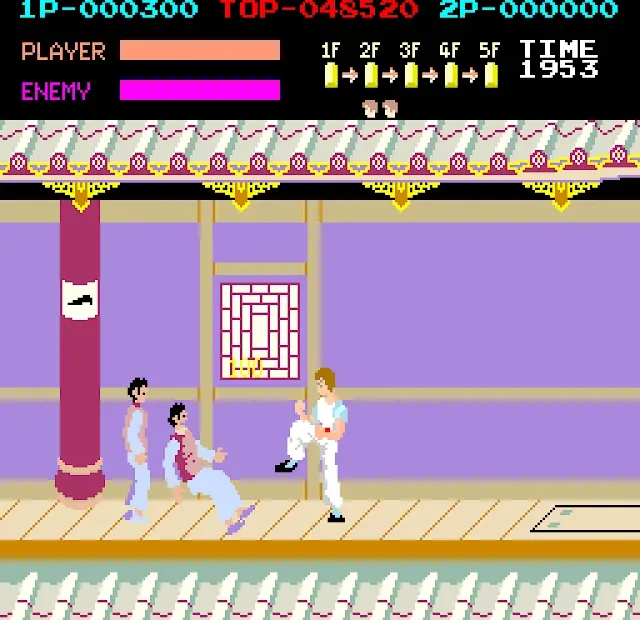

Kung-Fu Master A500 Edition brings Irem’s 1984 arcade action game to Commodore Amiga systems using the original OCS hardware standard. Created by Modern Vintage Gamer, the homebrew release is described as a near 1:1 reconstruction of the arcade game, including its familiar music and sound effects, while targeting even a stock Amiga 500 configuration.
That focus matters. This is not presented as a modern reinterpretation with expanded stages or a new combat system. Its purpose is to reproduce a very specific arcade climb: fight upward through Devil’s Temple, rescue Silvia, and reach Mr. X at the top. The release also supplies a set of practical conveniences that suit both original-machine players and emulator users, including configurable controls, selectable difficulty, high-score saving, and settings for starting from a chosen round.
An arcade structure built around pressure
Kung-Fu Master is a scrolling beat-’em-up: a game in which the player moves across a side-scrolling environment while fighting recurring groups of enemies. The premise is direct. Silvia has been kidnapped, and the player must ascend five floors of Devil’s Temple to confront Mr. X.
The route is not a free-roaming brawler. Each floor is a sustained gauntlet of threats, with grippers, knife throwers, dragons, snakes and exploding balls creating pressure as the player advances. A guardian waits at the end of each level, and defeating that opponent is necessary before taking the stairs onward. That structure makes enemy management and forward momentum central to the game’s identity: success is about surviving the stage’s escalating hazards as much as reaching its endpoint.
For more context, explore Waymo Halts Freeway Robotaxi Trips Nationwide After California Restriction.
For an arcade-faithful Amiga version, preserving that loop is the main point. The enemies, floor-by-floor objective, end-of-stage guardians and simple rescue setup all belong to the original game rather than being optional retro styling added after the fact.
Performance claims on stock Amiga 500 hardware
The developer says the port runs at 50 or 60 frames per second on stock Amiga 500 hardware. A frame is one displayed image in a sequence of animation; a higher, steady frame rate can make scrolling and character movement appear smoother. The distinction between 50 and 60 fps is especially relevant to older hardware because PAL and NTSC video standards traditionally operate at different refresh rates.
The game includes automatic NTSC switching, intended to account for that difference. It was also tested in cycle-exact WinUAE and on real PAL Amiga 500 hardware with a 68000 processor and OCS chipset. “Cycle-exact” describes an emulation approach that aims to reproduce hardware timing closely, which is especially useful when a program depends on the precise behaviour of an older system.
The minimum listed specification is an Amiga or accurate emulator with an OCS chipset, a 68000 CPU, 512 KB of Chip RAM and 512 KB of Slow RAM. Chip RAM is memory accessible by Amiga custom chips as well as the processor, making it important for tasks such as graphics and audio. Slow RAM is additional memory accessible to the CPU but not those custom chips. In practical terms, the listed target is a modest Amiga setup rather than a later, heavily expanded configuration.
Fast RAM detection is also included. Fast RAM is processor-accessible memory that can offer performance benefits over Chip RAM for appropriate work. The supplied details do not specify every effect of that detection in the game, but its presence indicates the software can recognise systems equipped with that additional memory.
Controls and accessibility options
Arcade accuracy does not mean every player has to use the same configuration. A dedicated options menu offers difficulty changes, starting-round selection, auto-fire, invincibility, and a choice of keyboard, one-button or two-button controls. That is a meaningful set of options for a game whose basic format is deliberately demanding.
- Difficulty: lets players adjust the level of challenge without changing the game’s core five-floor structure.
- Starting round: allows practice or repeat play from a selected point rather than requiring every session to begin at the first floor.
- Auto-fire: automates repeated attacks, potentially reducing the need for rapid, constant button presses.
- Invincibility: provides an option for exploring or practicing the game without the usual vulnerability to enemies and hazards.
- Control schemes: keyboard, single-button and two-button choices give users a way to match the software to their preferred Amiga setup.
Built-in high-score saving is another useful addition. High-score chasing is a natural fit for an arcade game structured around repeated attempts, and persistent score storage means strong runs can remain recorded after a session ends. Together, the settings make this more accommodating than an uncompromising fixed arcade cabinet experience while leaving the original objective intact.
Running it on hardware or through WHDLoad
The requirements call for one bootable 880 KB disk, or a system able to run WHDLoad. An 880 KB disk refers to the stated floppy-disk capacity needed for the bootable version. WHDLoad is named as the alternative system requirement for users taking that route. The release therefore identifies two supported ways to run the software without claiming that every Amiga configuration is identical.
The distinction is useful for anyone checking compatibility before trying the port. The key checklist is straightforward: OCS graphics hardware, a 68000 processor, at least 512 KB each of Chip RAM and Slow RAM, plus either the bootable disk arrangement or WHDLoad capability. The game was specifically tested on a PAL Amiga 500 configuration and in a timing-focused emulator setup, but prospective users should still match their own hardware or emulator settings against those requirements.
Tools and components behind the reconstruction
The project credits Modern Vintage Gamer for the port, reconstruction and Amiga code. It also identifies several tools and components used in production:
- PTPlayer 6.4 by Frank Wille, listed as public domain.
- ym2mod by adrdesign, described as a YM/AY/VGM/SDNH converter.
- NRV2S 68000 decoder by ross.
- Shrinkler executable cruncher by Blueberry.
- Bartman/Abyss’s amiga-debug toolchain.
These credits offer a glimpse at the technical work involved in fitting an arcade reconstruction into an Amiga-focused release. A converter such as ym2mod is used to handle music-data formats, while a decoder and executable cruncher relate to how program data may be stored and unpacked. The named debugging toolchain points to development work aimed at creating and checking software for Amiga hardware.
Most importantly, Kung-Fu Master A500 Edition is framed around the constraints and character of the Amiga OCS platform. It aims for smooth 50 or 60 fps operation, supports PAL and NTSC considerations, and offers input choices appropriate to a variety of setups. For players interested in Irem’s original arcade ascent, the result is a newly built route to the same five-floor fight on a machine-era-specific target.