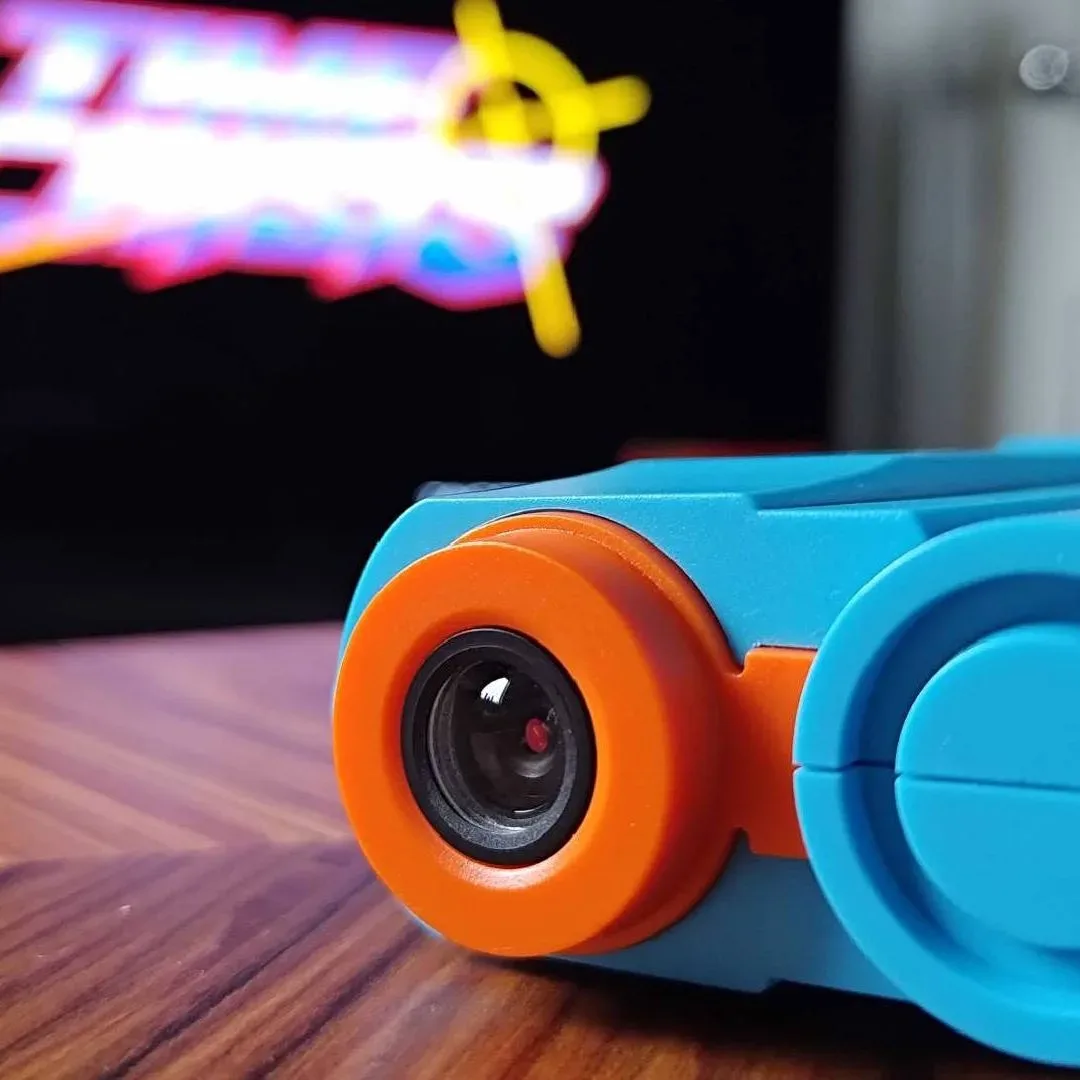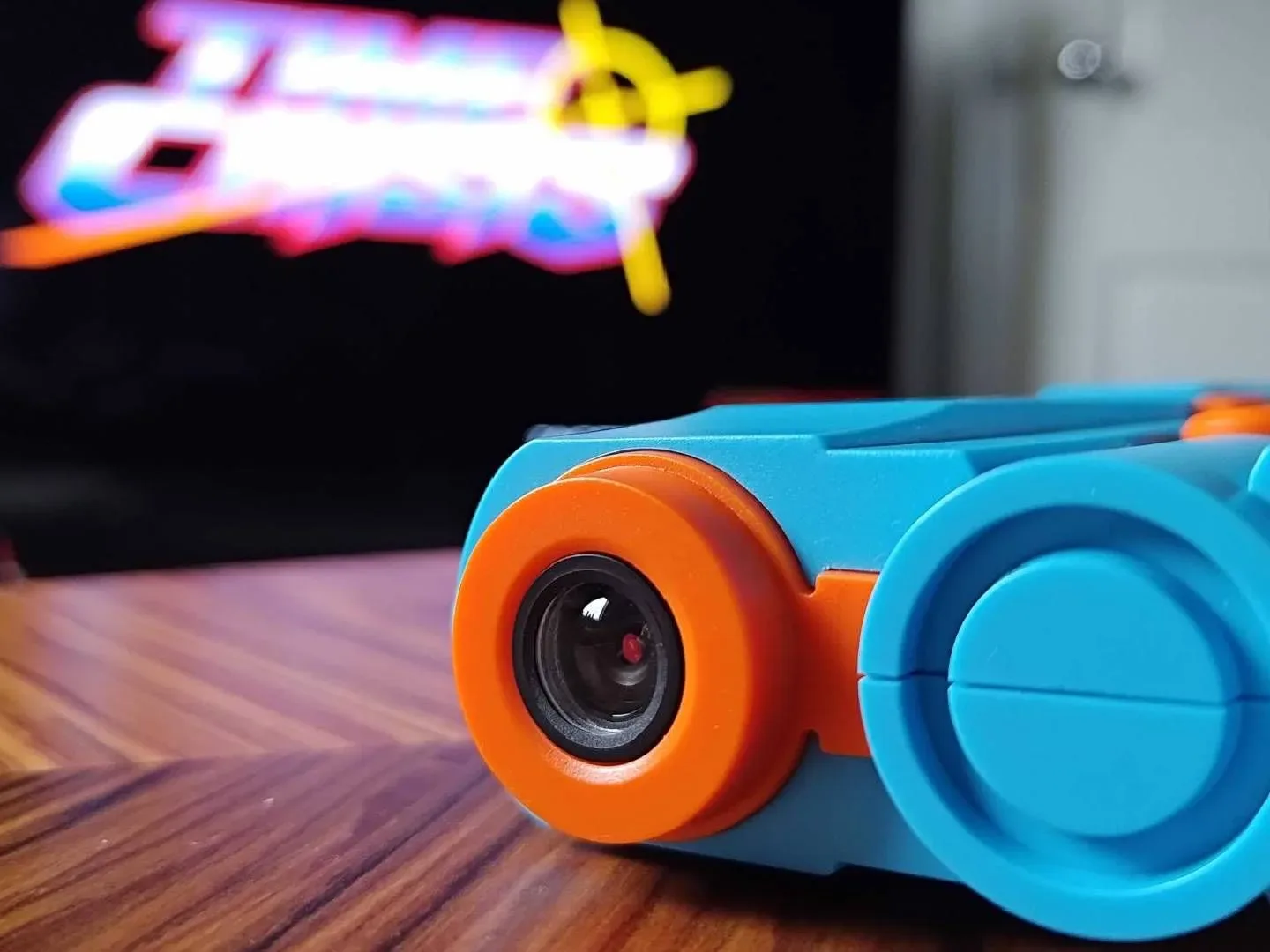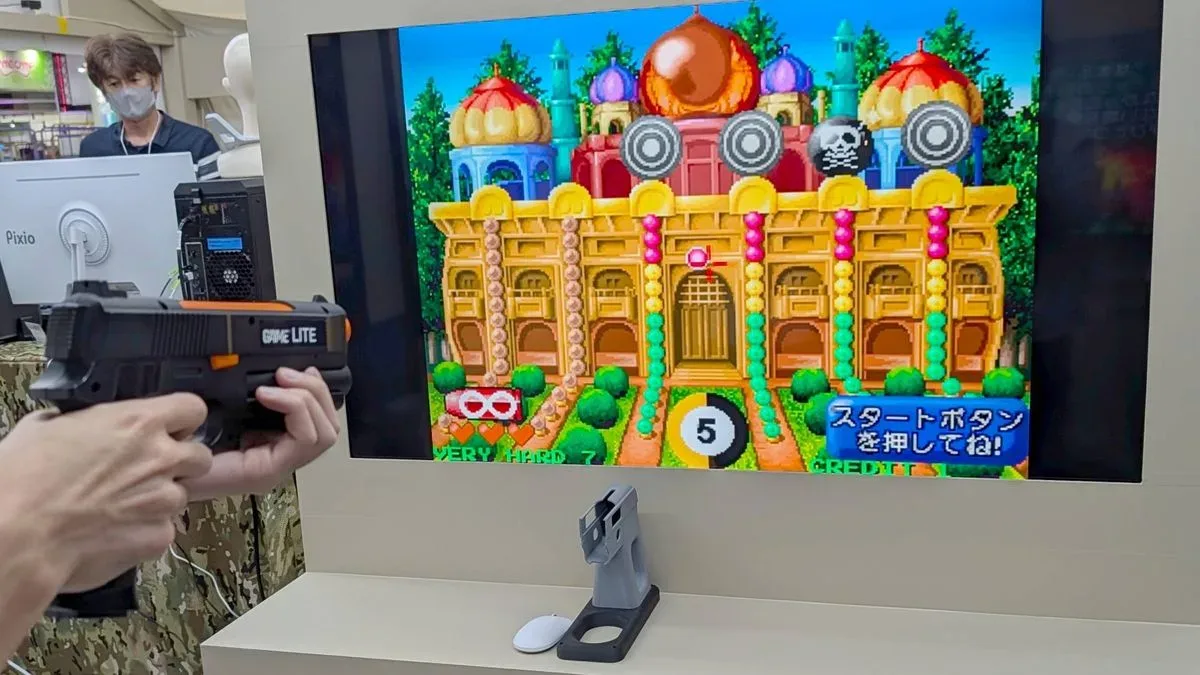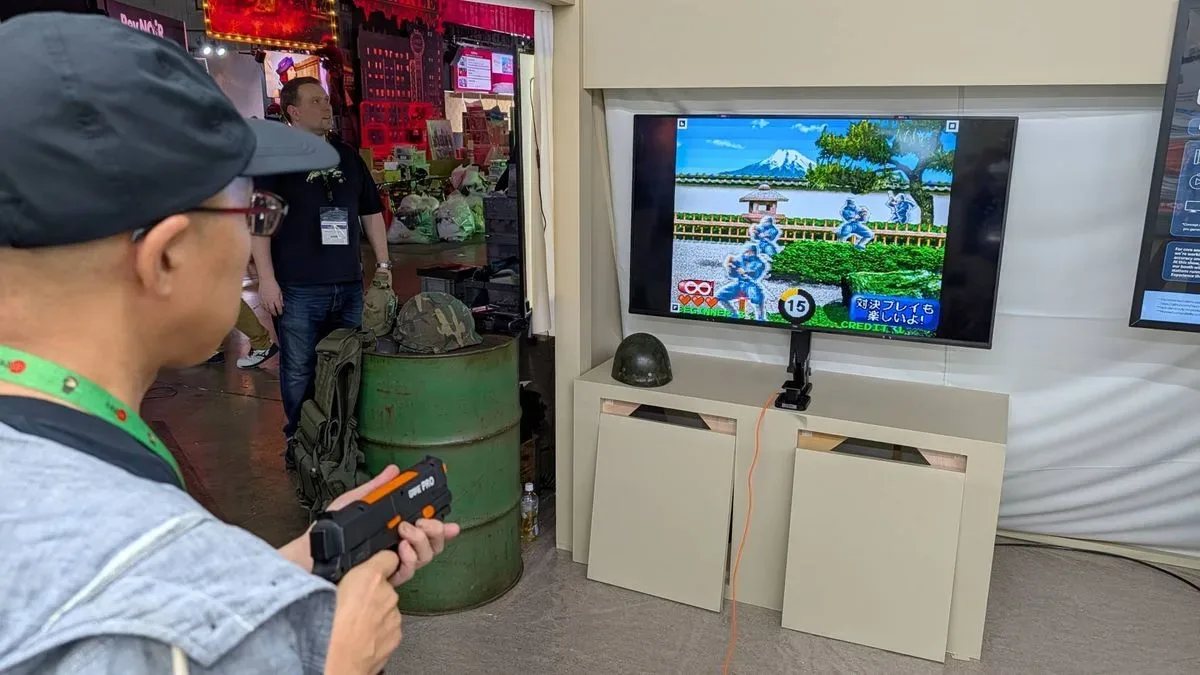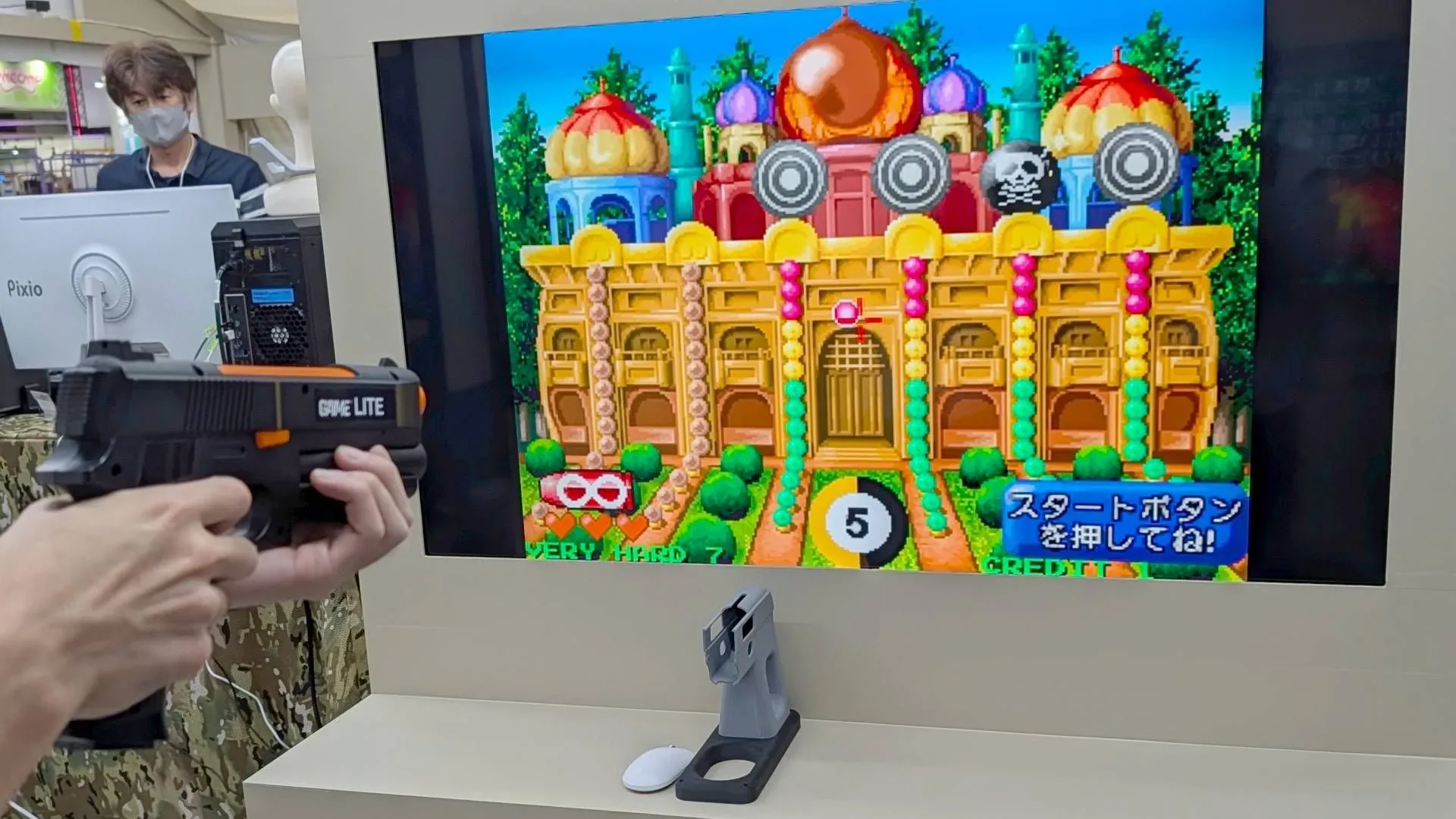
Tassei Denki has brought two new G’AIM’E lightgun concepts to Tokyo Game Show: the G’AIM’E Pro and G’AIM’E Lite. Both are technology demonstrations rather than finished retail products, and the company says they will not launch in their present form. Still, the prototypes reveal a notable change in direction for the modern-TV lightgun line.
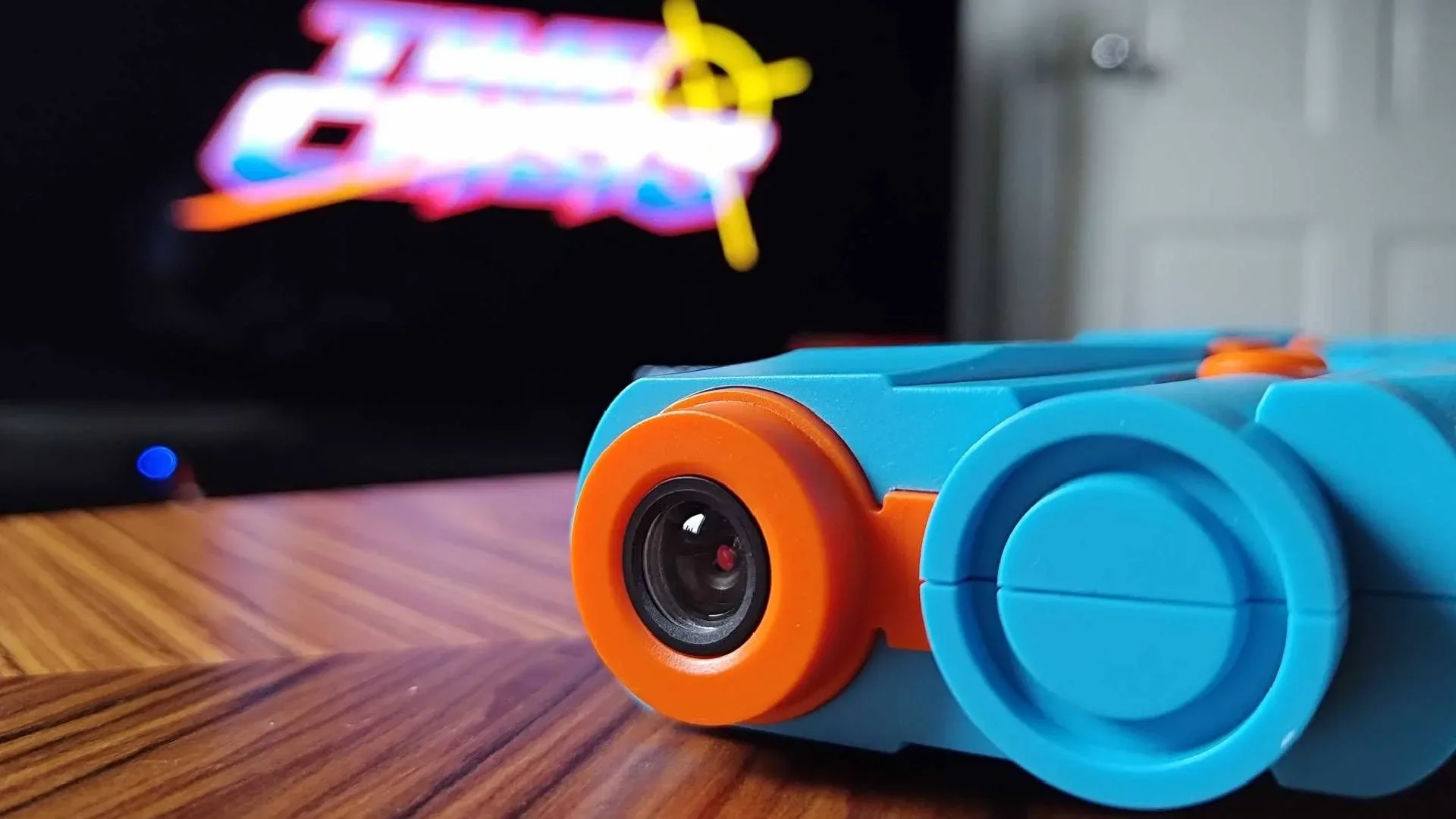
The prior G’AIM’E Time Crisis console used a camera-assisted system built into the gun. The Pro and Lite prototypes instead explore more conventional-looking approaches, with gyro controls central to the Lite and OpenFIRE-related technology indicated for the Pro. The distinction matters because it could determine whether G’AIM’E remains primarily a self-contained retro package or develops into a more flexible peripheral family for arcade-style games on contemporary hardware.
Two concepts, two different priorities
The Lite appears to be the more convenience-driven of the two. Its aiming is described as gyro-based, comparable in principle to motion sensing in a typical PlayStation controller. It also removes the camera-like component previously located in the barrel and replaces the integrated orange USB-C lead with what appears to be 2.4GHz wireless connectivity.
That combination suggests a deliberately simpler setup: no tether between player and console, and no Wii-style sensor bar positioned around the television. A gyro, short for gyroscope, measures rotational movement. In a controller, it translates how the player turns or tilts the device into on-screen movement. For a lightgun, that can make a modern flat-panel display act more like an aiming surface without relying on the old CRT-era method used by classic arcade and console guns.
There is an important caveat. Gyro controls can drift or become misaligned over time. The Lite prototype includes a reset button intended to recenter aim when that happens. In practical terms, players may need to point the gun at a reference position and reset it if the reticle no longer lines up with their physical aim. This is not necessarily a deal-breaker—recentring is common in motion-controlled hardware—but it is a meaningful part of the experience, especially in games built around rapid target acquisition.
Exactly how the Lite determines the edges or dimensions of the display remains unclear. Removing the gun’s camera component does not, by itself, explain how the prototype maps motion to a particular screen. The demonstration reportedly avoids an external light bar, but its screen-detection method has not been detailed. Until that information is confirmed, it would be premature to assume the Lite uses gyro data alone or that it will behave the same way across every TV and play space.
The Pro aims at accuracy and lower latency
The G’AIM’E Pro prototype has a more performance-oriented pitch. Unlike the wireless Lite, it retains a USB-C cable. Booth material frames it around accuracy and low latency, qualities that matter greatly to score-focused arcade players.
Latency is the delay between a physical action—pulling the trigger or moving the gun—and the resulting action on screen. In a lightgun game, low latency can affect both perceived responsiveness and a player’s ability to shoot targets quickly and consistently. A wired connection is often attractive in this context because it can avoid some of the potential timing and interference considerations associated with wireless systems. That does not prove the Pro will outperform the Lite, but it explains why the two concepts can coexist: one is pursuing convenience, while the other is positioned around competitive precision.
The Pro signage also points to the open-source OpenFIRE Light Gun project rather than an entirely proprietary in-house solution. Open source means the underlying project is developed in public, with code and technical work made available under its governing terms. For enthusiasts, that reference is potentially significant. Open projects can encourage experimentation and interoperability, but a prototype’s use of an open-source project does not by itself confirm final compatibility, support policies, setup requirements or a commercial release plan.
Current-generation PC support is also alluded to in the Pro display material. That possibility is among the most consequential details, but it remains only a possibility at this stage. There is no confirmed product specification, software list, platform list or release timetable. PC compatibility could involve a wide range of implementations, from supported native titles to particular configurations and drivers, so prospective buyers should treat the booth messaging as an indication of direction rather than a promise of plug-and-play support.
For the wider PC space, the news arrives as platform compatibility remains an active technical issue across games and devices. Valve has recently discussed how Half-Life: Alyx informed work on Steam Frame’s ARM compatibility, a separate example of how hardware ambitions can depend on software and input support being solved alongside the physical product.
Why modern TVs complicate lightgun design
Classic lightguns were closely associated with CRT televisions. Those older sets displayed images in a way that permitted traditional lightguns to identify where the screen’s scanning beam was at the instant a trigger was pulled. Modern LCD, OLED and similar displays do not operate in the same way, so old guns generally do not work directly with them.
That is why contemporary lightgun makers need an alternate tracking method. Different products can use cameras, visible screen borders, sensor bars, motion sensing or combinations of those approaches. Each route involves trade-offs:
- Camera-based systems can use visual information from the display, but may require calibration and careful conditions.
- Sensor-bar approaches add a physical reference point near the screen, which can improve tracking but introduces another item to position and power.
- Gyro aiming can reduce external hardware needs, though it may require recentering when drift occurs.
- Wired connections can prioritize consistent communication, while wireless connections favor easier living-room placement and movement.
G’AIM’E’s first Time Crisis-focused package used the camera-assisted route. It delivered an approachable bundled experience, but its scope was tightly defined: the console was tied to four included games and did not provide a way to add more. The new prototypes are therefore interesting not simply because their gun shells look different, but because their underlying technology may be part of an attempt to move beyond that closed, fixed-library model.
A possible move beyond a four-game box
The demonstration prototypes appear to use the same retro-style console box for now. But because the accessories and setup are explicitly not final products, the base hardware could also change before any release. That uncertainty is central to evaluating the news. A new gun attached to the same limited software ecosystem would answer one set of needs; a gun that can operate more broadly with PC software or future platforms would be a substantially larger proposition.
The Lite’s wireless design could preserve the appeal of a quick living-room arcade setup. The Pro, by contrast, may be the more revealing prototype because its emphasis on accuracy, low latency, OpenFIRE and possible PC use points beyond a simple all-in-one nostalgia device. Neither outcome is confirmed, and the two prototypes could eventually lead to products very different from what appeared at the show.
There are established alternatives employing other methods. The Sinden Lightgun uses a camera and a visible white border around the game image to identify the display area. The Intec Time Breaker uses a light-bar-like tracking setup and connects to PlayStation and PlayStation 2 hardware. These examples underline a basic fact about the category: there is no single universal method for making a plastic arcade gun behave naturally on a modern screen.
G’AIM’E’s prototypes should be judged in that context. A wireless gyro gun without a separate light bar could lower the barrier to putting on a quick session, provided its calibration and recentering prove dependable. A wired, OpenFIRE-adjacent model could appeal to players who value precision and want broader configuration options. But the final experience will depend on details that have not yet been announced: tracking hardware, supported displays, software compatibility, latency performance, calibration flow, final console relationship and whether either prototype becomes a consumer product at all.
What players should watch for next
For now, the responsible takeaway is cautious optimism rather than a purchase recommendation. The Pro and Lite are prototypes, no price has been announced, and no release date or final feature list has been provided. The most useful future information would be concrete rather than promotional: a clear explanation of each tracking method, confirmation of platforms and supported games, real-world calibration requirements, the role of OpenFIRE in the Pro, and whether G’AIM’E intends to expand beyond its current fixed game selection.
Those answers will decide whether this is a modest refresh of a Time Crisis-branded home package or a meaningful attempt to make modern-screen lightguns less niche. For a genre that depends on immediacy—the instinct to point, shoot and duck for cover—getting the setup out of the way may be just as important as getting the technology right.