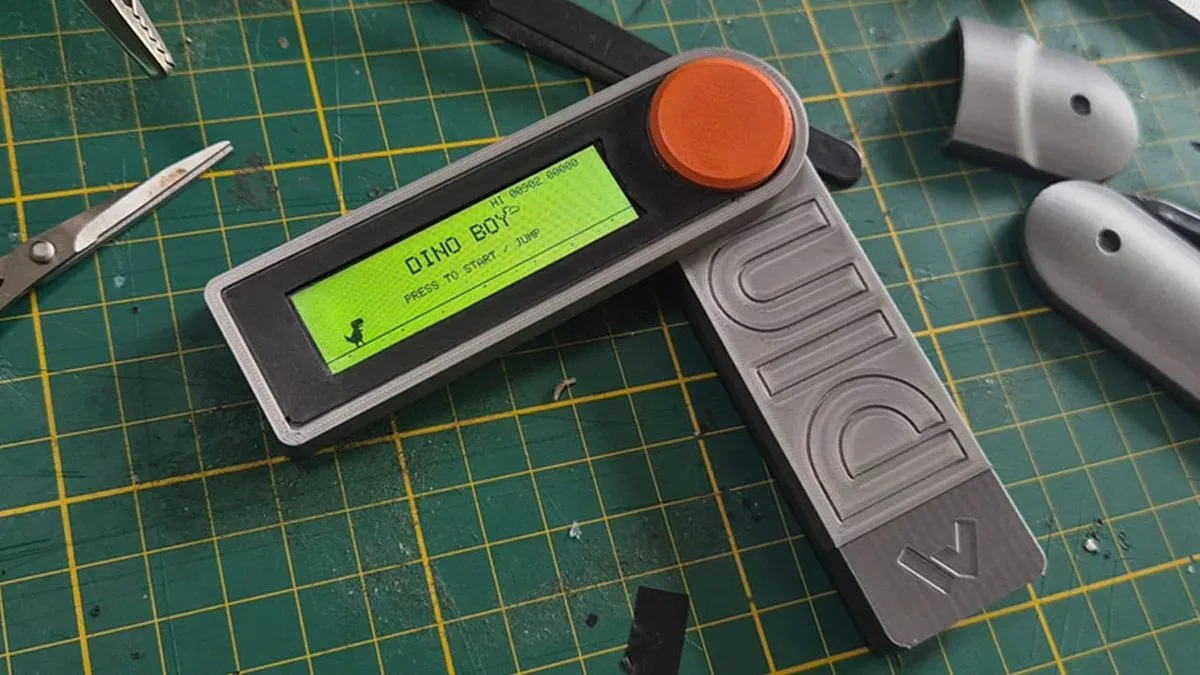
A handheld game does not need a full stick-and-button layout to make a persuasive case for itself. Dino Boy, a compact project created by Paul, reduces the experience to a single input and a familiar endless-running dinosaur game. It is a deliberately narrow idea: pick it up, press to clear obstacles, then put it down again. Yet the hardware design gives that simple premise a distinct personality.
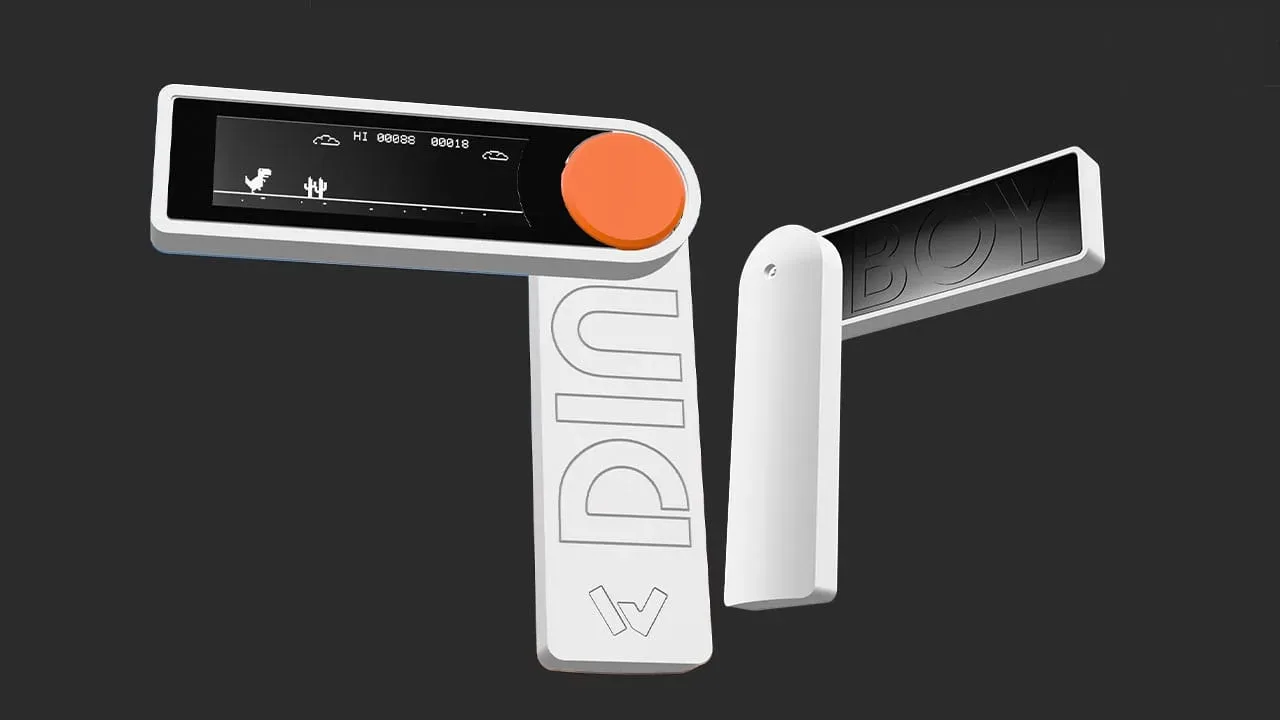
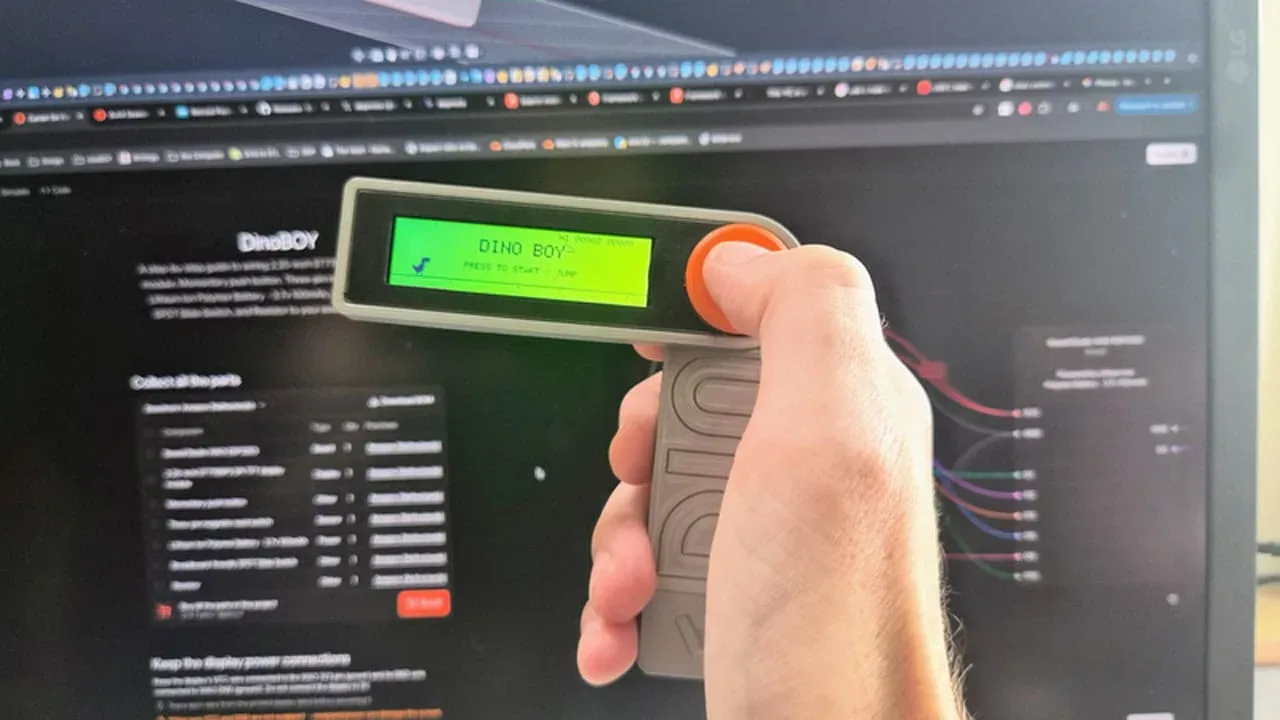
The device is intended to be used one-handed. Its screen flips up from a handle on a hinge, creating a roughly right-angled shape rather than the usual flat, horizontal handheld silhouette. The lone button is placed on the hinge section, where a user’s thumb naturally rests while the handle sits in the palm. In effect, the layout turns the physical act of holding the device into part of its purpose: an accessible, tactile object for tiny breaks rather than another general-purpose screen.
A familiar game, pared back to its essential action
Dino Boy runs the simple dinosaur game many people will recognize from the browser’s offline page. Its central interaction is especially suited to a one-button device: timely presses make the character jump over incoming hazards. There is no claim here that the handheld turns the game into a larger, feature-packed release. The appeal is the opposite. A format that is normally encountered incidentally becomes a standalone object with one job.
That makes the project a useful reminder of why a single-button game can still demand attention. “One-button” does not necessarily mean automatic or effortless. When an action has to be performed at the right instant, difficulty comes from timing, rhythm and anticipation rather than a long command list. One input also means there is almost no onboarding barrier. The player understands the basic control before the first obstacle arrives.
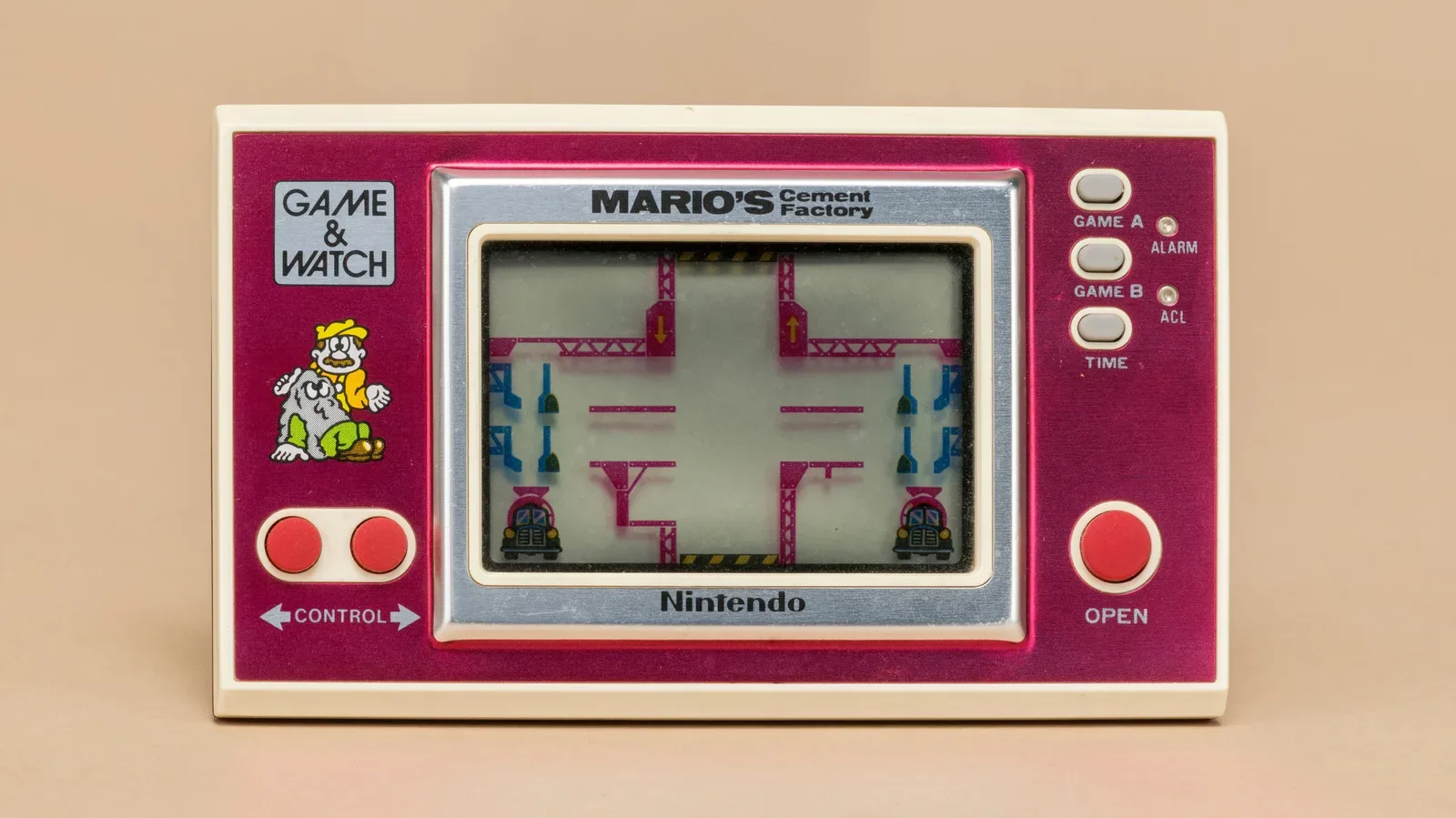
The design draws on the immediacy associated with older arcade games and early joystick-led systems, where a small control set could support quick, repeatable play. Dino Boy is not presented as a replica of a specific historic machine, however. Its design uses that stripped-back language for a contemporary object that is small enough to grab during everyday downtime.
Fold-out hardware built for the thumb
The hinge is the headline feature. Rather than merely serving as a way to close the device, it creates the relationship between display, hand and control. With the screen upright and the grip below it, Dino Boy resembles a small remote with a display perched at the top. The single button’s hinge placement appears chosen to avoid making the user stretch or change their grip every time they jump.
That kind of physical consideration matters more on a single-button machine than it might on a conventional handheld. A system with several controls can distribute a player’s hands across a familiar layout. Here, one button must be comfortable, easy to find without looking and satisfying to press repeatedly. The device’s creator describes it as both a retro gaming handheld and a mechanical fidget companion, so the feel of the object is as significant to the concept as the game itself.
Dino Boy also offers DMG-style and black-and-white play options. DMG is commonly used as shorthand for the original Game Boy model designation and, in a visual context, evokes that era’s monochrome portable-game presentation. The stated 1-bit style similarly refers to an image approach built around two color states rather than a broad color palette. On a game centered on a bold silhouette and clear obstacles, that limitation is aesthetically appropriate as well as readable.
Related coverage includes Dino Boy Turns Chrome's Running Dinosaur Into a One-Button Handheld.
Not just a game device: the phone-break idea
The more interesting ambition behind Dino Boy is not simply nostalgia. Paul frames it as an alternative to reaching for a phone when hands want something to do. The argument is that the urge behind habitual feed-checking has a physical component as well as a digital one: people may be seeking motion, a brief action and an immediate response. A dedicated object that offers a few seconds of play may satisfy some of that impulse without opening a feed built to keep the session going.
“Instead of fighting the urge to pick up a device, I wanted to build something that satisfied that urge without dragging you into the algorithmic abyss,” Paul said of the project.
That distinction is the key to Dino Boy’s identity. It is still a device, and it is still a screen, but it aims for a bounded interaction. A run ends, the player sets it down and the activity does not inherently lead to messages, alerts or another recommended clip. Whether a dedicated novelty handheld can materially change someone’s phone habits will vary from person to person, but the project’s constraint is meaningful: it offers a defined activity rather than an all-purpose portal.
There is an amusing tension in making a digital-detox companion that relies on technology, but Dino Boy does not claim to abolish technology. Its idea is to redirect a familiar behavior into a more intentional and limited ritual. The fold-out mechanism, physical button and focused game all support that approach. It is hard to accidentally turn a one-button dinosaur run into an hour of browsing.
The NFC shortcut and what it actually does
Dino Boy includes an NFC tag hidden inside the hardware. NFC, or near-field communication, is the short-range wireless technology used for tap-based interactions between compatible devices. Passing the handheld over a smartphone can trigger airplane mode, providing a playful “wand” gesture before a play session.
Airplane mode is a phone setting that disables wireless communications, though the exact behavior and which connections can later be re-enabled depend on the phone and its settings. In Dino Boy’s intended routine, the NFC interaction acts as a practical boundary: tap the handheld against the phone, limit incoming distractions, and use the focused game instead. It is an elegantly direct feature because it does not ask the player to browse menus before taking a break.
The device can also function as a desktop clock when it is not being used for games. That gives the upright display a purpose between sessions and reinforces the idea that it is designed to occupy a small physical space in daily life, not disappear into a drawer until a nostalgia impulse arrives.
What remains unknown
Dino Boy is compelling precisely because it is specific, but important details are still unconfirmed. There is no information indicating that the device will be manufactured for sale, nor is there confirmation that plans, files or instructions will be made available for others to build. Prospective buyers and makers should therefore treat it as a showcased concept rather than an announced product.
There are likewise no stated details on price, release timing, production quantities, battery life, display specifications or software expansion. It is also not known whether the project is meant to support anything beyond its featured dinosaur game and clock function. The absence of those details does not weaken the basic design exercise; it simply defines the current reality. Dino Boy is an intriguing custom handheld concept, not a retail promise.
For people drawn to portable hardware that celebrates a specific kind of play, its strongest feature may be that it resists feature creep. Modern handheld news often centers on larger libraries, more powerful chips and increasingly broad compatibility. Major dedicated gaming hardware can still thrive on a focused identity, but Dino Boy pushes focus to an extreme: one game, one button, one hand and a short interruption to the scroll.
That is enough to make the concept memorable. A hinge becomes a grip, a button becomes the whole control scheme, and an ordinary browser diversion becomes a physical desk companion. If Paul chooses to take Dino Boy further, the most important thing to preserve will be that clarity. The charm is not in promising everything a phone or mainstream handheld can do. It is in offering one small, tactile thing to do instead.