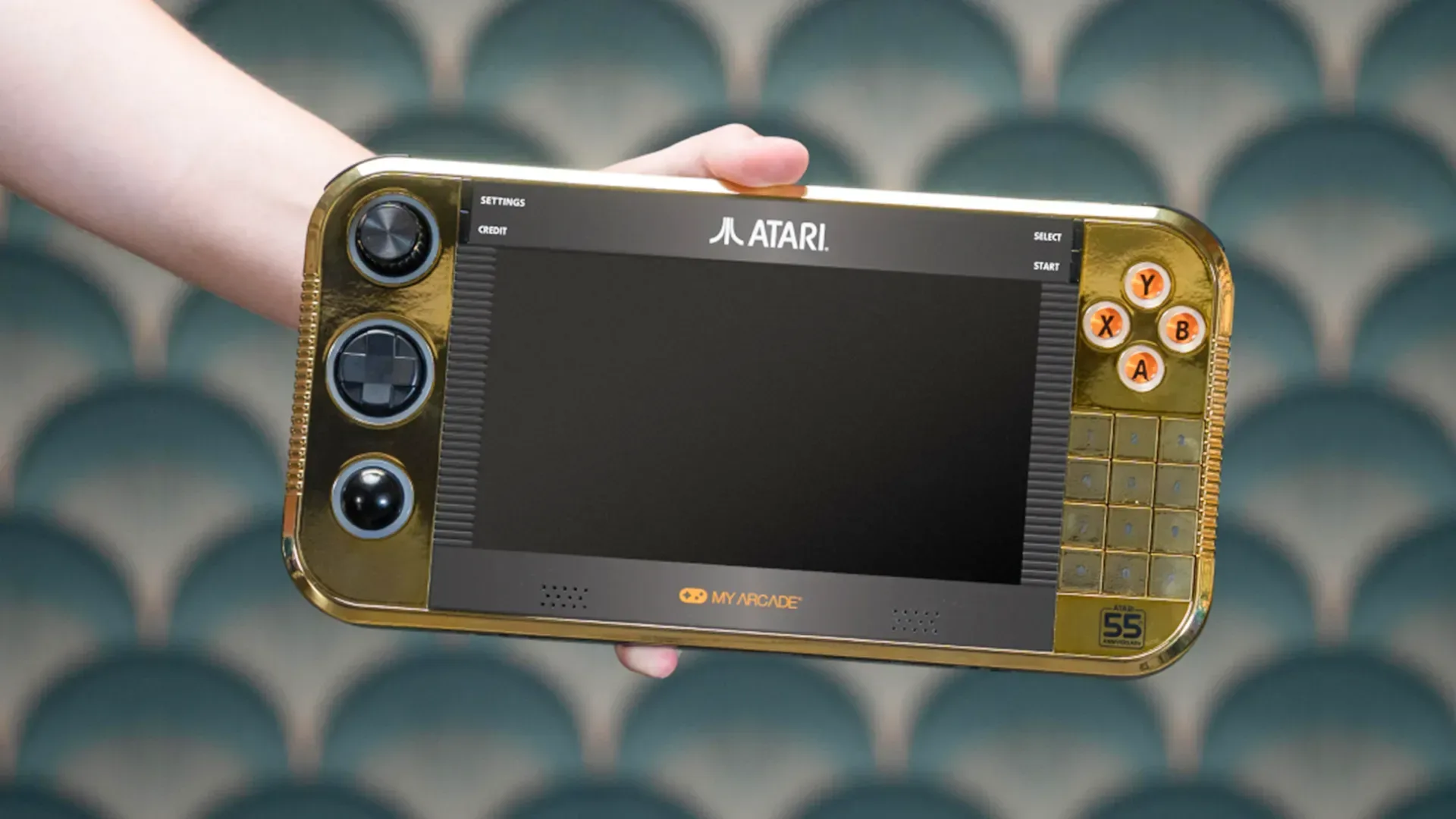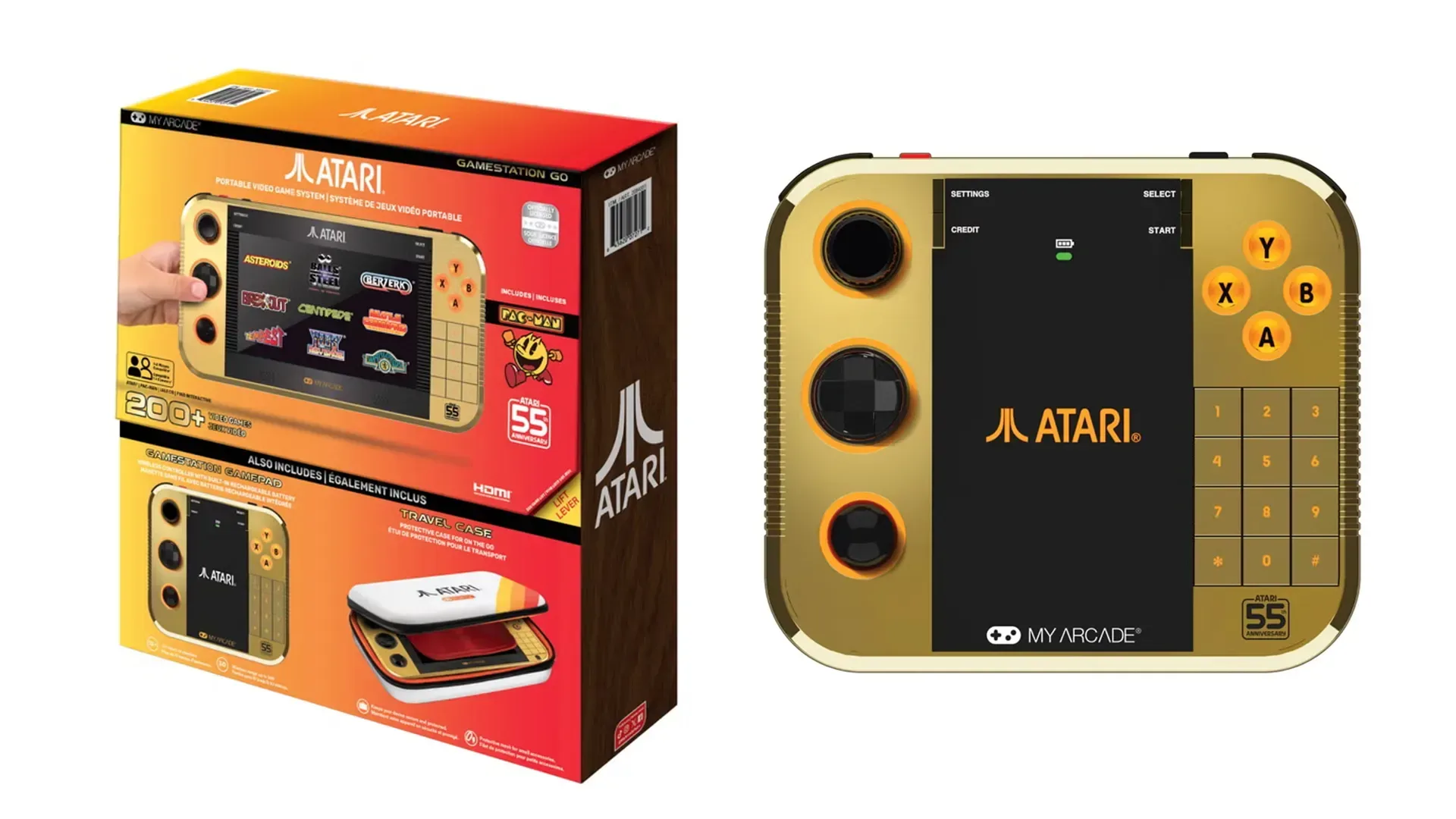
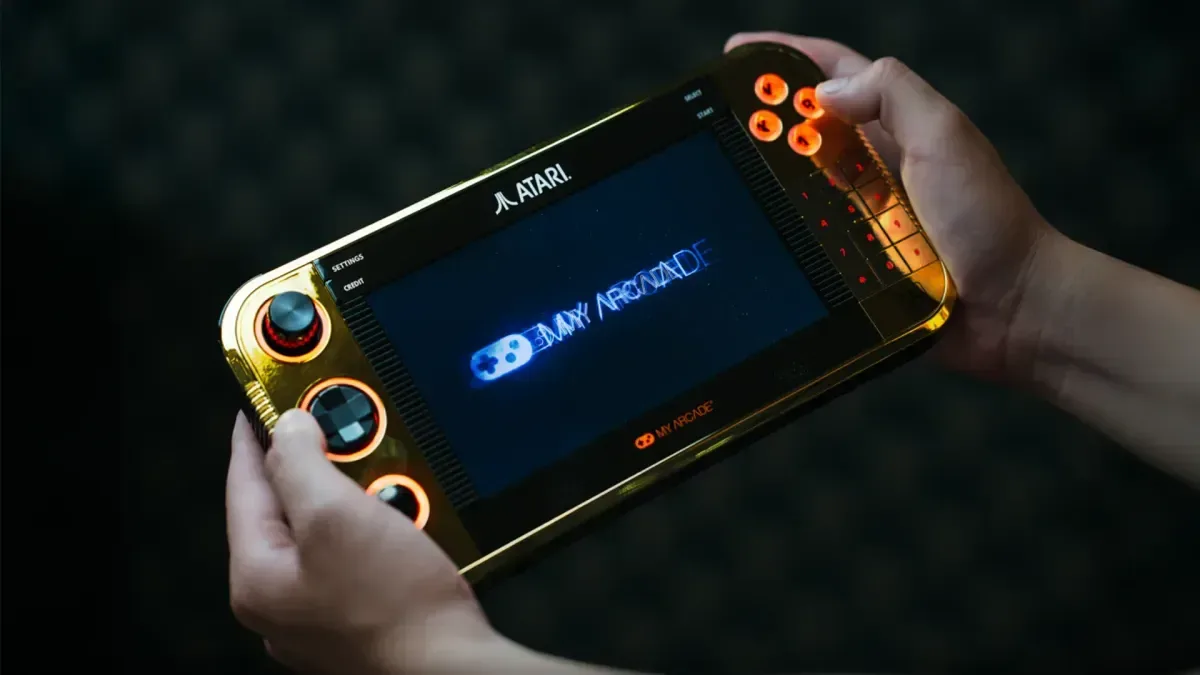
Atari is marking its 55th anniversary with a gold-finish version of the GameStation Go, a handheld made with MyArcade for players who want a self-contained way to play a large library of licensed Atari games. The GameStation Go Gold Bundle adds a matching Atari Gamepad and a protective travel case to the package, while retaining the original handheld’s most distinctive trait: controls intended to suit more than one era and style of classic game.
The bundle is exclusive to Costco. A price was not publicly provided alongside the bundle details, so prospective buyers will need to check Costco’s member-facing listing for current purchasing information. The gold treatment is paint rather than precious metal, which is probably for the best: nobody needs to be worrying about polishing their paddle controller between rounds.
What the Gold Bundle includes
The anniversary package contains three stated components:
- Atari GameStation Go handheld in a gold-finish colorway
- Atari Gamepad with the same gold-finish treatment
- Protective travel case
Its central appeal is aesthetic and bundled convenience rather than a newly described game library or an expansion of the hardware’s capabilities. For someone who already owns the standard GameStation Go, the meaningful differences presented here are the alternate finish, the included separate controller and the case. For someone entering the lineup for the first time, it is a complete, more display-ready package built around a specific retro catalog.
That distinction matters. “Gold bundle” can sometimes imply upgraded internals, a larger collection of software or premium materials. None of those changes have been specified here. The finish is explicitly not real gold, and the available details point to the same fundamental GameStation Go experience with extra hardware and accessories in the box.
A portable retro machine built around unusual controls
The GameStation Go is not positioned as a general-purpose handheld computer. It is a dedicated Atari machine with more than 200 licensed games built in. Its control layout is the part that separates it from a typical handheld that relies exclusively on a directional pad, analogue sticks and face buttons.
The device includes an integrated paddle, a trak-ball and a number pad in addition to its other controls. Those inputs are not merely decorative nods to old hardware. They address a practical problem with retro collections: games originally designed around specialized arcade or home controls can feel fundamentally different when translated to standard buttons.
What a paddle, trak-ball and number pad do
A paddle is a rotary input, generally turned left and right. It is associated with games where fast, finely controlled horizontal movement is the main action. A trak-ball is a rolling ball that reads movement across two directions; it can offer a more natural fit for games designed around quick, broad cursor-like movement. A number pad provides a grid of numbered inputs, useful where original controls used distinct selections or commands rather than a small set of multifunction buttons.
For a machine devoted to older games, these controls are a stronger argument than sheer processing power. They aim to preserve the relationship between the player and the game’s original design. A collection can have hundreds of titles, but a game that expects rotary or rolling input may not feel right if every command has been compressed into a conventional modern layout.
The included Atari Gamepad potentially broadens where and how the Gold Bundle can be used, especially when a player prefers a separate controller rather than holding the handheld. However, no further specifications have been provided for the gamepad’s connection method, supported modes or control layout beyond its inclusion in the package. It is safest to view it as an included accessory rather than assume functions that have not been detailed.
More than 200 games, but a fixed collection
The GameStation Go contains more than 200 licensed Atari games. Licensing is an important word in a retro product description: it indicates that the software collection is presented as officially authorized rather than as an open device relying on users to supply their own game files.
That approach brings a clear benefit. There is no described setup process involving file management, separate game acquisitions or configuring an emulator. The device is meant to be immediately usable as an Atari-focused library. The trade-off is equally clear: the library is fixed. There is no stated way to expand it with further games.
In practical terms, buyers should treat the included catalog as the purchase, not as a starter pack for an ever-growing handheld collection. Anyone whose goal is specifically an accessible, licensed set of Atari games may appreciate that simplicity. Anyone who wants to add titles, move between multiple platforms or tailor a library over time should recognize that this is not the purpose of the GameStation Go.
That fixed-library structure also separates the unit from a handheld emulator. An emulator is software or hardware that recreates the behavior of another system so that compatible software can run on it. Open handheld emulator devices can offer flexibility, but they commonly require users to manage their own software, settings and legal responsibilities. The GameStation Go’s value proposition is nearly the opposite: a curated Atari machine with licensed games already included, specialized controls and no stated expansion path.
Who the anniversary edition makes sense for
The Gold Bundle is most straightforward for a few groups of players. The first is an Atari enthusiast who wants a portable device that does not ask them to assemble a library or map every game to generic controls. The second is a gift buyer looking for a packaged solution with a handheld, controller and case already accounted for. The third is someone who sees the gold finish as part of the point: an anniversary version meant to feel more celebratory than a standard black-or-neutral piece of electronics.
It is less persuasive as an upgrade for a standard GameStation Go owner who only wants new games or a technical overhaul. Neither has been announced as part of this bundle. The appeal is in presentation and accessories, not a newly described platform revision.
Buyers should also keep expectations centered on the device’s known constraints. A prior evaluation of the GameStation Go landed at 6.7 out of 10, and display quality was identified as an area of concern. The Gold Bundle announcement does not describe a display change, so there is no basis to assume that the anniversary edition addresses that point. Nor are new display specifications provided.
Questions worth answering before purchase
Since price information was not publicly supplied in the bundle details, comparison shopping is more complicated than it should be. Costco exclusivity may also affect access depending on a shopper’s membership and region. Before buying, it is sensible to verify the current listing, price and any retailer-specific terms directly through Costco.
It is also worth deciding whether the included accessories solve a real need. The protective case has obvious practical value for a portable system. The separate gamepad may be particularly useful for buyers who expect to play away from the handheld’s built-in controls. But if the standard GameStation Go is already on hand and portability is the sole priority, the bundle’s extras may be less essential than the anniversary styling suggests.
Players who are instead comparing a dedicated retro machine with a broader computer purchase should separate those decisions rather than treat them as interchangeable. A fixed, licensed Atari library and specialized retro controls serve a different purpose from a PC built for current software; our look at the Alienware 16 Aurora’s pricing trade-offs illustrates how general-purpose gaming hardware has its own set of compromises. The GameStation Go is deliberately narrower in scope.
An anniversary package, not a reinvention
Atari’s GameStation Go Gold Bundle leans into the strengths that already define the handheld: a substantial built-in licensed Atari catalog and a control scheme designed for games that were not all made with the same controller in mind. The gold finish, matching gamepad and travel case make it a more complete anniversary package, while Costco exclusivity gives the release a limited retail route.
The key caveat remains just as important as the feature list. This is a closed Atari-focused device, not an expandable all-purpose retro handheld. Buyers who want that focused, ready-to-play format may find the bundle’s specialized inputs and included accessories compelling. Buyers looking for a better screen, a library that can grow or an all-platform emulation solution should not mistake a celebratory coat of paint for a change in mission.