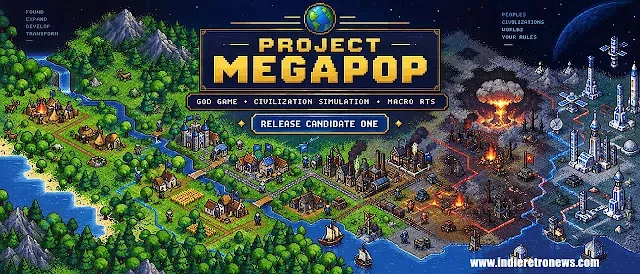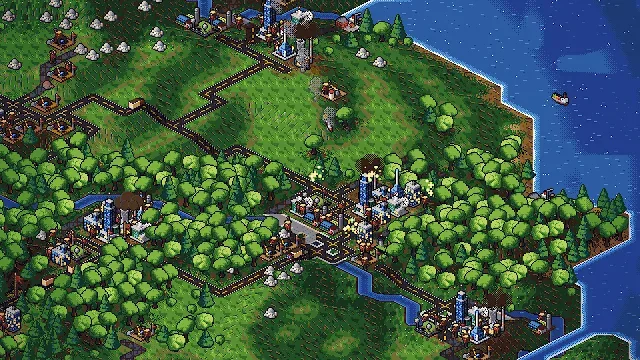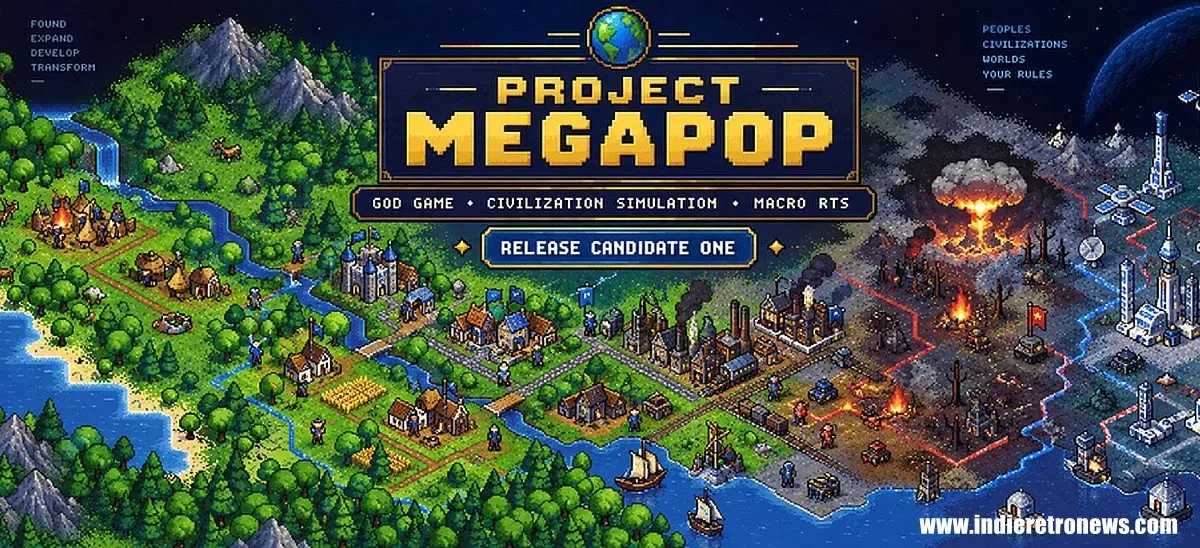
PROJECT MEGAPOP is a browser-based god game from solo developer D.B. Waldtier, built around a deliberately macro-scale form of strategy. Its stated touchstones are Amiga 500 classics Populous and Mega-lo-Mania, while its own pitch centres on a pixel-art world where a population carries out the everyday work without constant direct orders from the player.
That means the central question is not simply which unit to select next. Followers in PROJECT MEGAPOP are described as independently farming, mining, researching and fighting. The player’s role is to influence the conditions around them: reshape the land, set broader societal priorities and spend worship-derived power on supernatural interventions.
It is a potentially appealing setup for strategy players who enjoy watching systems interact as much as they enjoy issuing precise commands. A population that has its own jobs and behaviours can turn each change to terrain or policy into a wider chain reaction. At least in concept, the player is less a field commander and more an unpredictable deity with a landscaping problem—and, presumably, a civilization that may take a very dim view of surprise mountains.
A strategy game about influence rather than micromanagement
“Macro” strategy is a useful term here. In a micromanagement-heavy game, players commonly direct individual people, squads or buildings one action at a time. PROJECT MEGAPOP instead presents followers as autonomous. They perform core activities on their own, while the player makes higher-level decisions that can alter the environment and the direction of the society.
The distinction matters because it changes what counts as a good decision. Rather than focusing solely on rapid unit commands, the player is encouraged to think about the terrain beneath a settlement, the larger priority a society should pursue, and when an extraordinary power is worth deploying. These are interventions intended to affect many followers or the conditions they face, rather than instructions for a single worker.
Terrain manipulation is especially central to the god-game identity described for PROJECT MEGAPOP. Land is not just scenery in this model. If followers farm, mine, research and fight across the map, the shape of that map can be part of the strategy itself. Changing terrain may affect how a developing society operates, although the available information does not detail specific rules, resources, victory conditions or individual powers.
Societal priorities provide another layer above the day-to-day simulation. The description establishes that players can adjust them, but does not specify the menu of priorities or exactly how citizens respond. The important point is the intended hierarchy of control: followers make operational decisions, while the player steers the civilization’s broader direction.
Worship as a strategic resource
PROJECT MEGAPOP also ties its supernatural actions to worship. In practical strategy-game terms, this sounds like a resource loop: a player’s population supplies or enables divine power, and that power can then be used to influence the world. The source material does not say how worship is generated, how quickly it accumulates, or what individual abilities cost. Those details should not be assumed.
Even so, the idea clearly supports the game’s god-game framing. Worship is more than a thematic flourish when it fuels powers; it makes the population’s status relevant to a player’s ability to intervene. A strong society may offer more scope for dramatic action, while a struggling one could leave the player with fewer options. That is an interpretation of the described loop, rather than a confirmed description of its precise mechanics.
For players, the likely appeal is the tension between patience and intervention. If a society is autonomous, immediately solving every apparent problem may not be the point. The interesting choice may be deciding whether to alter the landscape, redirect a collective priority, preserve worship for a larger moment, or allow the simulation time to respond on its own.
Amiga-era inspiration, expressed through pixel art
Waldtier grew up with the Amiga 500, and PROJECT MEGAPOP’s influences are explicitly linked to two games associated with that era: Populous and Mega-lo-Mania. The reference is informative not because it promises a replica of either game, but because it signals a preference for strategy viewed from above the individual unit level.
Populous is synonymous with the god-game idea: influence a world and its inhabitants rather than merely commanding a conventional army. Mega-lo-Mania, meanwhile, is invoked as another classic strategic inspiration. PROJECT MEGAPOP combines that lineage with pixel-art presentation and a browser format.
Pixel art can carry a retro visual vocabulary without requiring a game to imitate every limitation or design convention of older hardware. Here, it sits alongside what is described as a comparatively deep simulation. That pairing is significant: the project is not presented only as nostalgia, but as a modern browser game using a familiar visual style and an autonomous-population premise.
For readers following smaller strategy projects, the browser angle is worth noting on its own. A browser-based game removes the need to frame the experience around a dedicated console or traditional desktop storefront in the information provided. No further details about supported browsers, monetization, save systems, input methods or release structure have been established, so prospective players should avoid reading those assumptions into the format alone.
What “AI-assisted” does—and does not—tell us
PROJECT MEGAPOP is described as AI-assisted, but that label needs careful handling. It identifies an aspect of the project’s creation, yet the supplied details do not explain which tools were used, what work they supported, or whether any AI system is involved in the game’s live simulation.
That last distinction is important. In game development, “AI” can refer to several very different things. It may mean generative tools used during development, traditional programmed behaviour controlling non-player characters, or a broader marketing description. The autonomous followers described in PROJECT MEGAPOP have behaviours such as farming, mining, research and combat, but the available information does not provide technical detail about how those behaviours are implemented.
So the safest reading is straightforward: AI assistance is part of how the game is characterized, while the player-facing design is an autonomous-society god game. It would be inaccurate to infer a particular development workflow, generative content system or advanced simulation technique from that phrase alone.
The terminology has become especially relevant as game makers discuss where assisted tools may fit into production. A separate discussion involving veteran creators has similarly stressed that such tools can accelerate prototyping without replacing the human work of forming an idea; that broader debate over AI and game prototypes provides useful context, though it does not add specific technical claims about PROJECT MEGAPOP.
Why the hands-off population model could stand out
Autonomy can give a strategy game a different rhythm. When workers and fighters are directly controlled, success often rests on execution: selecting the correct group, assigning a job and reacting quickly. When citizens act independently, the player instead evaluates outcomes and adjusts the rules or landscape that shape future actions.
That can make successes feel emergent. A player may recognize that a change to the land or a new societal emphasis created better conditions for the population, even if no one follower was manually assigned the result. It can also make setbacks feel more consequential, because a decision may echo across farming, mining, research and warfare rather than remaining isolated to one unit.
Of course, autonomy also creates a design challenge. Players need enough clarity to understand why their society is behaving as it is, otherwise high-level choices can feel detached from the result. The project is described as having deep simulation mechanics, but there is no information yet about its interface, feedback systems, tutorials or how clearly it communicates followers’ decisions. Those will be meaningful practical considerations for anyone evaluating how accessible the macro approach is.
For now, the clearest picture is of a solo-made browser strategy game with retro inspirations and a purposefully broad player role. PROJECT MEGAPOP asks players to guide a self-operating people through environmental changes, social direction and worship-powered acts, rather than treating every resident as a piece to be moved by hand.