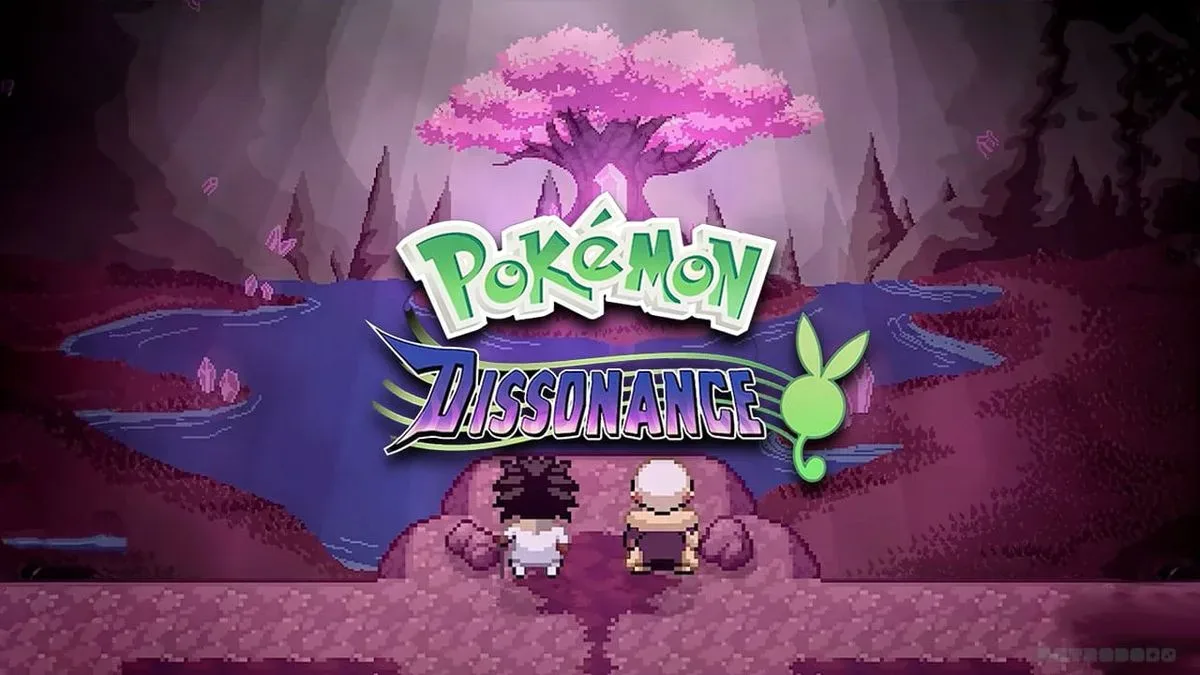
Pokémon Dissonance has surfaced with its first teaser, outlining a fan-made adventure that appears determined to challenge some of the series’ most familiar assumptions. The brief video presents a pixel-art world with a GBA-era visual foundation, but its setting, themes and stated structure point toward something substantially different from a conventional badge-collecting journey.
The most immediate departure is a major one: Team Dissonance says the game will have no starter Pokémon and no Gyms. Those two ideas have traditionally supplied the opening choice and much of the forward momentum in many Pokémon adventures. Their absence does not explain exactly how Dissonance will structure progression, but it establishes the project’s intent clearly. This is being framed as a more story-led experience about choosing a path rather than following a pre-set competitive circuit.
That focus comes through in the teaser’s voiceover, which considers the appeal of pursuing dreams while asking what people may have to give up to achieve them. In the context of the footage, the question is not merely decorative atmosphere. It is tied to a region depicted as worn down and unequal, with streets covered in rubbish and Pokémon shown resting on pavements, searching through bin bags or being put to work.
The footage is a teaser rather than a full explanation of the plot, so its scenes should not be treated as a complete account of the game’s story or systems. Still, they indicate a world where the relationship between trainers, Pokémon and ambition may be central to the narrative.
A familiar pixel-art language, used for a different kind of region
Visually, Pokémon Dissonance draws on the compact, top-down pixel-art look commonly associated with Game Boy Advance-era Pokémon games. “GBA-inspired” describes an aesthetic approach rather than confirmation that the project is made for, or will run on, original Game Boy Advance hardware. The teaser’s use of colour and scene composition gives its fantasy setting an identity that is notably more distressed than the bright routes and tidy towns typically associated with the series.
The contrast matters because pixel art can communicate far more than nostalgia. The teaser uses its streets, discarded rubbish and character placement to make the region feel inhabited by people and Pokémon under pressure. Rather than serving only as background decoration, the condition of the environment appears to support the game’s larger concern with aspiration and sacrifice.
One particularly conspicuous visual is a strange pink tree. Its precise role has not been revealed, and it is too early to assign it a lore function. For now, it stands as one of the trailer’s deliberately unresolved images: a potentially significant landmark in a setting that seems to be withholding as much as it shows.
Black African and Caribbean references are part of the project’s stated identity
Team Dissonance has said that Pokémon Dissonance will include numerous references to Black African and Caribbean culture. That commitment is one of the clearest pieces of creative context attached to the game so far, and it suggests the team is aiming for more than a visual remix of familiar Pokémon conventions.
Related coverage includes Pokémon Dissonance Teaser Promises a Darker, Story-Driven Fan Adventure.
Culture in a role-playing game can shape the texture of nearly every part of a world: the places players travel through, how communities are represented, the imagery used in its mythology and the questions its story chooses to ask. The teaser alone cannot show the scope or quality of those elements, but the team’s stated direction gives Dissonance a foundation distinct from a standard fan region built around familiar genre landmarks.
That is especially relevant to a project positioning itself as story-driven. If Dissonance is about finding an individual route through a world that expects people to pursue the same version of success, its cultural influences may be integral to its setting and themes rather than a cosmetic layer added around a typical Pokémon campaign.
What “story-driven” means here
Story-driven does not necessarily mean that player choice will branch the plot, nor does the teaser confirm how battles, exploration or party building will work. In this case, it means the project is explicitly emphasizing narrative purpose: a protagonist trying to find their own way in a society that applies pressure to conform.
The removal of starters and Gyms supports that pitch. In a traditional Pokémon structure, selecting one of three early partners establishes a player’s first tactical identity, while Gyms create clear, ordered milestones. Removing both could allow the game to introduce partners, challenges and goals in ways that are more closely tied to the story. That is an interpretation of the design direction, not a confirmed feature list; Team Dissonance has not yet detailed the replacement progression loop.
The project also plans to include voice acting. For a pixel-art fan game, voiced dialogue can be a useful storytelling tool, giving dramatic scenes and key characters a more direct presence than text alone. It also raises practical questions that the teaser does not answer, including how extensively voices will be used and in which parts of the game. Those details will need to wait for future material.
For fans interested in other Pokémon developments with a very different emphasis, Pokémon Pokopia’s Dazzling Decorations DLC shows how broad the franchise’s adjacent projects can be, from customization-focused additions to Dissonance’s darker narrative premise.
What the teaser confirms—and what remains unknown
The first look provides a useful outline, but not a full production roadmap. Here is the current picture:
- Confirmed by the project’s presentation: a GBA-inspired pixel-art style, no starters, no Gyms, a story-led premise, planned voice acting, and Black African and Caribbean cultural references.
- Shown in the teaser: a visibly dilapidated setting, Pokémon in difficult circumstances, and imagery that reinforces the story’s concern with dreams and sacrifice.
- Not yet provided: a release date, target platforms, a detailed account of battle and progression systems, or an explanation of the pink tree and the broader plot.
That distinction is important for a new fan project. A teaser can effectively establish tone and ambition, but it cannot answer every question about the finished game. There is no release window at present, so prospective players should regard Pokémon Dissonance as a project to watch rather than a game with a confirmed launch plan.
Even with that uncertainty, the pitch is unusually clear. Pokémon Dissonance is not using its retro-inspired presentation solely to revisit an old formula. Its early material points to a region shaped by social strain, an interest in cultural specificity, and a story that interrogates the price of ambition. Whether its final systems fully deliver on those ideas remains to be seen, but the teaser has given the project a distinctive identity from the outset.