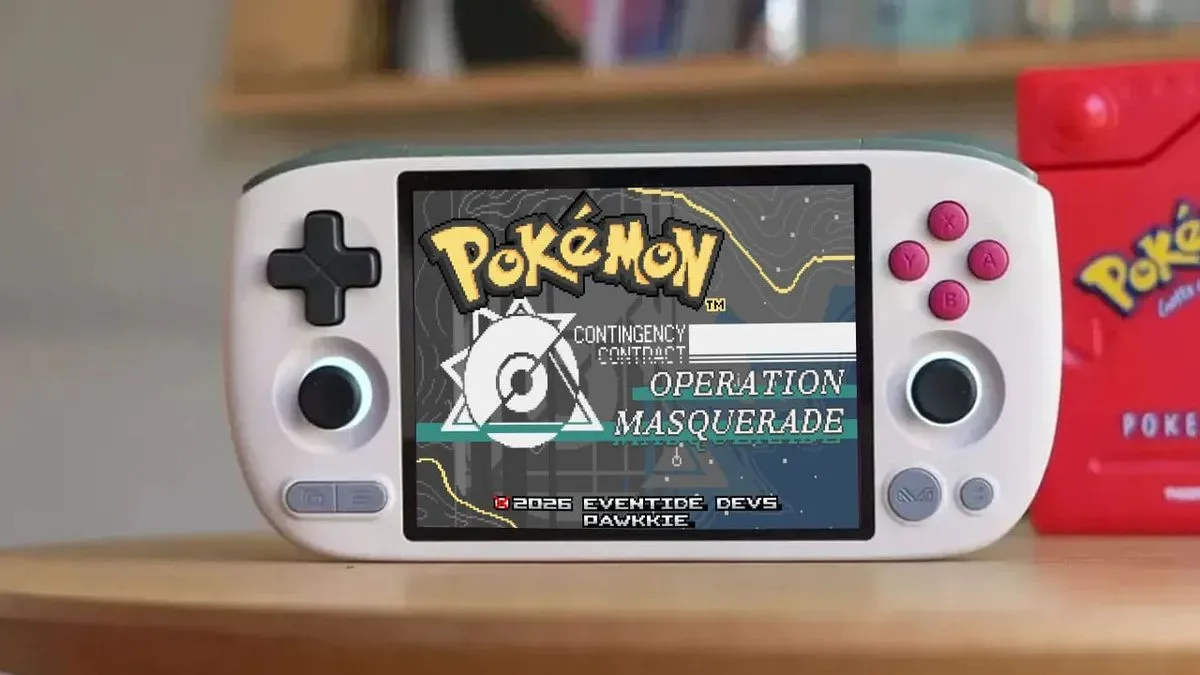
Pokémon CC: Operation Masquerade takes the familiar foundation of Pokémon Emerald in a markedly less familiar direction. Rather than positioning its player character for a standard regional journey, the hack puts Tiana into a sequence of demanding trainer gauntlets with only a limited number of Pokémon at her disposal. Its central inspiration is Arknights, specifically that game’s Contingency Contract mode, and the result is designed around choosing constraints, tuning a team and chasing stronger scores.
That premise matters because it shifts the usual Pokémon role-playing loop. The supplied description does not frame Operation Masquerade as a conventional badge quest, a broad exploration adventure or a straightforward remake. It frames it as a challenge-led experience: players establish battle modifiers, customize their Pokémon and work through tense encounters. In a game where the roster begins small and trainers arrive in gauntlets, every team choice can carry more weight than it would in a sprawling adventure built around gradual collection and progression.
A challenge format built on modifiers
“Battle modifiers” are the key term in Operation Masquerade’s pitch. A modifier is a rule or condition layered on top of a battle that changes the circumstances under which it is played. The available information does not specify the individual modifiers in this hack, so it would be premature to assume particular penalties or bonuses. What is clear is that selecting them is part of the intended structure, not a peripheral option.
That connects directly to the Contingency Contract influence. Within the context provided, the important idea is a configurable challenge format: instead of approaching a fixed encounter exactly as authored, players set conditions and then try to meet the resulting challenge with an optimized team. Operation Masquerade applies that philosophy to Pokémon battles and attaches it to high-score play.
High-score systems can change the question players ask before a fight. Winning remains essential, but the format encourages consideration of how a team is built for a particular set of conditions. A successful group may be one that can endure a run of trainers, answer a specific tactical problem, or make the best use of the Pokémon and items currently available. The hack’s stated emphasis on customization makes this planning a core part of the experience.
Because the opening situation gives Tiana only a small number of Pokémon, the project’s challenge structure appears deliberately focused. There is less room to treat every battle as something that can be solved by endlessly expanding a team. That does not tell us exactly how progression, encounters or score calculations work; those details have not been provided. It does establish a clear design intention: make the player engage with scarcity, preparation and escalating trainer battles.
A convention setting with credits to spend
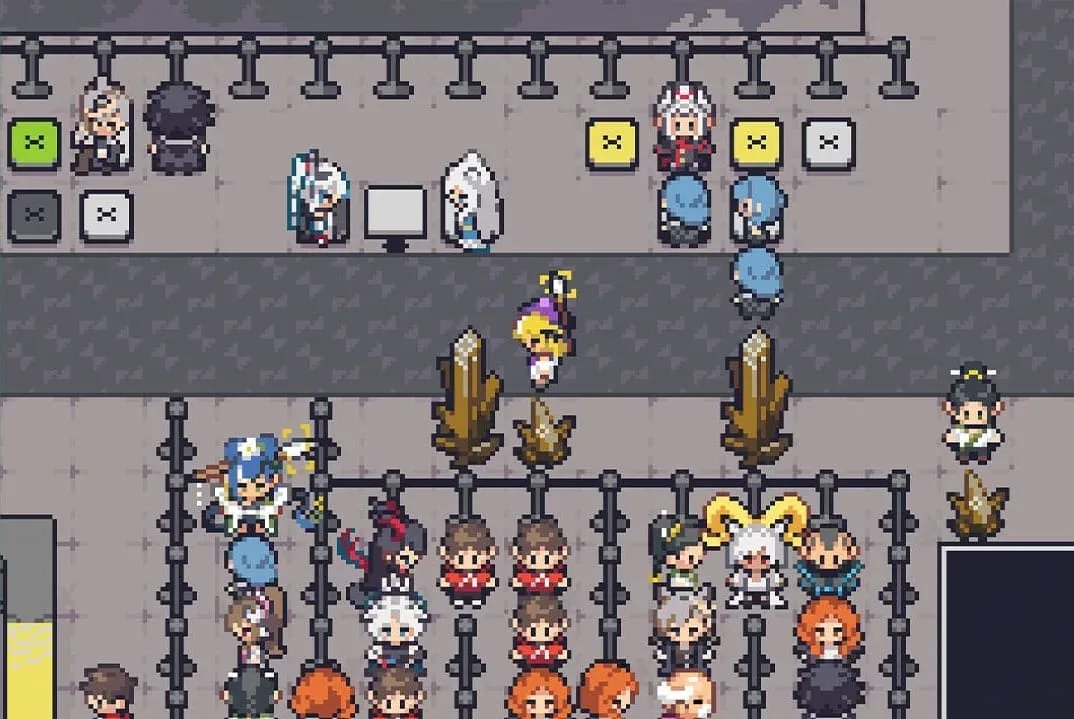
Operation Masquerade is set at a convention, an unusual backdrop for a Pokémon hack and a setting that supports its arcade-like score-chasing angle. The game lets players use credits in the convention environment, with the description likening the activity to spending money at a seaside arcade. Credits are earned in-game, then can be gambled for new items and Pokémon through the project’s gacha system.
Gacha is a randomized reward system: the player spends a currency for a chance to receive an item, character or, here, a Pokémon. The supplied material explicitly describes gambling credits for potential rewards, so the randomness is not merely cosmetic. It is part of the game’s progression and team-building loop.
Related coverage includes Pokémon CC: Operation Masquerade Turns Emerald Into a High-Stakes Trainer Gauntlet.
That makes credits an important strategic resource in concept, even though the precise rewards, odds and credit-earning rules are not detailed. A player is not only arranging a battle party and choosing modifiers; they are also deciding how to engage with a reward system that may expand the tools available for later gauntlets. The convention framing gives this mechanic a diegetic home rather than leaving it as an unexplained menu feature.
Randomized progression systems are often a major talking point in games because they affect predictability and player agency. In this case, the gacha element is openly presented as part of the Arknights-inspired identity rather than an accidental resemblance. Anyone interested in how other games handle gacha and progression discussions can also read our coverage of player questions around gacha and progression systems. Operation Masquerade’s approach should be considered on its own terms, however: it is a fan-made Emerald patch with credits, convention activities and trainer gauntlets at the center of its stated loop.
Custom art and scripting separate it from a standard Emerald run
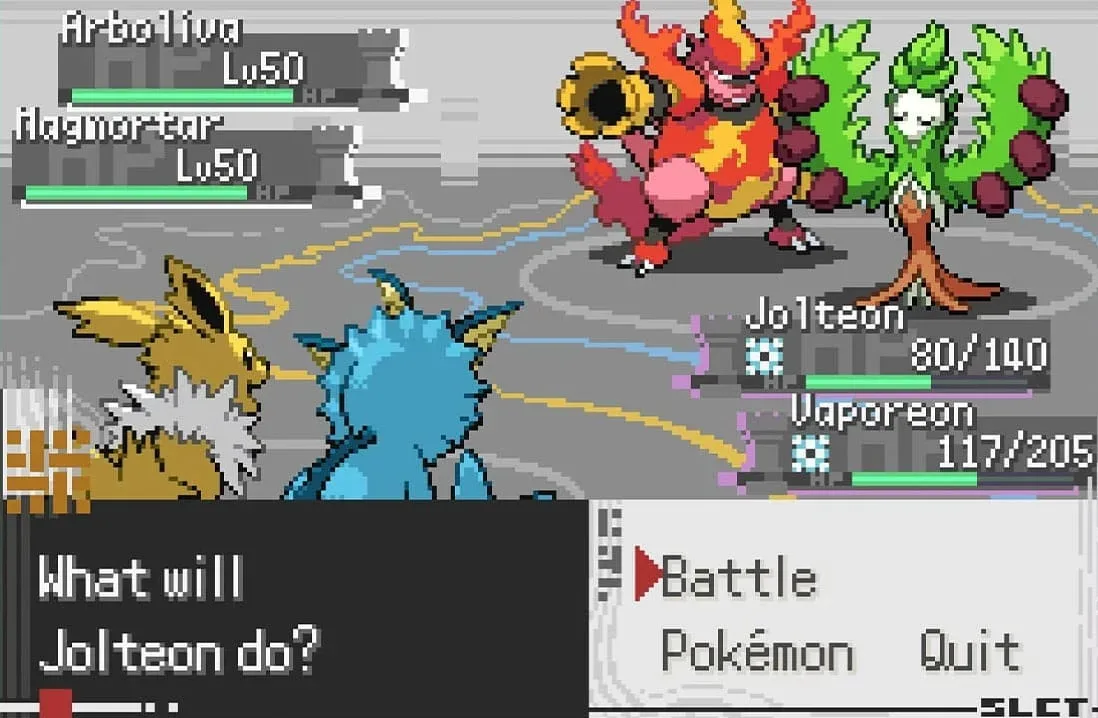
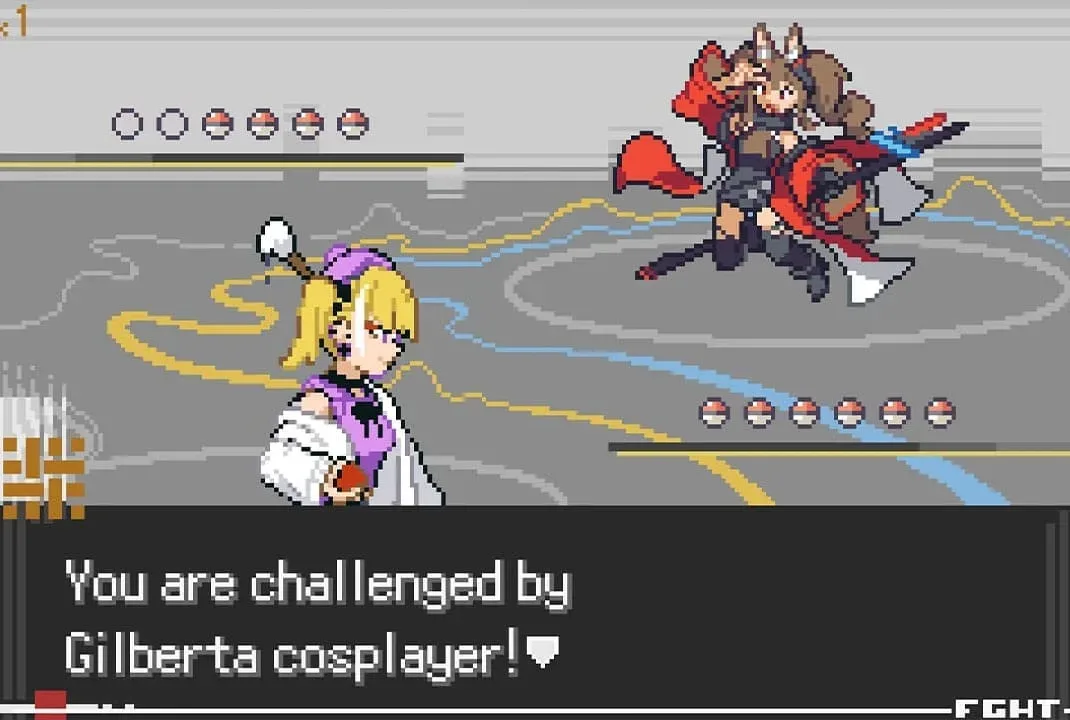
The project’s presentation is not limited to rearranging existing Pokémon Emerald material. Its creators—Turtleye, hedara and Pawkkie—have drawn the overworld, menu screens and the details of the battle interface from scratch. That is a significant creative commitment for a ROM hack, particularly when the visual work extends across both exploration-facing screens and the battle UI players will repeatedly use during challenge runs.
Overworld refers to the playable spaces outside combat: the areas in which a player moves through the setting and accesses its activities. Battle interface, or battle UI, means the visual layer used to read combat information and select actions. Reworking both lets a project communicate its own identity before players even reach its systems. Here, the handmade presentation helps align an Emerald base with a convention-centered, Arknights-inspired challenge game.
The team has also described the project as having an unusually large amount of scripting for the size of its map. In ROM-hack terms, scripting generally means the programmed event logic behind interactions, scenes, systems and conditional behavior. The statement does not provide a count of scripts or a map size, so neither can be measured from the available information. But it does signal that the project’s ambition is located in bespoke systems and encounters, not simply geographic scale.
That distinction is useful for prospective players. A compact map is not necessarily a small game in mechanical terms. When a hack centers modifiers, score pursuit, credit spending, customized menus and a new reward loop, a large amount of its work may happen beneath or around the familiar turn-based battles. Operation Masquerade appears to be aiming for that denser kind of redesign.
What players need to use the patch
Operation Masquerade is distributed as a patch for Pokémon Emerald, not as a standalone copy of the original game. Players need a legally acquired Pokémon Emerald ROM and must apply the Operation Masquerade patch to it. The patch is available through Hackdex.
This distinction is practical as well as legal. A patch is a file containing changes that are applied to an appropriate base ROM; it relies on the original game data rather than replacing the need for it. Anyone considering the hack should therefore make sure they have their own lawful Emerald copy before attempting to patch it.
Why the concept stands out
Pokémon fan projects often invite attention by revisiting a familiar game with a new region, story or difficulty curve. Operation Masquerade’s hook is more structural. It takes a Pokémon Emerald base and applies an Arknights-inspired challenge format where selected modifiers, restricted initial resources, trainer gauntlets and scores form the backbone of play. Then it reinforces that structure with a convention setting and a credit-based randomized reward system.
Its visual work and scripting claims add another layer to that identity. Newly drawn overworld elements, menus and battle-interface details suggest a project that wants to feel distinct rather than merely difficult. For players looking for a traditional Emerald replay, the gacha-driven convention format may be a sharp departure. For those who enjoy deliberately constructed challenge runs and team optimization, that departure is exactly the point.