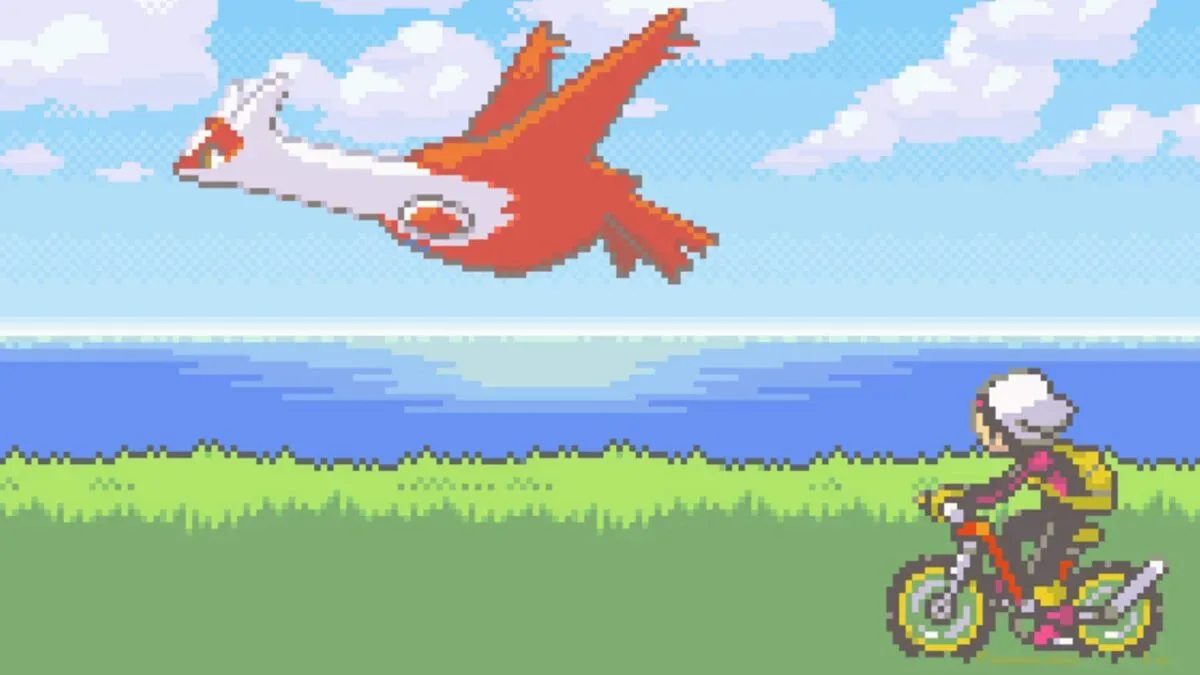
A brief clip of Pokémon Ruby and Sapphire has prompted a familiar Pokémon community pastime: examining every pixel like it is a rare encounter with a one-percent spawn rate. The footage, shared on X by the Pokémon Times account, shows Wingull Peeko following Mr. Briney—and it appears markedly cleaner and more colorful than the low-resolution presentation people expect from original Game Boy Advance-era material.
That visual difference is the entire basis of the current theory. Fans are wondering whether the footage could be from an unannounced Nintendo Switch release of the third-generation games, rather than an old recording or another form of capture. It is a reasonable question to ask, but it remains speculation. No release, date, platform listing, or official confirmation for Pokémon Ruby, Sapphire, or Emerald has been provided alongside the clip.
Why one short video has drawn so much attention
The shared scene is not an especially obscure moment: Peeko, Mr. Briney’s Wingull, is a recognizable part of Ruby and Sapphire’s early journey. What viewers noticed was the image quality. Comments quickly focused on unusually sharp output and vivid color, with some reading the footage as evidence that the game was running through a modern official presentation rather than being pulled from an older asset.
That distinction matters because the original games were made for Game Boy Advance hardware. When material from an older handheld game appears in a contemporary social-media post, its look can vary dramatically depending on how it was captured, encoded, resized, and uploaded. A crisp presentation alone cannot identify the hardware behind it. Video compression and scaling can alter an image substantially, while an account may also use preserved assets or newly prepared promotional material.
Still, the discussion is not based on picture quality alone. The post came from an account that describes itself as an official Pokémon information account. Fans have argued that an official Pokémon channel would be unlikely to use footage produced through an unofficial emulator, especially given Nintendo’s broader opposition to unauthorized emulation. That does not prove the clip is from Switch hardware, but it explains why the visual anomaly has been treated as more than a random upscaled social post.
The February emulator discovery is the more concrete clue
The strongest piece of background behind the renewed interest predates the Peeko clip. In February, dataminer LuigiBlood identified support for Pokémon Sapphire, Ruby, and Emerald ROMs in the official emulator used for Nintendo Switch versions of Pokémon FireRed and LeafGreen.
A ROM, in this context, is a game’s software image: the data that an emulator reads to reproduce the original game’s behavior. An emulator is software that enables a newer system to run software created for different, older hardware. Support for particular ROMs can be meaningful because it indicates that a technical pathway exists for those games. It does not, however, establish that a release is scheduled, approved for publication, or imminent.
That is the important boundary for interpreting the discovery. Technical compatibility answers a development question—whether software can potentially run through a given emulator. It does not answer the business and production questions: whether the game will be sold or offered, how it would be packaged, what changes might be made, whether all supported titles will be used, or when a publisher might discuss them.
Related coverage includes Pokémon Ruby and Sapphire Switch Speculation Grows After Crisp Official Footage Appears.
In other words, the emulator finding gives the high-definition clip a context that pure image analysis lacks. It makes a Switch route for Ruby, Sapphire, and Emerald plausible. But the clip itself does not transform possibility into confirmation.
Why Ruby, Sapphire, and Emerald are the obvious games to watch
Ruby and Sapphire are the third-generation Pokémon games at the center of the footage discussion, while Emerald is the closely related version also named in the emulator-support discovery. If Switch releases of FireRed and LeafGreen have indeed performed strongly as reported, that would naturally strengthen the argument that other Game Boy Advance Pokémon games could be candidates for the same treatment.
Reported sales success is not a release roadmap, and complaints that FireRed and LeafGreen were expensive complicate the picture. Strong demand and disagreement over value can exist at the same time. For players, the practical question is not just whether another set of older Pokémon games arrives on Switch, but what form that release would take and whether its presentation and pricing feel justified.
None of those details can be inferred from the current video. The clip does not establish whether a hypothetical release would include Ruby and Sapphire together, separately, or alongside Emerald. It does not show a menu, a storefront page, a release window, an interface feature, or a product description. It is evidence of interest and perhaps of a deliberate choice of promotional footage—not a substitute for a formal reveal.
What the footage can and cannot tell players
The useful way to assess this rumor is to separate its observations from its interpretations.
- Observed: Pokémon Times posted a high-definition-looking clip featuring Peeko and Mr. Briney from Pokémon Ruby and Sapphire.
- Observed: Viewers perceived the color and clarity as unusual compared with the rougher-looking footage often associated with older Game Boy Advance material.
- Observed: LuigiBlood previously found Ruby, Sapphire, and Emerald ROM support in the official emulator used for Switch versions of FireRed and LeafGreen.
- Interpretation: The new clip may have been captured from an unreleased Switch version.
- Not established: A Switch port, an announcement date, a release date, price, feature list, or the precise origin of this clip.
That distinction is especially useful in a franchise where old footage, remakes, rereleases, compatibility updates, and nostalgia marketing can all inspire fast-moving conclusions. A polished clip can be a hint. It can also simply be a polished clip. The lack of accompanying product information means there is currently no public basis for treating a Switch launch as locked in.
What “official emulator” does—and does not—mean
The word emulator can create confusion because it is often used as if it automatically describes an unofficial or improvised setup. It does not. The relevant issue is who has made, licensed, and distributed the software. The background here concerns an emulator used for official Nintendo Switch versions of FireRed and LeafGreen, which is why its indicated support for additional Game Boy Advance Pokémon ROMs attracted attention.
For a publisher, an official emulation release can provide a way to make an older game work on newer hardware while retaining its original software foundation. But compatibility is only one component of releasing a game. The publisher still has to decide the commercial form, the supported platforms, the presentation standards, and when the product should appear. This is why datamined support is best treated as an informed technical clue, not a promise.
It is also why the high-definition video has generated a more nuanced response than a simple “it looks good, therefore it is new.” Fans are combining two separate pieces of circumstantial evidence: an apparently updated-looking official social clip and a prior sign that the relevant games can be supported by an official Switch emulator. The combined theory is coherent; its conclusion remains unverified.
What to watch for next
The next meaningful signal would be something that identifies a product rather than merely displaying gameplay: a named Nintendo Switch listing, a formal Pokémon announcement, an explicit platform mention, or footage with a visible modern interface. Until then, players expecting Ruby, Sapphire, or Emerald on Switch should keep expectations calibrated.
For now, the Peeko footage is notable because it has revived attention around an existing technical lead and because it came through a Pokémon-branded account rather than an anonymous upload. It may be an early breadcrumb. It may be a social post whose sharp presentation has encouraged fans to fill in the blanks. Both remain possible.
Those broader conversations about how older games are presented, organized, and revisited on modern systems continue well beyond Pokémon; for a related retro-library angle, see this guide to organizing multi-disc Dreamcast games without duplicate entries.
Until an official product announcement arrives, the most accurate status is straightforward: Pokémon Ruby and Sapphire Switch ports are a credible fan theory supported by intriguing—but incomplete—circumstantial evidence.