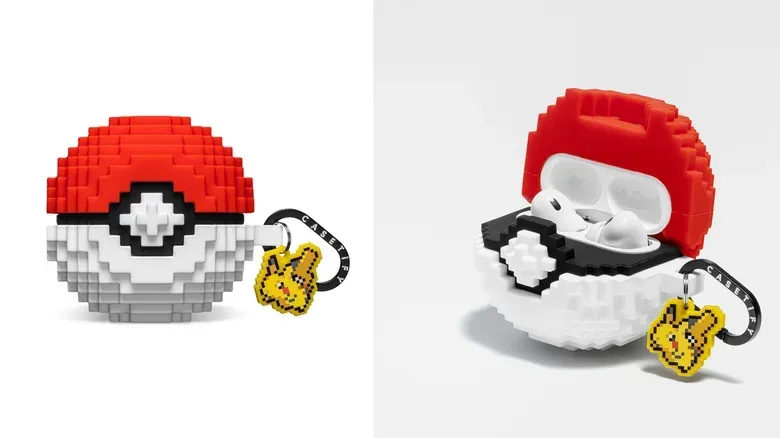
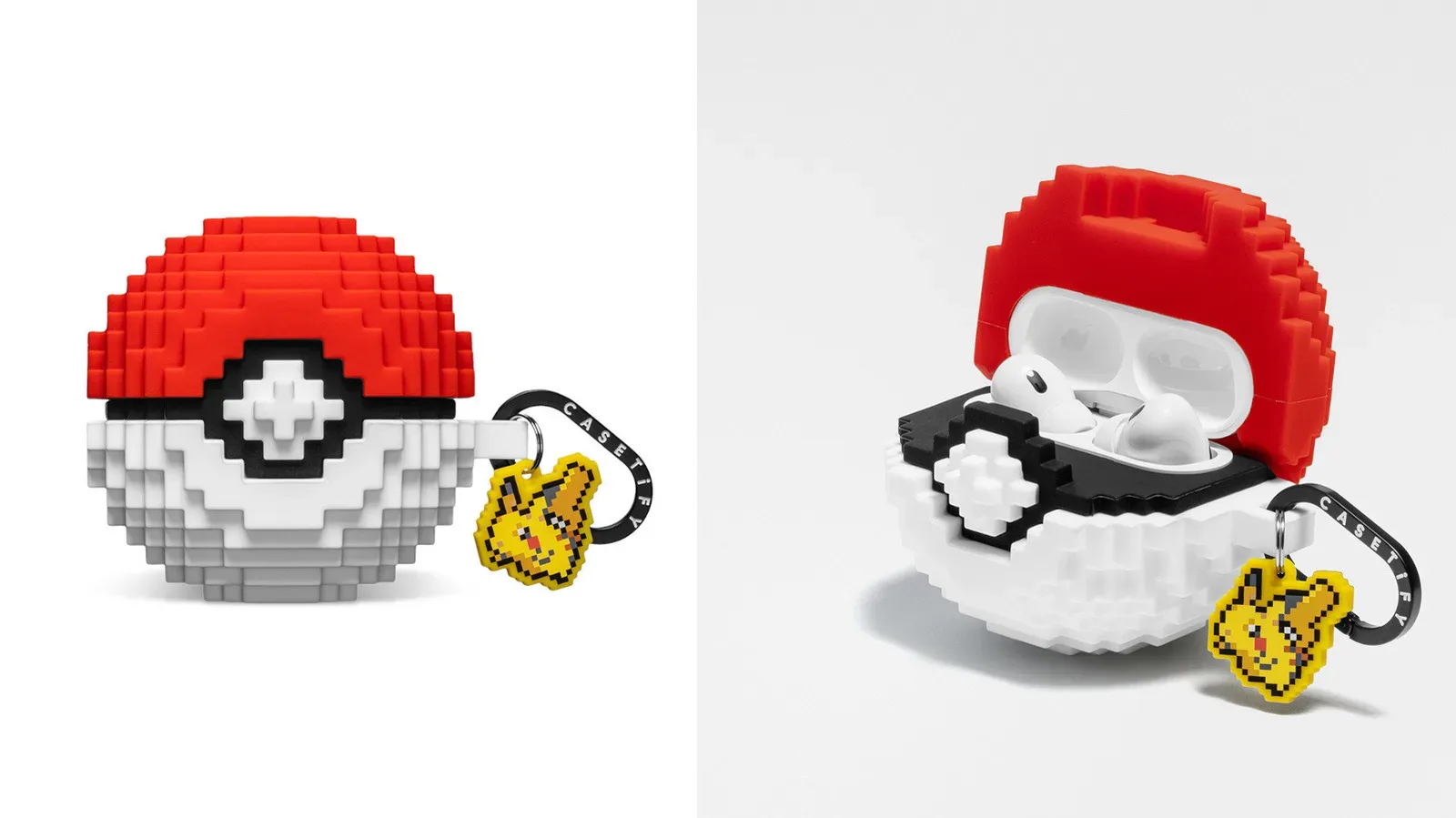
There are protective cases, and then there are accessories determined to make the gadget inside them feel like an artefact from a different universe. Casetify’s incoming Pokémon collection is firmly chasing the latter idea, led by an AirPods case shaped like a Poké Ball with an intentionally pixel-game-inspired look.
The collection is scheduled to go live on December 1 through Casetify’s website, app and physical shops worldwide. The headline piece is a rounded, three-dimensional case that opens to hold AirPods while presenting itself as a Poké Ball rather than a conventional sleeve. Its styling draws on the visual language of older 2D Pokémon games, translated into a physical object with a spherical form.
That distinction is the whole pitch. A standard AirPods case is designed primarily to disappear in a pocket or bag. This one appears designed to be seen, held and recognised immediately. It turns a small charging case into a conspicuous bit of Pokémon iconography—less a subtle skin and more a tiny display object that also happens to contain earbuds.
A Poké Ball case built for the theme first
Casetify has not announced a price for the Poké Ball AirPods case. That is an important missing detail for anyone deciding whether this is a playful everyday accessory or a premium novelty purchase.
There is, however, some useful context in Casetify’s existing elaborate collaboration cases. A Darth Vader-head AirPods case previously launched at $138 and is currently listed at $98, while an Evangelion Unit-01 AirPods case is currently listed at $110. Those products do not establish the price of the Pokémon model, but they illustrate the range occupied by similarly sculptural, character-driven designs from the company.
In practical terms, a sculpted case can ask buyers to weigh theme against convenience. Larger or more shaped accessories may be less pocket-friendly than a simple silicone cover, and their appeal rests heavily on whether the design itself is worth carrying around. For Pokémon fans, the appeal is unusually direct: the Poké Ball is a symbol that needs virtually no explanation, even before the pixel-influenced treatment enters the picture.
What “three-dimensional” means here: rather than printing a Poké Ball image on a flat accessory, the design uses the object’s physical shape to evoke one. The case also opens to reveal the AirPods inside, preserving the basic purpose of an earbud case while turning that opening action into part of the presentation.
The Shake Shake case adds moving pixel charms
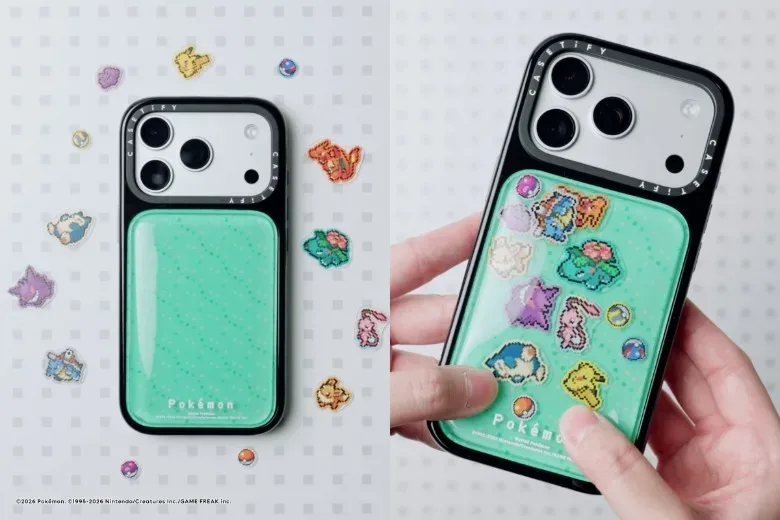
The Pokémon line is not limited to the AirPods piece. Casetify is also preparing the Pokémon Adventure Shake Shake Case for the iPhone 17 Pro. This case has a liquid-filled packet attached to its rear, and users can place pixel Pokémon and Poké Ball charms inside it. When the case is shaken, the small charms float and move through the liquid.
Related coverage includes Casetify’s Pokémon anniversary drop puts AirPods inside a Poké Ball.
“Shake Shake” is therefore a functional description rather than merely a catchy label. It refers to the mobile elements inside the liquid compartment. It is a more animated form of phone decoration than a printed illustration: the artwork is made of physical charms whose arrangement changes as the phone moves.
The feature should appeal to people who want the look of a miniature scene rather than a fixed character image. It also makes the iPhone case a more overtly tactile accessory. That said, the supplied details do not specify its price, the exact charm selection, or whether individual charm packs will be offered separately. Buyers interested in a particular Pokémon should wait for the official product listings rather than assume every character is included.
For a broader Pokémon story that is about game design rather than accessories, see how Pokémon Hearth and Thorn makes Gym Battle losses part of its branching story.
More accessories, from low-key cases to lit-up Pikachu
The December 1 release will also include simpler phone and AirPods cases, giving shoppers an option that is less sculptural than the Poké Ball design. Casetify is adding a Pikachu phone charm that lights up, along with a phone strap featuring Pokémon charms. The strap is framed around the idea of assembling a team, a fitting nod to a series built around choosing and travelling with Pokémon companions.
This creates a tiered collection in spirit, even though individual prices have not been detailed. At one end are conventional protective accessories with Pokémon branding; at the other are statement pieces with moving parts, illumination or a bold, three-dimensional form. That gives fans a choice between everyday utility and accessories that announce themselves from across a table.
What remains unconfirmed:
- The price of the Poké Ball AirPods case.
- Pricing for the iPhone 17 Pro Shake Shake Case and the remaining accessories.
- Which specific pixel Pokémon and Poké Ball charms will be included with the Shake Shake Case.
- Any further compatibility details beyond the iPhone 17 Pro model named for the Shake Shake Case.
What to consider before buying
People interested in the collection can sign up to Casetify’s waitlist for an availability notification. Since it is set to launch across the company’s website, app and worldwide physical stores, the waitlist is the clearest route mentioned for those who want to know when it becomes available.
For prospective buyers, the most useful first question is not simply “Do I like Pokémon?” It is “How do I want this accessory to behave in daily life?” The Poké Ball case seems aimed at collectors of playful franchise merchandise and fans happy to make their earbuds case part of their outfit or desk setup. The Shake Shake Case is for someone who wants the phone itself to become a moving little display. The plainer cases and strap provide alternatives for people who prefer the franchise reference without the bulk or animation.
It is also sensible to verify device compatibility at the point of purchase. The supplied information identifies the Shake Shake product as an iPhone 17 Pro case, but it does not identify which AirPods generations fit the Poké Ball case or which other phone models will receive simpler designs. A Pokémon-branded case is only useful if it fits the specific device a buyer already owns.
Analysis: why the collection’s strongest idea is instantly readable
The cleverness of the Poké Ball case is not technological complexity; it is visual shorthand. A Poké Ball is already a container in Pokémon, so using it as a container for another object is an intuitive match. The product does not need an elaborate explanation to communicate its joke. Open the ball, retrieve the thing inside, and the accessory’s premise has landed.
The pixel styling adds another layer without requiring the case to replicate a particular game screen. It points toward the series’ older visual era while avoiding the problem of trying to make a flat pixel sprite function as a protective shell. The design uses pixel art as an aesthetic cue and a spherical form as the product’s practical structure.
Meanwhile, the Shake Shake Case extends the collection’s focus on physical play. Its charms do not change the phone’s software or add a digital Pokémon feature; instead, they make the outside of the handset responsive to motion. That is a small distinction, but a useful one. These are decorative accessories, not gaming hardware, and their appeal lies in tactile character rather than added device capability.
With pricing still to come, the most grounded expectation is simple: the December 1 collection offers Pokémon fans multiple levels of commitment, from standard cases and a strap to a light-up charm, a floating-charm phone case and a Poké Ball built to house AirPods. The practical value will vary by design, but the theme is unusually cohesive: everyday tech, recast as trainer gear.