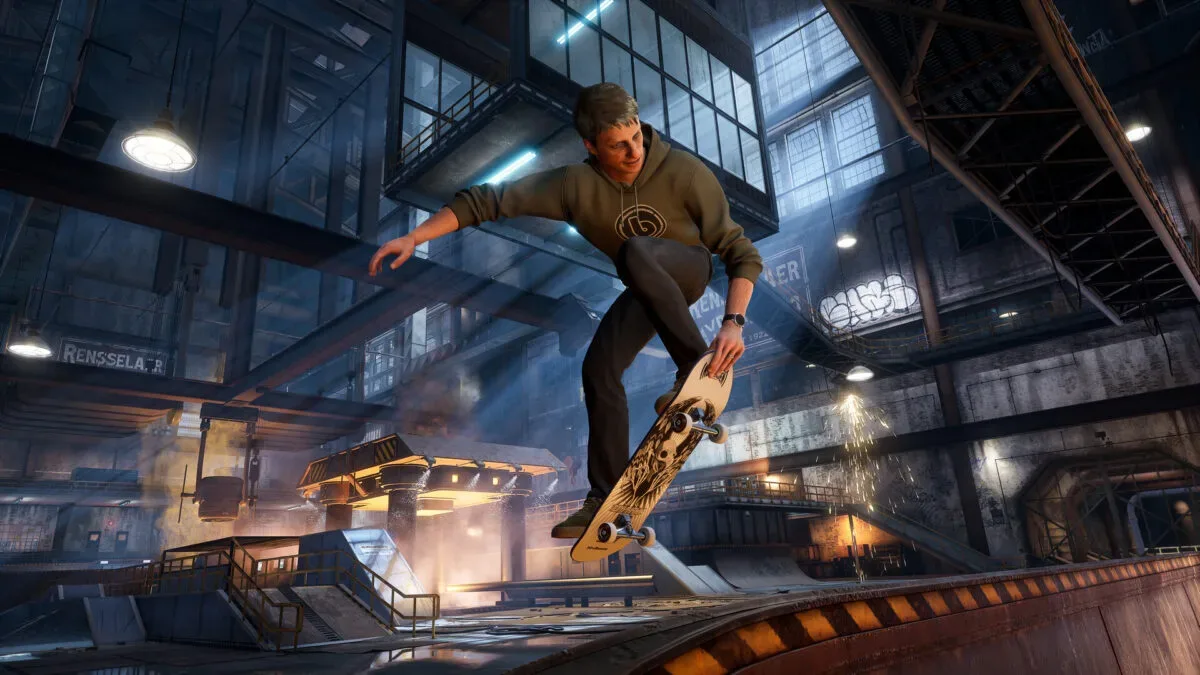
Tony Hawk returned to a very particular piece of video-game geography for the 25th anniversary of Tony Hawk’s Pro Skater 3: Pershing Square in Los Angeles, the real-world location that clearly inspired the game’s Los Angeles level. The celebration did not last long. Hawk said that security sent his group away while they were filming.
“Happy 25th THPS3!” Hawk wrote in a post about the visit. “We got kicked out of Pershing Square while shooting this today.” In a follow-up, he described the encounter as an anticlimax, saying security simply shooed the group away.
The outcome is funny precisely because of the setting. A skating icon revisiting a public-facing urban space that helped turn him into a video-game institution sounds like the most straightforward anniversary video imaginable. Instead, the clip’s real-life ending supplied a small, very Pro Skater-appropriate complication: the session was over before the full nostalgia lap could be completed.
A level built from a recognizable Los Angeles space
Pershing Square is not identified by name in Tony Hawk’s Pro Skater 3, but its influence on the Los Angeles stage is readily apparent. The real square’s distinctive modernist features—including stone crescent-shaped benches and large red spheres—gave the 2001 game an unusually specific visual vocabulary. Nearby, the car wash and its prominent blue obelisk also remain recognizable points of reference.
The square’s design is associated with architect Ricardo Legorreta. That architectural identity matters here. Many skating-game environments are composites, adjusted to create a satisfying route for tricks and objectives. Yet a level can still feel rooted in a city when it carries over landmark shapes, colors and sightlines. The elements at Pershing Square were memorable enough to become visual anchors for players, even when the game did not label the stage with the location’s real name.
In Hawk’s anniversary footage, he rolls through the square and revisits those familiar surroundings. The video also plays with a more deliberately game-like detail: Hawk recreates the slightly wobbly idle posture of his virtual counterpart. The gag narrows the distance between the real person and the polygonal character players controlled decades ago.
There is a useful distinction in that comparison. The game level is not a promise that every maneuver, route or object exists in precisely the same form in the physical space. It is a playable interpretation of a place. Game-level design rearranges reality around movement, camera framing, goals and the rhythm of a combo. But when the visual cues are strong enough, returning to the real location can still feel like stepping through a screen.
Why the location still lands for players
Tony Hawk’s Pro Skater 3 arrived in 2001 and was the first entry in the series to reach PlayStation 2. Its reputation has endured: it is tied with Grand Theft Auto 3 as Metacritic’s highest-rated game on that console. That standing helps explain why a quick location recreation can carry more weight than a routine social-media stunt.
Related coverage includes Tony Hawk Escorted From Pershing Square During Pro Skater 3 Recreation.
For longtime players, the Los Angeles stage is part of a mental map built through repetition. In skateboarding games, a location is learned less as a conventional tourist destination than as a chain of possible lines. A bench is an invitation to grind; a slope is a launch point; a wall or transition can become part of a route. Players remember not only what a level looks like, but also where a run begins, where a combo breaks and which pieces of scenery connect cleanly.
That is also why real-world inspiration has been so important to the series’ identity. It gives levels a sense of place without requiring them to function as literal simulations. The best-known spots become game spaces first and physical locations second, at least in the minds of people who encountered them through a controller.
Hawk’s use of “Blitzkrieg Bop” in the clip reinforces that memory loop. Music is inseparable from how many people remember the early games: not just as background audio, but as a pacing device that made a short run feel urgent and repeatable. Putting the Ramones track over footage from the actual square turns a straightforward revisit into a compact recreation of the era.
What “recreation” means in a skateboarding game
A recreation can mean several things, and Hawk’s visit touched on more than one. There is the physical act of standing in a location that inspired a stage. There is the visual recreation of recognizable landmarks. Then there is the performance recreation—copying an animation or pose that players associate with the game.
The latter is especially revealing. An idle animation is a small loop that plays while a player character is not moving. It is not a trick and it is not the usual highlight of a skating clip, but it can be iconic because players see it constantly between attempts. Recreating that stance is a nod to the strange way games preserve personality: sometimes the motion people remember most clearly is the one that happened when nothing was being done.
It also shows why an anniversary visit does not require a full skate session to make its point. Hawk and his team were able to establish the connection between square and level, then the security interruption became part of the story. There is no indication of an argument or elaborate confrontation in Hawk’s description; his account instead frames it as a brief, anticlimactic removal.
That restraint is worth keeping in view. Public spaces can have site rules, security practices and filming restrictions that are separate from a location’s cultural associations. The irony is that Pershing Square’s relationship to a skating game makes it feel, to fans, like a natural place for this exact kind of shoot. In practice, a beloved virtual version of a space does not automatically confer permission to film in the real one.
The anniversary arrives after a recent remake
The revisit comes after Tony Hawk’s Pro Skater 3 + 4, an Iron Galaxy bundle released in 2025 that remade the third and fourth games. The collection placed Pro Skater 3 back in active conversation rather than leaving it solely as a PlayStation 2 memory.
That context makes the Pershing Square video feel less like an isolated nostalgia exercise and more like a reminder of why the original still has a hold on the series’ audience. The 2001 game remains a reference point for players who want direct, score-driven skating action and instantly readable levels. At the same time, reception to the two halves of the newer package was not identical: the material associated with the earlier games drew the stronger response, while the Pro Skater 3 + 4 portion had a milder reception.
That difference reflects a broader tension around legacy skateboarding games. Fans continue to want new entries that retain the clarity and momentum of the classics, but creating them has proven difficult. A remake can preserve recognizable levels and familiar structure; a new installment has to decide what should remain untouched, what should be modernized and how to satisfy an audience with decades of attachment to the old formula.
For collectors and players keeping PlayStation 2-era libraries in use, the anniversary is also a reminder that hardware condition can matter as much as a game’s reputation. Optical discs can deteriorate over time, so anyone buying older PS2 games should know the warning signs before treating a copy as a long-term play copy. Our guide to disc rot, bronzing and pinholes on GameCube, PS2 and Dreamcast discs explains what to look for during an inspection.
An imperfectly perfect homage
Hawk’s short visit ultimately captures something that polished promotional campaigns often miss: the original games’ memories are built from ordinary places made extraordinary by interpretation. Pershing Square is still there, still recognizable in its key design features, and still capable of immediately calling up a PlayStation 2 level for people who spent years threading runs through its digital cousin.
The fact that the shoot ended with security asking the group to leave does not erase that connection. If anything, it gives the 25th-anniversary revisit a fittingly human ending. The game can keep a skater rolling indefinitely, ready for another run at the push of a button. The real square has rules, security and a hard stop.
For Hawk, that hard stop appears to have been brief rather than dramatic. For fans, the footage still delivers the central pleasure: seeing a foundational figure in skateboarding games return to one of the real places that helped define Tony Hawk’s Pro Skater 3. The only missing element was enough uninterrupted time to keep filming.