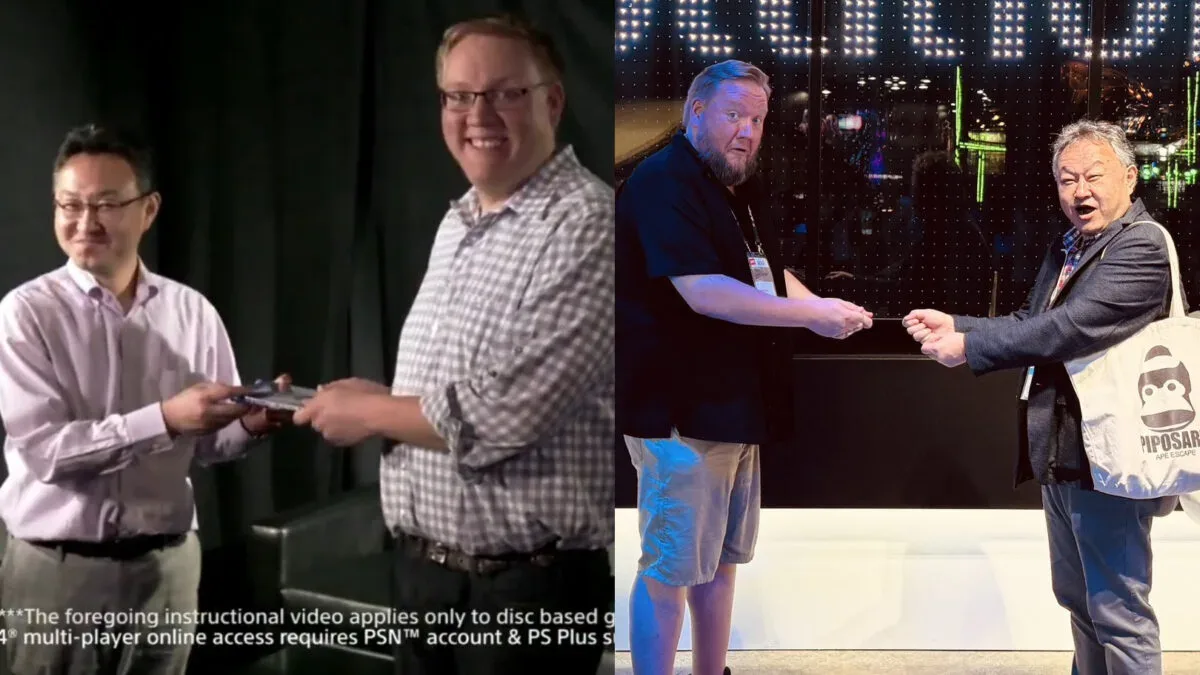
Two familiar faces from PlayStation’s PS4 era have revisited one of the company’s most memorable pieces of game-marketing theater. Shuhei Yoshida and Adam Boyes met at the PlayStation booth during Tokyo Game Show 2026 and recreated the pose associated with the brief 2013 used-game instructional video that became an instant point of comparison in the Xbox One and PS4 launch race.
The updated image has one conspicuous difference: there is no game disc between them.
That absence need not be read as a meticulously planned prop; it is entirely plausible that neither former executive simply had a disc to hand while walking a convention floor. Yet the visual lands differently in 2026 than it did in 2013. The original gag was built around the ordinary physical act of handing a game to another person. With reported plans for Sony to move away from physical games in 2028, the recreation has become an unexpectedly pointed callback to an earlier PlayStation message.
A 22-second answer to a complicated policy fight
The original video, titled Official PlayStation Used Game Instructional Video, lasted just 22 seconds. Its entire joke was simple: Boyes handed Yoshida a PS4 game, demonstrating how one person could share a physical copy with another. There was no extended explanation because the context already did the work.
At the time, Microsoft’s Xbox One plans had attracted a strong negative reaction over digital rights management, usually shortened to DRM. DRM is a broad term for technology and rules used to control access to digital content. In the Xbox One dispute, the issue was not merely a technical acronym. Players were worried about the conditions that could be attached to games they had bought on disc, including checks connected to the console’s online ecosystem and the implications for lending and used-game ownership.
PlayStation’s short video turned that anxiety into a visual punchline. Rather than arguing through a lengthy feature comparison, it made the central promise understandable in seconds: a disc could be given to a friend. The clip succeeded because it treated a contentious platform-policy debate as something tangible and familiar.
That communication choice matters as much as the joke itself. The PS4 message was not about processing power, a launch lineup, or a future roadmap. It was about the player’s relationship to a purchased object and the freedom traditionally associated with owning it. For people who lend games, trade them, buy used copies, or simply like maintaining a shelf of software, that relationship remains emotionally and practically important.
Why the disc-free recreation carries extra weight
Yoshida and Boyes were PlayStation veterans, but neither now works at the company. Boyes left PlayStation in 2016, while Yoshida departed in 2024. Both are currently consultants in the wider game industry. Their reunion therefore reads as a look back at a moment rather than a formal PlayStation statement or a new product announcement.
Related coverage includes Former PlayStation Leaders Revisit PS4's Disc-Sharing Joke as Physical Support Winds Down.
Still, the image naturally invites comparison between eras. In 2013, the physical disc was the whole point. In 2026, the same pose without one reflects a business whose future is increasingly discussed in terms of digital libraries and platform ecosystems. The reported 2028 move away from physical games makes the old gesture feel less like a victory lap and more like an inversion of the original joke.
It is important not to turn a convention-floor photo into a policy document. Yoshida and Boyes did not use the recreation to announce a change, explain Sony’s plans, or establish how existing libraries will be handled. Nor does an empty-handed pose settle the broader questions players have about discs, digital purchases, backward compatibility, or hardware design. What it does demonstrate is how durable the 2013 clip remains in the public memory—and how readily players connect it to current concerns about physical media.
Physical copies and digital licenses are not the same thing
The renewed conversation is ultimately about more than whether a console accepts a disc. A physical copy has historically enabled several choices that a digital license may not replicate in the same way: lending a game, selling it, buying it second-hand, giving it as a gift, or keeping it independent of a specific digital storefront account.
A digital license, by contrast, is generally an entitlement recorded in a platform account or ecosystem. It can be extremely convenient: there is no need to change discs, downloads can be available from a library, and purchases are tied to a user’s account rather than a particular piece of plastic. But it changes the nature of what players hold. The practical access is governed by platform policies, account status, technical compatibility, and the continued operation of the relevant services.
The irony in this particular callback is that Microsoft is now using DRM checks it once abandoned in a different direction: to provide players with digital licenses for physical games. That approach suggests an effort to join physical ownership habits with digital-library convenience. It also shows why DRM itself is not inherently one single consumer outcome. The player-facing consequences depend on how the system is designed, what rights it recognizes, and what restrictions accompany it.
For PlayStation players, the questions raised by an eventual move away from discs are likely to be concrete rather than abstract. Can people continue to use the discs they already own on compatible hardware? What happens to resale and borrowing when new physical releases are no longer part of the model? How clearly will the company explain the difference between access to a digital library and ownership of a transferable physical object? The supplied information does not answer those questions, but they are the natural pressure points behind the reaction to the Yoshida-Boyes photo.
An old PlayStation communication style
The 2013 video is also remembered for its tone. It was compact, direct, playful, and unmistakably aimed at a conversation players were already having. In a matter of seconds, two recognizable PlayStation figures delivered a clear answer to a competitor’s unpopular approach. It felt personal because real public-facing executives were part of the gag rather than merely names in a corporate statement.
That is why the recreation has a layer of nostalgia beyond the disc itself. PlayStation’s public communications have become more guarded over the years, while its most recognizable leaders have been less visible in openly discussing and defending the company’s evolving ecosystem priorities. The contrast is not necessarily proof that one communication strategy is always better than another; major platform plans often involve details that cannot be reduced to a joke. But the response to the old video shows the lasting value of clarity.
When platform decisions affect the way players buy, keep, and share games, a polished technical explanation can be useful. So can an immediately understandable human message. The 2013 clip had the latter in abundance. Its premise was so simple that it remains legible more than a decade later, even when recreated with no physical object at all.
There is a broader preservation angle as well. The shift from physical media to account-based access affects not only new releases but also the culture around revisiting older games. Conversations about legacy PlayStation software continue to matter, whether they concern original hardware, remasters, digital storefronts, or projects that revisit classic experiences in fresh ways. For example, a VR mod for Metal Gear Solid 2’s Tanker chapter is another reminder that players remain deeply invested in how older games can be experienced and re-experienced.
What the photo does—and does not—say
The Yoshida and Boyes reunion is best understood as a compact visual callback with unusually timely symbolism. It does not confirm hardware specifications, establish a final date for any platform transition, or tell players what form future PlayStation game ownership will take. It does, however, place a famous pro-disc message beside the prospect of a more digital future.
That tension explains why an apparently casual recreation can resonate so strongly. The original PS4 video made physical sharing look effortless. The newer image preserves the pose while removing the thing that made the joke work. For longtime PlayStation fans, that is enough to evoke both affection for a defining PS4-era moment and uncertainty over what comes next.