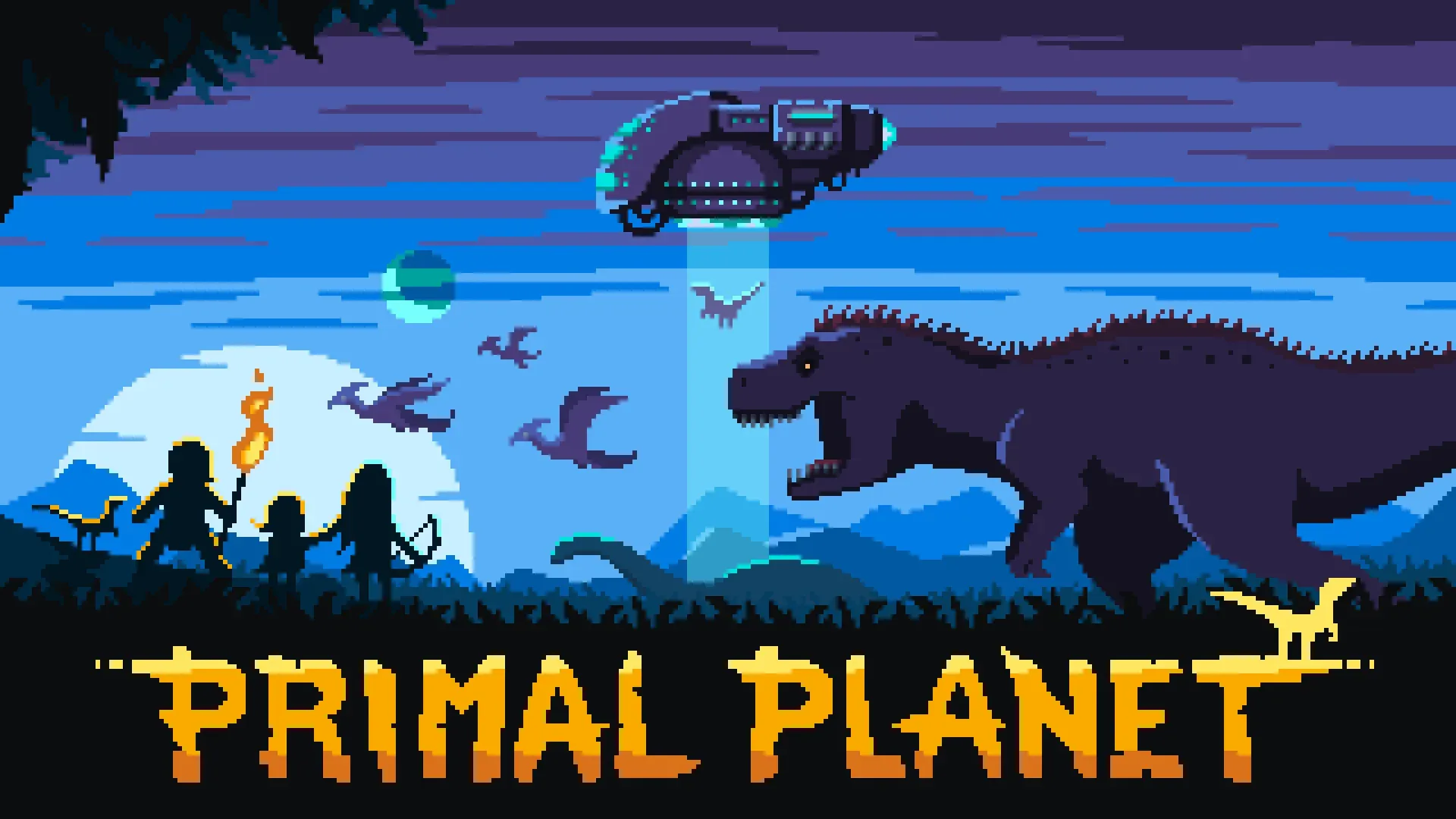
Primal Planet, the handcrafted metroidvania from solo developer Albert van Zyl of Seethingswarm, is now available for PlayStation 5 and Xbox Series X|S. The game puts players in the role of a prehistoric father trying to protect his family through a world occupied by dinosaurs, hostile tribes and ancient aliens.
The current-console release expands the game’s existing availability on Steam, GOG and Nintendo Switch. It is priced at $19.99 on PlayStation 5 and Xbox Series X|S, with a 10% launch discount for PlayStation Plus members and Xbox players. It also joins the slate covered in Joking Joystick’s games releasing today roundup for November 3, 2026.
A prehistoric adventure built around family
Primal Planet’s premise makes its emotional priority unusually clear. Its central character is not simply exploring an ancient wilderness or pursuing a grand conquest: he is a father defending his family. That setup informs the game’s stated focus on looking after someone close, including its approach to co-op.
The game tells its story without spoken or written dialogue. Instead, it relies on animation, environments and player observation to communicate events and relationships. This is commonly called environmental storytelling: narrative information is carried by what the player sees in locations, character behavior and the arrangement of details in the world rather than by explanatory conversations.
A wordless structure does not necessarily mean a story is simple. It means the game asks players to read visual context: the condition of a place, the movements of a creature, the dangers surrounding a character, and the consequences of action. For a game centered on a parent and child-like companion dynamic, that can make small interactions especially important. A gesture such as hugging the dinosaur sidekick is not just a novelty; it supports the broader idea that companionship is part of the adventure’s identity.
What “metroidvania” means here
Primal Planet is described as a metroidvania, a term generally used for exploration-focused action games built around an interconnected world. Progress often involves revisiting earlier regions after gaining a new ability, tool or route through an obstacle. The defining pleasure is not merely reaching the end of a linear stage, but gradually understanding how areas connect and uncovering what was previously inaccessible.
In Primal Planet, that exploration framework sits alongside combat, survival and crafting. The combination suggests that forward progress is not isolated from the player’s relationship with the environment. Combat establishes immediate danger, exploration rewards curiosity, survival brings attention to threats and preparedness, and crafting introduces the creation or improvement of useful resources. The supplied details do not specify particular recipes, weapons or progression systems, so players should not assume an exact implementation of any one of those elements. What is clear is that they are part of the game’s overall blend rather than separate modes.
The world’s mix of dinosaurs, savage tribes and ancient aliens gives the adventure a deliberately broad threat palette. The prehistoric setting is therefore not presented as strict natural history. It is a fantasy-action space where creature encounters, human adversaries and science-fiction mystery can coexist. That premise leaves room for changing kinds of danger as players explore, rather than treating every conflict as a variation on the same enemy.
Couch co-op turns the dinosaur companion into a second-player role
The most distinctive feature of this release may be its local couch co-op. A tiny dinosaur accompanies the main character and can fight alongside him. At any point, another person can take control of that companion.
Local couch co-op means multiple people play together in the same physical space, rather than connecting over the internet. For families, partners and friends sharing a console, the arrangement makes Primal Planet a game that can be played collaboratively without requiring each player to own a separate system or copy. It also provides a flexible way to bring somebody else into the action: the second player can join by controlling the sidekick when desired, instead of the game requiring a permanent two-player setup from the outset.
That flexibility matters for a game whose fiction emphasizes care and protection. The companion is not framed solely as an accessory or a passive mascot. It can participate in combat, and the second player can inhabit that role directly. In practical terms, that could make co-op a natural fit for players with differing experience levels, since the dinosaur role is a defined part of the adventure rather than an unrelated add-on. The available information does not describe difficulty options, separate abilities or how the game handles puzzles in co-op, so those details remain unspecified.
There is also a simple appeal in the premise: pass the controller, bring in a second player and let them be the small dinosaur at the hero’s side. The game’s emphasis on hugging that dinosaur underlines a tone that is more affectionate than a synopsis involving predators, tribes and aliens might initially suggest.
Five years of solo development
Van Zyl developed Primal Planet over five years as a solo creator. That context is relevant because the game combines a large number of creative disciplines: visual art, movement, combat encounters, world construction, progression, narrative presentation and co-op behavior all need to work together. A solo-developed game is not automatically small in ambition, but it is often shaped by the need for a consistent vision and careful prioritization.
Here, the attention appears to have gone toward a highly authored visual world. Earlier critical responses highlighted the game’s color, motion, detailed pixel art, environmental storytelling and abundance of secrets. Those observations align closely with the design goals suggested by the game’s genre. Exploration games depend on players wanting to inspect off-path spaces, notice visual cues and return to locations with fresh possibilities. Secrets are therefore not just optional collectibles or detours; they can reinforce the sense that the world has been deliberately made to reward attention.
Pixel art refers to imagery constructed with deliberately visible, grid-based pixels, often drawing on the visual language of older video games while using modern animation and color techniques. In a game like Primal Planet, the art style can do more than evoke nostalgia. It can clarify creature movement, distinguish hazards, give landmarks a memorable silhouette and make environmental storytelling readable at a glance. The praise for its movement is particularly notable for a metroidvania, where traversal frequently determines whether exploration feels inviting or laborious.
Why the console launch is meaningful
Primal Planet had already arrived on PC in 2025, and it is also available on Nintendo Switch. The PlayStation 5 and Xbox Series X|S editions now give current-console players direct access to its particular mix of solo exploration and shared-screen companionship.
For prospective buyers, the decision can be framed around the game’s clearest promises rather than assumptions about scale. Primal Planet offers a dialogue-free, story-led prehistoric adventure; exploration in the metroidvania tradition; combat, survival and crafting; and couch co-op in which a second player can control the dinosaur sidekick. Players seeking online multiplayer should note that the feature specifically described is local couch co-op. Likewise, those interested primarily in a fully realistic dinosaur simulation should recognize the game’s overtly fantastical ancient-alien element.
The launch discount may be relevant to players choosing between platforms, although the stated offer is limited to PlayStation Plus members and Xbox players at launch. The base price is $19.99. No additional information has been provided on the duration of the promotion, so interested players should check their relevant storefront for the current terms.
Primal Planet’s hook is concise: survive a dangerous prehistoric world, protect your family and keep a small dinosaur friend close. But its design reaches beyond that elevator pitch. The combination of visually led storytelling, an interconnected world, secrets, crafting and drop-in local co-op gives the game a cohesive identity. Its new PlayStation 5 and Xbox Series X|S availability makes that identity accessible to a wider console audience—especially those who would rather share the dinosaur duties from the same sofa than face the wilderness alone.