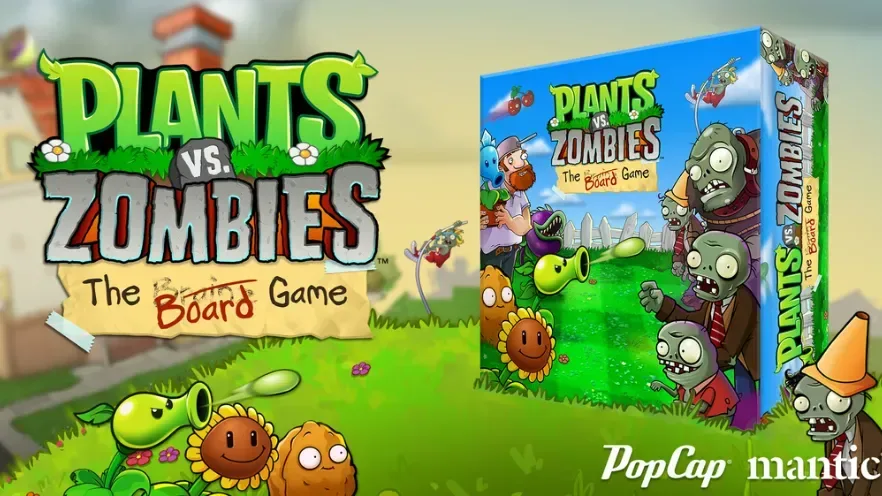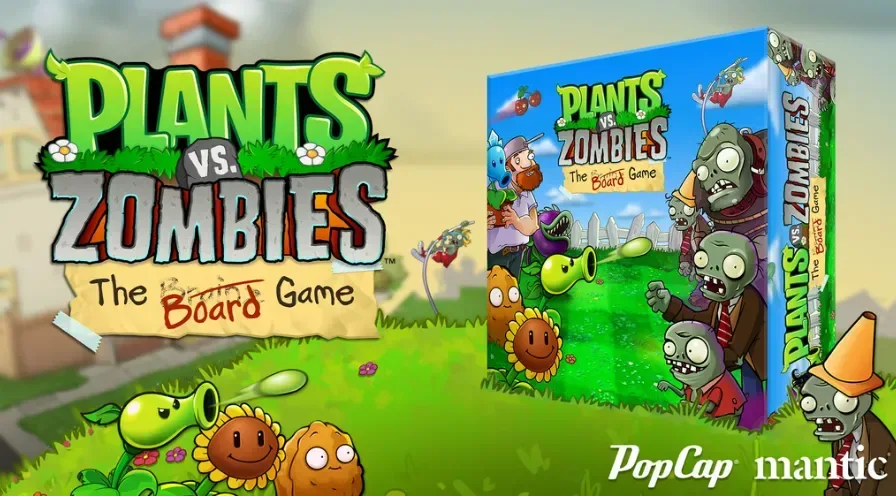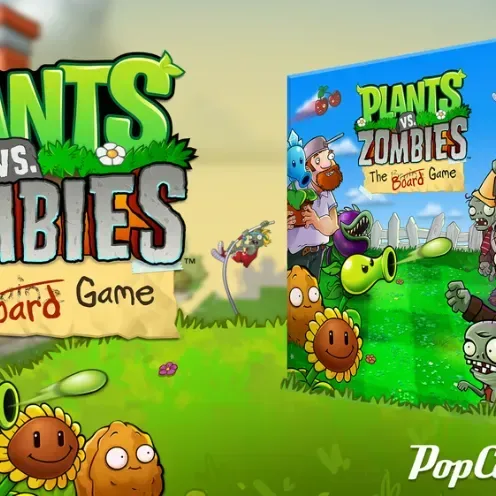
Plants vs. Zombies is heading from the digital lawn to the tabletop. Mantic Games plans to launch a Kickstarter campaign for Plants vs. Zombies: The Board Game on October 14. The proposed adaptation turns the series’ familiar defensive setup into a cooperative card game for one to four players, with a stated focus on the comedy, escalating pressure and chaotic zombie management that define the games.
The central idea is immediately recognizable: players must stop a growing zombie horde before any of it reaches the house. Rather than one player independently tending a lawn, the board game has the whole group work together through a sequence of levels. Each level is intended to introduce its own setup, objective and zombie forces, creating an advancing campaign-like structure rather than a single static scenario.
That format matters because the original series is fundamentally about prioritization. Defenses are never simply decorative; their placement, timing and lane coverage determine whether a garden can withstand what is coming. Mantic’s announced rules suggest it is trying to preserve that pressure in a physical format while making the decision-making collective.
How the tabletop adaptation is expected to work
The game is described as card-based. Players will use Plant cards and Tool cards to build and adjust their defenses, while Zombie cards push the threat toward the home. Examples given for Plant cards include Peashooters, which provide the series’ signature ranged attack, and Cherry Bombs, which offer an explosive response. Tool cards include a shovel for reorganizing a garden’s defenses and a lawnmower for cutting down zombies in a lane.
In practical terms, those tools point to three kinds of choices likely to drive play:
- Deployment: deciding which plants should occupy the available defensive positions.
- Reaction: using a disruptive option such as a Cherry Bomb or lawnmower when ordinary defenses are no longer enough.
- Repositioning: changing a plan with the shovel when an initially sensible layout no longer matches the approaching horde.
The shovel is particularly important as an adaptation detail. A tabletop game cannot depend on the split-second cursor movement of a video game, so its tension has to arise from planning, information and limited ways to repair mistakes. A card that lets players reorganize defenses suggests the group will have some ability to recover from a bad setup, but will still need to decide whether the correction is worth spending at a given moment.
The lawnmower is an equally natural translation. In the games, lawnmowers are an emergency final line for a lane. Here, Mantic describes the tool as able to cut down a lane of zombies, retaining its role as a high-impact safety measure. The interesting strategic question will be when players choose to spend such a rescue option rather than preserve it for a worse wave. Details such as card counts, hand limits, turn order and how often these tools can be used have not been announced, so the exact level of resource pressure remains unclear.
Simultaneous zombie cards could be the game’s key tension system
The most distinctive announced rule is that Zombie cards are played simultaneously. These cards move zombies closer to the house and display the paths they will take, giving the players information they can use to prepare defenses. Yet because all Zombie cards must be played at once, the group may have to confront the full shape of an incoming problem instead of calmly resolving threats one by one.
Simultaneous resolution means effects are revealed or handled together rather than in a leisurely sequence. For a cooperative defense game, that can create a meaningful difference. A player may be able to see that several lanes are threatened, but the team might not have enough cards or useful actions to cover every route. The game’s suspense can therefore come from the gap between recognizing danger and possessing the means to answer it.
That is a promising fit for Plants vs. Zombies. The series’ identity rests on readable lanes and overt threats, not hidden information alone. Seeing where zombies will go gives the table an opportunity to make a plan. Being required to deal with several revealed threats at the same time is what should stop that planning from becoming routine.
It may also give solo players a clear puzzle to solve. Since the game supports one to four players, its cooperative rules need to function both as a shared discussion and as a one-person decision space. The announced simultaneous Zombie-card system has the potential to work in either case: it presents one player with multiple priorities, or gives a group several competing calls to debate.
Levels, unlocks and the loss condition
Mantic says new Plants, Zombies and challenges will unlock as players progress, with each new level confronting them with a fresh horde. This is the tabletop version of progression: instead of relying only on a single match’s outcome, it gives players additional content and changing tactical possibilities over time.
Unlocks in this context are new game elements made available through advancement. They can refresh a game by adding options or complications without requiring an entirely new ruleset. For an adaptation of Plants vs. Zombies, newly available plants and zombies could be especially valuable because each side can change how players evaluate lanes, timing and emergency tools. Mantic has not yet detailed the specific unlock requirements, the total number of levels or whether progress will take a campaign form with persistent choices, so those should remain open questions ahead of Kickstarter.
The defeat condition, at least, is direct: the players lose if a zombie reaches the house. That clarity is part of why the theme maps cleanly to a board game. There is no ambiguity about the ultimate job of a lawn defense. The uncertainty lies in how much ground players can afford to yield, what resources they can preserve, and whether a clever reorganization can prevent a visible lane from becoming the fatal one.
Deluxe Edition and Night Edition plans
Mantic is also preparing a Deluxe Edition with pre-assembled miniatures of fan-favorite Plants and Zombies. The core game is card-based, but miniatures could make the board state easier to scan at a glance and give the release a more display-oriented option for players who enjoy physical representations of the characters. No full contents list, component count or pricing has been provided.
A standalone Night Edition is planned as well. Mantic says it will include additional Plants, Zombies and other content. Calling it standalone indicates that it is intended to function as its own entry point rather than merely an add-on that requires the base game, although the precise relationship between the two editions has not been outlined. It is not yet known whether content will be interchangeable, whether it will have a separate progression structure, or how its challenges will differ from those in the main game.
The use of a night-themed edition is a sensible thematic direction because the video game series has long used different situations to change the shape of its defense puzzles. Still, the announced information stops short of specifying mechanics for the Night Edition, so prospective backers will need to wait for the campaign page before assuming particular modes, plants or scenario rules.
Mantic’s tabletop adaptation background
Mantic has previously adapted a number of established properties for tabletop games, including Worms, Halo, Hellboy, The Walking Dead and Invincible. That background does not reveal exactly how this new game will play, but it establishes that the studio is approaching Plants vs. Zombies as part of a broader line of licensed tabletop projects rather than as an isolated experiment.
The fit is arguably strongest when the adaptation retains the source material’s own verbs. Plants vs. Zombies is not just a collection of recognizable faces: players place defenders, read lanes, manage a looming advance and rely on carefully timed backup. The announced Plant, Tool and Zombie card structure appears designed around those actions rather than around a generic combat system with Plants vs. Zombies art laid over it.
For video game fans, that distinction is likely to be more meaningful than the presence of miniatures alone. A board game version needs to make Peashooters, Cherry Bombs, shovels and lawnmowers feel like parts of a defensive system. Based on what has been revealed, Mantic is at least aiming squarely at that goal.
Where this sits for the larger series
The board game arrives after Plants vs. Zombies Replanted, a remake of the original game released last year. The most recent new series entry was 2024’s free-to-play mobile game Plants vs. Zombies 3, which has relaunched multiple times. The tabletop project therefore offers a different kind of return to the franchise’s roots: not another screen-based defense lawn, but a shared table where players collectively make the same broad sort of defensive calls.
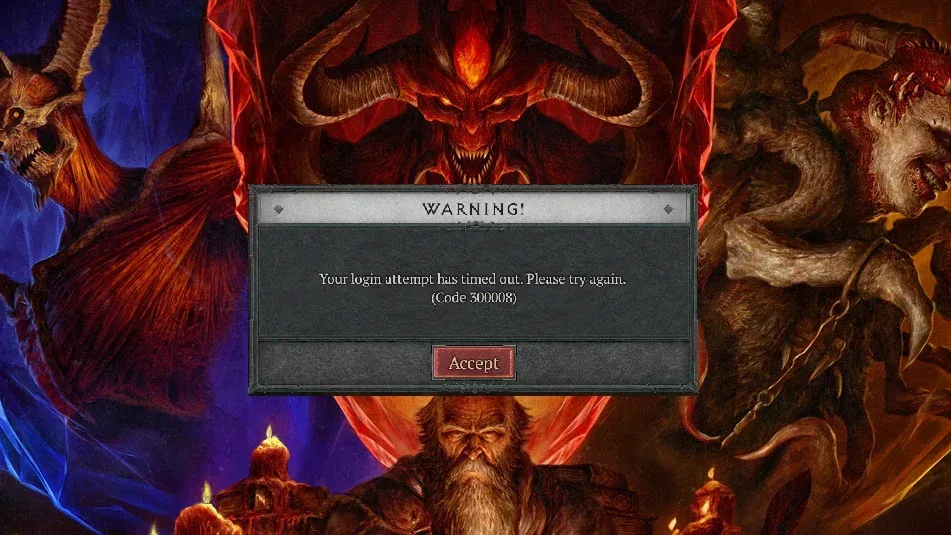
It also arrives at a moment when game audiences are accustomed to tracking both new releases and continuing changes to existing games. For another example of how operational updates can shape the conversation around a major game, see our coverage of Diablo 4 Season 15’s delay after login errors. Plants vs. Zombies: The Board Game is a different proposition entirely, but the Kickstarter campaign will be the point where its scope, editions and promises can be evaluated in full.
For now, the confirmed picture is straightforward: one to four players will cooperate across increasingly difficult levels, defend lanes with plants and tools, react to simultaneously played Zombie cards, and try to keep every zombie away from the house. The Kickstarter launch on October 14 should clarify the unanswered details around component lists, campaign structure, the Deluxe Edition and the standalone Night Edition.