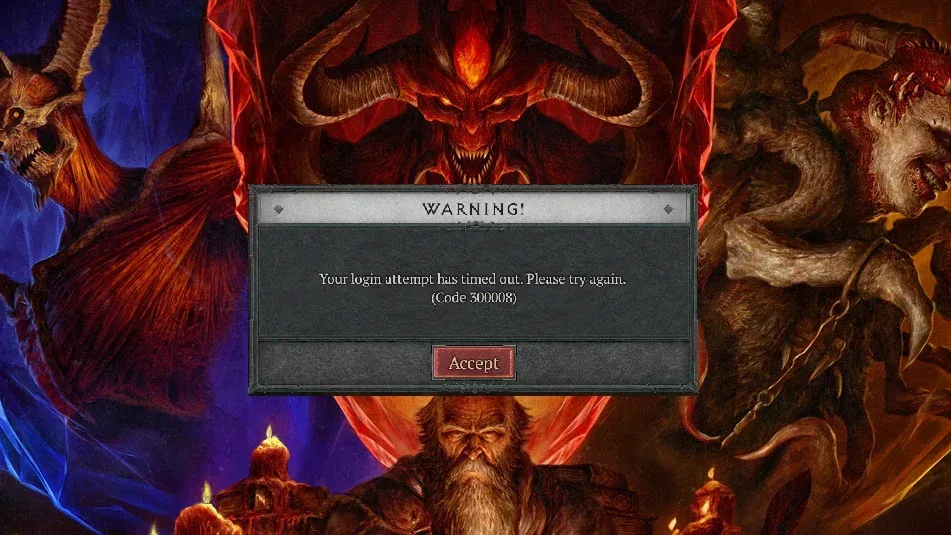
Diablo 4’s Season 15 is on hold after login problems disrupted the planned September 15 start of Season of Hell’s Legacy. The update was positioned as a major part of Diablo’s 30th-anniversary celebration, but players attempting to enter the action RPG reported a wave of access failures instead, including login error codes 3000008 and 3000006.
The problem emerged early in the day and persisted as the seasonal update began rolling out around midday. Blizzard acknowledged that some players were unable to log in and said its team was investigating. A later update made the bigger consequence clear: Season 15 itself was being delayed while the issues were addressed.
That delay matters beyond a temporarily inaccessible server. A Diablo season is a structured fresh-start environment with its own seasonal progression, economy, characters, and questline. When a launch is unstable, the priority is not merely getting players through the door; it is making sure those who get in are participating under the same rules as everyone else.
What happened during the Season 15 launch
Reports from players described multiple outcomes rather than one universal failure. Many could not reach the game at all, with error 3000008 the code most commonly mentioned and 3000006 appearing for others. Some players were able to enter the new season without obvious trouble.
That uneven access is especially awkward at the beginning of a season. Diablo 4’s seasonal format encourages players to begin at roughly the same moment and build their characters under the new ruleset. If a portion of the community is locked out while another group can accumulate gold, levels, gear, and seasonal progress, the opening race is no longer shared on equal footing.
A more serious report involved a player who said their gold and Paragon Board unlocks from the prior season had carried over into Season 15. Those elements are expected to reset for a fresh season. The report was tied to Rebirth, a new feature intended to move a character from the Eternal realm—the game’s non-seasonal, permanent realm—into the Seasonal realm.
It is important to distinguish a player report from a confirmed diagnosis. The reported carryover does not, by itself, establish the precise cause of the launch disruption or prove that every Rebirth use was affected. But it illustrates why a full delay can be necessary once a seasonal reset appears unreliable. Gold and Paragon progression are meaningful character advantages, and season-start integrity depends on them being handled consistently.
Why early progress may not survive
Players who did manage to begin Season 15 should be prepared for the possibility that their early progress will not remain. With the season delayed because of the scale of the day-one problems, progress made before the interruption will likely be rolled back.
Related coverage includes Diablo 4 Season 15 Delayed as Login Errors Disrupt 30th Anniversary Launch.
A rollback is the restoration of game data to an earlier, trusted state. In this situation, its purpose would be to remove potentially uneven or invalid early-season progress and return the seasonal environment to a clean starting point. It is an unpleasant outcome for anyone who got a character moving before the delay, but it can be the most direct way to preserve a fair reset if access and account data were behaving inconsistently.
Nothing in the available update provides a new start time, identifies the underlying technical cause, or confirms the exact scope of any rollback. Players should therefore treat their initial Season 15 activity as provisional until Blizzard shares a further status update.
For players waiting to dive in, the practical takeaway is simple: avoid assuming that a successful login means the season is fully settled. A character that can enter a temporarily troubled seasonal environment may still be affected by subsequent corrective work. The delay is a signal that the launch state has not yet been accepted as stable.
A difficult start for an anniversary centerpiece
Season of Hell’s Legacy was meant to do more than deliver the normal rotation of balance adjustments, endgame changes, and quality-of-life improvements. It is framed around Diablo’s past as the series reaches its 30th anniversary. The first Diablo released in January 1997, and Season 15’s seasonal questline is designed as a journey through recreated and refreshed pieces of that history inside Diablo 4.
The quest content includes the Diablo 4 debut of Deckard Cain, the legendary Horadrim figure associated with the franchise. The season’s premise also points players toward memories of notable heroes, enemies, and events from Sanctuary’s long, troubled history.
That nostalgic framing makes the technical delay more conspicuous, but it does not change the central short-term issue: the anniversary material cannot properly begin until the seasonal foundation is reliable. The first hours of a new season are when players form parties, choose builds, test changed systems, and begin the progression loop. A living-history questline works best when the modern game around it is functioning predictably.
Legacy Uniques are intended to stay
One of Season 15’s significant additions is not confined to the seasonal calendar. Diablo 4 is adding nine Legacy Uniques permanently. In Diablo terminology, Uniques are rare, powerful items with distinctive properties; the Legacy label here refers to their roots in Diablo history.
The announced group includes Messerschmidt’s Reaver, the Stone of Jordan, and Henri’s Perquisition, alongside other relics drawn from the series’ past. Their permanent status is notable because it separates them from the delayed seasonal start. The anniversary theme is not solely a temporary event layer; these items are intended to become lasting parts of Diablo 4’s broader item pool.
For build-focused players, that means the eventual impact of the update should extend beyond the first weeks of Season 15. New high-power items can influence which skills, class setups, and endgame approaches are appealing, particularly when paired with balance changes. The exact practical effect will depend on the items’ final in-game details and how they interact with the rest of the update, information not established by the delayed launch itself.
Technical terms behind the disruption
Login error codes
Error codes such as 3000008 and 3000006 are labels used to identify a particular failure state when a player tries to access an online service. They tell players that the login attempt did not complete, but the codes alone do not publicly explain the deeper cause. A code may be associated with authentication, service capacity, account communication, or another issue; without a technical breakdown, it would be speculation to assign a specific cause here.
Seasonal realm and Eternal realm
Diablo 4 separates seasonal play from the Eternal realm. The Eternal realm is the ongoing non-seasonal home for characters, while the Seasonal realm is built around a new seasonal cycle. The distinction is important because a season’s fresh-start rules depend on clean separation from previously accumulated resources and progression.
Paragon Board
The Paragon Board is a progression system tied to a character’s advancement. Because its unlocks represent meaningful character development, an unintended transfer of Paragon progress from a previous season could undermine the expected reset. That is why the report of carryover was more concerning than an ordinary login failure, even though its broader extent remains unconfirmed.
What players should watch for next
Blizzard has said it will provide updates as it works on the affected launch. The most useful next details for the community will be a revised Season 15 start time, confirmation of whether progress from the disrupted period was rolled back, and clarification of any restrictions or fixes connected to Rebirth and seasonal transfers.
Until then, there is no confirmed timeline for when Season of Hell’s Legacy will properly begin. The season’s new quests, Deckard Cain appearance, endgame adjustments, quality-of-life changes, and permanent Legacy Uniques remain the promised shape of the update, but the immediate job is restoring reliable access and a valid reset.
The episode is also a reminder that an online season is more than patch notes arriving on a given date. Its launch depends on login systems, realm separation, progression data, and equal access all working together. When one or more of those pieces fails, delaying the race is preferable to pretending it started cleanly. For more on the wider console-service conversation, see the latest discussion around Xbox Game Pass plans.