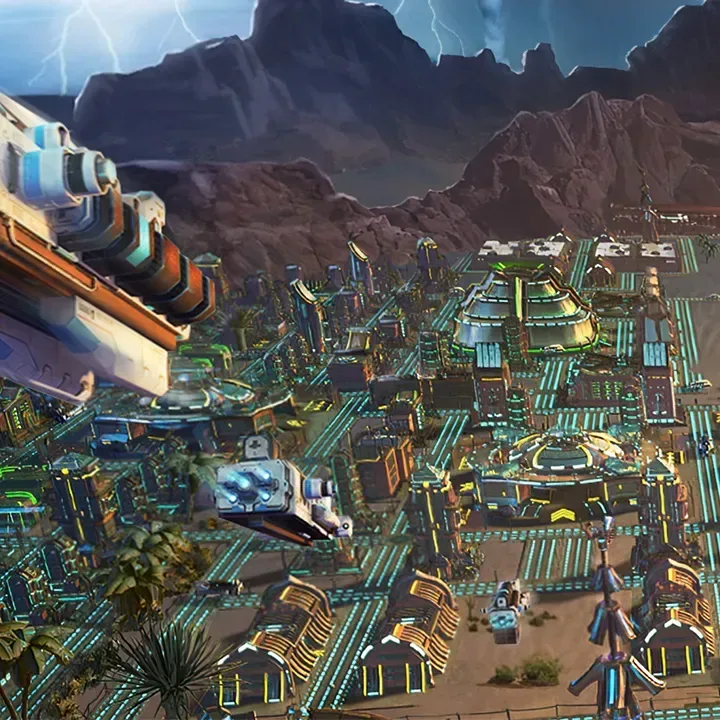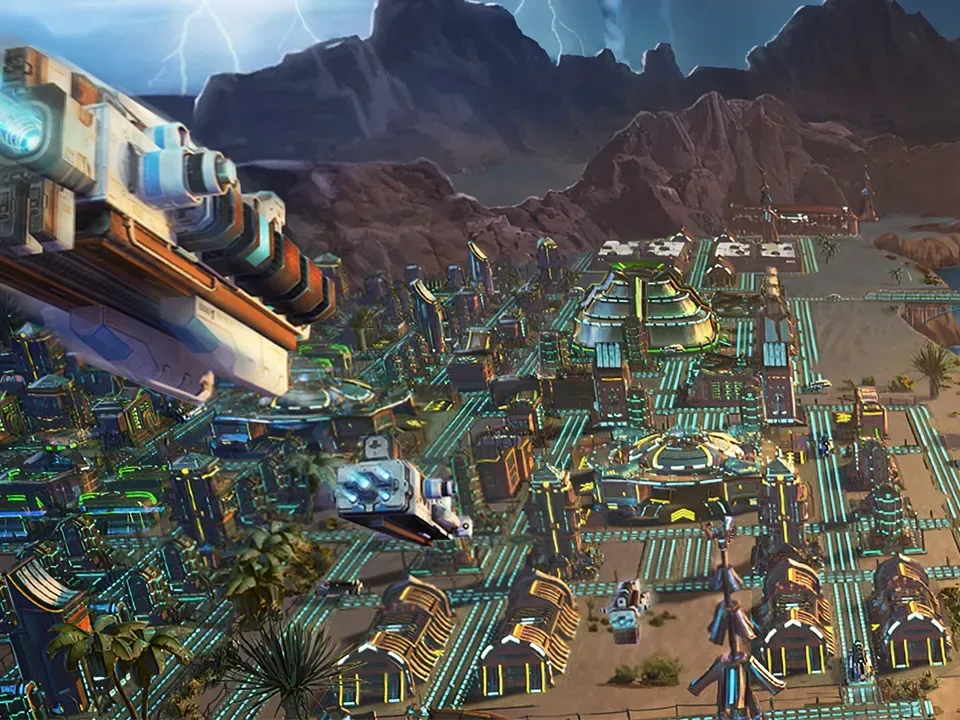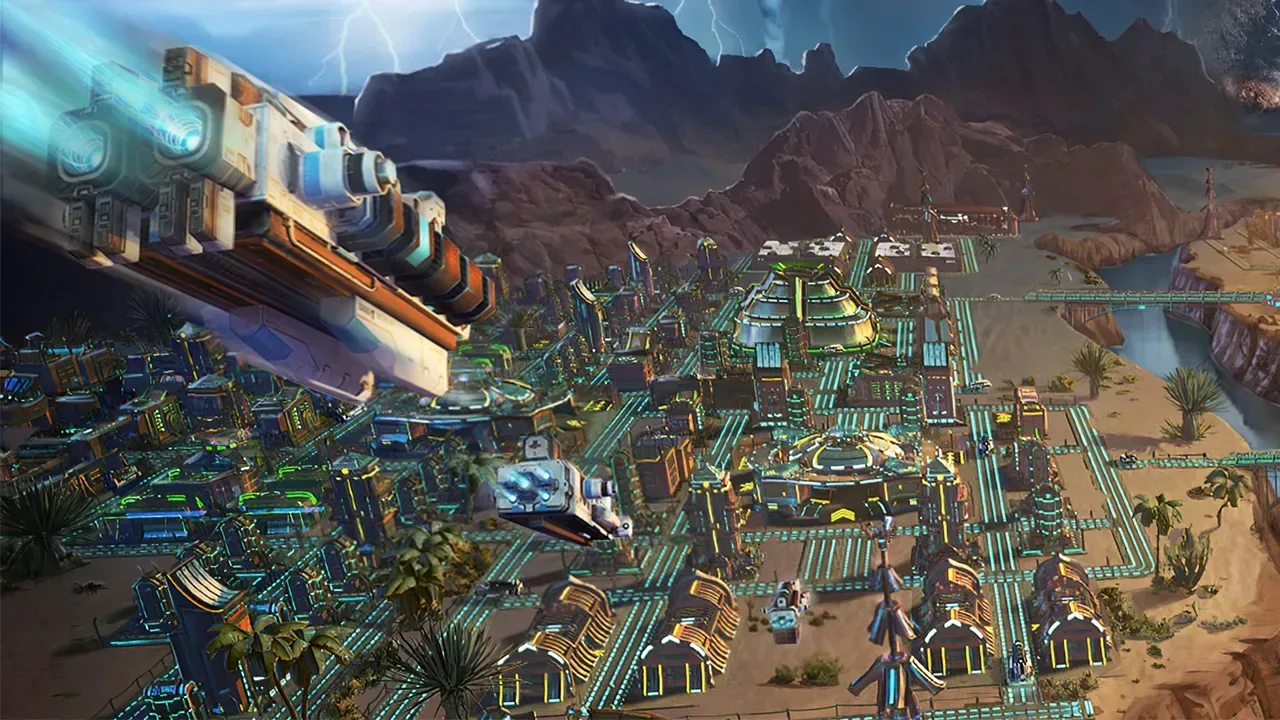
Xiri: Oasis Cities has been announced for PC, bringing an unusually hostile interpretation of the city-builder formula to a high-tech desert future. Rather than treating an oasis as a peaceful starting point for tidy districts and ever-rising efficiency charts, the game frames it as a vulnerable settlement surrounded by environmental danger, corporate competition, and political uncertainty.
The central challenge is survival. Players will establish and manage a city in the desert while contending with natural disasters, cyber warfare, and delicate alliances with nearby settlements. It is a setup that puts the usual city-building concern of growth under pressure from forces that may be harder to predict—or solve with another row of housing.
Its future is also one run by megacorporations, which means municipal management apparently comes with the kind of office politics that can wreck infrastructure rather than merely derail a meeting. Xiri: Oasis Cities plans to mix construction and resource decisions with industrial espionage, rival economic interests, loans, loyalty management, and the threat of spies operating inside a growing settlement.
A city-builder where the oasis is never fully safe
Desert city-builders naturally invite questions about resources, logistics, and expansion, but Xiri: Oasis Cities is positioning danger as an active part of its identity. Natural disasters are among the stated threats facing an oasis, making the surrounding environment more than a backdrop for futuristic architecture. A settlement may need to grow, but it must do so in a place where stability cannot simply be assumed.
The announced premise also emphasizes relationships between neighboring settlements. Those alliances are described as fragile, an important distinction in a game about a landscape where a nearby city could be a partner, a competitor, or both at different moments. That should make diplomacy matter beyond a simple friendliness meter, even though the precise form those systems will take has not yet been detailed.
What is clear is that Xiri is not presenting city management as an isolated exercise. Decisions within one oasis may exist alongside negotiations, economic maneuvering, and pressure from other settlements. The city on screen is only one part of a wider corporate desert, and a successful plan may depend on understanding what is happening beyond its borders.
Xiri: Oasis Cities places a new settlement at the crossing point of environmental survival, corporate power, and digital sabotage.
Humans, androids, and drones share the population ledger
The population in Xiri: Oasis Cities will evolve over time and include humans, androids, and drones. That three-part makeup is one of the more immediately distinctive parts of the announcement. It suggests a city whose residents and workers are not a single uniform group, but a mix of biological people and technological entities with potentially different roles in daily life.
Related coverage includes Xiri: Oasis Cities Brings Survival City-Building to a Corporate Desert Future.
The announcement does not spell out how each group will behave, what individual needs they have, or whether they can be assigned specialized work. Still, their inclusion gives the city a broader social and technological scope than a conventional settlement simulator. A future oasis may be a place where human residents live alongside androids and drones that help sustain, operate, or defend the city.
That mixture also fits the game’s larger emphasis on infrastructure. In a world where cyberattacks can target rivals, systems and automation are not just conveniences. They may be valuable assets, weaknesses to protect, or both. The difference between a smoothly functioning city and a vulnerable one could be especially meaningful when digital conflict sits next to resource and population management.
Corporate rivalry goes beyond the balance sheet
Industrial espionage is a stated component of Xiri: Oasis Cities, placing it squarely in a future where corporations compete through covert action as well as construction and trade. The game’s megacorp setting provides the backdrop for that competition, while its listed actions give a sense of how direct the rivalry may become.
Players will be able to launch cyberattacks against rival infrastructure. That detail makes the competitive side of the game feel more aggressive than simply undercutting a neighboring settlement’s production or winning a contract first. An attack on infrastructure could potentially turn an external dispute into a tangible problem for another city’s operations, though the announced information does not yet explain the mechanics, scope, or consequences of those attacks.
Other named systems include managing loyalty levels, negotiating loans, detecting spies, and manipulating economic conditions. Taken together, they point toward a city-builder with a significant political and financial layer. Building a functional oasis may involve more than placing structures and maintaining supply chains; it may also mean deciding whom to trust, when to borrow, how to maintain support, and whether a rival’s apparent setback is truly accidental.
There is plenty still unknown. No specific economic model, diplomatic interface, combat framework, campaign structure, or multiplayer mode has been outlined. It would be premature to assume that every listed idea has equal weight or that all of them will interact in a particular way. But the announced feature list establishes a clear ambition: urban planning in Xiri is meant to be entangled with corporate gamesmanship.
Cybersecurity becomes civic planning
Most city-builders ask players to think about services, residents, transport, production, and long-term planning. Xiri: Oasis Cities adds a more pointed digital-security angle through cyber warfare, cyberattacks, and spies. In this setting, protecting a city may not only mean responding to a disaster or balancing finances. It may also mean safeguarding essential systems against hostile intervention.
That concept fits the game’s high-tech tone particularly well. An oasis supported by advanced infrastructure is potentially more capable, but it may also be more exposed. The game has not specified what defensive tools players will use, whether cyberattacks can be prevented outright, or how espionage is uncovered. Even so, the presence of those concerns suggests that a city’s vulnerabilities may be as important as its visible buildings.
It is a timely thematic match for PC players accustomed to thinking about connected hardware and digital reliability outside games, too. For readers looking at broader technology built around busy gaming households, our coverage of the TP-Link Deco BE5000 WiFi 7 mesh three-pack explores a far less dystopian kind of network infrastructure. Xiri’s version, naturally, comes with corporate sabotage rather than a weak signal in the upstairs room.
What has been confirmed—and what has not
The confirmed basics are straightforward. Xiri: Oasis Cities is a survival-focused, high-tech city-builder planned for PC. It is set in a future shaped by megacorporations and centers on creating and managing a desert oasis. Its announced pressures include natural disasters, cyber warfare, and unstable alliances between neighboring settlements.
The game will feature an evolving population made up of humans, androids, and drones. It also includes industrial espionage and lists cyberattacks on rival infrastructure, loyalty management, loan negotiations, spy detection, and economic manipulation among its systems.
Beyond that, many practical details remain unannounced. A release date has not been provided. No price has been stated, and no additional platforms have been confirmed. The size of the team, the game’s final feature set, and its release window are likewise not established by the announcement information. Interested players can, however, wishlist Xiri: Oasis Cities on Steam.
Why the premise stands out
City-builders often create tension through a steady accumulation of responsibilities: more people require more services, greater production strains the map, and expansion creates new problems that must be solved before the next phase can begin. Xiri: Oasis Cities appears to retain that management foundation while surrounding it with pressures that are more overtly adversarial.
A disaster can threaten the city from nature. A rival can challenge it through corporate conflict. A spy can introduce doubt inside its own systems. A loan can offer an opportunity while creating obligations. And an alliance can be useful without ever becoming permanently secure. That collection of pressures could give each expansion decision a different tone from a city-builder focused solely on optimizing growth.
For now, Xiri: Oasis Cities is a promising announcement rather than a fully explained design. The screenshots and announcement trailer offer the first look at its world, while the outlined systems sketch a future in which a desert settlement must be planned, protected, and politically navigated. If the game can bring its survival, cyberwarfare, and espionage ideas together cleanly, this oasis may prove to be a much more dangerous place to build than it first appears.