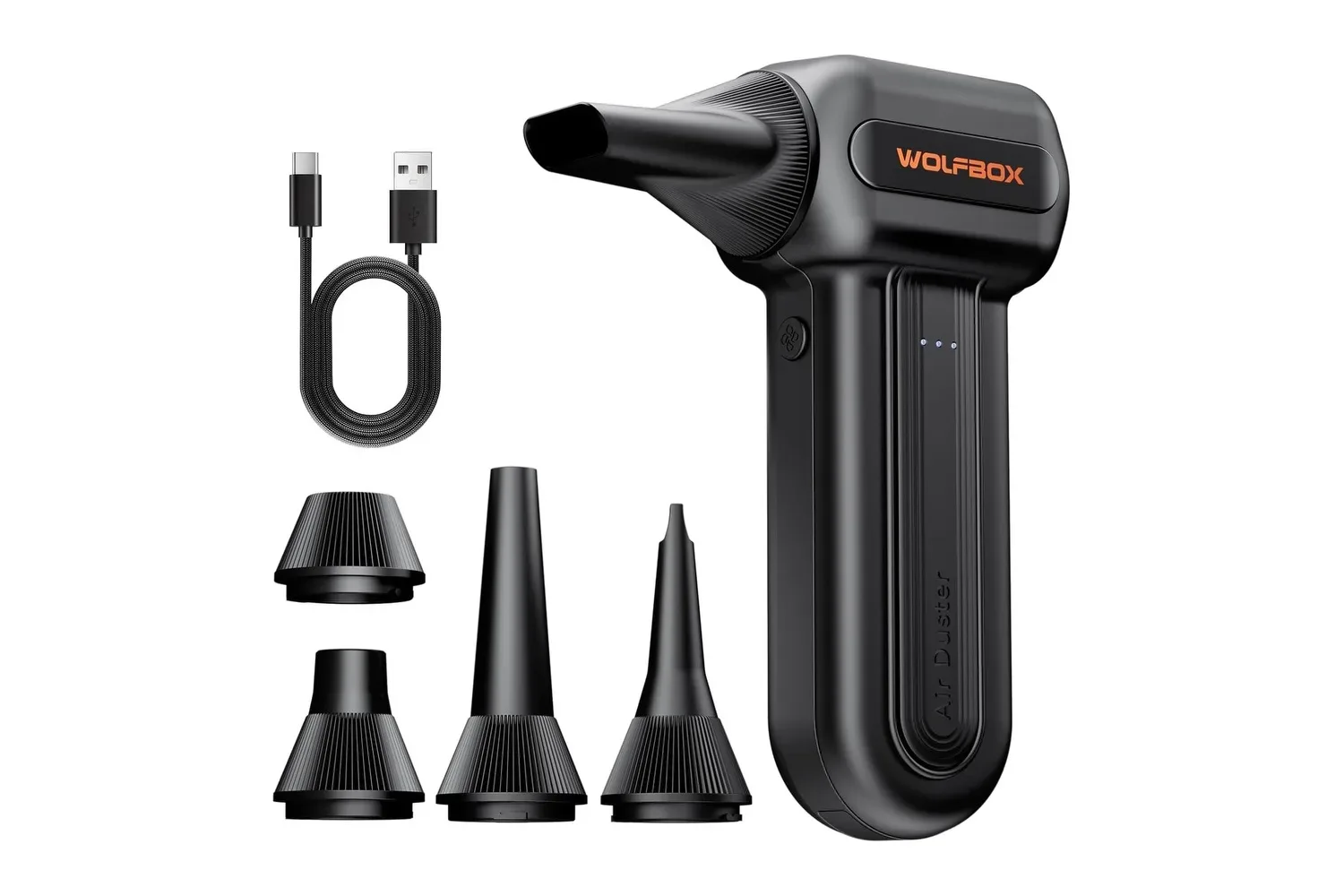
PC maintenance is rarely glamorous. It is the sort of job that tends to happen only after a fan has started sounding unhappy, a keyboard has accumulated a tiny geological layer of crumbs, or a glance through a case panel reveals dust settling where airflow ought to be. The WOLFBOX MF60 Compressed Air Duster is aimed at that unglamorous but useful category of desk and PC care, offering a rechargeable alternative to disposable compressed-air cans.
At the time reflected by the listing, the WOLFBOX MF60 was priced at $32, reduced from $50. That is an $18 reduction, or 36%. The important detail is not simply the headline discount: the MF60 combines a brushless motor rated up to 110,000 RPM, three selectable speed levels, two rechargeable 2,500mAh batteries, USB-C charging and five interchangeable tips in a device weighing about half a pound.
For PC owners, that collection of specs points to a straightforward proposition. Rather than keeping a supply of single-use cans on hand, a rechargeable blower can be stored with other maintenance gear and used on keyboards, case openings, fans and hard-to-reach nooks as needed. The MF60’s listed accessories also stretch its purpose beyond the desktop, with tips intended for vehicle vents and inflating items such as air mattresses and pool floats.
It is an accessory rather than a transformative piece of gaming hardware, of course. But the mundane tools are often the ones that make a setup easier to keep tidy. It is also one of several discounted accessories in the wider gaming gear and hardware sale mix, where the useful question is whether a product fits an actual recurring job rather than whether its percentage reduction looks dramatic.
What the three speed levels mean
The MF60’s motor is rated for a maximum of 110,000 RPM. RPM means revolutions per minute: it describes how quickly the motor rotates, not a directly stated measurement of air pressure or airflow volume. That distinction matters when reading blower specifications. A higher motor-speed number signals the machine’s operating speed, but it does not by itself tell a buyer precisely how forceful the air will feel at every distance or through every nozzle.
Still, the three modes provide a practical way to match the blower’s output to the job described for it:
- Level 1: 25,000 RPM. This lowest mode is positioned for sensitive electronics and is also the setting attached to the product’s maximum claimed runtime.
- Level 2: 60,000 RPM. This middle option is intended for standard dusting tasks.
- Level 3: 110,000 RPM. The maximum setting is intended for heavier cleaning tasks, including PC radiators and fans.
Variable speed is arguably more relevant than a single maximum number for routine computer cleaning. A narrow keyboard gap, an exposed case component and a dust-clogged fan do not necessarily call for the same approach. Being able to start with a lower output and move up when dust is stubborn gives the user more control than a device with only one setting.
That does not turn every cleaning task into a reason to use maximum speed. The supplied information identifies Level 1 as the option for sensitive equipment, while the highest setting is framed for heavier fan and radiator cleaning. Those use cases offer a sensible guide: use the output appropriate to the material and location being cleaned, rather than treating the top setting as the default because it is the largest number on the box.
Why the brushless motor is worth noting
The MF60 uses a brushless motor. In plain terms, a brushless motor is an electric motor design that does not rely on the physical brushes used in older brushed designs to transfer power in the same way. Here, the immediately relevant claim is that it supports the duster’s stated motor speeds and steady airflow.
For someone considering this as a PC-care tool, the more useful takeaway is modest: this is designed as a powered, reusable device, not as a consumable can whose usefulness ends once its contents are spent. It is a different ownership model. A disposable air can is ready when purchased but must eventually be replaced. The MF60 instead depends on keeping its batteries charged.
Neither approach removes the need for care around electronics. The device can move dust, but it cannot make a cleaning job automatic. Users still need to consider where the dust is being blown, which attachment is installed and whether a particular space calls for a gentler setting. The product’s controls and tips make those choices available; they do not eliminate the need to make them.
Five tips cover more than a PC case
The included tips are central to the MF60’s versatility. They are not five versions of the exact same nozzle. Each is described for a different kind of access or job:
- Flat tip: intended for cleaning around PC components and inside a case.
- Long tip: intended to reach deeper into keyboards and vehicle ventilation systems.
- Round tip: intended for general dust removal.
- Two inflation tips: intended for pool toys, floats, swim rings and air mattresses.
The flat and long tips are likely the most relevant pieces for a gaming desk. PC cases contain corners, cable-adjacent spaces and component layouts that are easier to target with a shaped nozzle than with a broad blast of air. Likewise, keyboards collect debris in narrow spaces between and beneath keys, where a longer reach can be more useful than simply aiming at the surface.
The inflation attachments broaden the MF60’s stated purpose, though they also underscore that this is a small utility tool rather than a dedicated PC-only product. Someone who only wants to clean a keyboard once a year may not need that breadth. Someone who has a computer setup, car interior and occasional inflatable item to deal with may find the variety more appealing.
Battery claims need the right context
WOLFBOX lists two 2,500mAh rechargeable batteries and says the MF60 can run for up to 240 minutes on the lowest speed. It also lists an approximately 3.5-hour recharge time through the built-in USB-C port. An LED indicator is provided to show the remaining battery level.
That “up to” language is crucial. The 240-minute figure applies specifically to Level 1, the 25,000 RPM setting. It should not be read as a promise of four hours at the 110,000 RPM maximum. The supplied information does not give runtime figures for Levels 2 or 3, so buyers looking to use high output regularly should treat the low-speed estimate as an upper-bound scenario, not a universal battery-life number.
USB-C is a practical inclusion because it makes the unit easier to fit into an existing device-charging routine. The feature does not say anything about the exact charger included or required, but the port means the duster does not require an unusual proprietary connector based on the available details. The battery indicator similarly helps make a rechargeable tool less inconvenient: it offers a visible prompt to recharge instead of leaving the remaining capacity entirely to guesswork.
A reusable alternative, with a narrower value question
The clearest appeal of the MF60 is replacing repeated purchases of disposable air cans with one rechargeable device. That may mean less discarded can waste over time, and it can simplify storage for people who already maintain a PC or clean keyboards frequently. At about half a pound, the unit is also described as light enough for one-handed handling and small enough to store in a drawer, camera case or glove box.
Whether the $32 listing is a good fit depends largely on use frequency. For people who repeatedly dust a PC, mechanical keyboard, car vents or other equipment, a reusable device may be more convenient than discovering the last disposable can has run out midway through a cleaning session. The five tips and three speed levels give it a broader role than a basic one-mode blower.
For occasional, minimal cleaning, the calculation is simpler: a rechargeable accessory introduces another battery to charge and another device to store. Its 240-minute headline runtime is a low-mode figure, and no specific high-mode runtime is stated. Those are not defects so much as boundaries on what the listed specifications establish.
On the evidence available, the WOLFBOX MF60 is best understood as a compact, rechargeable cleaning tool with the controls and attachments to cover common PC and desk-maintenance tasks. The sale brings that package to $32 from $50, while the value of replacing disposable cans will vary with how often someone actually cleans their gear.
Shop the products
Check current price, model and availability at the retailer.