Witchspire, Envar Games’ open-world co-op adventure on Steam Early Access, has received its Dormant Powers update. The patch is built around a broad set of connected systems: expanded crafting and salvage, a new familiar named Scrappy, improved familiar controls, a familiar-focused emote wheel, spell-altering Sigils, and a substantial combat and equipment revision called Weapon Systems 2.0.
The update appears especially consequential for players interested in build-making rather than simply obtaining a stronger replacement weapon. Its new enhancement table allows Spell Gems to move freely between weapon bases, while both weapons and Spell Gems can be upgraded. Paired with Sigils that modify spell behavior and a revised spell selection that includes shielding and healing, Dormant Powers gives Witchspire more explicit room for support, damage, and hybrid magical roles.
Weapon Systems 2.0 changes the relationship between weapons and spells
The largest mechanical piece of Dormant Powers is Weapon Systems 2.0. The update adds a weapon enhancement table through which players can swap Spell Gems between weapon bases without restriction. In practical terms, a Spell Gem is now a more portable part of a build: it need not remain tied to the weapon base on which a player was using it previously.
That separation matters because weapon progression can otherwise force an unpleasant choice. A player might find a preferable weapon base but hesitate to change gear if doing so means abandoning the magical component they have developed. Letting Spell Gems move between bases creates a clearer distinction between the weapon itself and the spell-related component installed in it. Players can consider a new weapon base without automatically treating their existing Spell Gem as obsolete.
Weapons and Spell Gems can also be upgraded under the new system. The supplied update details do not specify upgrade costs, upgrade limits, materials, or the precise effects of each upgrade, so those particulars remain unknown. What is clear is that progression now applies to both halves of the arrangement: the weapon base and the Spell Gem.
For co-op groups, the update’s combat additions are notable because they extend beyond burst damage. Dormant Powers brings in new spells intended to support shielding and healing roles alongside high-damage configurations. A support role generally refers to a build focused on keeping allies protected, restored, or otherwise effective, rather than exclusively maximizing direct damage. Shielding is defensive mitigation or protection; healing restores allies. The exact values, ranges, cooldowns, and targeting rules for these new tools have not been detailed, but their inclusion signals that a party can now approach magical specialization with more than one job in mind.
High burst damage, by contrast, means concentrating a large amount of damage into a short period. It is often valuable when a team wants to rapidly pressure a target, but it is only one expression of combat value. Adding defensive and restorative options could give co-op players greater reason to coordinate complementary builds—provided the systems’ final balance supports that variety.
Sigils add a second layer of spell customization
Dormant Powers also introduces Sigils, items that alter spells with especially potent effects. The examples named for the system are multi-shot and orbiting projectiles. A multi-shot modifier generally means a single spell use can produce more than one projectile, while orbiting projectiles describes projectiles that circle around the caster or another focal point rather than simply traveling straight outward. The update identifies these as examples, not a complete list of Sigil effects.
Related coverage includes Witchspire’s Dormant Powers Update Adds Scrappy Familiars, Sigils and Weapon Systems 2.0.
The central rule is that rarer spells can accept more Sigils. That makes spell rarity relevant to customization capacity, not merely to the spell’s baseline standing. A spell with more available Sigil slots can potentially combine several modifiers, opening a wider design space for a player’s chosen magic style.
There is an important difference between a spell becoming numerically stronger and a spell changing how it works. A direct damage increase mostly asks whether a player wants more power. A modifier such as multi-shot or orbiting behavior can change positioning, coverage, timing, and how a spell is used around allies and enemies. Sigils therefore look set to affect spell identity as well as spell output.
The update does not enumerate every Sigil, list their rarities, explain whether particular combinations are restricted, or establish which combinations will be most effective. It would be premature to declare a best setup. Still, the stated system makes the intended direction clear: rarer spells can serve as deeper customization platforms, while the Sigils fitted to them help define the resulting playstyle.
Crafting and salvage become more prominent
The update adds extensive crafting and salvage systems. Crafting refers to creating items from available resources or components, while salvage generally means breaking down unwanted items to recover materials or otherwise convert them into useful value. The update information does not lay out individual recipes, resource types, yield rates, or whether every weapon and item can be salvaged, so players should not assume details beyond the presence of those systems.
Even without a full breakdown of the economy, crafting and salvage fit naturally beside the new upgrade, weapon, Spell Gem, and familiar features. Players now have more equipment-related decisions to make, and a salvage system can offer a path for dealing with gear that no longer suits a build. The degree to which those loops are generous, demanding, or optional will depend on implementation not described here.
For Early Access players, that caveat is particularly important. Early Access means the game remains in active development rather than being presented as a finished release. Systems can be expanded, adjusted, rebalanced, or reworked as development continues. Dormant Powers is available now, but its arrival should be viewed as an evolution of Witchspire’s current game rather than a declaration that its design is locked.
Scrappy joins Witchspire’s familiar lineup
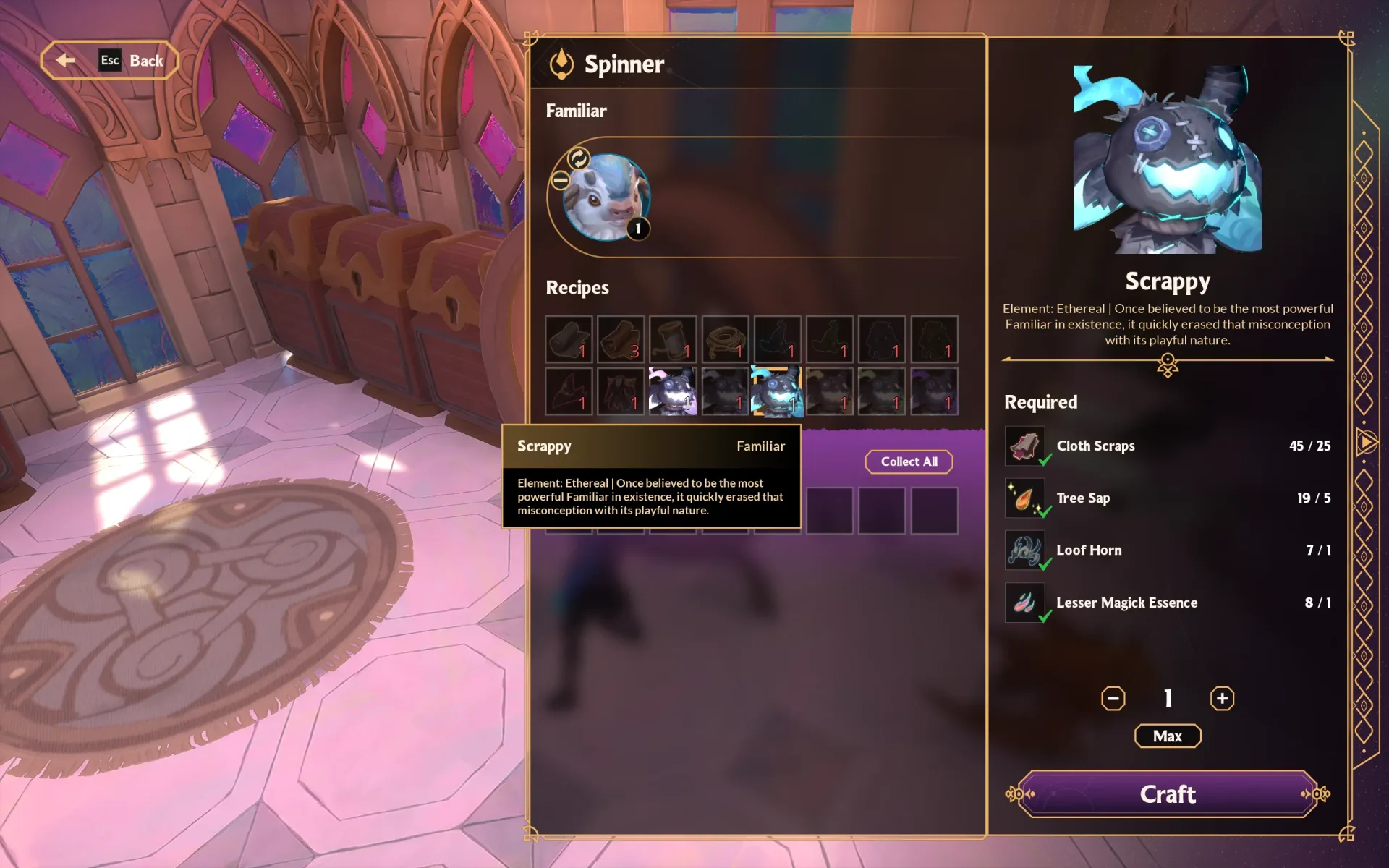
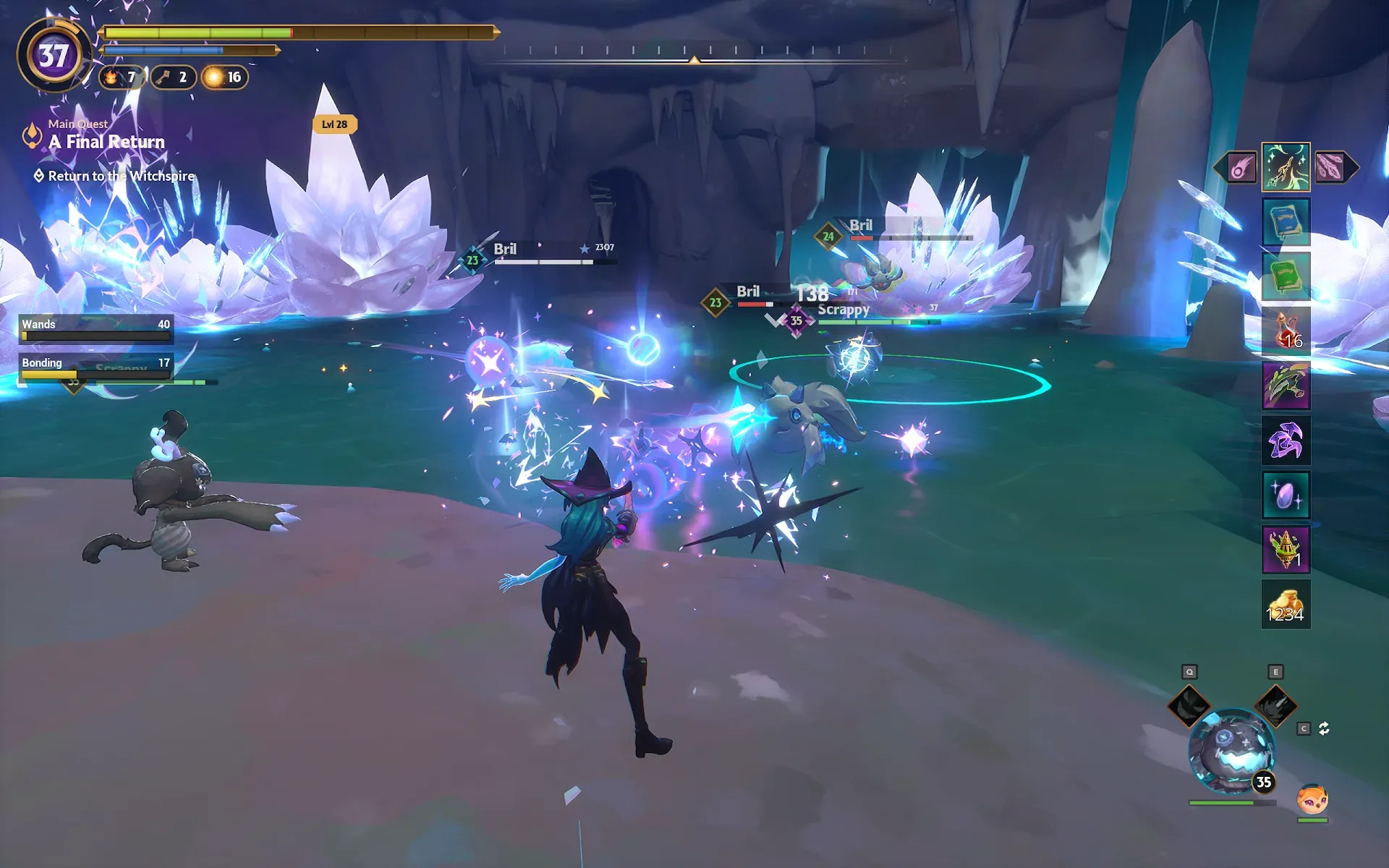
Dormant Powers adds Scrappy, a new familiar with six craftable variants. Each variant has different elemental abilities. A familiar is a companion creature associated with the player, and the update is not treating Scrappy as a purely cosmetic addition: the elemental distinction suggests that choosing a variant may matter to a player’s approach.
The supplied information does not name Scrappy’s six variants, define their elemental abilities, or explain whether they are interchangeable after crafting. It also does not establish whether one variant is stronger than another. The relevant confirmed detail is that there are six craftable choices and that their abilities differ by element.
Familiar control has been improved as part of the same update, and players also receive an emote wheel for familiar interaction. An emote wheel is a menu interface that groups expressive or interaction commands in a radial selection layout. Here, it is specifically tied to interacting with familiars. The announcement does not specify every available emote or say whether the wheel has gameplay consequences beyond interaction, so it is safest to view it as an added communication and companion-engagement feature unless further details establish otherwise.
Scrappy arrives after Witchspire’s earlier Haunted Magick update, which added two other familiars: Enmire and Pumpaling. With three named familiar additions across those two updates, the companion side of Witchspire has received sustained attention alongside combat, inventory, cosmetic, and construction systems.
What Haunted Magick established before Dormant Powers
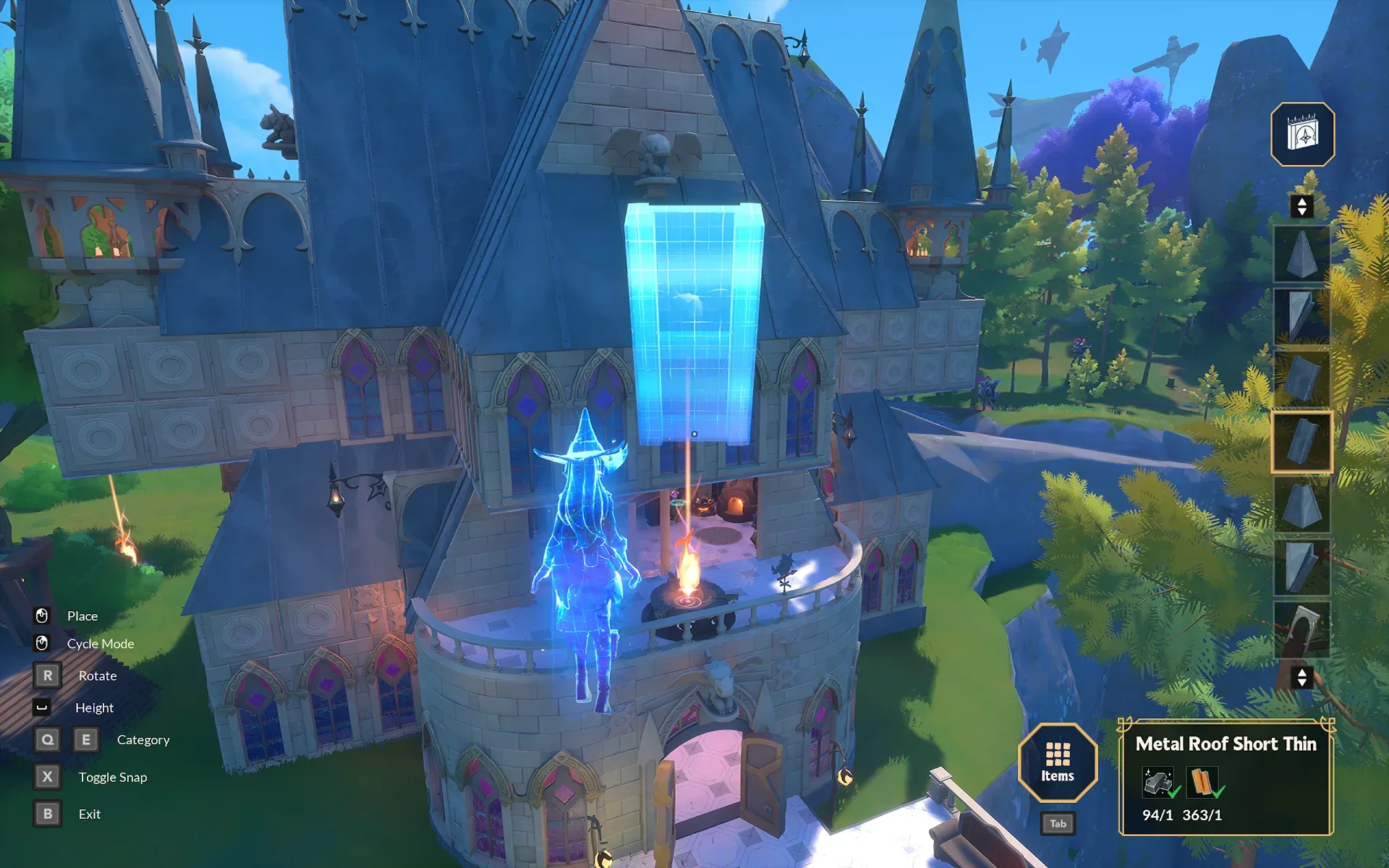
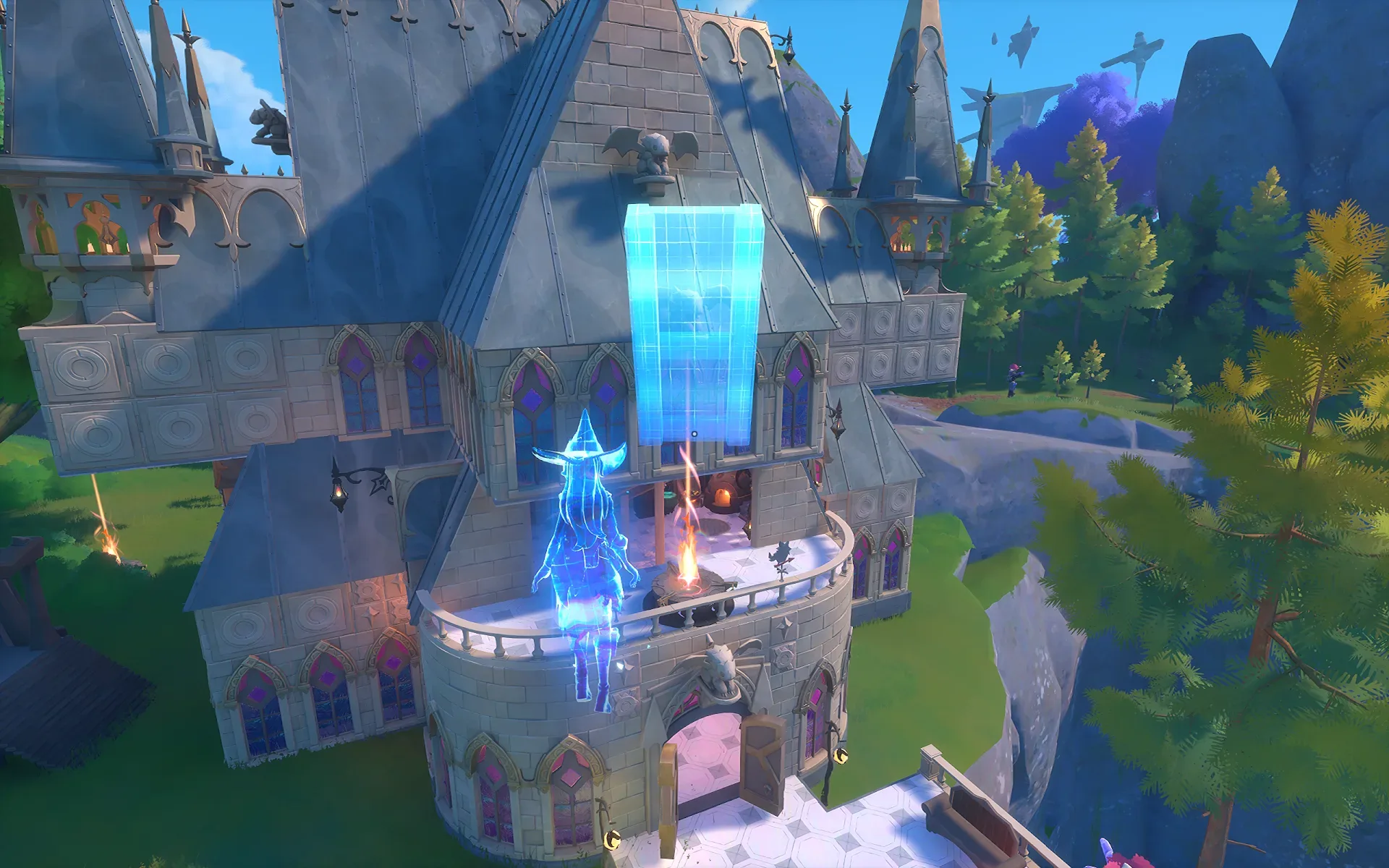
The immediately preceding Haunted Magick update had a different emphasis. It introduced inventory sorting, new outfits and player heads, an 82-piece Gothic building set, and more than 40 extra building decorations. It also added Enmire and Pumpaling.
Inventory sorting is a quality-of-life feature: it organizes a player’s carried items into a more manageable order. Its value can grow as a game adds crafting inputs, upgrade pieces, gear components, and collectibles, because more systems usually mean more inventory to oversee. The available details do not explain how the sorting functions operate, but the feature forms useful context for Dormant Powers’ broader crafting and equipment additions.
The Gothic building set brings 82 pieces, with over 40 additional decorations expanding construction options further. Those figures distinguish the building content from the newer mechanical emphasis of Dormant Powers. Haunted Magick primarily increased the available visual and architectural palette, while Dormant Powers puts more focus on the behavior of weapons, spells, companions, and resource loops.
Together, the two updates illustrate a game developing on several tracks at once: personal appearance, building, companion options, inventory management, and combat customization. That does not mean every player will engage equally with every track. A player interested chiefly in cooperative combat may care most about Spell Gems, Sigils, support spells, and Scrappy’s elemental variants. Someone drawn to building has the Gothic set and decorations from Haunted Magick as the more relevant recent additions. The overlap comes through crafting, gear choices, and the continued expansion of the game’s systems.
What players can reasonably expect now
Players returning to Witchspire for Dormant Powers can reasonably expect a changed equipment and spell-customization framework, not merely a content drop with a single companion. The weapon enhancement table, movable Spell Gems, upgrades, Sigils, and new role-oriented spells are interlocking elements. The likely immediate question for established players will be how existing preferred spells and weapon bases fit into the new arrangement.
Newer players should also recognize the limits of the available information. Dormant Powers confirms that these systems exist, but it does not provide a complete guide to resource acquisition, upgrade paths, optimal Sigil combinations, familiar crafting requirements, or combat balance. As an Early Access update, it expands the available options without resolving every practical question a player may have before opening the game.
Witchspire remains available through Steam Early Access. For more on PC gaming developments elsewhere on the site, see our coverage of Shrek 2 Remastered’s PC requirements.