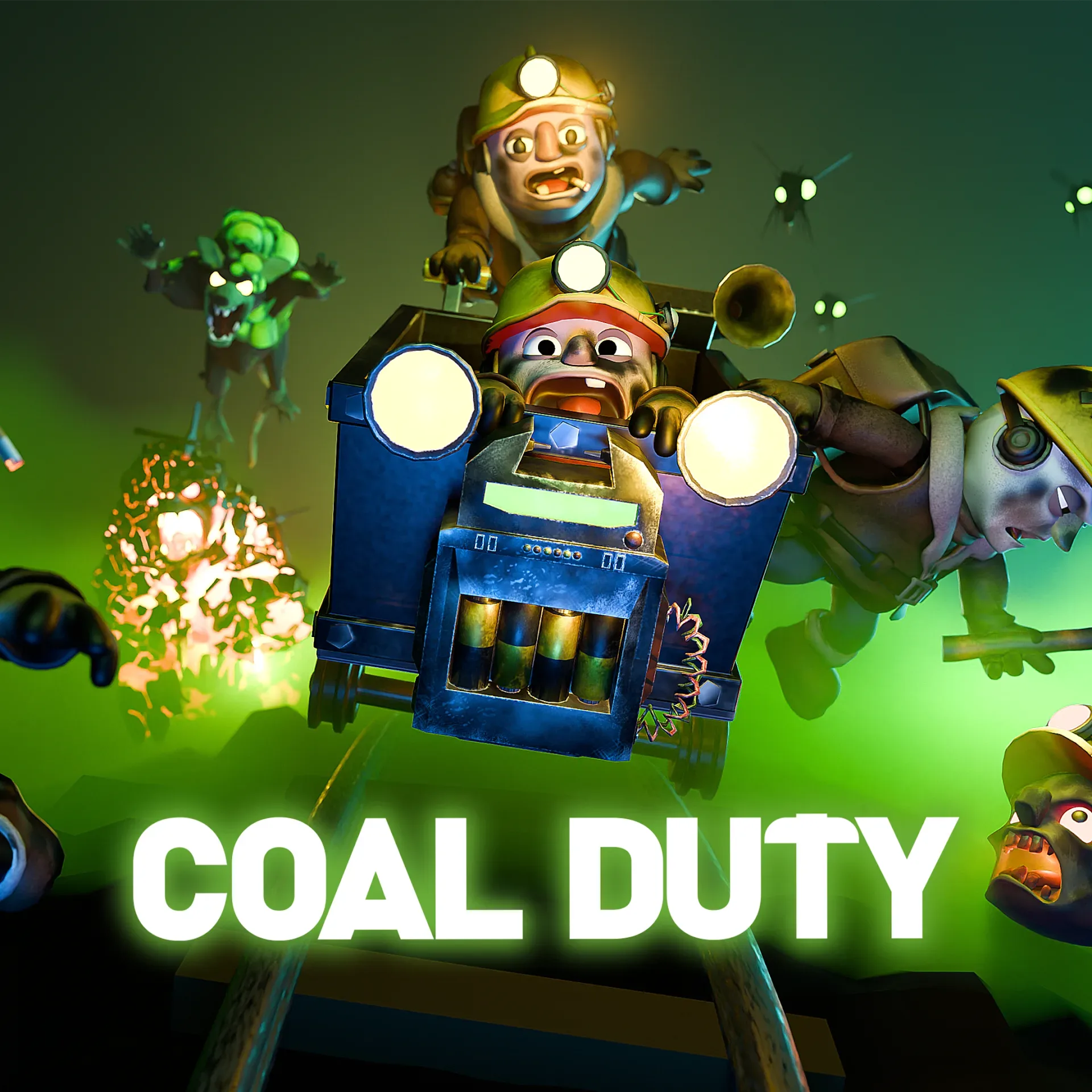
Coal Duty, a 1–5 player cooperative extraction horror-comedy from Corecrew Games, is scheduled to enter Steam Early Access on Tuesday, October 27, 2026. The game casts players as miners working beneath a frozen sky, where the standing order is brutally uncomplicated: meet the quota.
The Early Access launch expands substantially beyond the currently available demo. While the demo gives crews six expeditions on one mine floor and two quotas to complete, the Early Access version is set to open the wider operation with Easy and Hard floors, mines generated across multiple biomes, the full creature roster, and an escape machine that was not included in the demo.
Two complete endings will be available from day one. Corecrew estimates that the first can be reached in around five hours, while the other is intended for groups willing to investigate more thoroughly or follow alternate routes through the mines. That distinction is important: Coal Duty is not being framed only as a sequence of repeatable quota runs, but as a co-op game with an authored route through its larger structure as well.
A mining shift where talking can be dangerous
Coal Duty’s premise places its workers in a world where the sky froze three generations ago and the State continued operating the mines. Players enter that pressure cooker as employees expected to bring in enough value to satisfy a quota, while dealing with whatever is moving beyond the next tunnel bend.
The game’s co-op structure supports between one and five players. Crews can coordinate with proximity voice chat, trade loot, use workshop tickets and interact with a smuggler in restricted areas. Proximity chat means voice communication is based on in-game location rather than being heard equally everywhere: a nearby teammate may hear a warning clearly while someone farther down the shaft may not. Coal Duty adds a more ominous twist by making overheard planning part of the danger. Whatever is waiting in the tunnel can hear the crew, too.
That mechanic has the potential to turn ordinary co-op conversation into a tactical decision. In many multiplayer games, voice chat is an external layer players use freely to relay directions, call out hazards and react to surprises. Here, communication appears to be one of the systems under pressure. A loud, immediate warning may help a nearby teammate, but it may also advertise the group’s presence. Conversely, discretion can preserve uncertainty for the crew itself.
Players should not read that as confirmation of particular enemy behaviours or specific stealth rules; those details have not been laid out. What is clear is that the game deliberately connects spoken planning with the threat of the mine, rather than treating communication as completely separate from play.
What “extraction” means in Coal Duty’s setup
Extraction games generally organize a run around venturing into a hostile space, gathering valuable resources or completing objectives, then making it out with the rewards. The central tension is not simply whether a crew can acquire loot. It is whether that crew can safely convert what it has found into progress by escaping.
Coal Duty applies that broad structure to a mining operation. Loot, quotas and escape are all explicitly part of its loop, and the escape machine is among the features being held back from the demo until Early Access. The result is a setting where financial or operational pressure and survival pressure point in the same direction: crews need to stay in the mine long enough to make the quota, yet each extra detour can create another opportunity for things to go wrong.
The presence of workshop tickets and a smuggler suggests additional choices around resources and preparation, although the available information does not define their precise uses. They nonetheless fit the game’s broader push toward decision-making between expeditions and within restricted spaces. In a co-op extraction setup, a useful item is often not merely something a player finds; it can become the subject of a group decision about who carries it, when it is spent and whether the team risks staying longer to pursue something better.
Coal Duty also labels itself a horror-comedy. The horror side is apparent in the hostile mine, creature roster and precarious escapes. The comedy component is less specifically defined, so it is sensible not to presume the exact tone of its gags or encounters. Still, there is a naturally darkly comic edge to a bureaucracy that reduces an underground nightmare to a work target. “Make the quota” is a suitably bleak instruction when the workforce is navigating procedurally generated mines under a permanently frozen world.
Early Access content: floors, biomes, creatures and endings
The Early Access release will introduce both Easy and Hard floors beyond the single floor accessible in the demo. Floors imply different layers or tiers of the operation, while the Easy and Hard labels plainly indicate an intended range of challenge. The available details do not say exactly how difficulty changes from one floor to another, whether through hazards, layout, creature behaviour, resource demands or some combination of those elements.
What is established is that the mines will be generated across multiple biomes. In practical terms, procedural generation means the game can construct or arrange mine spaces for individual runs rather than relying on one fully fixed layout. Multiple biomes broaden the potential environmental variety within that generated structure. The information provided does not promise endlessly unique maps, nor does it identify the biomes themselves, but it does indicate that the full version is designed around more variety than the demo’s one-floor slice can show.
Corecrew will also make the game’s complete creature roster available in Early Access. Since no individual creatures or abilities have been detailed, players should be cautious about assuming which threats appear where or how they react. The important confirmed point is scope: the demo does not represent every danger intended for the initial Early Access build.
The two endings are perhaps the clearest signal that the developers are thinking beyond an endless-run format. The first is expected to take roughly five hours to reach. The second requires a crew to dig deeper or make alternate route choices. That phrasing leaves room for players to interpret “deeper” both as a literal mining objective and as an invitation to probe the game’s branching paths. It also means groups interested in seeing everything should expect their decisions and willingness to explore to matter more than a straight trip to the first available finale.
A public development process with more updates planned
Corecrew Games is a five-person team developing Coal Duty in public. Around 2,500 players participated in community playtests before the demo, and the studio intends Early Access to remain an active feedback channel rather than a final, fixed product launch.
The planned Early Access period is 12 to 18 months. That estimate is a development target, not a guarantee of a final release date, but it provides a useful expectation for anyone considering when to join. Early Access is a model in which a game is playable before its full development is complete, with updates added over time. Its practical trade-off is straightforward: players can help shape the game and access its evolving systems earlier, but they should expect change during the process.
Coal Duty’s roadmap includes new escape routes and endings, creatures, biomes, expanded hub activities, and additional tools and items. Each category connects to a different layer of the game. New escape routes could widen the decisions surrounding a successful run; endings could build further on the game’s launch-day alternate paths; new biomes and creatures can refresh the mine’s dangers; and tools, items and hub activities can deepen preparation and the time between expeditions.
None of those planned additions has a confirmed schedule in the available information. The roadmap is therefore best understood as a direction for the Early Access period rather than a list of features guaranteed on a particular patch date. For a small team, player feedback can help determine which issues and ideas take priority, especially in a game where the pacing and clarity of group communication may be central to the experience.
Demo availability and language support
The free Coal Duty demo has been on Steam since October 8 and is available through Steam Next Fest October Edition. It offers six trips through a single mine floor and two quotas, making it a more limited look at the broader Early Access package rather than a replacement for it. Players looking at other current Steam demos can also find a useful comparison point in this look at another Steam demo arriving ahead of launch.
Coal Duty will launch with support for 13 languages, including Turkish, Japanese, Korean and Simplified Chinese. That is a meaningful consideration for a game whose communication is part of the premise. The exact division between text localization, interface support and any other language features has not been specified, but the 13-language launch support establishes a broader intended audience for the game’s first Early Access build.
Full game footage is under embargo until October 19 at 9 a.m. Pacific. Until then, the demo is the available hands-on route for players who want to judge the core loop for themselves. The larger question for the October 27 launch will be how successfully the expanded floors, randomized mines, creatures and escape system turn Coal Duty’s quota-driven premise into a co-op ritual worth repeating—preferably with enough whispering to avoid waking up the neighbors underground.