A fast-food mascot-led game can be a quick novelty, a strange promotional tie-in, or—in the rare case that seems to apply here—a game that visibly wants to be played. WendyQuest: Legend of the Four Corner Stones is a forthcoming 2D, pixel-art, turn-based RPG for Steam that casts Wendy as the lead of a quest to save a culinary kingdom from evil mech-monsters.
Its premise is knowingly silly, but the material shown so far gives that silliness a clear game-shaped framework. Wendy travels with a party of three other adventurers through areas filled with food-themed hazards, encounters sentient menu-item enemies, and enters battles in which restaurant items can restore HP. The result is not a claim that a burger is suddenly fantasy literature; it is a remarkably committed attempt to turn a restaurant menu into RPG language.
No precise release date has been provided. The current window is simply “soon”, and the game has an official Steam page. That means interested players have a place to follow the project, but they should not mistake the listing for a confirmed launch day, price, or full breakdown of the game’s systems.
A restaurant parody built around recognizable RPG ideas
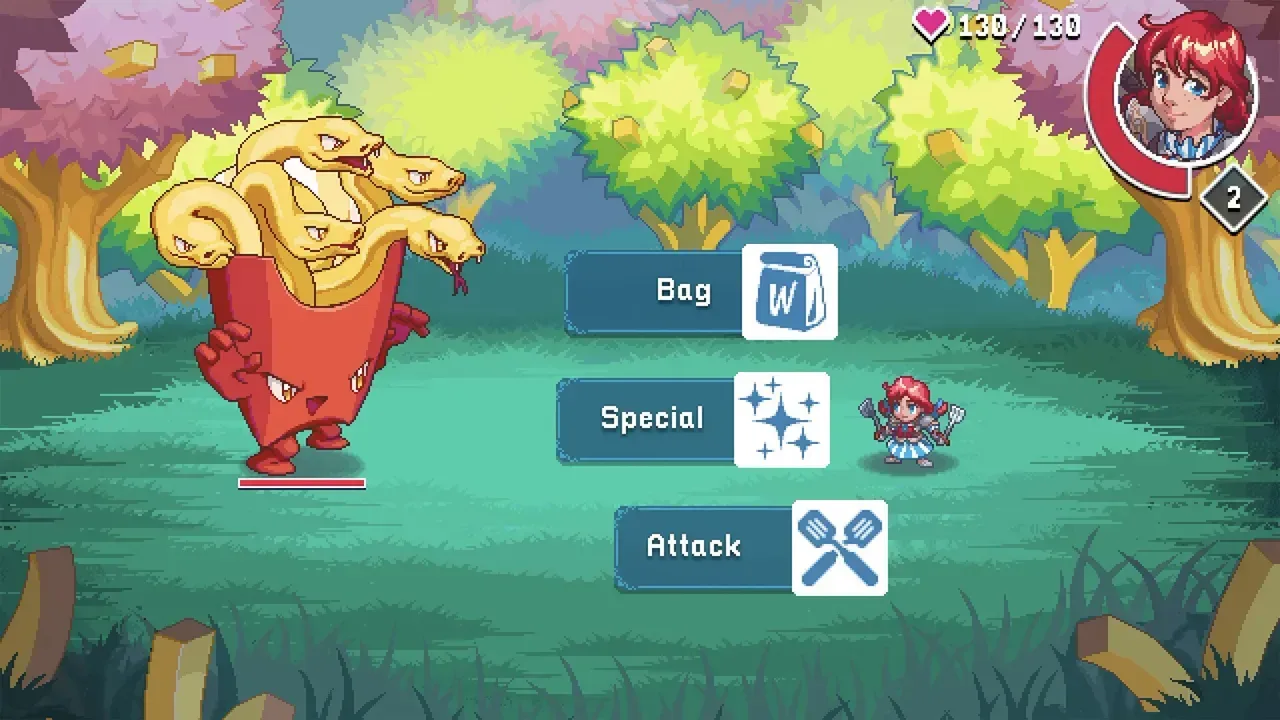
At its most basic level, WendyQuest is using a familiar role-playing structure. A party travels through a world, confronts enemies, and manages health during turn-based combat. Turn-based means participants take actions in sequence rather than attacking simultaneously in real time. That format puts an emphasis on choosing an action at the right moment—whether that is an attack, a recovery item, or another available command—rather than reflexes alone.
Only a limited portion of the combat system has been shown, so it would be premature to infer the presence of classes, elemental weaknesses, character progression, equipment systems, or other genre staples. What is established is that Wendy can use items including a Dave’s Single and a Junior Bacon Cheeseburger to recover HP, or hit points. HP is the common RPG term for a character’s remaining health; restoring it is usually central to surviving a string of encounters.
The food branding is therefore not merely pasted onto menus. At least in the examples shown, it has been folded into the game’s basic vocabulary: dishes become restorative items, food containers become monsters, and spilled sauce becomes an environmental problem. That coherence matters. A branded game does not need to hide the brand to be enjoyable, but it does need its theme to serve the game rather than interrupt it. WendyQuest’s early footage and screenshots suggest a world designed from the premise outward.
Frydusa and the perils of a sauce river
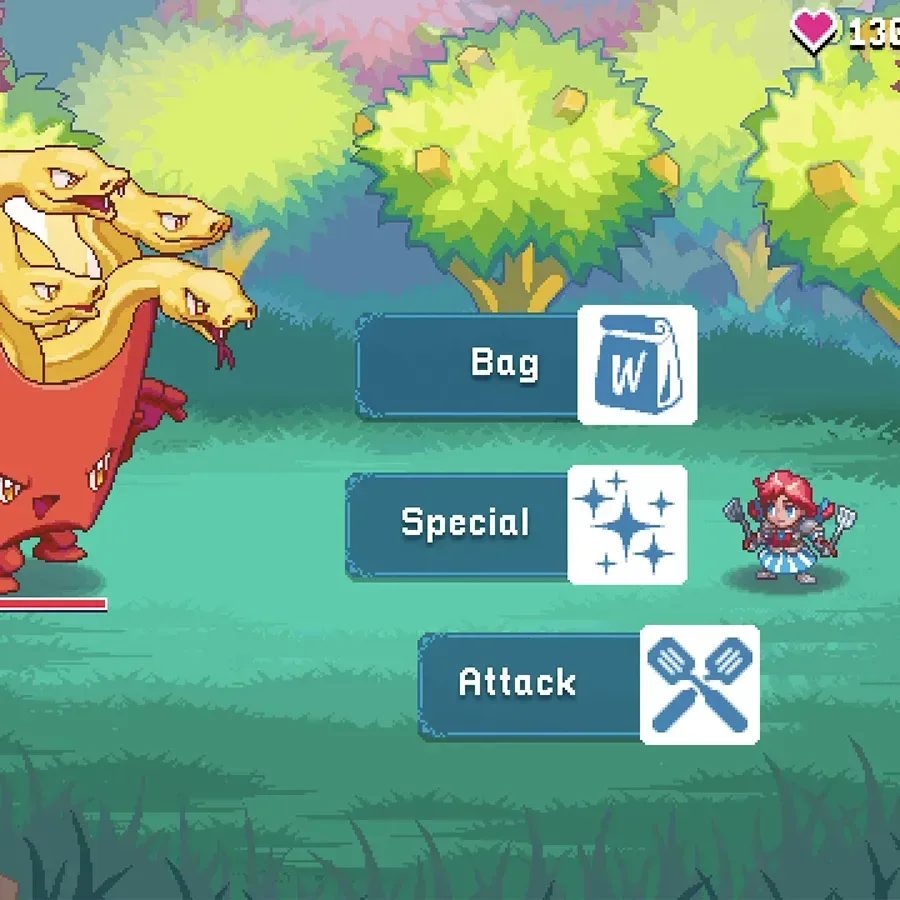
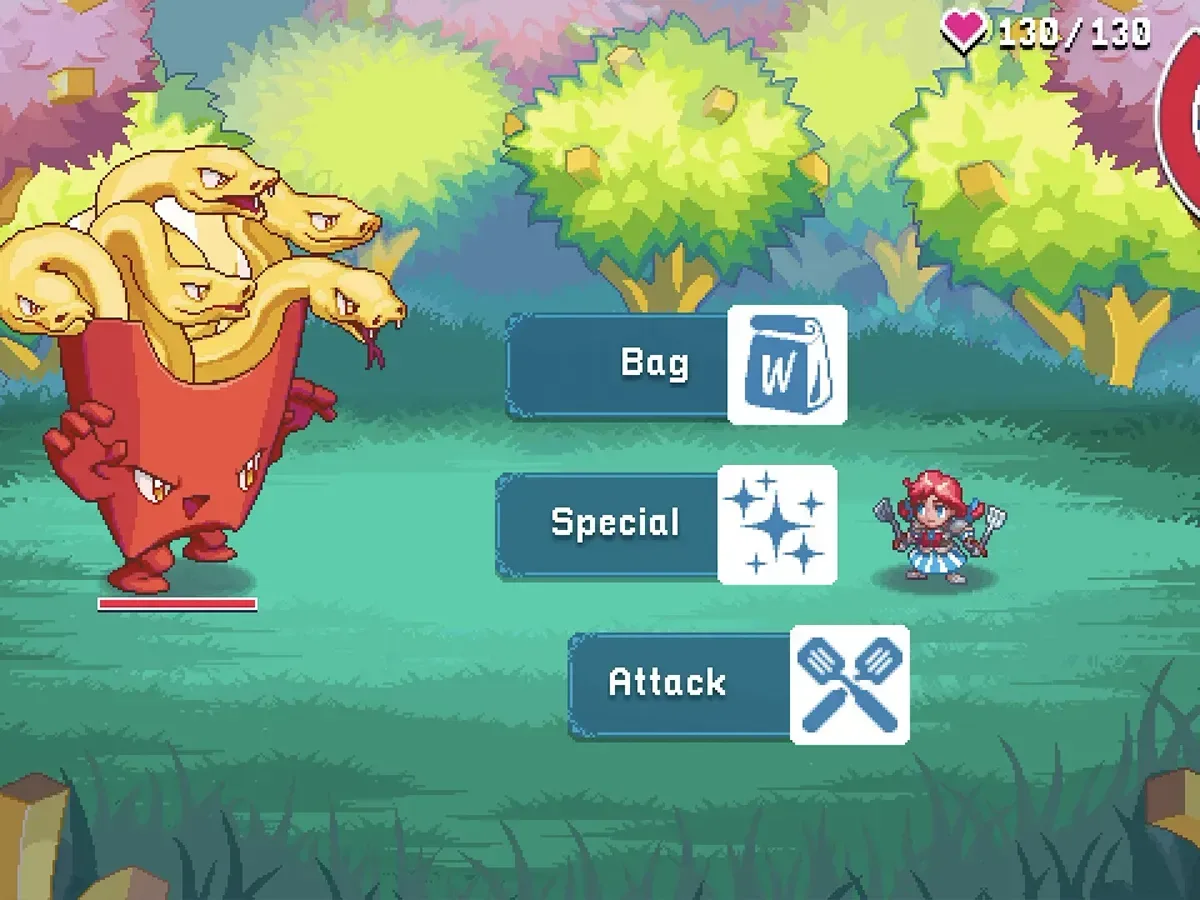
The clearest expression of that approach is Frydusa: a container of french fries transformed into snake-like creatures. It is an intentionally absurd enemy concept, but it reads immediately as a threat within a cartoon fantasy world. It also communicates the project’s tone without needing a lengthy explanation. This is a place where food is alive, hostile, and apparently capable of becoming a mythological nuisance.
Elsewhere, Wendy must deal with a river of sauce spilled from a container. That image hints that exploration will involve more than walking from one battle to the next, though it does not confirm the exact kind of obstacle-solving the finished game will contain. It could be a straightforward route-blocking puzzle, a contextual interaction, or simply a story beat. For now, the reliable takeaway is that the maps shown include hazards intended to make the culinary setting feel physical rather than decorative.
Related coverage includes WendyQuest Brings a Pixel-Art Turn-Based RPG to Steam.
The party includes Sir Chicken, with other allies also accompanying Wendy. The party size and visuals point toward the kind of ensemble travel associated with classic 2D RPGs, where a group of distinct characters can make combat scenes and dialogue more expressive. Still, the available material does not establish each ally’s combat role or whether the lineup changes over the course of the adventure.
The jokes understand the assignment
WendyQuest is not trying to play its premise straight. Screenshots show dialogue that openly acknowledges how strange its own names are. In one moment, Wendy sees notes written to someone called Baconator and questions whether that could possibly be a real name. In another, the game works in the enduring “Where’s the beef?” line.
Those are not subtle jokes, and subtlety is clearly not the intended flavor. The dialogue appears to frame the world as a parody that knows it is built around familiar restaurant terminology. That self-awareness can be useful in a licensed or promotional game: it gives the player permission to laugh with the game instead of wondering why it expects every branded name to carry grave dramatic weight.
There is also a practical storytelling advantage. Menu names, mascot imagery, and food puns are immediately legible. They give the developers a common language for enemies, locations, items, and throwaway dialogue. The challenge will be whether the full game can keep introducing ideas beyond the initial joke. A single Frydusa is a good gag; a sustained RPG needs encounters, places, and character moments that make the gag feel like a setting rather than its only setting.
Why the response has been unusually warm
Early reactions have focused less on the fact that a restaurant chain is making a game than on how polished the pixel-art presentation appears. That distinction is important. Players are used to odd crossovers and branded promotions. Surprise comes when a project seems to have visual identity, a readable world, and mechanics appropriate to its genre instead of functioning as a disposable ad wrapped around a logo.
Pixel art is a visual style built from deliberately visible, block-like pixels. It can evoke older games, but it is not automatically retro in design or limited in ambition. In WendyQuest’s case, the pixel presentation gives the food enemies and terrain a consistent 2D look, while the turn-based format provides a natural fit for an adventure driven by party encounters and item use.
The game is being developed by 81monkeys, an independent studio based in Port Moody, British Columbia. The studio is also working on World of Anterra, described as an innovative open-world role-playing game inspired by classic and modern titles. The connection does not reveal WendyQuest’s scope, but it does place the project with a developer already working in the RPG space rather than presenting it as a mascot concept assembled without genre experience.
The Steam page also describes WendyQuest as “100% fresh and 100% human made.” That wording has drawn favorable attention because it directly addresses concerns around generative AI in game production. It is a production claim presented on the game’s own listing, not a detailed account of every element of development, but it is nevertheless a deliberate part of how the project is being introduced.
Fast-food games have form, even if the results vary
WendyQuest is not the first game connected to the chain. In 2019, Wendy’s released Feast of Legends, a free 100-page tabletop RPG in which players could battle Ronald McDonald. That earlier project already demonstrated a willingness to use role-playing conventions for promotional world-building.
The broader fast-food-game conversation also inevitably brings up Burger King’s Sneak King, released in 2006. Its central idea was stealth comedy: players, as the King, sneak up on unsuspecting people to give them food. Its unusual premise made it memorable, even if it was received more as a novelty than as a standout game. WendyQuest’s visible commitment to a full RPG structure is why comparisons are being made, but the two projects are built around very different genre assumptions.
That history is a reminder that recognizability is not the same as longevity. A game can live on as an internet curiosity because its concept is bizarre. A game that earns sustained interest usually offers a satisfying loop beyond the initial surprise. WendyQuest’s shown ingredients—party travel, turn-based fights, healing items, environmental obstacles, and a deliberately ridiculous fantasy setting—are the beginnings of such a loop. Whether they become a complete, satisfying RPG will only be clear once more of the game is detailed and it reaches players.
What is known, and what remains open
For now, the responsible expectations are modest but genuinely positive. WendyQuest is a 2D, pixel-art turn-based RPG set in a food-themed fantasy kingdom. Wendy leads a group of adventurers against mech-monsters and sentient menu items. Frydusa is among the revealed enemies. Menu items can replenish HP. 81monkeys is developing it, and Steam is the confirmed platform. The release window is “soon.”
There are major unanswered questions: its exact release date, price, length, full party roster, depth of combat customization, and whether it will come to platforms beyond Steam. None of those omissions make the project less real; they simply define what has not yet been confirmed.
Until then, it is fair to say the project has already cleared the hardest hurdle for a promotional game: people are paying attention because they want to know whether the RPG itself is good, not solely because the concept sounds like a punchline. For more on another PC-focused story where platform signals need careful reading, see this look at gamepad work and unconfirmed platform plans.