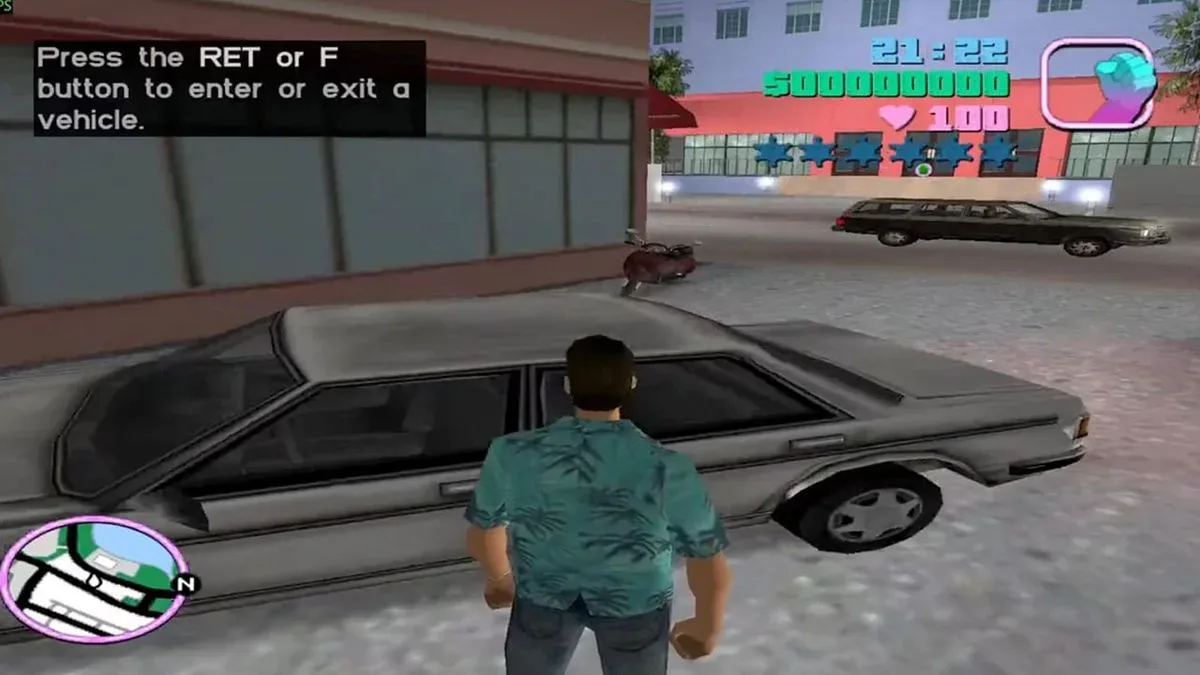
Grand Theft Auto: Vice City can now be made considerably less cool in the most technically charming way possible. ViceBounce, a mod created by tek-95, takes the classic game’s characters and world assets and makes them move, stretch and bounce in time with music selected by the player.
This is not a conventional expansion that adds missions, vehicles, map space or a new gameplay system. Its entire premise is audiovisual disruption: pick a track, let the mod detect its beat, and watch Vice City’s usual presentation become a rhythm-driven physics spectacle. That means scenes intended to be serious, including the game’s opening material involving Tommy Vercetti, can suddenly play out with everyone bobbing and warping to the chosen song.
A shared clip demonstrates the idea using “Boom, Boom, Boom, Boom” by the Vengaboys. It is an immediately understandable showcase for a mod whose appeal is less about preserving the original mood than gleefully dismantling it. The results will likely depend heavily on the selected music: a steady dance rhythm may produce a readable, playful pulse, while a more erratic track could turn the city into something much stranger.
What ViceBounce actually changes
ViceBounce affects the game’s assets rather than simply placing a music player over Vice City. In practical terms, the mod is designed to make elements of the game move, scale and bounce to the detected rhythm. The distinction matters. A custom soundtrack changes what players hear; ViceBounce attempts to make the visual world respond as well.
Beat detection is the key technical idea. It refers to software identifying the recurring rhythmic pulses in a piece of audio. Here, that detected pulse is used as a trigger for the mod’s visual transformations. The goal is synchronization: a beat arrives, and the on-screen world reacts.
Automatic timing is not guaranteed to feel perfect with every song or every listener’s expectations, so ViceBounce also includes a manual synchronization adjustment. That is useful because beat detection can identify a rhythm while still feeling slightly early or late once it is attached to visible animation. A manual option gives users a way to line up the effect more closely with what they hear.
The project is therefore best understood as a visualizer built inside a game world. Vice City supplies recognisable streets, characters and scenes; the player supplies the audio; ViceBounce connects the two. It is a simple concept, but its effect is unusually broad because it applies to the presentation of the game itself rather than a single object, vehicle or character model.
Requirements for the mod
ViceBounce is listed for Windows users and has a specific baseline setup. It requires the classic Steam release of GTA: Vice City, a 64-bit installation of Windows 10 or Windows 11, and an ASI loader that can load plugins from the game’s scripts directory.
Related coverage includes ViceBounce Turns GTA: Vice City Into a Music-Driven Physics Experiment.
- Classic GTA: Vice City on Steam
- Windows 10 or Windows 11, 64-bit
- An ASI loader configured to load plugins from scripts
An ASI loader is a utility used by many PC game modifications to load additional plugin files when a game starts. For ViceBounce, it is part of the chain that allows the game to recognize and run the mod’s script-based components. Players without a working loader will not get far merely by copying files into the installation folder.
The stated installation process is straightforward in principle: close the game, download the mod, and copy the contents of its scripts folder into the GTA: Vice City scripts folder. Anyone updating an existing installation is advised to keep their current ViceBounce.ini file.
That configuration-file advice is worth noting. An .ini file commonly stores settings, meaning an update may replace or alter a user’s established preferences if the existing file is not retained. Keeping it should help preserve prior configuration rather than requiring the player to start from scratch.
How to use personal music
Once the mod is installed, users can press F11 to choose a music file. The listed supported formats are MP3, WAC, FLAC and OGG. ViceBounce does not upload that music; it runs the chosen local file while the mod is active.
That is an important practical boundary. The feature is presented as local playback and reactive visuals, not as a service that transfers a player’s music collection elsewhere. The selected song provides the audio signal for beat detection while the game is running.
For players planning to experiment, track choice is likely to be the main creative decision. Songs with a pronounced, regular beat should make it easier to see exactly how the mod is interpreting the rhythm. Conversely, tracks with frequent tempo changes, softer percussion or abrupt transitions may be more revealing tests of the automatic system and the available manual sync controls.
There is also an obvious trade-off. Vice City has its own atmosphere, dialogue delivery and visual identity. Turning every scene into a music-responsive bounce routine can undermine dramatic timing or make ordinary driving difficult to take seriously. But that is not a defect in the premise so much as the point of a deliberately absurd mod: it offers a temporary alternate lens for revisiting a familiar game rather than a replacement for its intended presentation.
A mod focused on reinterpretation, not more content
Many game mods are judged by the volume of new content they introduce: extra missions, systems, locations, characters or technical fixes. ViceBounce takes the opposite route. It changes how existing content is perceived without claiming to enlarge the game.
That makes it a particularly accessible kind of novelty. Players already know what a Vice City cutscene, pedestrian-filled street or dialogue exchange looks like. The surprise comes from seeing those familiar pieces behave in a way the original game never intended. The mod does not need a new storyline to create a new moment; it repurposes the game’s ordinary visual language into a beat-led gag.
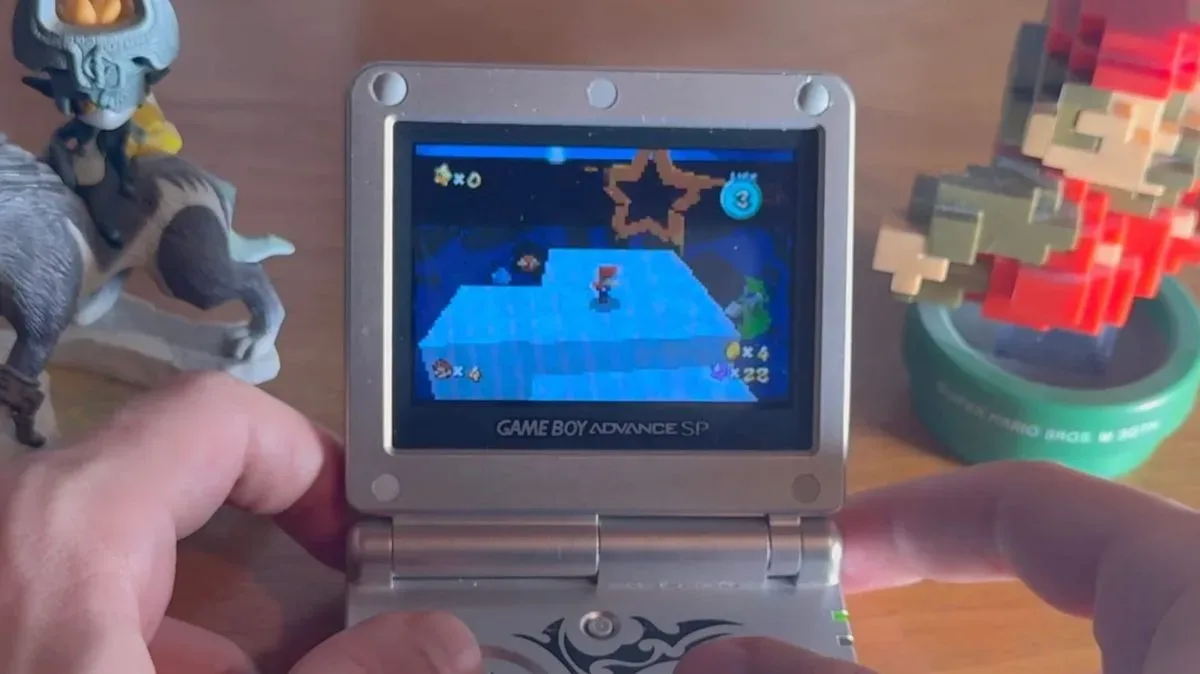
It also reflects a wider appeal of PC game modding: old games can remain platforms for experiments long after their original release context. Some efforts are reconstruction projects, such as the work described in a Super Mario Galaxy rebuild for Game Boy Advance. ViceBounce is a much smaller-scale proposition in narrative terms, but it shares the same impulse to ask what happens when a familiar game is placed in an unexpected technical framework.
ViceBounce’s listed project credits include Claude as a contributor. The precise scope of that contribution is not detailed in the available project information, so it would be premature to infer how much of the mod’s design or implementation involved it. The concrete claim remains the mod’s behavior: it uses chosen music, detects its rhythm and applies movement and stretching effects to GTA: Vice City’s assets.
What players should keep in mind
ViceBounce is for a specific version and platform setup, not a blanket mod for every release of Vice City. The stated requirements name the classic Steam edition and 64-bit Windows 10 or 11. Players using another version should not assume the same installation steps or compatibility will apply.
It is also sensible to make a backup before modifying a game installation. The mod’s instructions involve copying files into the scripts directory, and keeping a copy of existing configuration files gives users a clearer path back to their previous setup if needed. That is especially useful for a novelty project that may be installed for experimentation rather than permanent use.
For anyone whose ideal Vice City experience is exactly the original one, ViceBounce is unlikely to be essential. For anyone who wants Tommy Vercetti’s world to convulse in rhythm with their own music library, it is an unusually direct answer to an extremely specific question. It does not ask players to learn a new mode or complete new challenges. Press F11, choose a local song, and let the city attempt to dance.