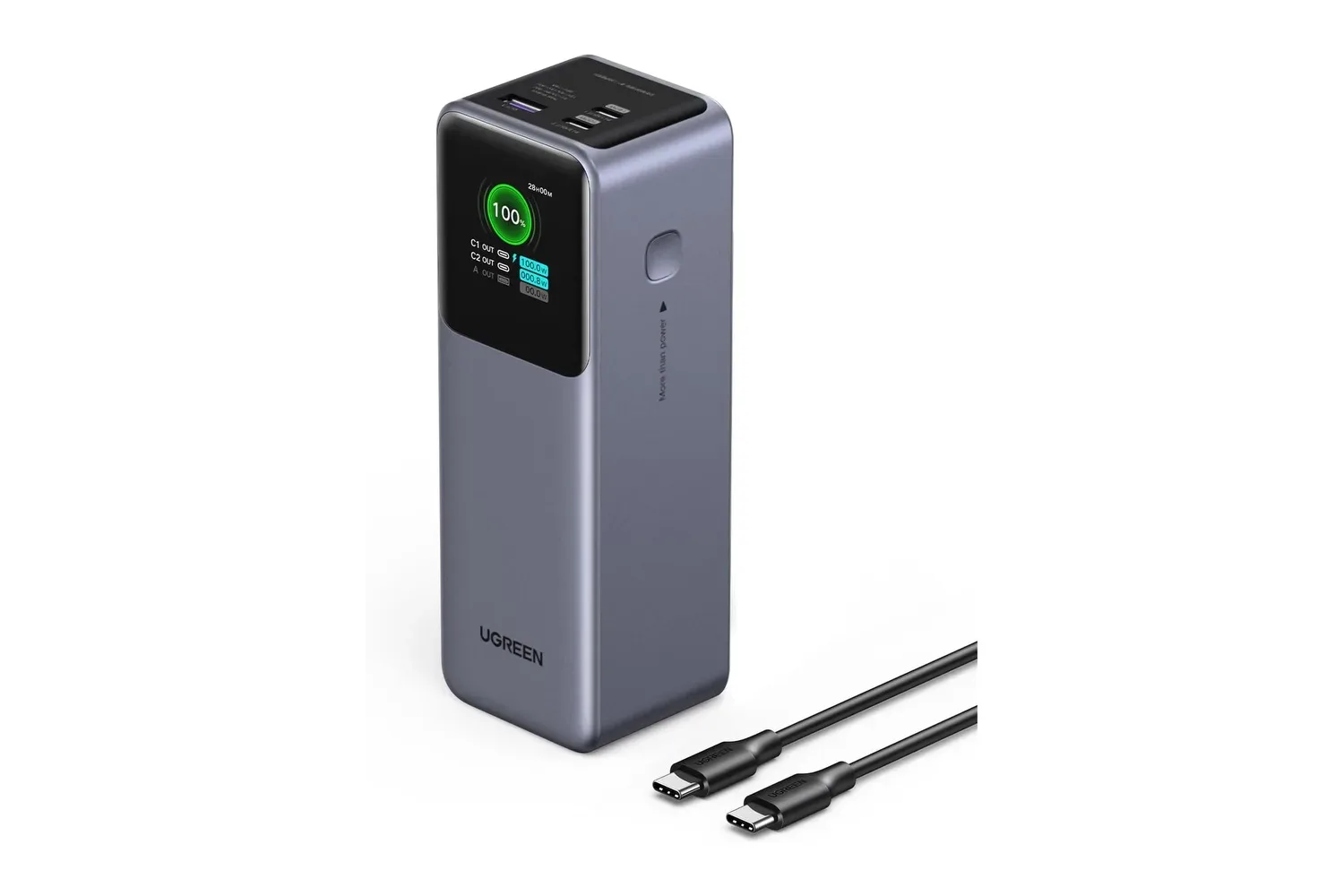
A power bank is normally the accessory you reach for when a phone’s battery bar turns the alarming shade of red. UGREEN’s Nexode 25,000mAh 200W PD 3.1 TFT 3-Port Power Bank is aimed at a considerably more demanding job: keeping a laptop supplied while also topping up the smaller gear that tends to gather around a portable gaming setup.
The 25,000mAh Nexode is listed at Amazon for $85, down from a stated usual price of $130. That is a $45 difference, or 35% off. Retail listings and promotional pricing can change quickly, so shoppers should confirm the displayed price and seller details before completing an order.
What distinguishes this particular battery pack is not merely its capacity. It offers 200W of total output, including up to 140W through one USB-C port, and uses the PD 3.1 charging standard. In a market full of pocket batteries intended primarily for phones, that changes the purpose of the device. It is built for people whose travel bag contains a notebook computer, a phone, earbuds, perhaps a handheld, and the eternal confidence that every cable packed will somehow be the wrong one.
A portable battery for more than emergency phone duty
For PC players, creators, students, and travelers, laptop charging is the headline feature. Conventional portable banks commonly provide around 20W or 30W, a level that can be useful for a smartphone but is not necessarily enough to make a meaningful dent in a power-hungry notebook’s battery while it is being used. The Nexode’s 140W USB-C output is designed for much more substantial charging demands.
The available information identifies a 16-inch MacBook Pro as a laptop that can charge from the 140W USB-C connection while work continues. PD 3.1 compatibility also broadens the field to MacBooks, Dell XPS systems, and many gaming laptops, provided the individual machine supports USB-C charging and its requirements fit the power delivery available. That final condition matters: a USB-C port does not automatically mean every laptop can accept power through it, and a computer’s own charging limits still apply.
That makes the Nexode potentially relevant to the sort of PC gamer who alternates between a desk and everywhere else. A gaming laptop will not magically behave like it is connected to its original wall adapter under every load, particularly during demanding games. But high USB-C output can be very useful for maintaining or restoring charge during lighter work, downloads, travel, strategy sessions, editing, and all the other less glamorous activities around actually playing games.
Anyone weighing a move between Apple hardware and a dedicated Windows gaming machine may already be familiar with the practical differences in laptop ecosystems, chargers, performance demands, and peripherals. Our look at switching from MacBook to Windows for PC gaming examines some of those trade-offs. A high-output battery does not erase them, but it can be a useful part of a more flexible mobile setup.
Three ports, one less cable-management side quest
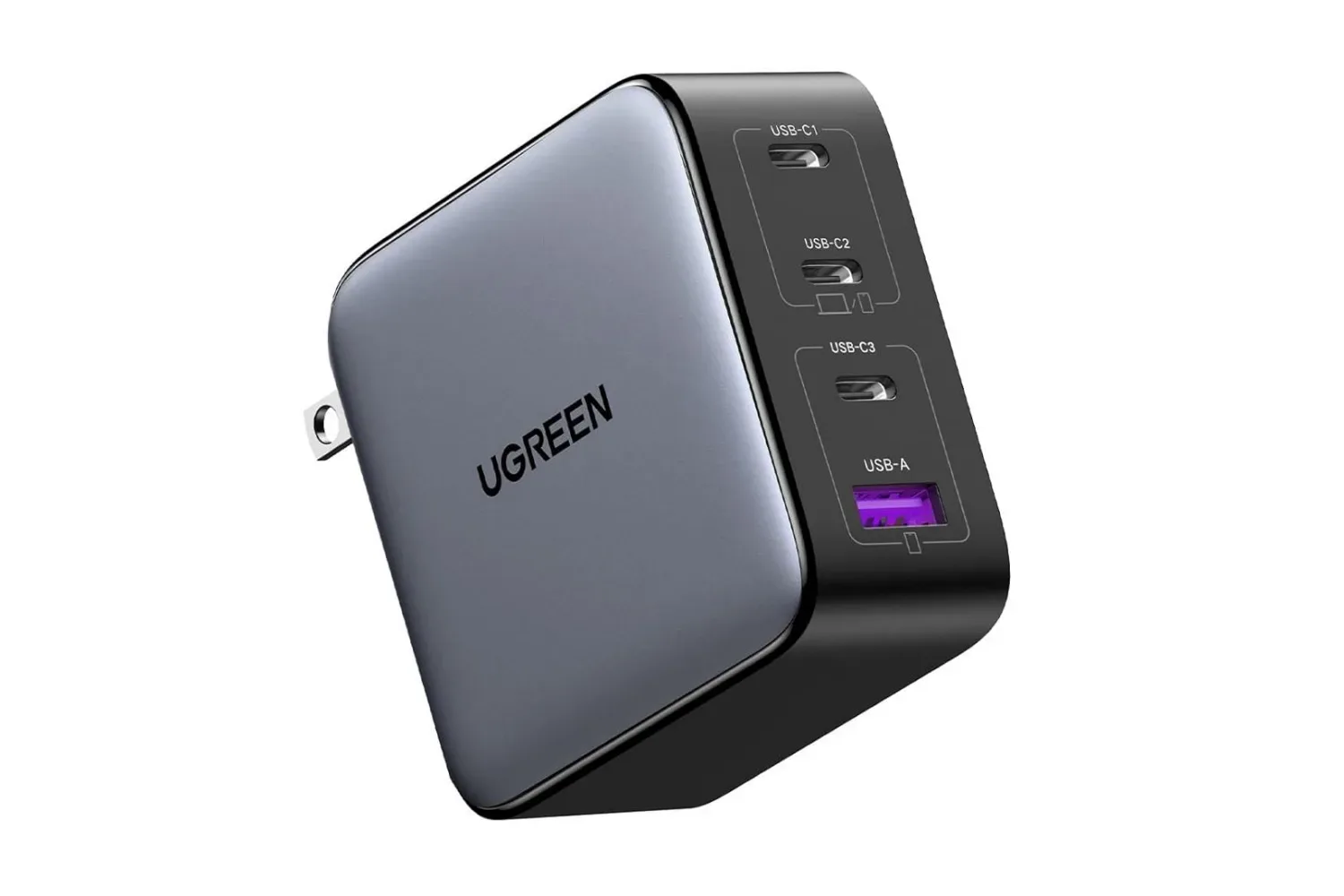
The UGREEN model has two USB-C ports and one USB-A port. This is a practical spread for a mixed collection of current and older accessories. One USB-C port can serve as the laptop connection, while another could handle a phone, portable monitor, handheld device, or newer accessory. The USB-A port remains handy for legacy charging cables and peripherals that have not yet joined the USB-C uprising.
Its 200W output is shared dynamically across the three connections based on the connected devices’ needs. The appeal is straightforward: a user can charge a laptop, phone, and earbuds at the same time without needing to manually configure a distribution profile. Real-world results will depend on what is connected, each device’s charging protocol, cable capabilities, and the bank’s remaining charge. Still, a shared 200W ceiling provides far more room than a phone-first travel battery.
For a gaming event or a long day away from outlets, this flexibility can prevent the usual triage routine. Rather than deciding whether the laptop or phone gets the only available cable, a single power bank can act as a charging hub for several essentials. That will be familiar to anyone who has tried to keep a laptop, controller, wireless headset, phone, and battery-powered mouse alive on a train seat with precisely one accessible outlet.
The TFT screen provides actual charging information
Many power banks communicate their condition through a few small indicator lights. Those LEDs are better than nothing, but they can make capacity feel like a weather forecast: vaguely useful, rarely precise, and unexpectedly stressful right before a trip. The Nexode instead includes a color TFT display with real-time charging data.
The screen shows the battery’s state of charge, the wattage entering the pack, the wattage leaving it, and an estimated time until the bank is full. Those details make it easier to see whether a laptop is drawing meaningful power, whether the power bank is itself recharging at the expected rate, and whether there is enough stored energy for the next stop.
It is also an especially helpful feature on a high-output model. When several devices are attached, knowing that power is being distributed is more useful than seeing four dots and trying to deduce whether the situation is “comfortably charged” or “one video call away from disaster.” The display does not change the underlying battery capacity, but it does provide better visibility into how that capacity is being used.
Capacity, travel rules, and reasonable expectations
At 25,000mAh, the Nexode has the stored energy for roughly five full smartphone charges in the stated estimate, with the exact number varying by handset and charging losses. Laptop results will vary more dramatically because notebooks have very different battery sizes and power consumption patterns. The information available suggests it can potentially fully charge one laptop depending on that machine’s needs, with some remaining capacity possible afterward.
Capacity claims deserve a little context. A power bank’s mAh figure should not be treated as a direct promise that it will deliver the same number of mAh to every connected gadget. Voltage conversion, heat, cables, device behavior, and battery-management systems all introduce losses. A 25,000mAh pack can still be a very substantial reserve; it simply is not a mathematical clone of a phone or laptop battery.
The Nexode is rated at 100Wh, placing it within the stated airline limit for portable batteries in carry-on luggage. That gives it an advantage over bigger packs that may exceed the threshold. Airline policies can differ and may change, so travelers should check the requirements of their airline and route before flying. Portable batteries generally belong in carry-on baggage rather than checked luggage, and capacity markings should remain visible for inspection.
For gamers traveling to a convention, visiting friends, working remotely, or simply enduring an outlet-poor airport, the 100Wh figure is an important part of the package. It aims for the upper edge of common carry-on battery limits without crossing into the territory where travel becomes more complicated.
Fast refilling and pass-through support add utility
A large battery bank is only as convenient as its own recharge time allows. UGREEN says the Nexode can be replenished through a USB-C port at up to 140W, taking typically less than two hours under the appropriate conditions rather than requiring an overnight refill. Reaching that maximum will require a compatible high-wattage charger and cable; a lower-power charger will take longer.
The pack also supports pass-through charging. In practical terms, it can continue providing power to attached devices while the bank receives power from another source. That may be useful at a hotel desk or in a workspace with limited outlets, letting one wall connection serve the battery bank and gear connected to it. Users should still pay attention to heat and their devices’ guidance when charging several items in a compact setup.
At $85, the UGREEN Nexode’s appeal lies in bringing laptop-class charging, a three-port arrangement, a data-rich display, and carry-on-friendly 100Wh capacity into one unit. It will make the most sense for people who truly need high USB-C output and multiple simultaneous connections. Those carrying only a phone and earbuds can likely buy something smaller. For the traveler trying to keep a notebook, mobile devices, and gaming accessories alive, however, the extra power is the whole point.