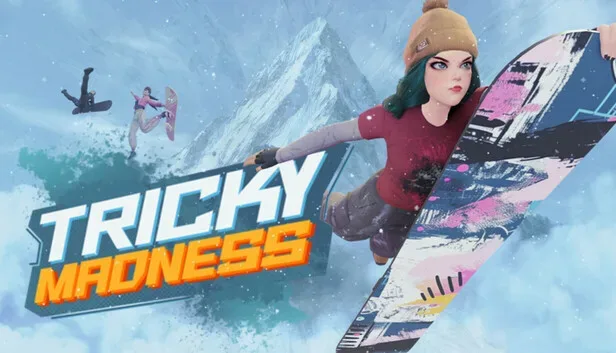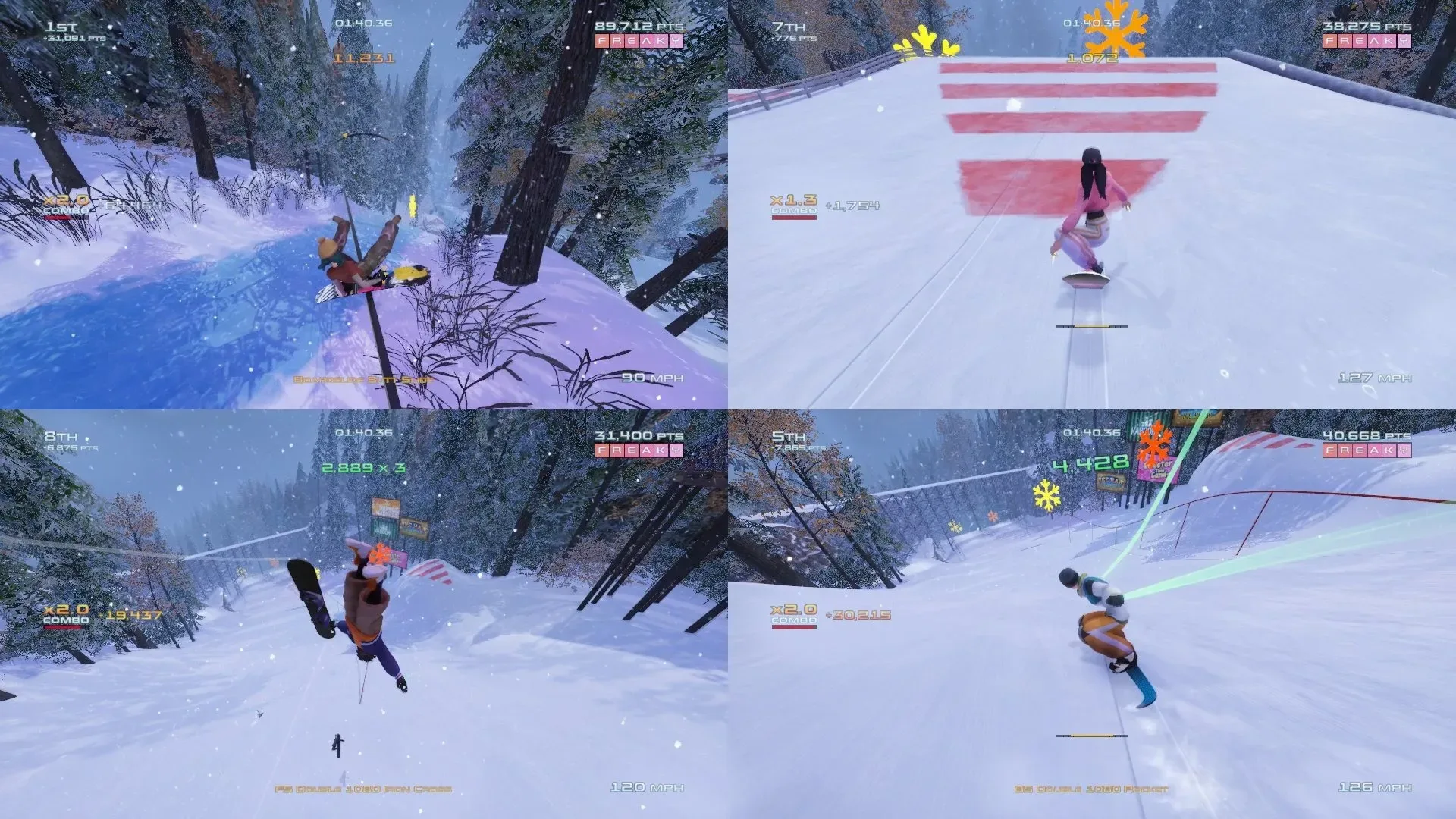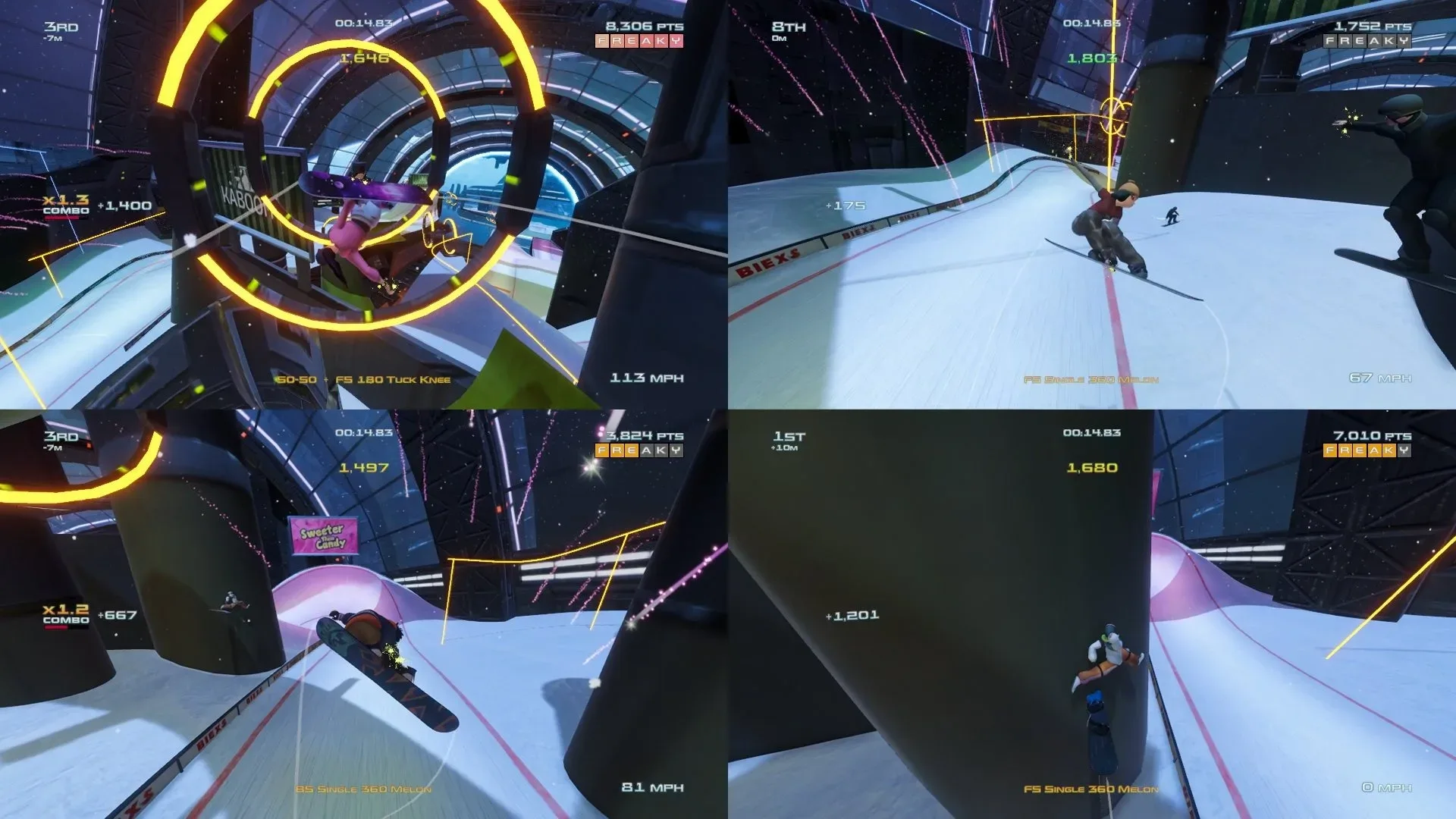
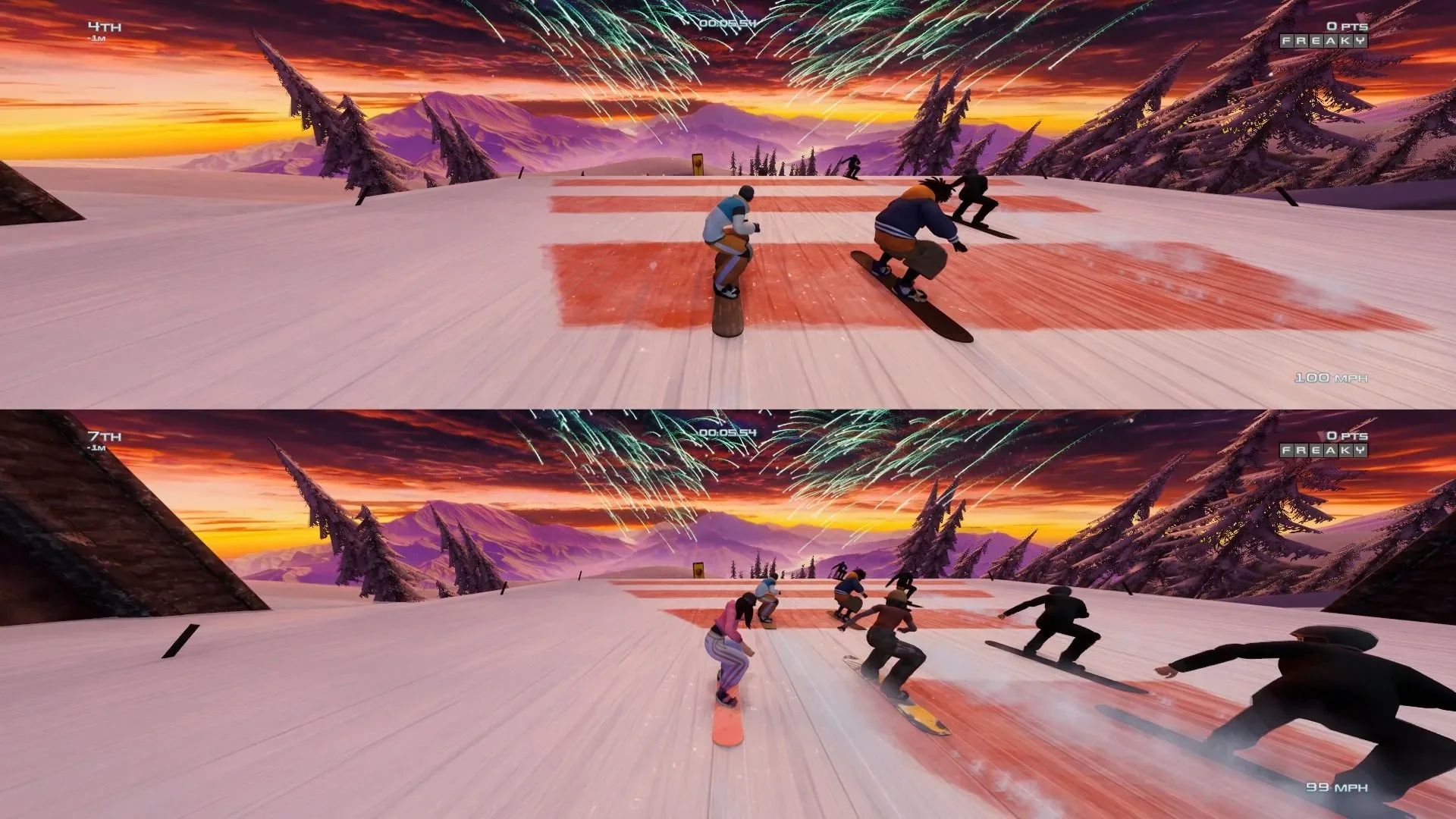
Tricky Madness, the arcade snowboarding game in Steam Early Access, is set to receive multiplayer and a new Jam Mode in a free update on December 17. The expansion gives its trick-focused downhill action a social lane: up to eight people can share sessions, including up to four local players, while local split-screen participants and online players can occupy the same lobby.
For a game built around building scores or chasing fast runs, that is a meaningful change in how players can approach the mountain. The existing premise is deliberately arcade-forward, drawing on the feel of early-2000s snowboarding games with familiar trick inputs, recognizable aerial moves and an emphasis on polished, accessible play. The update turns those individual pursuits into something that can be shared with friends on a sofa, opponents online, or a mix of both.
The game has a Very Positive user rating on Steam from more than 450 reviews at the time of the update announcement. Multiplayer will arrive for existing owners at no additional charge.
How Tricky Madness multiplayer will work
The core headline is support for sessions of up to eight players. Four players can take part locally, and the game will allow a mixed-lobby setup in which local and online players meet and queue together. In practical terms, this means split-screen is not isolated from internet play: a group gathered around one display can join a wider online room rather than being restricted to a separate local-only mode.
That distinction matters. “Local multiplayer” generally means several people play from the same machine, often with the display divided into individual views. “Online multiplayer” connects players over the internet from different locations. A mixed lobby combines both arrangements, so a local pair or group can enter the same matchmaking pool or friend session as remote players.
Tricky Madness will support local split-screen, Steam friend invites and online matchmaking. Friend invites are the direct route for players who already know who they want to ride with. Matchmaking, by contrast, is the automated system that finds other available players. Offering both gives the update two different uses: organized sessions with a regular group, and drop-in play for people looking for a populated event.
Eight riders also gives the slopes a more party-game-shaped ceiling than a conventional one-on-one time comparison. The announcement does not outline exact scoring rules, competitive formats, networking requirements or the full course rotation for multiplayer, so those details remain to be clarified when the update is available. What is confirmed is the player limit, local cap and the ability to blend the two ways of playing.
Jam Mode is designed to keep the session moving
The same update introduces Jam Mode, an endless arcade-style multiplayer option. Players will be able to enter alone, with friends or with strangers, then vote on the next event and course. Rather than treating each activity as the end of a session, the mode is intended to keep matches rolling across repeated selections.
Related coverage includes Tricky Madness Multiplayer and Jam Mode Update Lands December 17.
“Endless” here describes the session structure, not an announced infinite mountain or a new open-world area. The stated idea is a continuing multiplayer playlist: players complete an event, take part in a vote, and move into the next course or event. That is a useful fit for a score-and-speed game because it reduces the friction of repeatedly backing out, rebuilding a party and choosing a new activity manually.
Player voting also creates a small layer of group control. A lobby is not simply handed a fixed sequence; its members can influence what comes next. The details of how voting resolves ties, whether every activity is always available, and whether players can alter other session settings have not been specified. Still, the basic format is clear: Jam Mode is positioned as a persistent social queue rather than a single event type.
For solo players, online matchmaking means Jam Mode is not framed solely as an option for pre-made parties. For groups, split-screen and Steam invites leave open the possibility of beginning locally and expanding the lobby online. The result is a mode designed around the simple arcade appeal of another run, another course and another chance to land a better trick sequence.
Why trick systems and multiplayer are a natural pairing
Tricky Madness describes its design as a modern take on early-2000s arcade snowboarding. Its stated features include a tricking system, iconic moves, updated visuals and accessibility options for people playing for either speed or points. Those two objectives are worth separating.
Speed-focused play puts the priority on completing a route quickly. The key question is how cleanly a rider carries momentum through a course. Points-focused play instead centers on scoring through tricks and combinations. A player can be fast without producing the most elaborate sequence, while a player pursuing a huge score may make riskier choices to extend a combo.
The planned full version also lists an enhanced points system with speed boosts, Wicked Tricks and Grinds. A speed boost is a mechanic that increases movement pace; the announcement does not provide its precise trigger or effect. Grinds are tricks performed while riding a rail or comparable surface. Wicked Tricks is the game’s named category of trick feature, although the available information does not define exactly how it is activated or scored.
These ingredients make a multiplayer addition especially relevant even without assuming a particular rule set. Different players can bring different priorities into the same session: one may be chasing a clean racing line, another may be hunting high-value aerials, and another may simply want an accessible arcade run with friends. Jam Mode’s event and course voting is positioned to support that variety over time rather than locking the lobby into only one kind of contest.
What is in Early Access, and what remains planned
Tricky Madness is currently in Early Access on Steam. Four maps are available in that version, from a stated plan for eight handcrafted standalone maps at full release. Four of the eight intended voiced characters are also playable now: Tess, Maya, Curtis and Ryan.
Several broader features are listed as part of the planned full-release direction. These include a dedicated open-world mountain campaign that transitions between maps, all eight voiced characters, a voiced in-game DJ commentator, and three principal mode families: freestyle, time trials and races.
It is important to read that list as a roadmap, not as a promise that every element is included in the December update. The confirmed December addition is multiplayer and Jam Mode. The standalone-map total, mountain campaign, remaining characters and other listed features are described as planned full-release content.
Early Access is a development model in which people can buy and play a game before the developer considers it finished. It allows the game’s systems and content to grow through updates, but it also means prospective players should distinguish between what is playable now, what has a dated update, and what is an intended future feature. In this case, the December 17 patch has a clear Steam release date; the final console release is planned, but no console platforms or timing have been specified.
That distinction is particularly useful for anyone waiting on a particular mode. Players interested in couch play and online sessions have a defined target date. Players holding out for the complete eight-map offering, the connected mountain campaign, or the full character line-up should treat those as future goals rather than December guarantees.
A larger Early Access step for a solo-developed game
Tricky Madness is developed by Nathan Dearth, working solo. Adding local split-screen, online opponents, friend invitations, matchmaking and mixed lobbies is a substantial expansion of the ways a game can be played, even though the update is free. It extends the title beyond the solitary score attack or time chase without changing its central arcade snowboarding identity.
The update also follows a broader pattern visible in PC development, where post-launch patches can alter a game’s social options and replay structure considerably. For another recent example of a PC game expanding through extensive technical and content work, see The Joust’s engine and graphics overhaul.
For Tricky Madness specifically, the practical appeal is straightforward. A household can use split-screen for up to four riders, connect with remote friends, or jump into matchmaking. Jam Mode then gives those groups a way to stay together through continuing event and course votes. It is an update aimed less at adding a single isolated feature than at making the mountain a repeatable gathering spot.
The multiplayer and Jam Mode update is scheduled for December 17 on Steam, free for everyone who already owns Tricky Madness. A full release on consoles is planned for the future.