Tiny Routes is headed to Steam in early 2027, offering a minimalist take on traffic management built around a deceptively demanding premise: a city’s public-transport system is only as good as the connections that keep people moving. Players will draw routes, join stops, manage buses and trains, create additional lanes and respond to the congestion that follows expansion.
The setup puts the game in strategy-puzzle territory rather than presenting it as a traditional, open-ended city builder. The objective is not simply to make a network larger. It is to make the network function as commuter demand grows. When routes become overloaded or poorly connected, traffic builds and riders become unhappy. That clear pressure point should make each addition to the map matter, whether it is a new line, more capacity, or a direct train connection between stations.
Its reveal also outlines city maps inspired by real street layouts and landmarks, with New York, Los Angeles, Tokyo, Paris and Seoul specifically named. Each city is set to have its own mechanics and events, while daily and weekly systems aim to give the compact sessions a reason to remain challenging after a player has learned the basics.
A transit puzzle centered on flow, not just construction
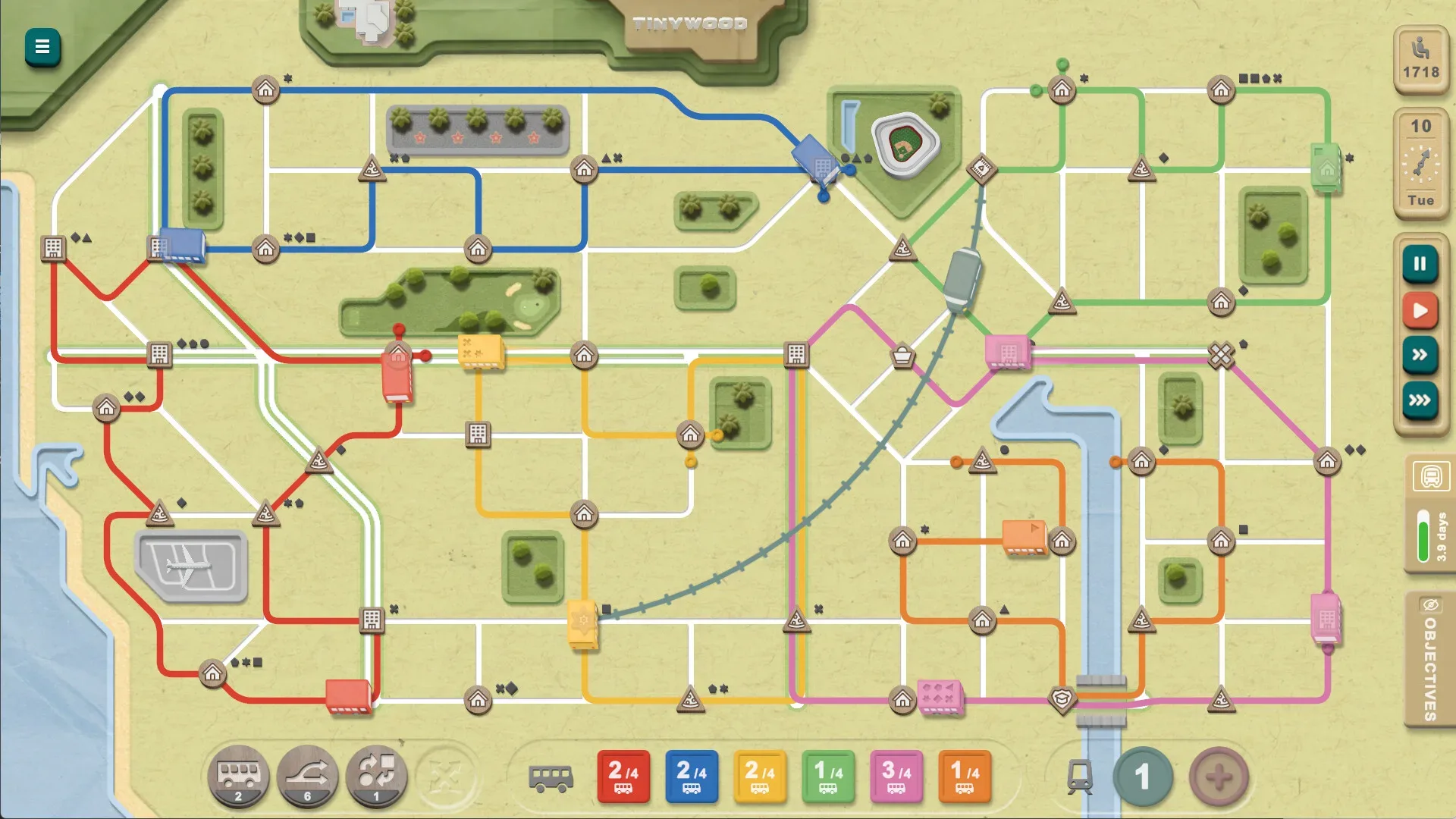
Route planning is the heart of Tiny Routes. In practical terms, a route is the path a vehicle takes between stops; a line is the service structure that ties those stops together. A player can draw a line that looks tidy on the map, but a visually neat network is not automatically an efficient one. The important question is whether the line gets riders where they need to go without forcing too many transfers, bottlenecks or long waits.
That is where traffic-management games draw much of their tension. Every expansion can solve one immediate issue while creating another. Adding a stop can serve a new area but may load more passengers onto a busy corridor. Adding a bus may increase capacity, yet it will still need a route that can absorb the service. A train that directly links two stations can provide a powerful shortcut, but it also changes where passengers enter and leave the wider network.
Tiny Routes lists buses, lines, lanes, accordion trailers, shape swaps, hubs, line boosts and trains among its eight upgrade types. Although their exact implementation has not been detailed, the names indicate a toolset split between capacity, routing and network structure.
- Buses are likely to represent additional service on the road network.
- Lines concern the routes through which passengers and vehicles are organized.
- Lanes point to more room for vehicles to travel, an especially relevant answer when road congestion becomes the limiting factor.
- Accordion trailers refer to articulated vehicle capacity: the longer, jointed bus design commonly used to carry more passengers.
- Shape swaps suggest that changing the form or configuration of a route may be a strategic option.
- Hubs are interchange points, where multiple services can meet and riders can transfer.
- Line boosts imply a way to improve the performance of a particular service.
- Trains have a clearly stated role: they can connect any two stations directly.
The direct-connection rule for trains is particularly notable because it establishes a distinct network function rather than merely treating trains as another bus with a different appearance. A direct link can bypass intermediate roads and stops, potentially relieving a crowded section of the map or connecting two important points quickly. The trade-off, if there is one, has not been described, so it would be premature to assume costs, limits or operating rules beyond that stated connection ability.
What “minimalist” may mean for the decision-making
Minimalism in a strategy puzzle generally describes presentation and interaction more than a lack of depth. Tiny Routes is being framed around tracing routes and responding to congestion rather than managing every civic detail of a municipal simulation. The cited focus on quick sessions reinforces that idea: players should be making readable, consequential network choices without necessarily committing to a single enormous campaign map for hours at a time.
Related coverage includes Tiny Routes brings transit puzzles to Steam in early 2027.
That format can make failure easier to understand. If angry commuters and congestion are the visible outcomes, the player gets a direct signal that capacity, coverage or connections need attention. The challenge is then to identify which part of the system is responsible. Is one station receiving too many passengers? Is a line too indirect? Does a section need another lane, a stronger line, an articulated bus, or a train link? The announcement establishes the ingredients, even though it does not yet explain the game’s exact scoring model or passenger simulation.
Quick sessions do not necessarily mean simple sessions. A short puzzle can become demanding when choices escalate faster than the player’s ability to make clean changes. Tiny Routes is planned to include weekly escalating choices, a phrase that suggests decisions will grow in consequence over the course of a run or challenge. What those choices specifically involve remains unannounced, but the concept fits a transit-planning puzzle well: an early choice about a line or hub can shape what is feasible when a later demand spike arrives.
Five cities, distinct twists
New York, Los Angeles, Tokyo, Paris and Seoul have been identified as maps inspired by real-world layouts and landmarks. The game is not promising a one-size-fits-all board with a different visual skin. Instead, it says the cities will bring city-specific mechanics and events.
That distinction matters. A map is more than its outline. In a route-planning game, the geography and rules of a city determine the problems the player must solve. A compact layout can put many competing services close together; a spread-out one can make long connections more important. Landmarks and street patterns can create recognizable reference points, but the city-specific mechanics and events are what may ultimately distinguish strategies between locations.
There are no further details yet on the individual rules assigned to the named cities. Players should therefore treat the city list as a confirmed set of planned settings, not as confirmation of particular real-world transit systems, landmarks, vehicle types or event scenarios. Still, tailoring maps beyond visuals has the potential to make relearning and adaptation central to the game, rather than asking players to apply the identical solution everywhere.
Daily Challenge, leaderboards and repeatable objectives
Tiny Routes will feature objectives and global leaderboards, alongside a Daily Challenge that changes both the city and rules each day. These systems give the game two different kinds of replayability.
Objectives give individual maps defined targets, which can help turn an open planning problem into a puzzle with a clear measure of success. Global leaderboards add comparison, although the announcement does not specify whether standings will be based on score, survival, efficiency, completion time, or another metric. That missing detail is significant because the scoring method changes what a competitive strategy looks like. A leaderboard based on speed favors rapid deployment; one based on long-term performance may reward more resilient infrastructure.
The Daily Challenge is the more concrete of the two recurring modes. A new city and a fresh ruleset every day should prevent it from becoming a routine replay of a fixed scenario. Changing the city alters the map context, while changing the rules can alter the decision space. Together, those variables can encourage players to reconsider familiar upgrades rather than relying on a permanently optimal network blueprint.
Weekly escalating choices, meanwhile, appear designed to extend pressure across a longer cadence. The announcement does not explain how the weekly system relates to the daily mode, objectives or standard city sessions. It is safest to view them as separate announced features rather than assume they share progression or rewards.
Steam Workshop support could make the map pool much larger
Steam Workshop support is planned for custom-city design and sharing. The Workshop is Steam’s platform for players to distribute game-specific user-created material, and here the intended material is custom cities. That could be important for a game whose core challenge depends so heavily on layouts and rules.
A well-designed custom city can change the puzzle even without adding a new vehicle or system. Different stop placement, route shapes and pressure points can all produce a new network-management problem. If creators can share cities through the Workshop as stated, players may have a straightforward way to circulate those scenarios and try approaches developed by others.
The scope of creation tools has not been explained. There is no confirmed information on whether creators can set special events, modify city mechanics, establish objectives, alter Daily Challenge rules or make anything beyond custom cities. The confirmed promise is more focused: players will be able to design and share their own city maps through Steam Workshop support.
For players drawn to building rather than competitive optimization, that prospect may be as appealing as the formal challenges. It places Tiny Routes near other games that let communities make their own spaces, including the creative, player-led construction approach discussed in Fangtopia’s Creative Mode, though Tiny Routes’ announced focus is public-transport puzzles rather than hex-kingdom building.
What is confirmed, and what still needs clarification
There is already a solid outline for Tiny Routes: it is a minimalist traffic-management and route-planning strategy puzzle; it is planned for Steam in early 2027; it includes buses and trains, expanding roads and lines, multiple city maps, city-specific mechanics and events, objectives, leaderboards, a daily rule-changing challenge, weekly escalating choices and Workshop-backed custom cities.
Several practical details remain unknown. No price, precise launch date, system requirements or additional platform release has been provided. The announcement also does not define the exact nature of the weekly choices, the rules governing each upgrade, the way commuters behave, or the criteria used for leaderboards. A reveal trailer is available, but the written details currently establish the broad design rather than every system-level rule.
That leaves Tiny Routes with a promisingly clear premise and plenty of room for its eventual play systems to determine its identity. The potential appeal is easy to see: a compact city map, rising demand, a handful of upgrades and the satisfying attempt to turn a knot of crowded stops into a network that flows. Whether that flow comes from disciplined bus lines, better lanes, well-placed hubs or a timely direct train connection is likely to be the central puzzle when the game reaches Steam in early 2027.