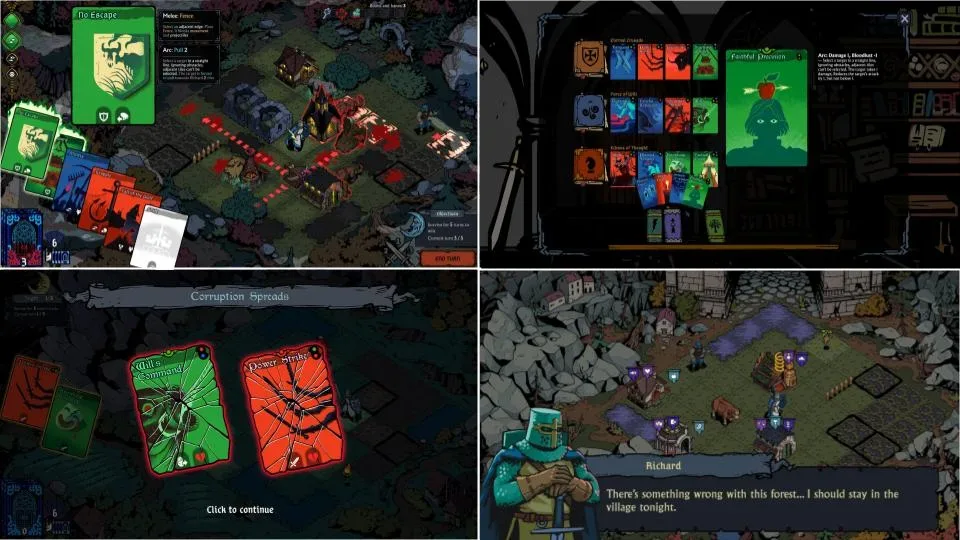
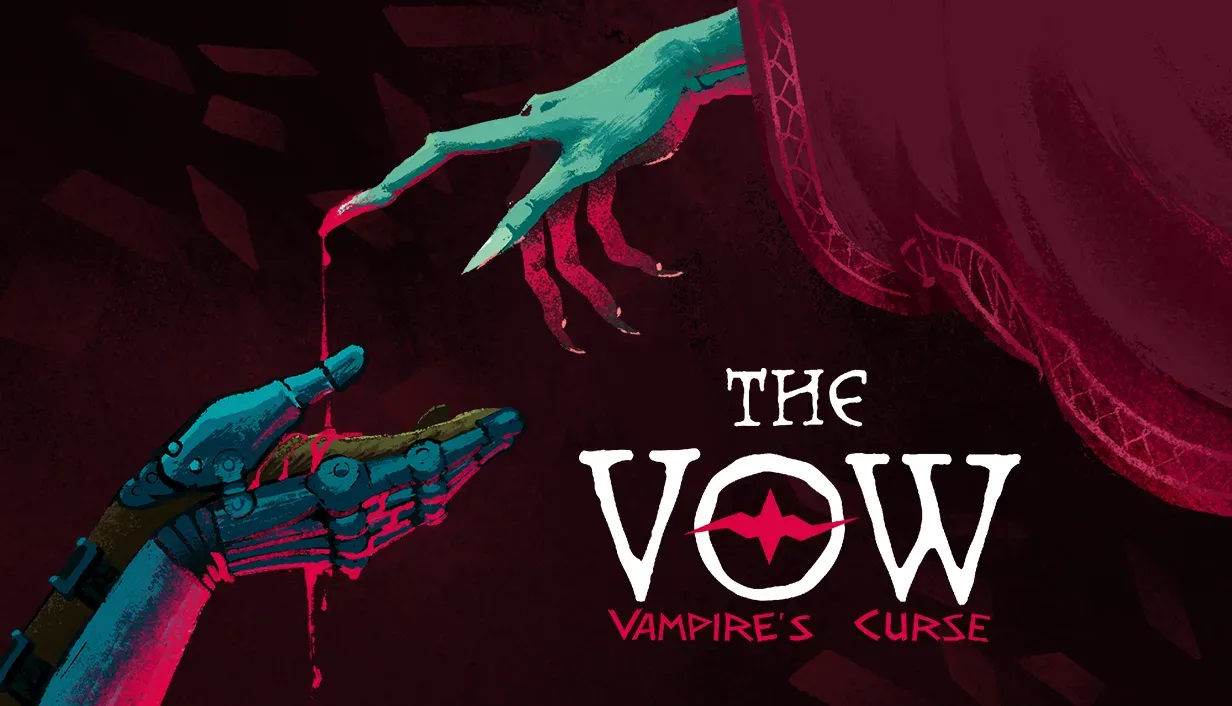
The Vow: Vampire’s Curse, a gothic roguelite from Mimyr Games, now has a substantially refreshed demo on Steam. The updated slice introduces a revised opening, new daytime card-based systems, a revised tutorial, redesigned upgrades, new cards, additional animation work and changes to combat, bosses and progression.
Its premise is suitably grim: Sir Richard’s wedding to Eleanor is shattered by the arrival of the vampire lord Arnaud. Richard dies trying to defend her, returns to life under unexplained circumstances, and begins a journey toward Arnaud’s mountain-top castle to rescue her. The hook is not simply the undead revenge tale, though. The game frames that quest through a repeating seven-day structure in which each day asks the player to build a defence before each night threatens to tear it apart.
That framework matters because The Vow is combining several systems that often live in separate genres. It has roguelite progression, deckbuilding, tactical grid combat and village management. The refreshed demo is meant to offer a broader early look at how those parts connect, rather than presenting the nighttime fights in isolation.
A day-and-night loop built around preparation
During the day, Sir Richard prepares villages for the coming attacks. Players can develop and upgrade those villages, choose abilities through four buildings in each village, unlock effects, position defensive obstacles, and assign villagers and allies. At night, the focus shifts to confrontations with vampires and thralls.
The distinction is more meaningful than a visual change of time of day. Daylight decisions establish the conditions of a later battle. A defensive object placed before nightfall, an ally assigned to a useful role, or an ability chosen from a building can affect the space and options available when enemies arrive. The game therefore asks players to consider both immediate threats and future turns before the first hostile unit moves.
“Grid-based combat” means the battlefield is divided into discrete spaces rather than operating as a free-roaming arena. Positioning consequently becomes a resource in its own right. The available information indicates that hazards, summoned objects and allied units all influence the nighttime encounters, alongside Richard’s placement. In practical terms, cards are not only attacks: their value can depend on where they are used and what has already been established on the grid.
The full game is described as a seven-day adventure ending at the castle atop a mountain. The demo does not cover that entire arc. It gives players the first five days of Richard’s journey, which should make it a more substantial introduction than a single combat scenario while still stopping short of the final destination.
Cards are both tactics and long-term planning
Deckbuilding sits at the centre of The Vow: Vampire’s Curse. Here, deckbuilding refers to shaping the cards available for play, thereby determining the tactical tools a run can offer. Players select three themed card sets and can build toward different priorities: defence, aggression, movement or control of the battlefield.
Related coverage includes The Vow: Vampire’s Curse Demo Refresh Brings Five Days of Gothic Roguelite Strategy.
Those labels suggest distinct ways to approach the same nightly pressures. A defence-minded selection may support survival and fortification. Aggression prioritizes pressuring enemy waves. Movement can improve positioning or help units respond around the grid. Battlefield control concerns shaping the fight itself, which is particularly relevant in a game where hazards, summoned objects and spatial decisions already matter.
The card system also rewards sequencing. Playing cards of the same colour consecutively can trigger combo benefits. This creates a layer beyond choosing the individually strongest card at a given moment. A player may need to weigh the direct effect of a card against the benefit of preserving, extending or starting a colour chain.
That is an important technical distinction. A combo system based on consecutive colours is not merely about what is in a deck; it is about the order in which cards are played. The same collection of cards can lead to different outcomes depending on hand order, the intended chain, enemy positions and how much value can be gained from a particular turn. It also gives the three-set selection a likely effect on consistency: themed choices shape the possible tools and colours that can appear together, even though the precise contents and rules of the sets have not been detailed.
The refreshed demo adds new cards and redesigned card upgrades. Upgrades generally matter in a deckbuilding structure because they can change the value of returning cards over the course of a run. Specific upgrade effects have not been outlined, so players should treat the refresh as an opportunity to explore the revised early-game decisions rather than assume exactly how any card has changed.
What the roguelite structure means for failed runs
Roguelite is a useful term here because it describes progress that survives failure. When Sir Richard dies, he is sent back to the church. Yet the journey is not reset in every respect: story progress, accumulated knowledge and unlocked cards carry over.
That persistence changes the role of defeat. A failed attempt can still reveal how a village setup performs, how enemy waves behave, or whether a particular deck direction works with the player’s preferred approach. It can also contribute to the broader progression that continues between runs. The game’s structure is therefore not presented as a single uninterrupted march through seven days, but as a repeating effort to learn, unlock and advance.
Artefacts and dangerous omens can further alter a run. Artefacts are items with special effects, while omens are framed as risky modifiers rather than straightforward bonuses. No individual examples have been specified, but their inclusion points to changing conditions that can affect planning from one attempt to the next. For a game combining village investment with a finite seven-day objective, modifiers that alter a run can make choosing a safe plan versus a high-risk plan especially consequential.
There is a narrative fit, too. Richard’s resurrection is more than the inciting event: it supports a loop in which the protagonist repeatedly returns to the church after death. The story of love, death and resurrection is thus tied to the game’s repeatable structure, instead of being completely separate from it.
Two bosses appear in the refreshed demo
The current demo includes two major boss encounters: Godfrey and Arnaud. Arnaud is the vampire lord responsible for interrupting Richard and Eleanor’s wedding, which makes his presence in the demo notable even though the full-game objective remains reaching his castle. The available details do not establish how the demo’s confrontation with Arnaud fits into the eventual campaign structure, and players should not infer that the sample includes the final version of the game’s ending.
Boss encounters have been enhanced as part of the refresh, alongside the broader combat improvements. In a tactical card game, a boss can test more than raw damage output: preparation, board placement, card sequencing, available allies and an ability to adapt to a changed battlefield all have room to matter. That is analysis based on the game’s stated systems, not a confirmation of specific boss mechanics, which have not been disclosed.
The revised tutorial may be just as significant for new players. A game asking players to manage villages by day, select building abilities, prepare units, assemble three card sets, use colour chains and handle grid-based enemy waves has multiple interconnected rules to explain. A better tutorial can make the first five days a clearer representation of the intended loop, particularly for players who are unfamiliar with either tactical deckbuilders or village-focused strategy games.
What to look for in the Steam demo
For players trying the refresh, the most useful approach is likely to examine the connection between every daytime choice and the ensuing night rather than treating each phase as a separate mode. The demo’s five-day scope gives room to test how buildings, village abilities, obstacles, allies and card sets contribute to the same defensive problem.
- Compare card-set priorities: The game explicitly supports approaches built around defence, aggression, movement and battlefield control. Trying contrasting selections can clarify which choices best suit a player’s tactical habits.
- Watch colour sequencing: Consecutive same-colour cards can create combo benefits, so consider both a card’s immediate effect and its place in a possible sequence.
- Use the grid deliberately: Hazards, summoned objects, allies and positioning are all part of the combat model. A card’s usefulness may change based on the current layout.
- Treat preparation as part of combat: Village upgrades, buildings, assignments and obstacles are not background management; they are the setup for the next attack.
- Expect learning to persist: Death returns Richard to the church, but story progress, knowledge and unlocked cards continue. Early attempts can therefore be used to understand systems as well as to push forward.
The demo is available now on Steam, where players can also wishlist the game. Mimyr Games is also directing interested players to its Discord community for development updates. For readers in the mood for another horror game with a very different angle, Tenebris Somnia’s live-action horror maze offers a separate example of the genre experimenting with form.