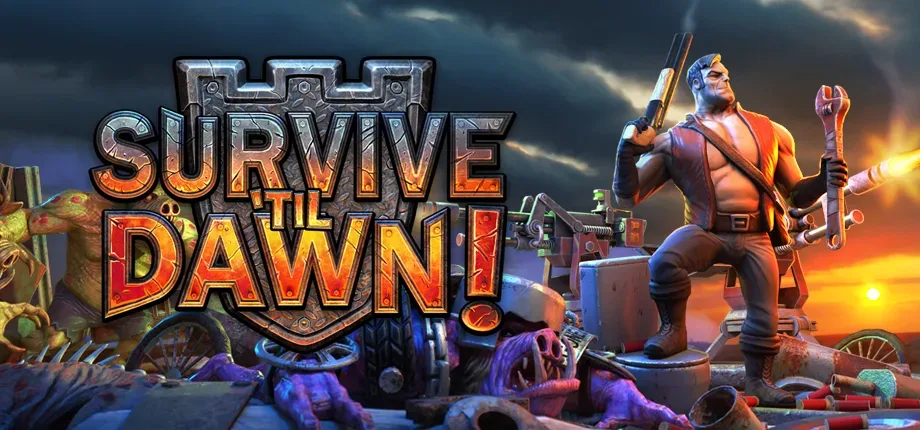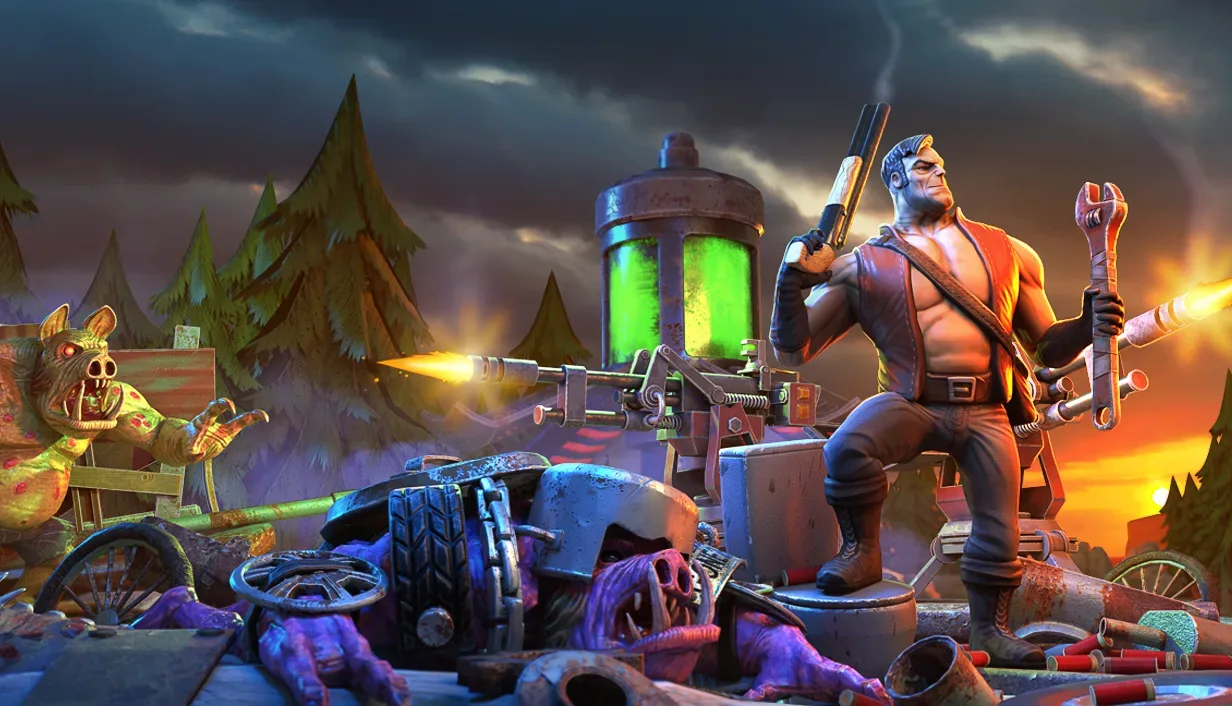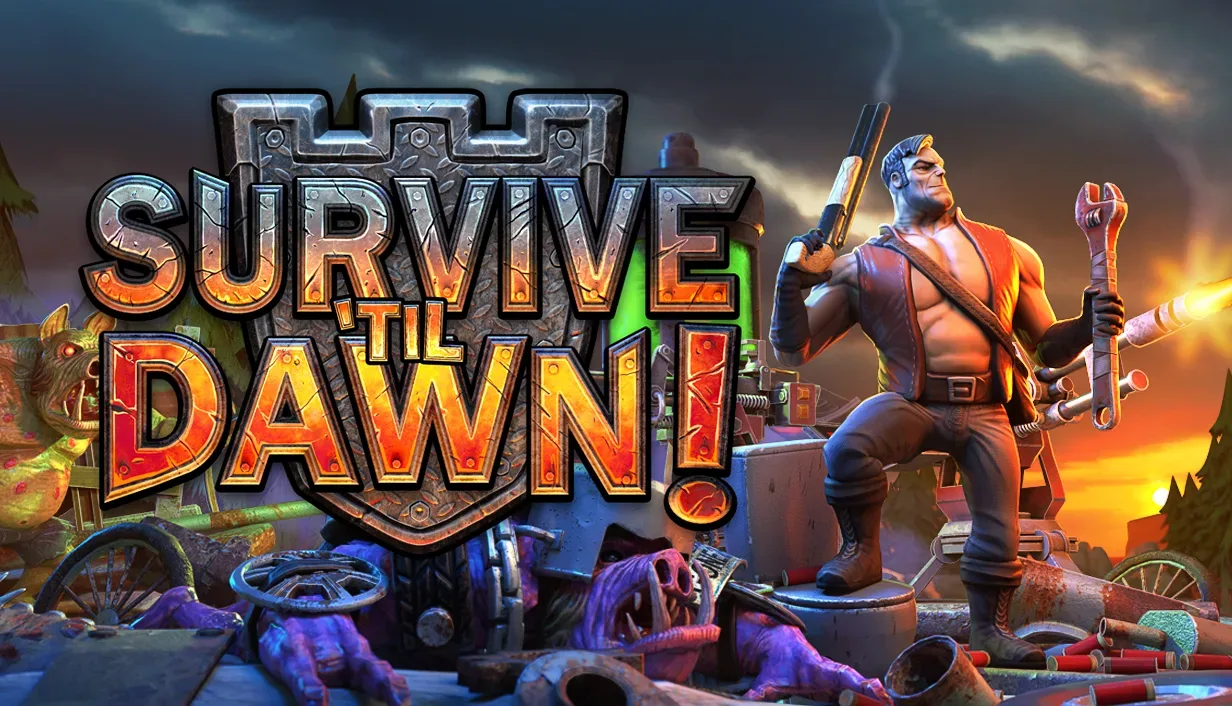
Black Lab Games is preparing Survive ’Til Dawn!, a darkly comic action tower-defence game scheduled for Steam in 2027. The Perth studio’s new project combines a familiar defensive-planning loop with third-person combat: players will scour a wrecked wasteland for scrap, convert it into improvised protection, and step directly into the firing line when their carefully arranged hardware is no longer enough.
That last part is the central distinction. In a conventional tower-defence game, the player’s major interaction is usually indirect: place a unit, select an upgrade, observe an enemy route, and revise the layout before the next pressure point arrives. Survive ’Til Dawn! is built around the promise that the plan can fail in a much more immediate way. Enemies that get through the traps and turrets do not simply represent lost health or an abstract setback; the player is expected to meet them with weapons such as a wrench and boomstick.
The Aegis is the thing worth defending
The game’s nightly danger is tied to the Aegis, an anti-alien-spore machine. It has to recharge each night, and that recharge period is when it becomes vulnerable. The broad objective is therefore easy to understand: get the Aegis safely through its exposure window, using whatever defences can be assembled from the wasteland’s remains.
“Tower defence” is a useful label here, but it can obscure what players will actually be doing. The genre generally revolves around controlling approaches to an objective. A defence may be strong because it damages enemies, but it can also be valuable because it slows, redirects, groups, or softens them up for the next obstacle. In Survive ’Til Dawn!, the available devices are intended to create that kind of layered response around the Aegis rather than provide a single automatic answer to every threat.
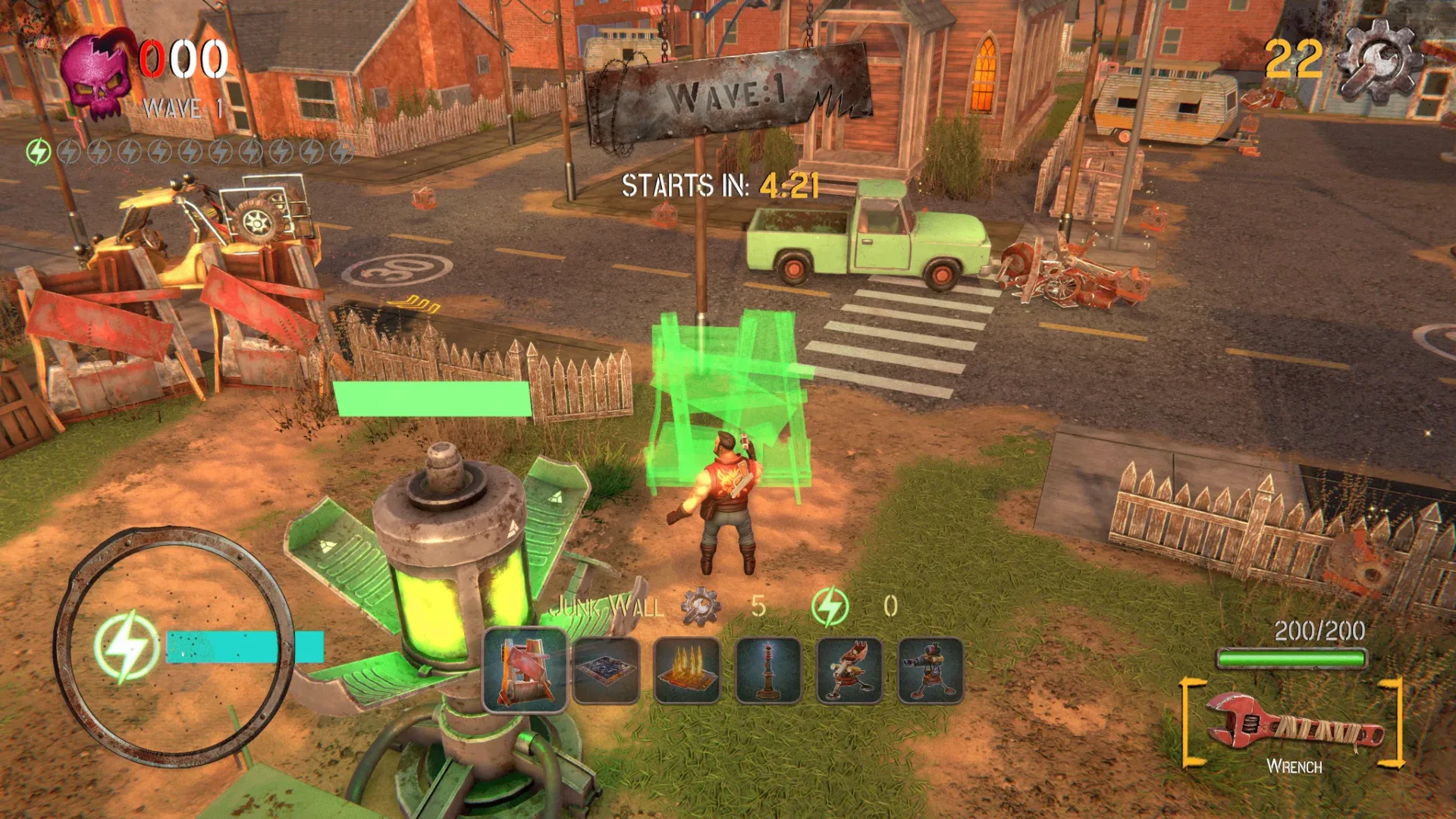
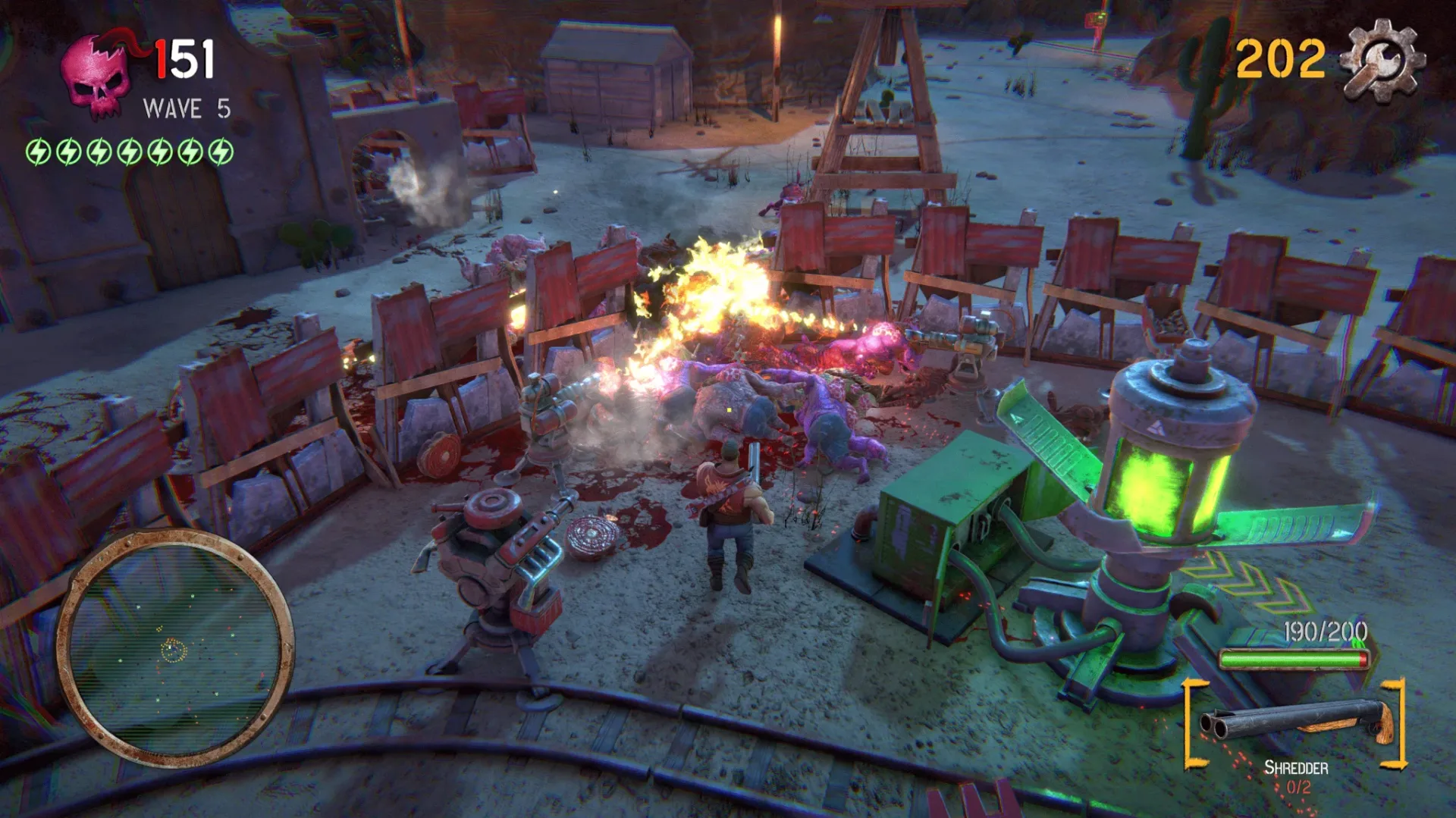
The announced options include spinning spike traps, electric shock towers, flame vents and gas-powered turrets. Each is a conspicuously rough-hewn fit for a wasteland scavenging premise: scrap is not only a currency or backdrop, but the material basis for a line of defence. The important tactical question, based on the game’s stated structure, will be how placement turns those individual machines into a durable perimeter before the recharge cycle begins.
Building a line, then becoming its emergency measure
Third-person combat changes the value of a breach. A turret may cover one route reliably but lack the flexibility to respond somewhere else. A trap may be effective only at a chokepoint. The player character can potentially fill the gaps left by the system: finish a survivor after it has run the gauntlet, deal with a threat that reaches an unprotected side, or simply buy time while the static defences do their work.
That is an explanation of the announced hybrid, not a claim about exact combat mechanics that have yet to be detailed. There is no indication yet of specific resource costs, enemy statistics, construction limits, campaign length, matchmaking structure, or upgrade trees. Those details will determine how much of the game’s tension comes from long-term planning versus in-the-moment shooting. What is clear is that Black Lab Games is not presenting the player as a distant commander. The premise asks them to be both engineer and last line of defence.
The studio’s prior work includes Warhammer 40,000: Battlesector and Battlestar Galactica Deadlock. Those titles establish that Black Lab Games has worked on strategy-led games, while Survive ’Til Dawn! points its strategy in a different direction: smaller-scale defensive construction paired with direct action, colourful characters and deliberately unruly B-movie horror.
Related coverage includes Survive ‘Til Dawn! Brings Action Tower Defence to Steam in 2027.
A wasteland with a deliberately silly pressure valve
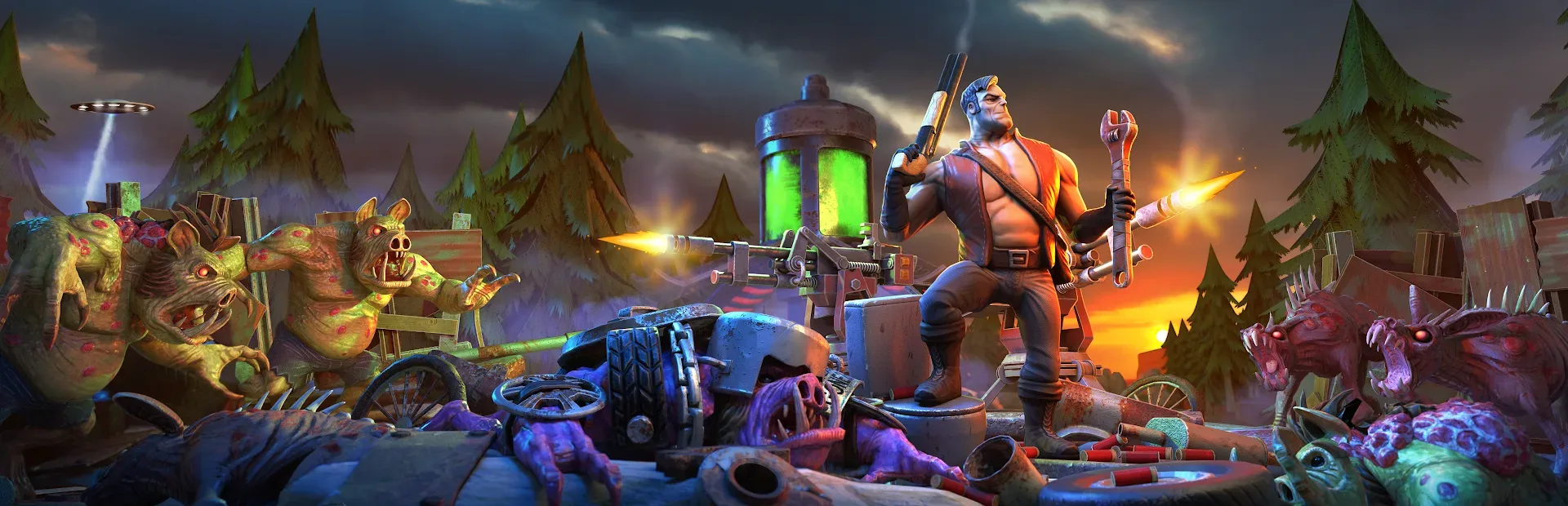
The game’s enemies include mutant lizards and other creatures, with the campaign travelling through varied wasteland environments. The stated aesthetic leans into dark humour and an ’80s B-movie attitude rather than unbroken grimness. That tone is also reflected in a particularly unusual content option: players can toggle the game’s over-the-top gore, replacing splatter with balloon animals and silly noises.
This is more than a standard on/off gore setting in presentation, because the alternative appears designed as a joke in its own right. The option lets players adjust the visual and audio expression of violent encounters without changing the basic defensive scenario: the Aegis remains exposed at night, and the creatures still need stopping. For people who enjoy the construction-and-combat setup but would rather not have exaggerated splatter on screen, it is a meaningful accessibility-of-preference choice. For others, the balloon-animal substitute seems intended to reinforce the game’s absurd sense of humour.
It also signals a tonal balancing act. A wrecked world threatened by alien spores could be played as straight survival horror, but the announced tools, weapons and gore replacement all point elsewhere. The game appears to want the pressure of holding a failing perimeter while making room for broad, knowingly messy genre comedy. Whether that mixture lands will depend on writing, pacing and the feel of the combat, none of which can be judged from the present announcement alone.
Campaign, co-op and Mutant Rush
Survive ’Til Dawn! is set to include three named ways to play. The campaign takes players through multiple wasteland environments against mutant lizards and other enemies. Online co-op will allow a player and a friend to defend together. Mutant Rush is a wave-based mode where the threat escalates and players draft upgrades between rounds.
“Drafted upgrades” describes a selection process rather than a fixed sequence of unlocks. Between rounds, players are offered options and choose from them, meaning a run can develop differently depending on what is available and selected. The announcement does not specify the size of those choice pools, whether they are randomised, or whether Mutant Rush is playable solo as well as with a partner. Still, the format suggests a mode focused on adapting to mounting pressure instead of advancing through a scripted campaign route.
Co-op is a natural fit for the game’s divided responsibilities. One player might be preoccupied with an enemy that has slipped past the outer traps while the other watches the construction side of the defence, though the game has not laid out formal roles. More broadly, sharing a perimeter creates opportunities for on-the-fly coordination: deciding which breach needs attention, working around the strengths of different weapons, and reacting when the planned setup becomes inadequate.
There are practical unknowns that prospective players should keep in mind. The announcement identifies online co-op but does not confirm the number of players beyond playing with a friend, cross-platform support, offline play, progression sharing, or any other multiplayer specifications. Steam is the only announced platform, and the expected release window is 2027. Until Black Lab Games provides more detail, those points should remain open rather than assumed.
Why the hybrid matters
Mixing tower defence with direct combat is not simply a matter of placing turrets between shooting sections. The best version of the idea makes the two halves inform each other. A trap layout should affect where enemies emerge and which encounters are dangerous; player intervention should make an imperfect build survivable, rather than render building irrelevant. The vulnerable-Aegis premise gives that relationship a clear focal point: every device and weapon ultimately serves the same overnight defence.
Scrap scavenging is similarly important because it frames construction as improvisation. The announced defences are not sleek military installations. Spinning spikes, flame vents and gas-powered turrets suggest contraptions assembled from what can be recovered in a ruined environment. If the resource loop is substantial, the decision of what to build could become the game’s key strategic trade-off: commit materials to a turret, cover a narrow lane with a trap, or preserve enough flexibility to respond later. Specific systems have not been confirmed, but the scavenging-to-defence loop is the foundation Black Lab Games has described.
There is also a wider business backdrop for projects built around distinct genre combinations. The games industry continues to see organisational change, including Skydance combining Paramount and Warner Bros. Games teams under Tony Driscoll. Against that kind of shifting corporate landscape, a clearly defined Steam project from a studio known for strategy work stands out by pitching a specific fantasy: turn rubbish into a kill zone, protect the machine through the night, and personally clean up the mess.
What has been confirmed so far
- Developer: Black Lab Games.
- Platform: Steam.
- Release timing: Expected in 2027.
- Core setup: Scavenge scrap, construct traps and turrets, and use third-person combat to defend the vulnerable Aegis during nightly recharging.
- Defensive tools named: Spinning spike traps, electric shock towers, flame vents and gas-powered turrets.
- Modes named: Campaign, online co-op and the escalating, upgrade-drafting Mutant Rush mode.
- Tone and content option: Dark humour, colourful characters, ’80s B-movie inspiration, plus a setting that swaps gore for balloon animals and silly sounds.
For now, Survive ’Til Dawn! remains in development, so the most sensible expectation is a broad one rather than a checklist of unconfirmed systems. Its announced identity is unusually clear: a defensive strategy game where the barricades are homemade, the monsters are mutant, the objective is a night-vulnerable anti-spore machine, and a breached line is the moment to grab a weapon rather than give up.