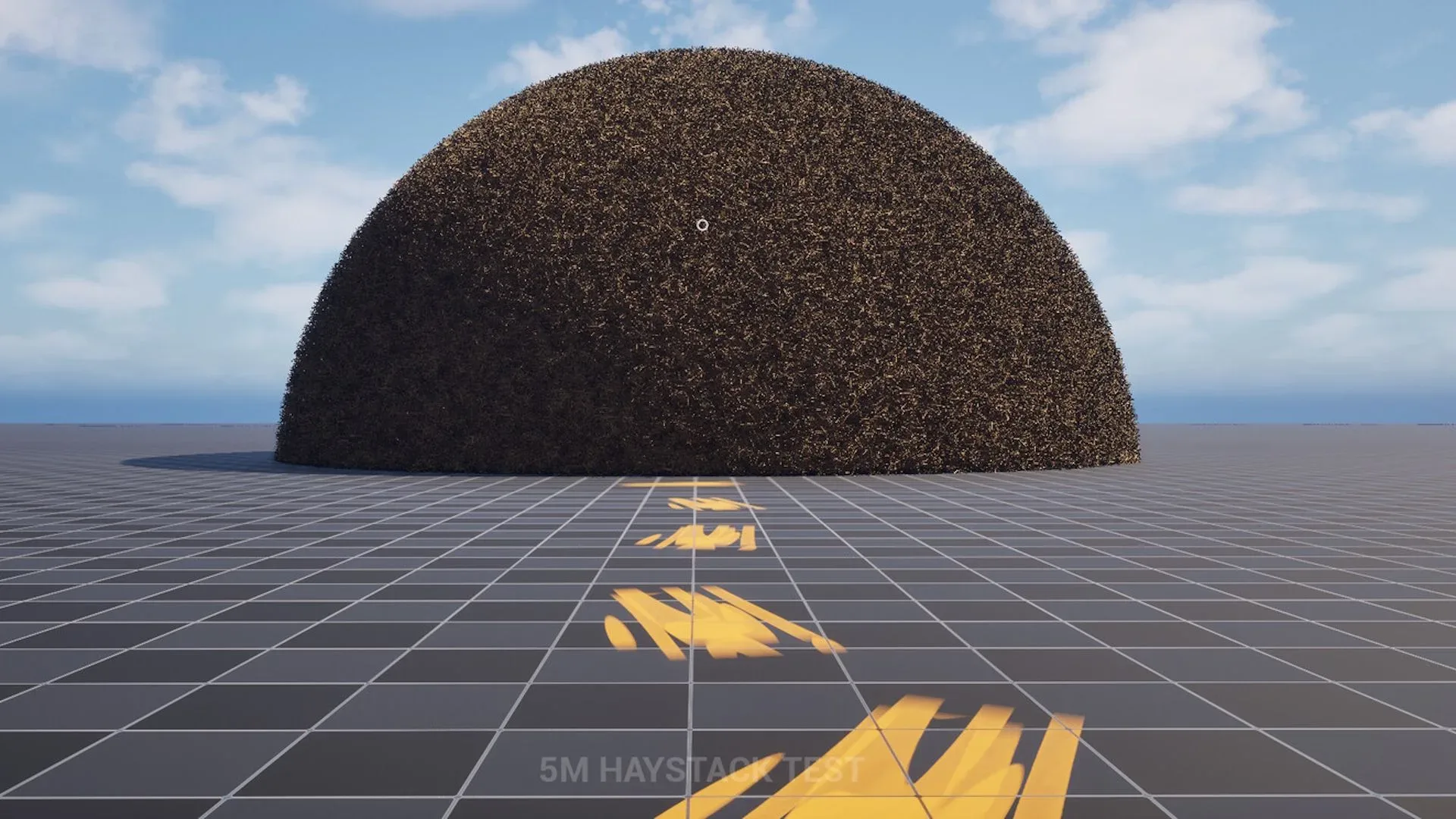
Steam’s discoverability problem has found a mascot, and naturally it is buried under straw.
Needle in a Haystack Simulator, an incremental game built around the deliberately arduous task of locating a needle in a haystack, went viral after an August clip drew more than 50 million views on Twitter. Yet anyone searching Steam for “needle in a haystack” now faces a wonderfully bleak contradiction: the original is surrounded by a growing thicket of similarly named games that echo its premise, presentation, or both.
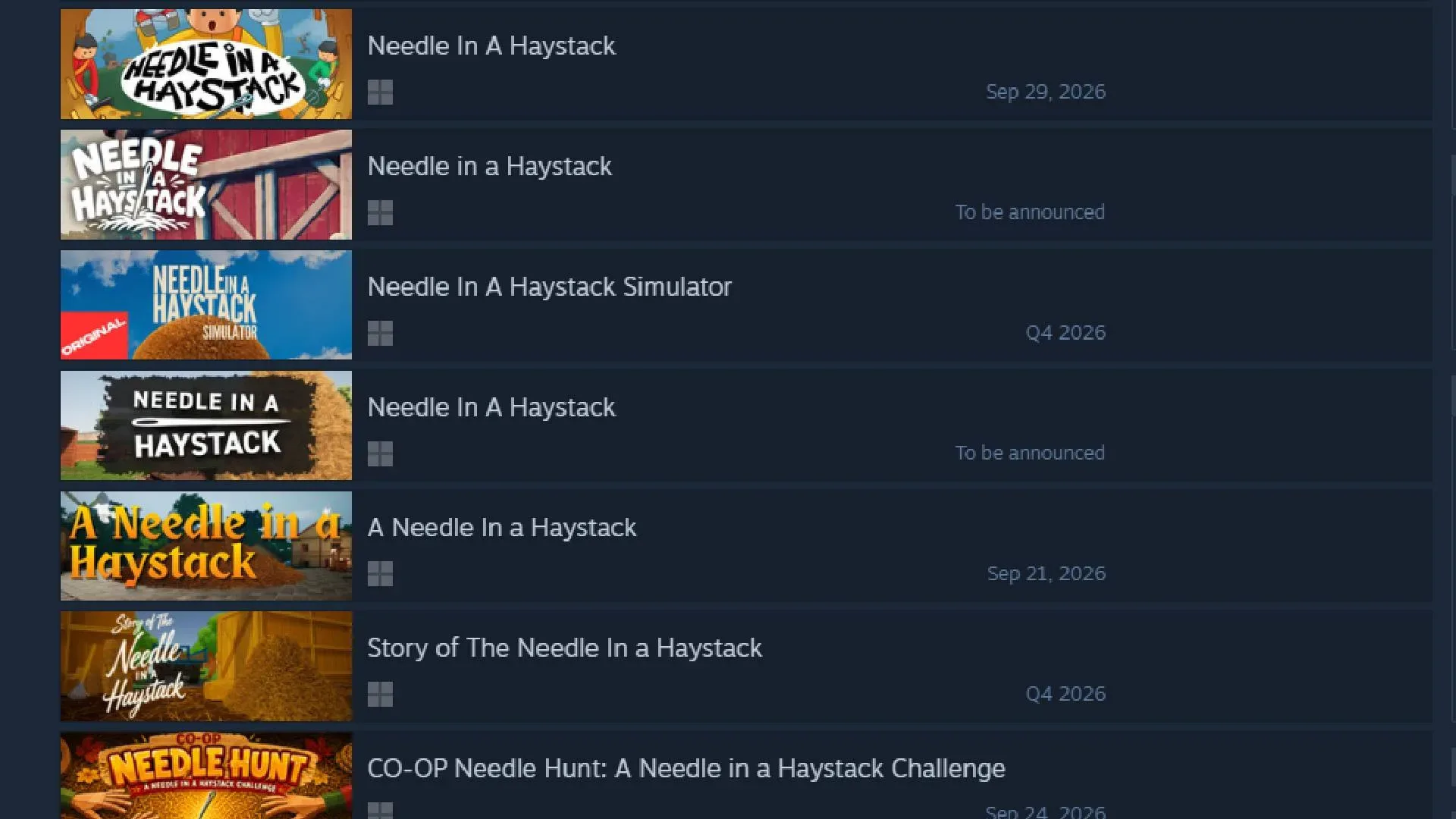
At least eight lookalike listings arrived within days of the original game’s late-August viral reveal. Further searches put the number above 10 before Needle in a Haystack Simulator has even launched. Its planned release window is Q4 2026, while some of the imitators are listed to arrive sooner.
That is the sharp end of the issue. A small developer can turn a strange, simple idea into a viral moment, but viral attention may also become an open invitation for competitors to plant near-identical signposts around it. A player looking for the game that caught their eye is suddenly asked to distinguish the intended destination from a stack of nearly interchangeable storefront entries. The joke is obvious. The practical consequence is less funny.
A crowded search for a very specific game
The copycat titles make the pattern unusually easy to see. Listings include A Needle in a Haystack, CO-OP Needle Hunt: A Needle in a Haystack Challenge, Story of The Needle in a Haystack, and Needle in a Million Haystacks. Other variations, including Hay! One Billion! and Find the Needle, broaden the pile without abandoning the core idea.
The concern is not merely that several games share a broad genre. Plenty of games use familiar mechanics, and no single premise can carry an entire medium alone. Here, though, the listings reportedly show few meaningful changes to the viral game’s central formula. The speed of their arrival and their close naming make the practical effect clear: they can complicate the simple act of finding the specific game that players saw shared online.
Discoverability is the industry term for that act of being found. It covers the route between curiosity and a page a player can identify, evaluate, wishlist, or buy. Search terms, names, key art, store tags, recommendations, festival lineups, and outside social-media links can all shape that route. A crowded genre is not inherently a failure of discoverability. A crowded cluster built around an unusually specific, newly viral concept is more troubling because the player’s search query is also the clone-maker’s easiest marketing tool.
For an unreleased game, this matters before a sale is even possible. Wishlists, follows, and recognition are valuable signals of audience interest, but the supplied information does not establish how Steam’s search or recommendation systems treat these listings. It would be speculation to say precisely how much traffic any one clone diverts. What is demonstrable is the extra burden placed on users: a search for the phrase attached to the viral game yields enough similar entries that scrolling is required to locate the original.
Related coverage includes Steam Copycats Are Making Original Indie Games Harder to Find.
The developer is being forced to label the obvious
The original game’s developer has responded by putting a large red box on its Steam key art identifying it as the original. Its store description also emphasizes that it is “the one and only.” Those choices are understandable, but they are also an awkward use of a game’s most visible marketing space.
Key art is the prominent promotional image used to communicate a game’s identity at a glance. In an ideal world, it sells tone, style, character, or a compelling hook. In this case, it must also act as a warning label. Rather than letting the haystack-and-needle gag stand on its own, the developer needs to tell prospective players that this is the version they were probably trying to find.
That distinction is important. Calling attention to the original does not prove that every similarly titled game is legally infringing, nor does the available information establish who made any of the listings or whether they copied code, assets, or text. The issue described here is market confusion and visibility, not a legal judgment. Similar games may be permitted to exist while still making a storefront worse for players and harsher for the creator whose work prompted the rush.
It also creates a perverse incentive. If the most direct path to a storefront audience is attaching oneself to a sudden viral phrase, then the work of creating an idea and getting it noticed becomes separable from the work of capturing attention after the fact. The first developer takes the creative and promotional risk. Fast followers benefit from the search demand that risk produced.
AI questions need careful wording
Some of the copycat logos have an appearance associated with generative-AI imagery, and the pace of the listings has led to suspicion that AI may have helped accelerate their creation. But most of the relevant pages reportedly do not include AI disclosures. That means there is no supplied evidence that can confirm generative AI was used on any particular game.
That uncertainty should not be smoothed over. Generative AI refers to systems that produce material such as images, text, code, audio, or other content from prompts and training-derived patterns. It can potentially speed up parts of a project, but a glossy or odd-looking logo is not proof of its use. “AI slop,” by contrast, is a critical label for work perceived as low-effort, mass-produced, or poorly considered; it is not a technical finding about how a game was made.
The more solid concern is behavioral rather than forensic: a viral concept has been followed by a rapid wave of highly similar listings. Whether each one relied on AI, conventional tools, or a mix of both, the result presented to Steam users is the same dense cluster of games competing for the words most closely associated with the original.
The broader controversy around AI-assisted game listings has already touched other games. The surprise hit Meccha Chameleon continues to spawn copies that make only minor alterations, including changing player models into animals or adding sexualized designs. Meanwhile, Librarian: Tidy Up the Arcane Library!, itself part of an AI debate, was followed by many AI-assisted organization games focused on arranging different spaces.
These examples point to a recognizable storefront pattern: an idea gets attention, then variations appear with the same basic appeal and just enough surface change to stand as separate products. The needle game is simply the clearest illustration because the core activity is so literal and its title is so searchable.
Why timing makes the pile-up more damaging
A clone appearing after an original release is one problem. Similar entries arriving before the originator’s announced Q4 2026 launch are another. Players who encounter one of the earlier titles may assume they have found the viral game, or may not realize a different version is still forthcoming. Even a shopper who does recognize the difference must invest time sorting the pages.
That is an especially bad fit for an ecosystem in which the number of new games is already increasing. Steam events such as Steam Next Fest are also described as being crowded by AI slop, adding another layer to the discovery challenge. Events meant to expose people to upcoming games can only do their job when players have a reasonable chance of connecting an intriguing demo or trailer to its actual creator.
There is a human cost hidden inside the very boring phrase “storefront clutter.” Independent developers often have limited capacity to explain a game repeatedly, revise their art, answer confused players, and preserve the identity of a project online. Having to do all of that because search results have become a semantic haystack is a distraction from the game itself.
It is also a player-experience issue. Nobody should need specialist knowledge to identify a game after seeing its viral clip. A storefront should help users separate an original from similarly named alternatives, not make them conduct an informal authenticity investigation from title variations and promotional art.
What a useful response would need to address
There is no confirmed Steam policy change in the supplied information, and it would be premature to declare a simple remedy. Still, the problem suggests several principles worth considering. A platform response would need to focus on misleading proximity without treating every mechanically similar game as forbidden. Similarity alone is not enough; naming, timing, presentation, and the likelihood of user confusion are the meaningful pressure points in this case.
- Clearer identity signals: Players need reliable ways to tell which listing belongs to the game that generated the interest.
- Better treatment of unusually similar titles: Stores can examine whether a sudden pack of nearly identical names makes searches less useful, even where the games are separate listings.
- Meaningful disclosure: If AI-use disclosure is a platform expectation, it needs to give players information they can actually use rather than leave them guessing from artwork.
- Discovery that rewards recognition: Viral attention should lead viewers toward the project they recognize instead of rewarding whoever can occupy adjacent search space fastest.
None of these ideas requires declaring that inspiration is theft or that every derivative project should vanish. They address the more immediate problem: when a game becomes popular enough to be searched by name, the store should not turn that search into a contest of who can look most plausibly like the answer.
The stakes extend beyond one intentionally tedious simulator. As PC game releases multiply, the ability to recognize and locate the thing you actually want becomes part of the product experience. The wider games business is already grappling with uncertainty around which prospective projects will materialize, as seen in a recent discussion of a possible Cytoverse tabletop game. On digital storefronts, the related challenge is making sure that when a project does exist—and captures the public imagination—people can still find it.
Needle in a Haystack Simulator made an absurdly mundane search into its premise. The flood of lookalike Steam pages risks making that premise the most accurate description of its route to players.