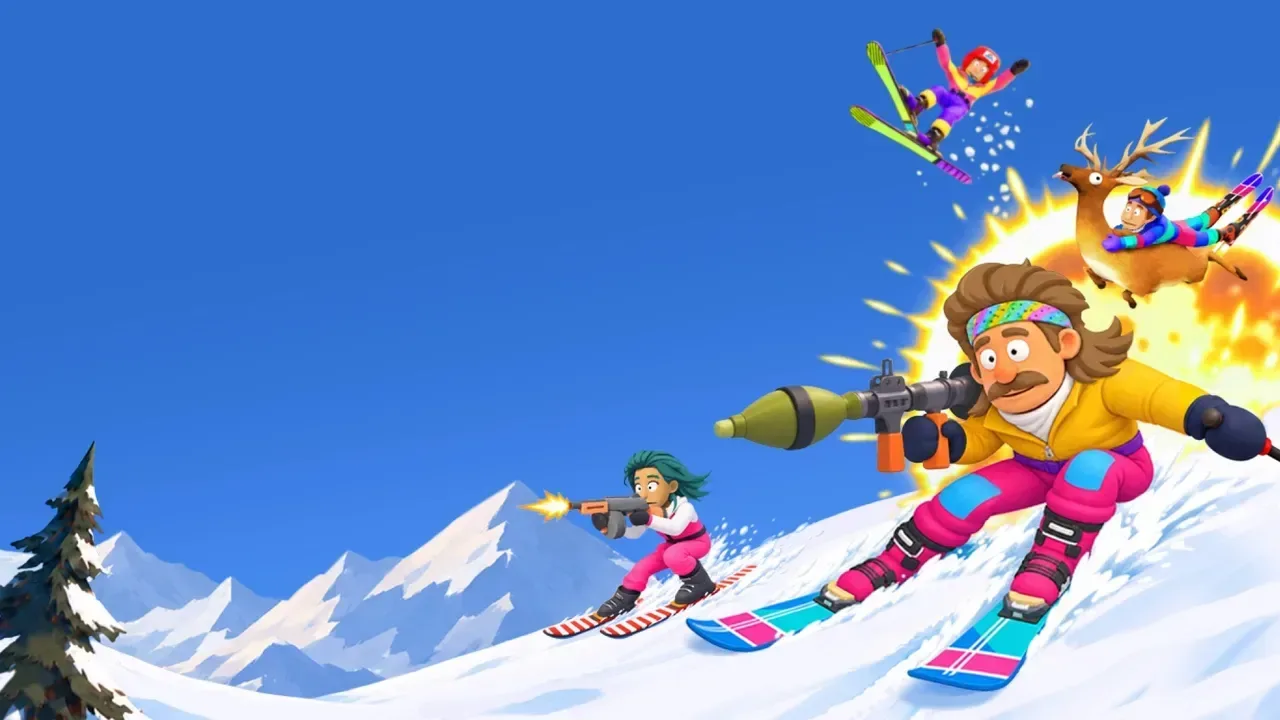
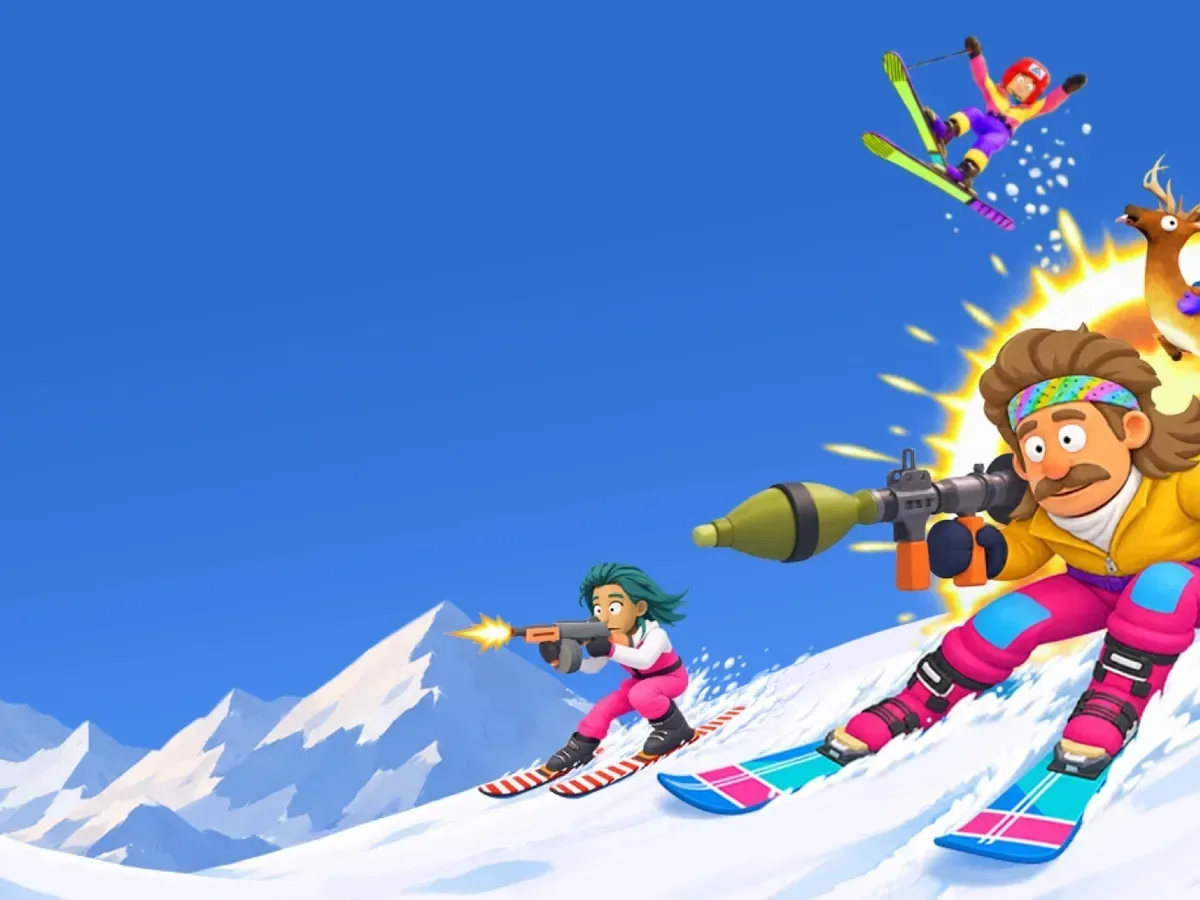
There are racing games built around precision lines, clean overtakes and shaving fractions from a lap time. Snow Panic is positioning itself somewhere much louder: a downhill skiing race where reaching the bottom first is the objective, but rockets, bullets, mines, airstrikes, hostile wildlife and even a literal exploding goat can make the route considerably less straightforward.
Developer KAFI has announced Snow Panic for PC as an arcade-style online skiing game for up to eight players. The pitch is deliberately irreverent, with the team framing the game as a collision between the high-speed downhill energy associated with SSX and the item-fuelled disruption of Mario Kart. That comparison is useful shorthand, not a promise that it will replicate either game’s systems: the confirmed details point to competitive skiing built around weapon use, sudden hazards and spectacular wipeouts.
Snow Panic is also designed so a match remains competitive even when a group cannot fill every slot. Bots will complete the field when there are not enough human players. For players who routinely organize smaller groups, that may be one of the more meaningful details in the announcement. Rather than waiting for a full lobby, a few friends should still be able to enter a populated downhill race.
A finish-line race with chaos baked into the course
The core rule is admirably uncomplicated: be the first skier to reach the bottom. What complicates that race is nearly everything else. KAFI has confirmed bullets and rockets among the threats racers may face on the descent, alongside mines, airstrikes and what it calls suspiciously aggressive wildlife. The exploding goat is the most obviously comic example, but it reinforces the game’s intended tone. Snow Panic is not presenting a serene mountain-sports simulation; it wants the mountain to feel like an unruly multiplayer arena.
That design puts its emphasis on race disruption. In a conventional racing game, disruption might mean losing momentum after clipping an obstacle or taking a turn poorly. Here, the announced arsenal and environmental dangers suggest that opponents can actively turn a clean run into a recovery problem. The question is not solely whether a skier can choose a fast route; it is also whether they can stay upright, react to hazards and recover after another competitor interferes.
“Ragdoll” is a useful technical term to unpack in this context. Ragdoll physics generally refers to an animation system in which a character’s body reacts dynamically after a collision instead of following a fixed fall animation. KAFI says every hit produces a full ragdoll crash. In practical terms, an impact is meant to be an event rather than a small penalty: the skier tumbles, momentum is lost, and the result can be unpredictable enough to become a memorable replay or social clip.
Every hit is intended to become a full crash rather than a minor bump on the way downhill.
That approach can make moment-to-moment races volatile. A leader may still be vulnerable close to the finish, while somebody knocked down early may be able to regain ground if other skiers suffer worse mishaps. The announcement does not detail item balance, recovery mechanics, mountain layouts or how players acquire weapons, so it is too early to judge how consistently skill will outweigh randomness. But the stated goal is clear: clean runs are not the expected default. They are the exception the game is designed to challenge.
Related coverage includes Snow Panic Brings Eight-Player Skiing Mayhem to PC.
Six mountains and 14 launch weapons or items
KAFI plans for Snow Panic to launch with six mountains. More mountains are planned for post-release updates, though no schedule or further specifics have been announced. Six locations does not, on its own, reveal the number of routes, modes, variations or individual races, so players should avoid reading more into that total than has been confirmed. It does establish the opening map count and signals an intention to expand the selection after launch.
The game will also have 14 weapons and items at launch. Again, the full list has not been revealed, but the announced examples give a sense of the range: direct attacks such as bullets and rockets, area-denial hazards such as mines, and more extravagant dangers including airstrikes and the explosive goat. In arcade racers, items are often tools that temporarily alter positioning, speed, control or safety. Snow Panic’s confirmed set appears focused primarily on making a rival’s descent go terribly wrong.
That distinction matters for people deciding what kind of racing experience they want. A game with competitive items can create comeback opportunities and moments of laughter, but it can also make outcomes less controlled than in a pure time-trial or simulation-style event. Snow Panic is openly leaning into the former. It is a game whose premise treats a pile-up on a snowy slope as part of the attraction, rather than an unfortunate interruption.
Proximity chat turns crashes into a group spectacle
Snow Panic will feature proximity voice chat. This is a voice system in which players are generally heard based on their virtual distance from one another, rather than every participant speaking at the same volume across an entire lobby. In a downhill race, that could mean nearby rivals are audible as they attack, pass, collide or disappear into a ravine.
The feature fits the game’s social-first framing. The developer has explicitly tied it to hearing friends react when the mayhem sends them off course. For an established group, proximity chat can make each race feel less like a silent leaderboard contest and more like a running chain of threats, panic and instant blame assignment. For players joining with strangers, it may be a consideration in the other direction: voice interaction can be a major part of the atmosphere, and individual comfort with online chat varies.
It is also worth distinguishing the confirmed feature from assumptions about moderation or voice controls. Proximity chat is announced, but no further details have been provided about settings, safety tools, push-to-talk options or chat management. Those are important practical questions for online multiplayer games, but they have not yet been answered here.
Customization is confirmed, while deeper progression details are not
Players will be able to customize their skier’s hair, outfits and skis. Those options should help groups distinguish racers in an eight-player pack, especially when everyone is wearing winter gear and falling down the same hillside. Custom skis and clothing also give the game room to support a playful visual identity beyond the chaos happening on the course.
However, the announcement does not specify whether cosmetics are unlocked through play, tied to progression, offered in other ways, or purely selectable from the start. It also does not describe character abilities, ski stats, ranked play, split-screen support, controller support, cross-platform functionality or an exact release date. None of those omissions implies that a feature will or will not appear; they are simply details still unconfirmed.
For now, the practical takeaway is that Snow Panic has a focused, comprehensible hook. It will put up to eight skiers on a mountain, fill empty seats with bots, make first place the only stated victory condition, and supply enough weaponry and hazards to ensure the line between racing and disaster keeps disappearing. The six-mountain launch plan, 14-item pool and customization options give that hook some structure, while proximity chat is meant to turn the inevitable crashes into a shared event.
Snow Panic is in development for PC and can be wishlisted on Steam. Its broader appeal will likely depend on the balance between chaos and control: enough disruption to create stories, but enough responsive skiing and readable hazards that a recovery feels earned. KAFI has not yet offered the details needed to settle that question, but the announced direction is unusually direct. This is downhill racing for players who believe the mountain should fight back—and perhaps explode while doing it.
For another look at a PC game evolving in response to player input, see our coverage of The Expanse: Osiris Reborn’s changes after beta feedback.