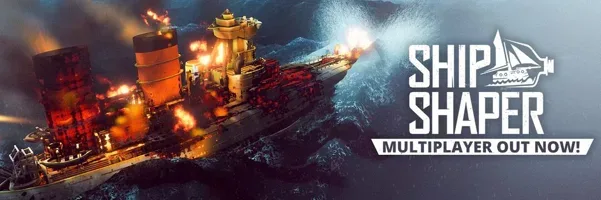
ShipShaper has entered the multiplayer phase of its Steam Early Access voyage. A free update, released on November 19, 2026, lets players take their self-built vessels online for naval warfare, racing and the kind of engineering mishaps that tend to happen when a ship design meets actual physics.
The central promise is refreshingly direct: build a ship piece by piece, consider how its components work together, and then find out whether it can survive contact with other players, an arena, or a poorly timed turn. The update is available now through Steam Early Access.
Developed by Tomas Sala and published by Wired Productions, ShipShaper is a standalone shipbuilding sandbox with a physics-driven foundation. Sala is also the creator behind The Falconeer and Bulwark: Falconeer Chronicles. Where those projects establish a connection to an oceanic fantasy setting, ShipShaper’s stated focus is on the act of making vessels and putting those handmade designs through practical tests.
What the multiplayer update adds
Multiplayer is framed as a major expansion of ShipShaper’s creative sandbox rather than a separate mode detached from the building tools. Players construct ships, then bring those designs into online combat and racing arenas. The available activities include naval warfare, races and collaborative or competitive experiments that may end in a vessel sinking spectacularly.
That last part is important to the game’s identity. ShipShaper is not simply presenting ship construction as cosmetic customization before a conventional match. Its design premise is that a vessel’s construction matters once it is on the water. Weight, sails and engineering are specifically identified as factors players must balance.
In practical terms, multiplayer turns each build into a claim that can be challenged immediately. A ship that looks imposing may not necessarily be well-balanced. A fast design may have difficulties remaining stable. A creation designed around one kind of contest may prove ill-suited to another. The update gives those questions a social setting, where friends can race, battle and compare the consequences of very different approaches to the same construction tools.
Creativity, physics and multiplayer
The update represents the third major stage of ShipShaper’s Early Access development, bringing together three pillars: creativity, physics and multiplayer. Those labels explain the basic loop more clearly than a feature checklist would.
Creativity: the ship is the player’s design
The creative side is the ability to build vessels piece by piece. That means a ship is handcrafted rather than selected from a fixed roster. Players can approach construction as an engineering exercise, a race to make something efficient, or an invitation to make a wonderfully impractical boat and see what happens.
Related coverage includes ShipShaper Adds Free Multiplayer to Its Steam Early Access Voyage.
Creative sandboxes work best when the building phase leads to meaningful results. Here, the result is not merely a saved design or a decorative showcase. It is a vessel that can be taken into an online arena. The builder has a reason to think about the layout and purpose of their craft before launching it.
Physics: designs have consequences
A physics-driven simulation means the game is built around simulated physical behaviour rather than treating the ship as a single, abstract vehicle. ShipShaper’s announcement points specifically to balancing weight, sails and engineering.
Weight concerns how the vessel is distributed and supported. In a shipbuilding context, it is not enough for a design to appear symmetrical or sturdy; the placement of parts can affect how it behaves.
Sails are a key part of propulsion and handling in the game’s sailing-focused setup. Their inclusion signals that movement is tied to the ship’s construction, not just a generic acceleration button.
Engineering, as described here, covers the larger problem of putting the parts together into a working vessel. A practical build has to reconcile competing goals: moving effectively, coping with the conditions of an arena and remaining viable when things get chaotic.
The appeal of a system like this is the feedback loop. Build decisions lead to visible outcomes. A successful run validates an idea; a failure identifies an assumption that did not hold up. The game’s emphasis on designs that may “survive or sink” makes failure part of the experiment rather than simply a match result.
Multiplayer: the test bench gets busier
Online play supplies more than opponents. It makes shipbuilding legible to other people. Friends can challenge one another in races, test their designs in combat or simply watch an overly ambitious vessel discover a fatal flaw at the worst possible moment.
For players who enjoy construction systems but do not necessarily want an open-ended solo project, this is the useful practical change: multiplayer gives a build a clear occasion. A race asks whether a design can move and handle well enough. Combat asks whether it can endure pressure in an arena. Less formal sessions leave room for experimentation and engineered chaos.
Because the update is free, existing Early Access players receive multiplayer without an additional charge. New players should also keep the Early Access label in mind: ShipShaper’s rollout is explicitly being presented in stages, and this multiplayer release is stage three rather than a declaration that development is complete.
Why online shipbuilding is a natural fit
ShipShaper’s ingredients reinforce one another. A freeform construction system creates variety because players can pursue different solutions. A physics simulation makes those choices matter. Multiplayer supplies the environment where the differences become visible.
Racing, for example, is more than a simple speed contest when vehicles are player-made. Participants are also testing decisions made before the start: how the ship was assembled, how it is balanced and how it handles its sails. Naval warfare adds a different pressure point, asking players to bring their work into a confrontation rather than a clean time trial.
That does not mean the game promises perfectly rational engineering every time. The update deliberately makes room for disasters. In a creative sandbox, an unexpected failure can be valuable entertainment as well as useful information. A shipwreck is an outcome, but it is also an explanation: something about the design did not withstand the situation it entered.
The game’s online direction also distinguishes a shipbuilding sandbox from a menu of preset vessels. Instead of learning the strengths and weaknesses assigned to a developer-made craft, players are asked to create the strengths and weaknesses themselves. A clever solution can be challenged, adapted or abandoned once other players and arena conditions expose its limits.
What players can reasonably expect now
The confirmed multiplayer activities are combat and racing arenas, supported by the broader prospect of building, testing and challenging friends. ShipShaper’s foundation remains its hands-on construction and deep simulation, so the clearest expectation is an experience where the process of designing a vessel is inseparable from using it.
Players looking specifically for a polished final-release package should note that the game remains in Steam Early Access. For players drawn to evolving creation tools, however, the new update is a meaningful threshold: handmade ships can now leave the workshop and encounter other people’s ideas online.
It arrives alongside a busy day for PC releases; see our November 19, 2026 games release roundup for a wider look at what is landing today.
The announcement also makes the extraordinary claim that ShipShaper is currently outselling GTA VI on Steam. That is presented as a claim within the announcement, not independently established sales data. The concrete, player-facing news is more straightforward: ShipShaper’s multiplayer update is live, free, and ready to put custom vessels through online races, battles and a likely number of watery design post-mortems.