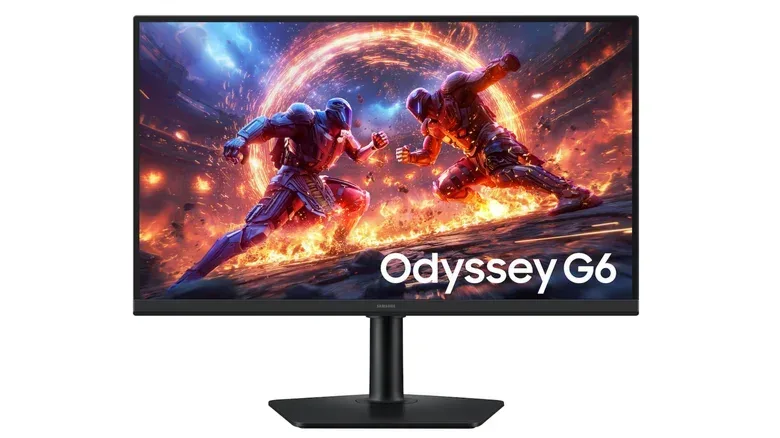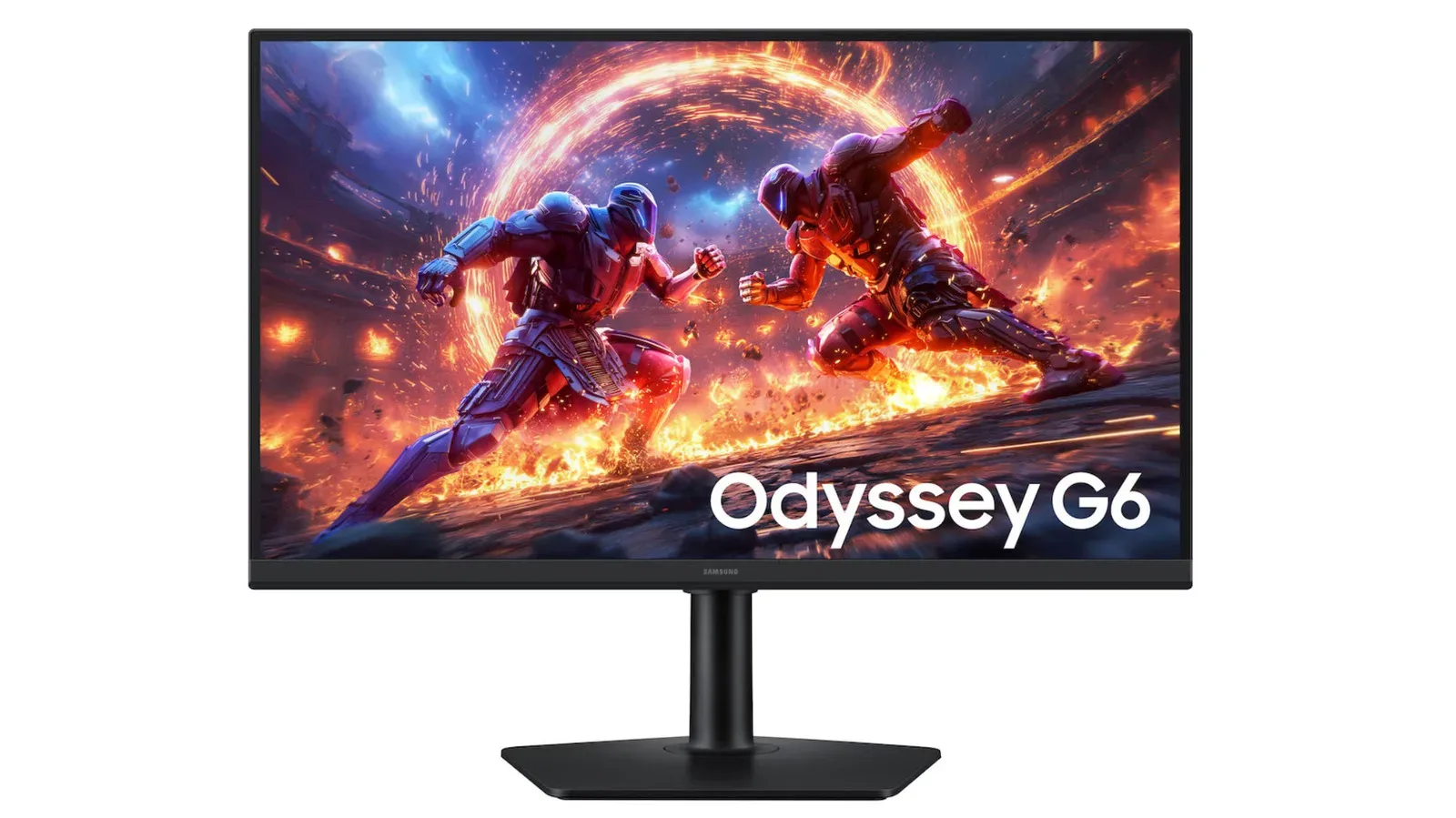
Samsung has announced the Odyssey G6 G60H, a 27-inch gaming monitor that takes the refresh-rate arms race to an eye-watering 1,100Hz. It is an extraordinary figure, and also one with an important asterisk the size of a desktop wallpaper: the display reaches that maximum only in its HD, 1,280 × 720 mode.
Buyers instead get a dual-mode IPS panel with two native operating points. One prioritizes sheer update speed at 720p and 1,100Hz; the other runs at QHD, or 2,560 × 1,440, with a still remarkably high 600Hz refresh rate. In other words, the G60H is not claiming that players can have maximum sharpness and maximum speed simultaneously. It makes the trade-off explicit, which is more useful than pretending physics has taken the afternoon off.
For the vast majority of players, 600Hz at QHD may be the more immediately interesting specification. The 1,100Hz setting is a highly specialized option aimed at situations where lower image detail is an acceptable sacrifice for the fastest possible screen updates—most plausibly high-level competitive first-person shooters.
What 1,100Hz actually changes
A monitor’s refresh rate is the number of times it can redraw its image each second. At 1,100Hz, the G60H can refresh up to 1,100 times per second. At 600Hz, it can refresh up to 600 times per second. Higher refresh rates can make movement appear smoother and reduce the interval between a newly rendered frame and the opportunity for it to appear on screen.
That does not mean every game will suddenly output 1,100 frames per second, nor does it mean a player will always see a useful new image on every refresh. The game, the PC and its graphics hardware must all produce frames quickly enough to take advantage of the panel’s ceiling. A monitor can provide the runway; it cannot personally persuade the rest of a system to become a rocket.
The practical target is therefore narrow. A professional or seriously competitive FPS player who runs performance-focused settings and plays a title capable of exceptionally high frame rates may value the incremental reduction in motion blur and display latency. For players enjoying cinematic single-player games, strategy games, or anything where image detail outweighs split-second tracking, the 720p compromise is likely to be far harder to justify.
Samsung’s QHD mode deserves to be considered on its own merits rather than merely as the consolation prize for not being 1,100Hz. Six hundred hertz at 2,560 × 1,440 remains above the refresh capability of most monitors available today, while QHD supplies substantially more image detail than 1,280 × 720. That creates a more versatile proposition than a monitor built solely around its headline number.
The central compromise: 720p versus QHD
Resolution describes how many pixels form the image. QHD on this monitor is 2,560 pixels wide by 1,440 pixels tall. Its HD mode is 1,280 by 720. The latter has far fewer pixels to render, which lowers the workload required of the PC and helps make extraordinarily high frame rates more feasible.
The consequence is clarity. At 27 inches, 720p will not offer the fine desktop text, detailed scenery or general-purpose workspace comfort expected from QHD. That may be acceptable when a game is configured for competitive visibility rather than visual spectacle, but it is a decision buyers should make with their eyes open. The G60H is a dual-mode display because it asks users to choose an operating philosophy, not because it somehow abolishes the usual relationship between resolution, rendering load and refresh rate.
It is also worth separating a monitor’s refresh-rate capability from a game’s frame rate. A 1,100Hz panel has the capacity to update at that rate. Whether it presents 1,100 distinct game frames depends on the system sustaining an equivalent frame rate, and on the game itself behaving appropriately at such extreme performance levels. The monitor is one part of a chain, albeit a very flashy, very fast part.
Panel, motion and synchronization features
The Odyssey G6 G60H uses an IPS panel. Samsung lists 400 nits of typical brightness, HDR10+ certification and a 1ms gray-to-gray response time. Gray-to-gray refers to how quickly pixels transition between shades of gray, a common measurement used to indicate pixel-response performance. Refresh rate determines how frequently the panel has an opportunity to show a new image; response time concerns how rapidly pixels can change to represent that image. Both matter to perceived motion clarity, but they describe different jobs.
Samsung is also including Odyssey Clear Motion, described as a custom algorithm intended to reduce blur and preserve image sharpness during movement. The company’s black equalizer feature automatically adjusts brightness in dark scenes to increase perceived contrast. In a competitive setting, dark-area adjustments can be relevant because visibility in shadowed portions of a map may affect target recognition. That said, these are image-processing and visibility aids; they should not be confused with the fundamental 600Hz and 1,100Hz panel modes.
Support for AMD FreeSync Premium and NVIDIA G-Sync provides variable refresh-rate compatibility. Variable refresh rate, often shortened to VRR, allows the monitor’s updating behavior to better match the pace at which a compatible graphics system delivers frames. Its purpose is to reduce distracting visual artifacts that can occur when frame delivery and display updates fall out of step. For a display marketed around speed, support across the two major PC graphics ecosystems is a meaningful inclusion.
A stand built for adjustment, plus one small limit
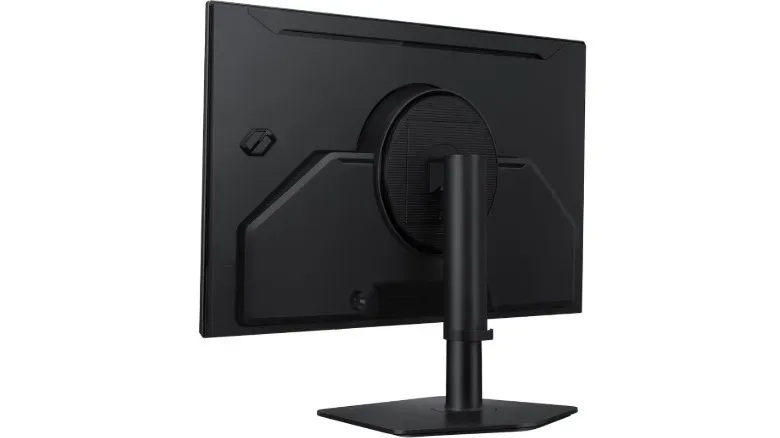
The G60H’s stand supports height adjustment, swivel, tilt and pivoting. Samsung does not say that it can rotate all the way to a portrait orientation, so prospective buyers who specifically need a vertical screen should not treat pivoting as a guarantee of full portrait use.
Another convenience feature is Auto Source Switch+, which detects a newly connected input and switches the monitor to it without requiring the user to navigate the rear joystick controls manually. It is not the statistic that will dominate a product page, but it could matter to people regularly moving among systems. A monitor that notices the newly active device by itself is a modest quality-of-life win—especially after a buyer has spent their budget chasing four-digit hertz.
Who should care about this monitor?
The clearest audience is the small group of competitive FPS players for whom every available performance edge is worth investigating. At that level, the appeal is not that 1,100Hz transforms an ordinary setup into instant tournament dominance. Rather, it is an attempt to shave away another layer of display limitation in a pursuit where smooth motion, rapid visual updates and consistent response can matter.
For a broader PC-gaming audience, the G60H is more interesting as a sign of how far enthusiast display hardware is willing to push specialization. A shopper who wants a high-refresh QHD screen may find the 600Hz mode more relevant than the 1,100Hz headline. A shopper who values graphical detail, larger working space, or the sharpness that comes with higher resolution should pay particular attention to the fact that the record-setting speed requires 720p.
That distinction should keep expectations realistic. The best setting depends on the game and the player’s priorities. The 720p mode is built around competitive speed. The QHD mode is built around maintaining considerably more image detail while still operating at a refresh rate that remains exceptional. Neither setting invalidates the other; the value of the monitor lies in having both options, provided the buyer actually has a use for them.
PC display advances also sit alongside a wider stream of gaming hardware and platform activity, including the upcoming VR Forever Awards 2026 SteamVR festival. The G60H is a different kind of enthusiast proposition, but it similarly illustrates how varied the demands of PC gaming can be: one player may be chasing virtual-reality experiences, while another is counting milliseconds on a 720p competitive display.
Price and release date remain unconfirmed
Samsung has not provided official pricing or a release date for the Odyssey G6 G60H. That makes it premature to assess its value against other high-end monitors, or to recommend it on price alone. Displays in this class can cost around $1,000 or more, but that is only a broad expectation rather than confirmed pricing for this specific model.
Until those details arrive, the important facts are straightforward. Samsung’s 27-inch Odyssey G6 G60H offers two native modes: QHD at up to 600Hz and HD at up to 1,100Hz. It combines those modes with an IPS panel, 400-nit typical brightness, HDR10+, 1ms gray-to-gray response time, FreeSync Premium, G-Sync compatibility, motion-focused processing and a highly adjustable stand. Its record figure is real, but so is the resolution trade-off required to reach it. For its intended niche, that may be exactly the point.