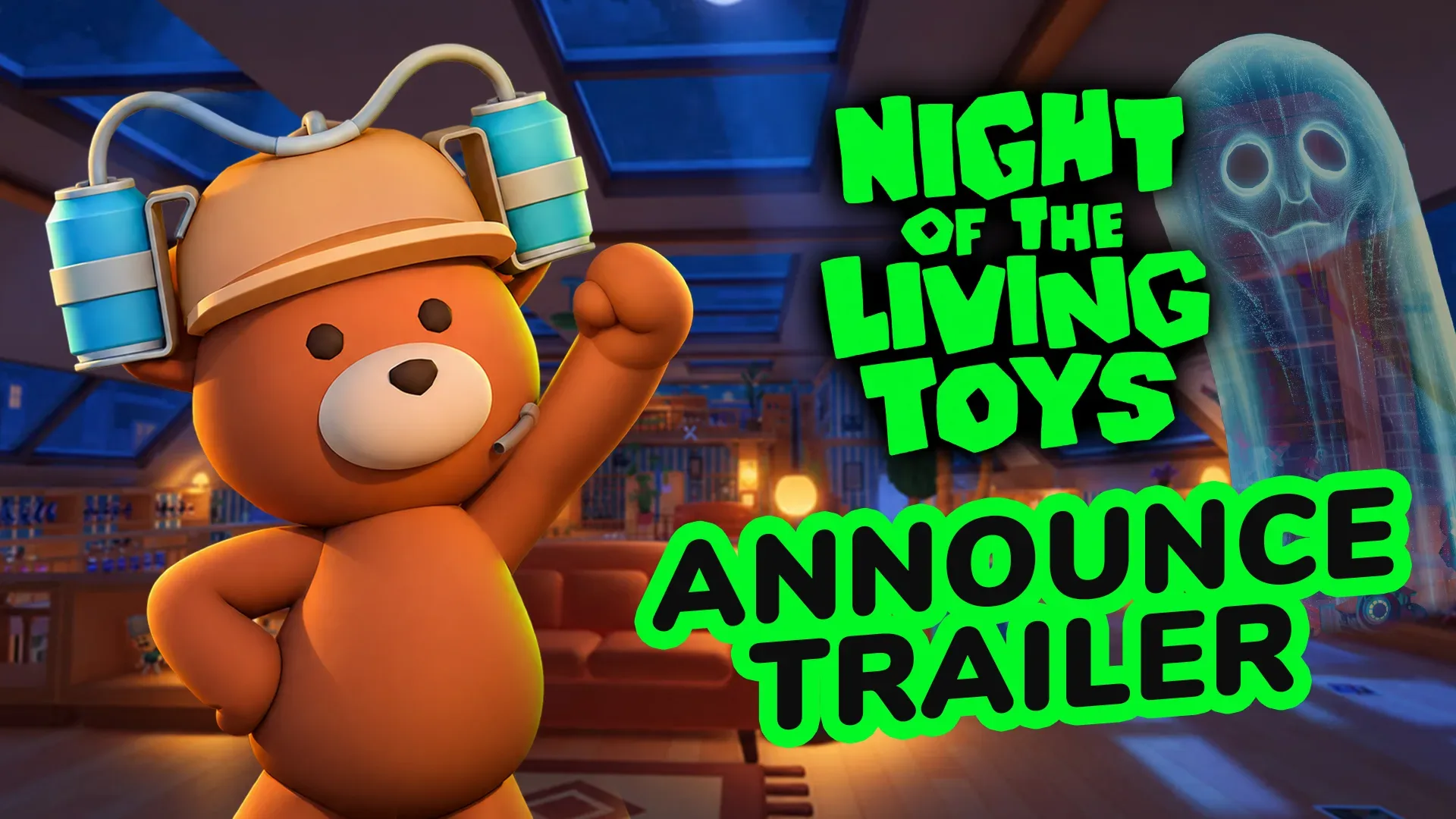
Night of the Living Toys is scheduled to launch on Steam on December 10, 2026, inviting players to clock in for a night shift at a toy store where neat shelves are apparently a direct challenge to the supernatural. Developed by Toivo & Raivo and published by Xiombarg, the game combines sorting, tidying and virtual toy collecting with a steadily stranger after-hours atmosphere.
The setup sounds pleasantly ordinary at first: put toys in order and make the shop presentable. But this is not a straightforward retail-simulation shift where the greatest danger is an incorrectly faced shelf. The more order players create, the more mysterious events begin to emerge. That escalating premise gives the game a useful tension between cozy organization and toy-box weirdness: a player may start by arranging a display and end up running from a ghost or pursuing a living teddy bear.
It can be played alone or cooperatively with up to three friends. In practical terms, that means a group of as many as four players can share the same strange shift, dividing the work—or creating a workplace incident involving boxes, costumes and airborne objects.
Two approaches to one unusually haunted shop
Night of the Living Toys presents two distinct ways to play. One is a relaxed sorting-and-tidying session, aimed at the simple satisfaction of restoring order. Sorting games turn small acts of classification into their core loop: identify an item, decide where it belongs and gradually transform visual clutter into a more orderly space. Here, shelves are not merely decoration; they are central to the player’s work.
The other mode emphasizes collecting. Players open boxes, find toys of varying rarities, assemble sets and build out a collection shelf by shelf. Rarity describes how commonly a particular toy is found, while a set is a connected group of items intended to be completed. Those ideas make each new box potentially meaningful beyond the immediate cleanup task: an item might fill an empty shelf space, advance a set or simply add another discovery to the display.
That distinction matters because the two modes appear to offer different reasons to spend time in the store. The tidying option foregrounds calm, visible progress. The collecting option foregrounds discovery and completion. Players looking for a lower-pressure organizing activity have a clear route, while those who enjoy opening boxes and gradually filling a display have another. Both are rooted in the same toy-store setting rather than being separate games stitched together with tape and a suspiciously cheerful bow.
Coins, boxes and gadgets in the cleanup loop
The announced gameplay tools suggest that cleaning will involve more than manually picking up every stray toy. A piggy bank can be shaken for coins, while surprise boxes, upgrades and magical gadgets form part of the game’s broader progression. Coins are a game currency here: a resource players earn or obtain and that is tied to the game’s systems. The supplied details do not specify prices, upgrade trees or the exact function of every gadget, so those mechanics remain to be detailed.
What is clear is the purpose of the magical equipment: it helps speed up cleanup. That is significant for a game built around repeated sorting. Tools that make a task faster can change the pace of a session, letting players move from basic tidying toward larger goals such as opening boxes, finishing a set or investigating whatever has begun to haunt the premises.
Surprise boxes also fit the collecting side especially well. Their appeal is uncertainty: before opening one, the player does not know which toy will be inside or whether it will be common or rarer. The game’s announced focus on discovering different rarities and completing sets gives that uncertainty a clear outcome. A box is not just another container to process; it can be the source of a missing addition to the shelf.
Importantly, this is an in-game collection rather than a real-world collecting product. The stated goal is to build the game’s collection shelf, toy by toy, as part of play. Its satisfaction comes from organizing a virtual space and completing virtual sets—not from physical condition, storage or marketplace value.
Co-op is allowed to get gloriously unprofessional
For all its tidying, Night of the Living Toys is not portraying teamwork as a solemn procession of workers quietly filing plush animals by category. Its co-op interactions include stuffing friends into boxes, throwing items, taking group photographs in silly costumes, fleeing a ghost and chasing a wandering living teddy bear.
Those details point to a social mode that leaves room for players to make their own chaos amid the cleanup. In cooperative games, shared objectives and player-driven mischief often pull in opposite directions: one person may want the shelves pristine, while another may regard their colleague as a box-shaped opportunity. Night of the Living Toys appears prepared for that contradiction rather than treating it as an accidental side effect.
The ghost and living teddy bear establish that the store’s mystery is active, not merely an ominous backdrop. The available information does not explain what triggers these encounters, whether they can interrupt either play style, or how players respond beyond running and chasing. Still, their presence gives the game's central joke a sturdy structure: the effort to make a toy shop orderly seems to reveal that the shop has very different plans.
Costumes and group photos add a lighter kind of co-op activity. They are not presented as a required system for advancement, but they provide a way for groups to mark a session with a shared image. Alongside the ability to toss objects or box up friends, they suggest that the game expects a degree of playful downtime between the actual shelf work and supernatural interruptions.
Why the premise has room for both comfort and chaos
The strongest part of the announced concept is how its ingredients support each other. Sorting and collecting naturally suit a toy shop: players can restore displays while also finding reasons to care about individual objects. Then the mysterious events complicate the otherwise serene loop. The game is not simply selling the idea of a haunted store, nor simply offering a collection checklist. It is positioning order itself as part of the setup for increasingly unusual happenings.
That gives solo and co-op players different possible moods without changing the setting. A solo session can focus on the tactile appeal of clearing clutter, opening boxes and adding toys to the shelf. A group session can retain those goals while making room for accidental—or extremely deliberate—disruption. The announced maximum of three friends is a particularly natural fit for this kind of compact shared space: enough people to create competing priorities, but not so many that every toy must file an incident report.
Steam players interested in upcoming PC releases can also keep an eye on other store-bound oddities, including The Last Gas Station: Winter Resort DLC, although its snowy-resort premise is clearly a different sort of shift from policing a toy shelf with supernatural labor conditions.
What has been confirmed—and what has not
The confirmed details are substantial enough to outline the basic play loop: sort and tidy toys, or focus on opening boxes and building sets; use coins, upgrades and magical tools; play alone or with up to three friends; and contend with odd events as the store becomes more orderly. The game is set to launch on Steam on December 10, 2026.
Several particulars have not been specified. There is no stated price, no announced console version, and no explanation of the full upgrade system, the toy rarity breakdown, the number of sets, or the precise mechanics behind the ghost and living teddy bear. It is also not yet clear how the relaxed and collecting-focused options are selected or how much their systems overlap. Those are reasonable questions for closer to release, but the available outline already establishes the intended blend of calm work, collectible progress and co-op toy-store nonsense.
For now, Night of the Living Toys looks designed for players who can appreciate the very specific pleasure of putting every object in its proper place—right until a bear gets up, walks away and makes that organizational plan considerably more complicated.