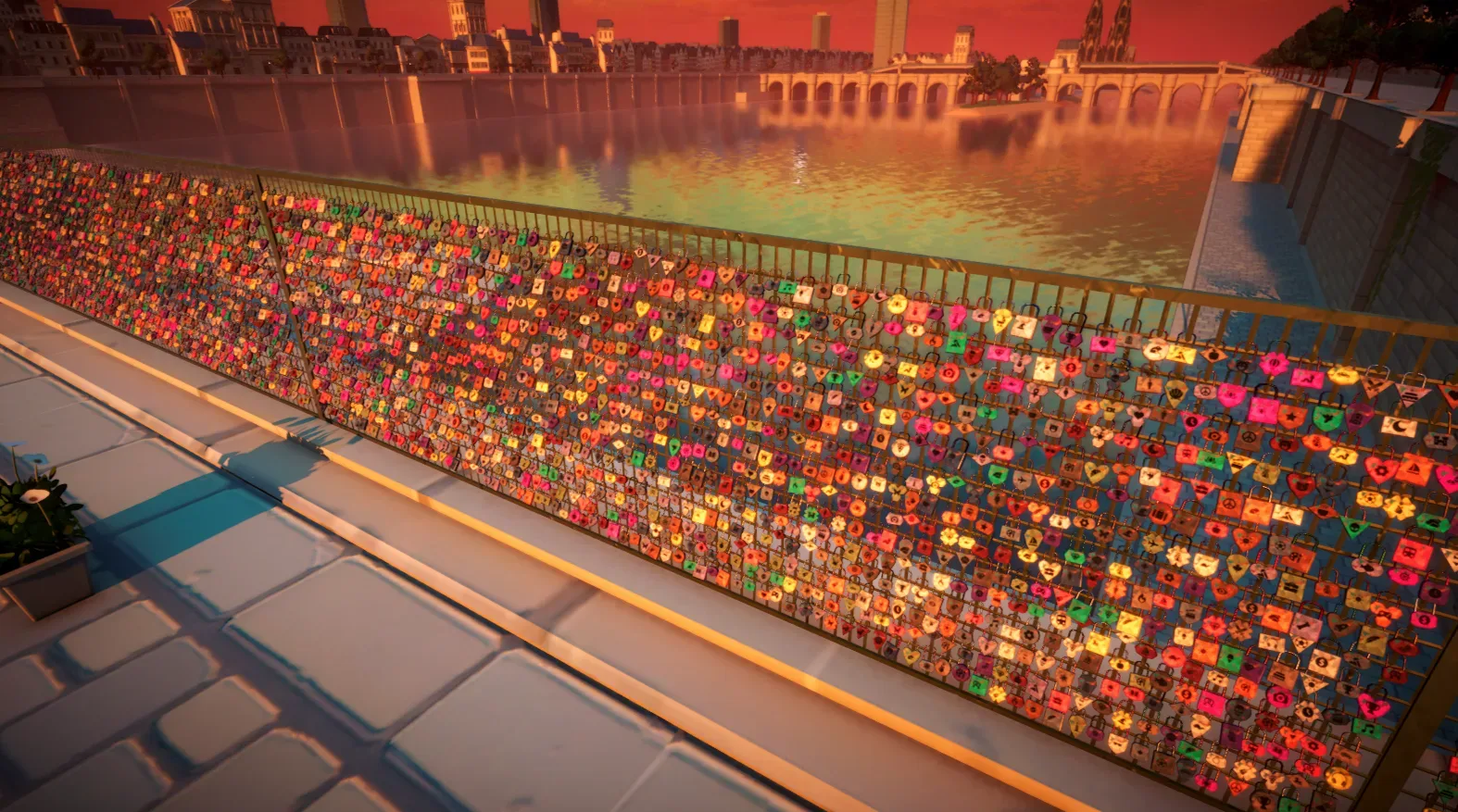

Love Locks is scheduled to launch worldwide on Steam for Windows PC and macOS on December 3, 2026. Developed by Blue Brain Games and Collision Games, the first-person cleanup game gives players a distinctly oversized civic chore: removing 100,000 love locks from a bridge in Paris.
The basic task is deliberately simple, but its framing is unusual. Rather than making the bridge a backdrop for a combat mission or a sightseeing sequence, Love Locks makes restoration the entire objective. Players operate a specially equipped drone, fish discarded keys from the Seine with magnets, identify the lock each key belongs to, and progressively clear the bridge.
It is a premise built around repetition, recognition and visible change. One removed lock may be a tiny action, but the stated total of 100,000 turns that action into a long-form shared cleanup project. The game is also designed for players who would rather approach that job quietly on their own, as well as groups that want to divide the work through online co-op.
A cleanup game with a deliberately enormous target
Cleanup games tend to get their appeal from a straightforward feedback loop: a cluttered space becomes orderly because of the player’s effort. Love Locks applies that loop to a very specific kind of object and makes the number part of the pitch. There are 100,000 locks to remove, not a vague quantity of scattered debris or a short series of scripted tasks.
That number matters because it establishes the scale before anyone even picks up a tool. Clearing every lock is positioned as an extended undertaking, whether it is tackled casually, cooperatively or competitively. The game’s core process begins with the keys rather than the locks themselves: players use a drone to magnet-fish keys from the river, match them to their corresponding locks, then dismantle those locks to reclaim the bridge.
Magnet-fishing, in this context, means using a magnet to retrieve metal objects from the water. Love Locks turns it into a gameplay step rather than treating the keys as automatically available. Matching each key to a lock adds a sorting and identification layer to the cleaning process, giving the act of removal more structure than simply clicking every lock in sight.
The setup also leaves room for players to decide what they find relaxing. Some may enjoy methodically locating keys and resolving matches. Others may be drawn to the accumulating visual result: fewer locks on the bridge and a larger portion of the job completed. The key point is that the game presents cleanup as the progression, not as busywork between unrelated objectives.
Tools begin modestly and get much louder
Love Locks will not limit players to keys and pliers. Its stated tool progression starts there, then moves through saws, bolt cutters, shotguns and lasers. The escalation gives the premise a knowingly comic edge. A game about a bridge covered in sentimental padlocks begins with practical removal tools, then eventually introduces equipment with a far more extravagant tone.
Related coverage includes Love Locks Sets December 3, 2026 Steam Launch for Paris Bridge Cleanup.
The announcement does not define the individual mechanics, limitations or unlock requirements for those tools, so it is too early to assume how each one will change the pace of play. What is clear is the intended contrast: careful key matching and hand-tool work sit alongside increasingly dramatic methods of dismantling locks.
That contrast is important to the game’s identity. Love Locks is described as relaxing, yet its progression includes equipment that sounds intentionally over-the-top. Those ideas do not necessarily conflict. In cleanup-focused games, a stronger tool can function as a reward for persistence, letting players approach the same broad task with more options later on. Here, the jump from pliers to lasers signals that the developers are not treating the project as a wholly sober simulation.
Players interested in other unusual PC concepts currently headed to Steam can also see The Devil’s Due’s roguelite poker and tarot-driven setup.
Solo cleanup or four-person online co-op
Love Locks supports solo play and online co-op for up to four players. The co-op implementation has one especially useful detail: every player has independent locks and progress.
Independent progress means a player’s advancement is tracked separately rather than being folded into one shared completion state. In practical terms, that can make cooperative sessions friendlier for groups with different schedules or different amounts of available time. A player does not have to depend on everyone else being present to retain credit for their own work.
It also fits the game’s central premise. Removing 100,000 locks is a large collective target, but independent tracking means the individual contribution still has weight. Players can clean in company without the game implying that only the group’s combined result matters.
The announcement calls out both a relaxing solo route and multiplayer cleanup, suggesting that neither is merely an afterthought. Solo players can focus on the methodical loop at their own pace. Groups of up to four can turn the same bridge into a shared job, potentially splitting attention between retrieving keys, locating matches and removing locks. The exact division of roles has not been detailed, but the systems described naturally support a cooperative rhythm.
Each lock can reveal a relationship flashback
The locks are not only environmental clutter. Dismantling them reveals humorous relationship flashbacks, adding a small narrative payoff to removal. This gives individual locks a potential personality beyond their role in the overall count.
The supplied details do not say how frequently flashbacks appear, whether they are randomized, or how long they last. Still, the idea helps explain why matching and dismantling a single lock might remain interesting amid such a large total. The player is not just watching a number go down; the cleanup may also uncover a series of comedic glimpses connected to the locks left behind.
Love Locks also includes an unlockable companion for players without friends or a significant other. It is a characteristically cheeky feature for a game rooted in romantic symbols, and it keeps the tone from becoming overly sentimental. The bridge’s love-lock premise is used as comedy material as much as scenery.
That tonal balance may be the clearest way to read the project so far. The game uses a calm, restorative activity as its foundation, but pairs it with relationship jokes, a potentially lonely-player companion and a tool list that eventually reaches shotguns and lasers. It is not trying to present romance as sacred architecture. It is presenting an absurd accumulation of romantic gestures as a very large mess that needs sorting out.
A speed challenge with a wedding-or-divorce prize
To mark the launch, Love Locks will also offer a prize opportunity tied to clearing all 100,000 locks. The player with the fastest verified completion time has the chance to receive up to US$5,000 toward a wedding or a divorce, subject to the official rules.
There are several qualifiers worth keeping intact. The award is described as up to US$5,000, it is attached to a fastest verified time, and eligibility or final terms are governed by the official rules. Details such as the verification process, regional eligibility and any additional requirements have not been provided here, so prospective competitors should look to the official rules once available rather than assuming the exact structure from the headline figure alone.
Even so, the challenge introduces a second way to interpret the game’s large lock count. For a relaxed player, 100,000 locks are a long-term cleanup goal. For a speed-focused player, they become a route-optimization problem: complete the same giant task as efficiently as possible while meeting whatever verification standards apply. The wedding-or-divorce framing keeps the prize aligned with Love Locks’ irreverent relationship humor.
What is confirmed for launch
- Release date: December 3, 2026.
- Platforms: Steam for Windows PC and macOS.
- Developer teams: Blue Brain Games and Collision Games.
- Core objective: Remove 100,000 love locks from a Parisian bridge.
- Primary loop: Use a drone to magnet-fish keys from the Seine, match them to locks and dismantle the locks.
- Tools named so far: Keys, pliers, saws, bolt cutters, shotguns and lasers.
- Modes: Solo play and online co-op for up to four players.
- Co-op progression: Locks and player progress are independent.
- Additional content: Humorous relationship flashbacks and an unlockable companion.
- Competition: A fastest-verified-time opportunity for up to US$5,000 toward a wedding or divorce, subject to official rules.
Pricing has not yet been announced. Players can wishlist Love Locks on Steam ahead of its December 3 release.