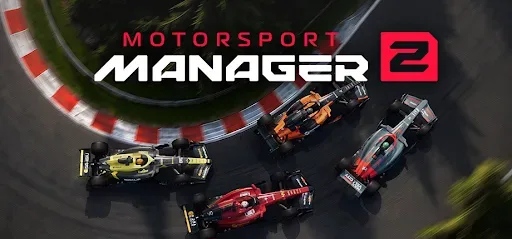
Motorsport Manager 2 has received its first gameplay reveal alongside the opening episode of From The Pit Wall, a developer-diary series intended to examine the racing-management sequel in more detail. The game is planned for Steam in 2027, with its newly shown systems placing particular emphasis on unpredictable race weekends and a broader world beyond the player’s own garage.
The reveal material presents new circuits, a revised user interface and an expanded management scope. More importantly, it introduces the design ideas expected to shape the moment-to-moment decisions of a race: Reactive Racing, a weather model with conditions that can vary around one circuit, and teams whose personnel and long-term development are influenced by the player’s choices.
A trailer can demonstrate the look and scale of a management game, but the details provided here point to what players will actually be asked to weigh from the pit wall. The proposed systems are about reacting to changing information rather than merely applying a plan made before the lights go out.
Reactive Racing aims to make the whole grid matter
The central new race-management feature is called Reactive Racing. Rival teams are intended to alter their strategies dynamically during a race weekend instead of operating from fixed, predetermined plans. In practice, that means a rival’s choice should be part of the player’s decision-making environment, not just background activity displayed elsewhere in the standings.
The factors named for this system are traffic, tyre condition, fuel, car condition, safety cars and the actions of other teams. Each is familiar to motorsport strategy, but their stated interaction is the important part. A team stuck in traffic may see the value of its current stint change; another squad’s pit call may affect available track position; a safety car can compress the field and change the cost or benefit of stopping. The game is designed for such events to create chain reactions across the grid.
That “chain reaction” language suggests that strategy is not being treated as a private spreadsheet belonging only to the player’s team. A good call can be undermined by circumstances created by competitors, while a rival’s compromised race could open an opportunity. It also creates a clear reason to monitor more than the leading car and one’s immediate championship opponent.
Technical context: a race stint is the portion of a race completed between pit stops. Tyre strategy concerns when to stop and which tyre choice to use; fuel strategy concerns how much fuel is carried and how that influences the timing and pace of a run. Safety cars matter because they alter normal racing conditions and can reshuffle the strategic value of a pit stop. Motorsport Manager 2’s stated goal is to have these variables affect one another rather than resolve in isolation.
Weather is planned to move across the circuit
The new weather simulation adds another layer of uncertainty. Weather systems are designed to move across circuits in real time, and different areas of the same track can experience different conditions. Rather than treating a circuit as uniformly wet or dry, the game is aiming for situations in which the information a manager receives is geographically uneven.
This matters because tyre decisions are rarely simply a matter of seeing rain and selecting a wet-weather option. If one section of a circuit is affected while another remains comparatively dry, the trade-off becomes harder. A tyre that provides confidence through a wet corner may bring a compromise elsewhere. The announcement specifically identifies tyre changes and driving in mixed conditions as decisions this model will force.
For a management game, this is potentially significant because it makes timing and confidence part of the challenge. The key question may not only be whether conditions have changed, but whether they have changed enough, where they have changed, and whether a team should act immediately or wait. The available information does not establish exactly how forecast tools, driver feedback or tyre compounds will work, so those details remain to be shown. What is clear is that weather is being positioned as an active system, not just a race-start setting.
Team building extends from parts to personalities
Racing is only one half of the proposed management loop. Away from the circuit, players will be able to design and manufacture parts, influence future cars, grow headquarters and develop power units. These are the areas that should determine how a team evolves from season to season, linking a current race result with decisions that may pay off later.
A power unit is the vehicle’s propulsion package. In management terms, its development is part of the wider balancing act between performance, reliability and longer-term planning, although the precise way Motorsport Manager 2 will model those trade-offs has not been detailed. Similarly, the reveal confirms parts design and manufacturing without specifying individual component categories or a research structure.
The people side is also set to have more weight. Drivers and staff will have distinct personalities, ambitions and relationships, and player choices can affect them. That is a meaningful addition to the usual recruitment-and-statistics layer because it frames personnel decisions as more than selecting the strongest available number. A driver or staff member’s place in the team may involve expectations and interpersonal consequences as well.
The reveal does not define the full range of those consequences, so it would be premature to assume a particular morale or contract system. Still, the stated direction is clear: management decisions are meant to reach both the engineering department and the people working within it.
A larger racing world, including motorbikes
Motorsport Manager 2 will continue to include single-seater, GT and endurance racing, while adding motorbike racing to the series for the first time. This broadens the disciplines represented in the game, though the announcement does not yet explain how management responsibilities will differ between them.
Single-seater competition, GT racing and endurance racing are all named as returning categories, while motorbike racing is the headline newcomer. Their inclusion indicates that the sequel’s wider motorsport world is not limited to one championship ladder or vehicle type. Players will also be able to follow simulated junior categories, recruit prospects into a driver academy and deal with championship rules that evolve over time.
A driver academy is a development structure for identifying and nurturing future talent before it reaches the senior team. The practical appeal is continuity: rather than only shopping for established drivers, players can maintain a pipeline of prospects. The announcement confirms recruitment into such an academy, but does not specify how advancement, contracts or competition in junior categories will be structured.
Evolving rules could make long-term planning less static. Regulations are the rules governing a championship, and changes to them can alter which investment priorities matter in a future car. No particular rules or timetable have been announced, but the feature’s inclusion supports the idea of championships changing over time rather than repeating under permanently fixed conditions.
Liveries and mod support are part of the plan
Customization is also on the list, with a new livery editor confirmed. A livery is the visual paint-and-sponsor-style identity applied to a race vehicle. The announcement does not lay out the editor’s tools or sharing options, but its inclusion gives players a direct way to shape the presentation of their teams.
More broadly, full mod support is being developed from day one. Mod support refers to the tools and compatibility that allow players or creators to alter or add game content. The scope of supported modifications, distribution method and release timing have not been set out in the available information. It is therefore best understood as a development commitment rather than a detailed specification. Even so, making that commitment at this stage recognizes that management-game communities often want room to tailor seasons, teams and other aspects of a long-running save.
What the new diary series may clarify
From The Pit Wall is planned as an ongoing developer diary series featuring the development team. It is intended to focus on different areas of the game, answer community questions and include guests from the creator and community spaces. That structure could be especially useful for a game with several interlocking systems, where a gameplay trailer can establish direction but cannot fully explain how every decision feeds into the next.
The first gameplay material is a starting point rather than a complete technical breakdown. It establishes the sequel’s priorities: opponents that react, weather that moves across a circuit, management systems spanning cars and staff, a larger talent pipeline, changing rules and a new racing discipline. The remaining questions concern implementation—how visible the underlying information will be, how the various racing categories will differ, and how much control players will have within each subsystem.
For now, Motorsport Manager 2 is scheduled for Steam in 2027. Players tracking the broader PC calendar can also see what is arriving now in our September 30, 2026 games release roundup.