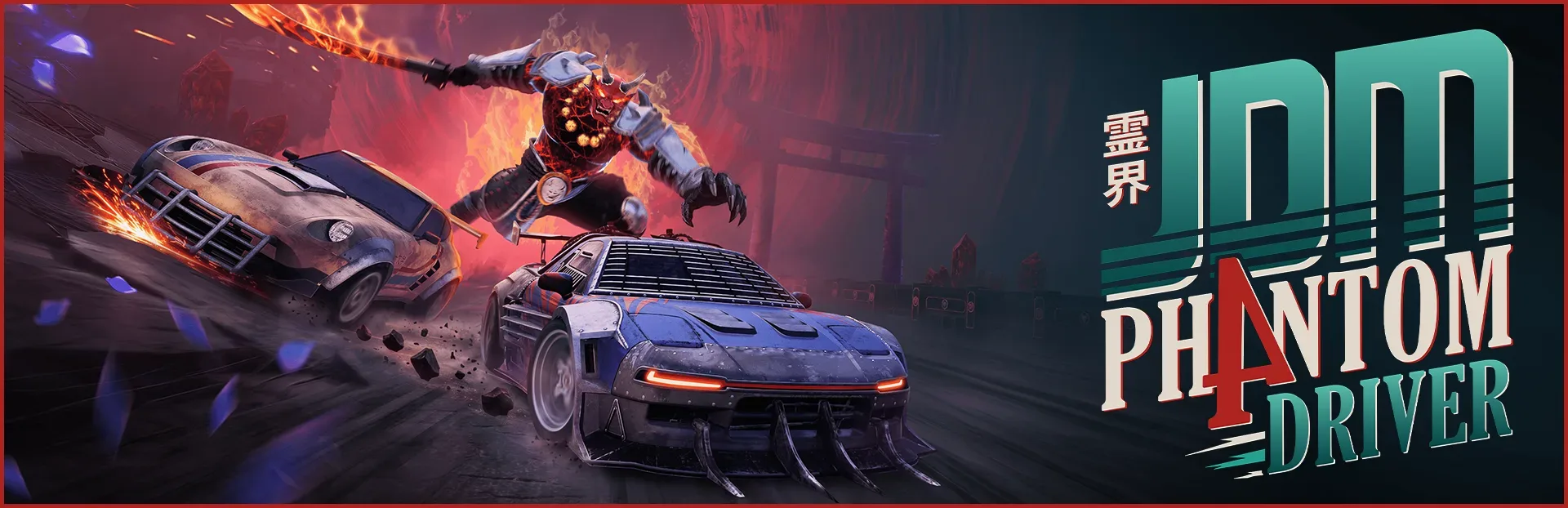
JDM: Phantom Driver is headed to Steam with a premise that puts the vehicle firmly at the center of both movement and combat. The standalone spin-off from the creators of JDM: Japanese Drift Master is an action-oriented arcade racer set in a demon-overrun version of the fictional Japanese prefecture of Guntama. Its drivers will not be reaching for conventional weapons: modified JDM cars, drifting, Nitro-Drift boosts and destructive supernatural power are the tools used to fight back.
That setup immediately separates Phantom Driver from a straightforward racing game. Racing remains part of the formula, but the stated focus is brawling through encounters with the car itself. The campaign pits the player against the Oni armies of a ruthless demon and creatures drawn from Japanese folklore, known as youkai, while eventually leading toward Shouten Douji, identified here as the Demon King.
The concept is ambitious in a pleasingly direct way: take the expressive handling language of arcade drifting and make it carry the weight of an action system. If the game delivers on that connection, a clean slide will be more than a stylish line through a corner. It will be part of how players attack, sustain a combo and build toward more powerful abilities.
A racing game where the car is the weapon
The central design rule is unusually clear. JDM: Phantom Driver combines racing and combat, but the car is the weapon; there are no blades or guns in the described combat approach. That matters because it frames vehicle control as the primary combat vocabulary rather than a way of getting between on-foot fights.
In practical terms, players can expect positioning, momentum and direction changes to matter beyond simply winning a race. The game is described as arcade-style, with agile cars designed to be easy to control. That description suggests accessibility is an intended priority: players should be able to direct a car into a slide, recover, boost and continue attacking without the kind of demanding simulation handling that might get in the way of a fast action loop.
It is worth distinguishing “arcade racing” from “easy” in the broader sense. Arcade handling generally emphasizes immediate response, readable speed and dramatic maneuvers over an attempt to reproduce every physical behavior of a real car. In this case, that approach is especially logical because combat asks the player to make rapid, intentional use of their vehicle. A system that is responsive enough to support an aggressive drift can also make it possible to redirect between enemies and turn a near miss into another attack opportunity.
Nitro-Drift and Hakai, explained
The key named mechanic is Nitro-Drift, described as drifting combined with boosting. A drift conventionally means deliberately breaking traction so a car slides through a turn at an angle. Nitro, in racing-game language, usually means a temporary burst of acceleration. Bringing the two together gives Phantom Driver a clear high-speed identity: players are meant to use a controlled slide and a burst of pace as a single movement tool rather than treating drifting and boosting as unrelated actions.
Nitro-Drift is also said to chain combat skills and build Hakai score. Hakai is the game’s supernatural power of destruction, so it appears to function as a core reward system for assertive driving and successful combat sequences. The supplied details do not establish the exact scoring rules, how skills are triggered, or precisely what thresholds unlock. Still, the intended loop is clear enough: use car control to maintain offensive momentum, link skills together, and accumulate destructive power.
Related coverage includes JDM: Phantom Driver Brings Demon-Battling Drift Combat to Steam.
That makes score more meaningful than a post-race number. A Hakai score tied to combat performance can encourage players to stay engaged with the game’s movement systems instead of simply finding a safe route through an encounter. The eventual balance will hinge on how generously that score builds and how punishing a broken chain is, details that have not been outlined. But the structure points toward a game in which driving well is inseparable from fighting well.
Guntama’s corrupted open world
The action takes place in an alternative Guntama, a fictional Japanese prefecture that has fallen under demonic control. The open world is described as Corrupted, with moss-covered streets and crumbling architecture. Those details establish an environment shaped by occupation and decay rather than a clean motorsport setting.
For an open-world driving game, visual character can do more than provide a backdrop. Streets, ruined structures and demon territory collectively suggest that exploration is meant to feed the campaign’s escalation. Players will venture further into hostile areas as they improve their cars’ performance and combat capabilities, rather than merely driving between disconnected events.
The available information does not specify the size of Guntama, the number of districts, mission types, or whether activities will be structured as races, arena-like fights, pursuits or something else. It is sensible not to assume any of those details. What is confirmed is the basic progression direction: explore a corrupted world, upgrade and customize cars, push deeper into demon-controlled territory, and confront increasingly serious threats culminating in the Demon King.
That progression has a strong thematic fit. Vehicle upgrades are not just garage-side statistics in this setup; they are part of the fiction of preparing a JDM machine to survive a supernatural invasion. The game specifically promises both customization and upgrades, alongside boosts to performance and combat ability. It does not yet detail individual parts, cosmetic options, vehicle roster, or how upgrades are earned, so prospective players should treat those elements as broad pillars rather than a confirmed feature list.
JDM culture meets Japanese folklore
Phantom Driver draws on two stated inspirations: JDM street culture and Japanese folklore. “JDM” is commonly used in automotive contexts to refer to the Japanese domestic market, and it has become a familiar shorthand for Japanese car enthusiasm and modification culture. In this game, the term is connected directly to modified cars and a street-racing-informed presentation.
Alongside that automotive identity is a supernatural enemy force built around Oni and youkai. Oni are demon-like figures in Japanese folklore, while youkai is a broad term for supernatural beings and phenomena. The game’s fictional setting and alternate version of Japan are important qualifiers: the premise uses folklore as inspiration within its own action-fantasy world, not as a claim to recreate real places or traditions literally.
Shouten Douji is positioned as the ultimate threat, the Demon King at the top of the opposing force. The supplied material does not explain how the confrontation is structured, whether it is a single boss encounter or the endpoint of a wider sequence, so the safest reading is simply that he is the campaign’s major adversary.
The blend creates room for a more overtly fantastical tone than the studio’s prior JDM-branded game might lead some players to expect. This is not presented as another entry that merely expands a realistic drift-focused premise. It is a separate, action-first branch: street-inspired cars take on folklore creatures using otherworldly destruction powers.
A standalone story told through manga panels
The single-player campaign will be delivered through hand-drawn manga panels and a fully realized dialogue system. The manga presentation fits the project’s stated cultural and supernatural influences, while the dialogue system indicates that the narrative will be more than brief framing between races or battles.
Crucially, JDM: Phantom Driver is a standalone spin-off. No prior knowledge of JDM: Japanese Drift Master is required to follow its story. That makes it approachable for players drawn by its arcade action or folklore premise, even if they have not played the earlier game.
Existing fans are not being ignored, however. The game is expected to include easter eggs and character cameos for people familiar with the wider JDM world. Those nods are positioned as optional extras rather than required story homework, which is the right distinction for a spin-off seeking a fresh audience.
What is confirmed for Steam—and what remains open
The confirmed destination is Steam. The information provided does not specify a release date, price, hardware requirements, controller support, other platforms, or the exact scope of its car lineup and world. None of those details should be inferred from the Steam plan alone.
A multiplayer component is already in development, but that wording also leaves key questions unanswered. There is no confirmed launch timing for multiplayer, no stated mode list, and no detail on whether it will be competitive, cooperative, or offer both. For now, the defined centerpiece is the single-player campaign and its open-world drift-combat progression.
Players looking to keep track of the day’s PC slate can also browse games releasing today on October 15, 2026. As for JDM: Phantom Driver, the clearest takeaway is its commitment to making every part of its fantasy revolve around the driver’s car: navigation, customization, combat, scoring and supernatural retaliation all flow through the same machine.
Its eventual appeal will likely rest on the feel of that loop. The promise is not simply to drift through a haunted open world, but to use a drift as an attack, a boost as a connector and a tuned JDM car as the means of taking back Guntama from a demon army. For a project built around high-speed motion, that is a focused and appropriately loud foundation.