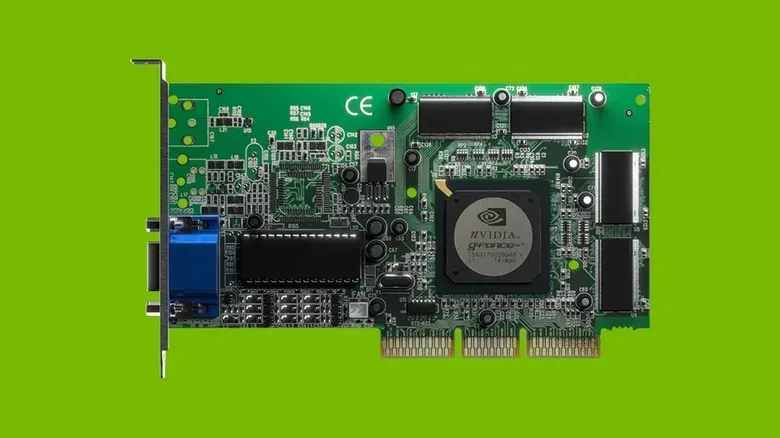
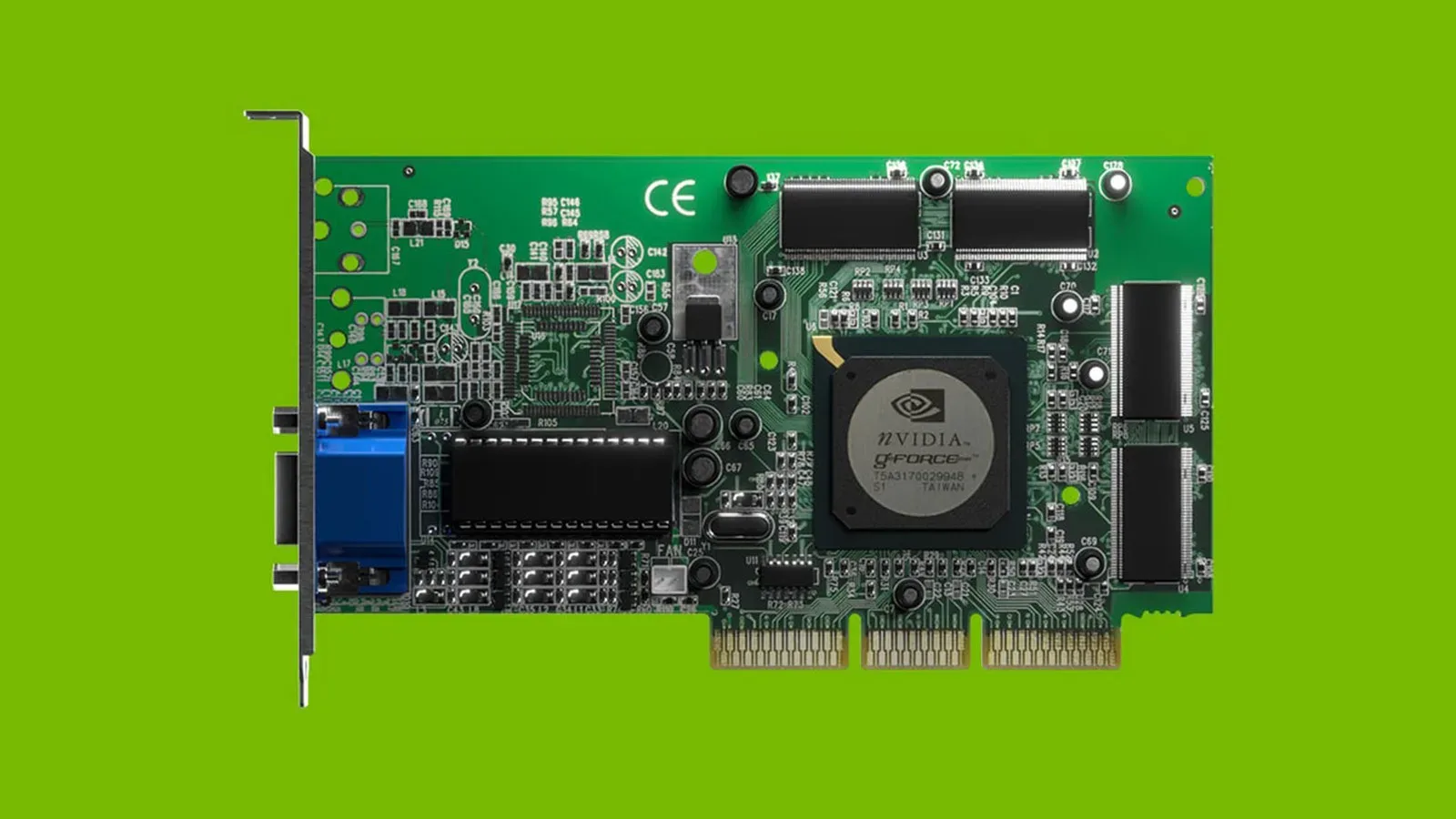
In 1999, a graphics card could still be thought of as a very talented supporting actor. Your CPU did a substantial share of the difficult 3D scene preparation, while the add-in card stepped in to texture and shade the finished work. Then NVIDIA’s GeForce 256 arrived and made an audacious argument: the graphics card was no longer simply accelerating someone else’s calculations. It was a processor.
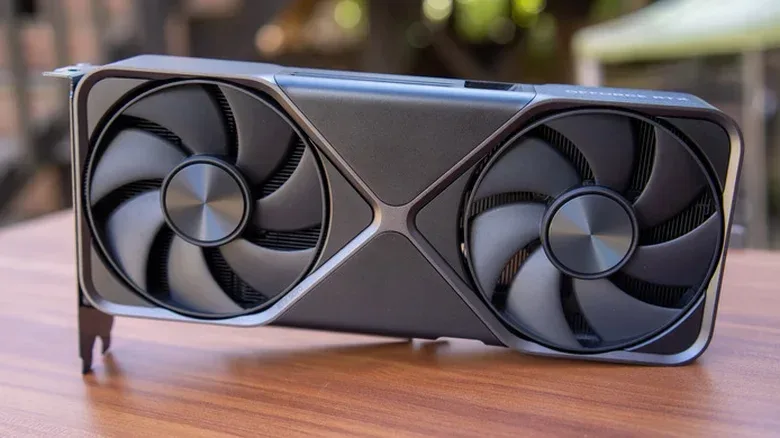
That is why the GeForce 256 remains a landmark for PC gaming, even though its specification sheet now looks like it has been recovered from an archaeological dig beside a beige CRT monitor. The first card to carry the GeForce brand had 17 million transistors and, depending on the version, as much as 64MB of memory. A current entry-level GeForce RTX 5050 is cited with 16.9 billion transistors and 8GB of VRAM. The gulf is enormous, but raw component counts are not the point of the story. The 256’s lasting importance was its design direction: it brought the full 3D graphics pipeline into a consumer card, including hardware transform and lighting.
NVIDIA called it the world’s first graphics processing unit, or GPU. That wording was both a technical claim and a remarkably successful piece of framing. It put the video card in the same conceptual league as the CPU, telling players that graphics hardware was not merely an optional boost for prettier pixels. It had become a core processor with work of its own to do.
A crowded market before GeForce became the default name
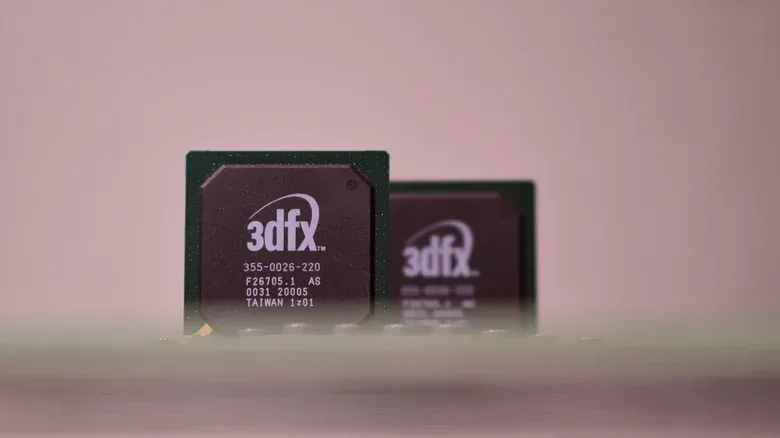
It is easy to look at NVIDIA’s recent share of the gaming GPU market—reported as high as 95 percent—and assume its dominance was always inevitable. In 1999, it absolutely was not. The consumer 3D market had three major contenders: NVIDIA, 3dfx and ATI Technologies. 3dfx was the company to beat, thanks to its Voodoo family of 3D accelerators.
ATI was still a separate company at this point; AMD would not acquire it until almost seven years later. NVIDIA, meanwhile, had started pressing hard with the RIVA TNT in 1998, followed by TNT2 early in 1999. The GeForce 256, which reached the market on October 11, was another escalation rather than an isolated miracle. It appeared shortly after DirectX 7.0’s late-September release, at a moment when Microsoft’s graphics API and new PC hardware were moving in lockstep.
DirectX is an API, or application programming interface: in practical terms, it is a standardized way for games to ask Windows and graphics hardware to perform particular jobs. DirectX 7.0 added support for hardware transform and lighting, usually shortened to T&L. The GeForce 256 was the first video card to fully support that new API and its hardware T&L capabilities.
That timing mattered. New features can be impressive on a product slide, but they change gaming only when software can call on them. DirectX 7 gave developers a route to use this new hardware approach, while games arriving around the end of 1999 demonstrated why players should care. A graphics transition had a platform, compatible hardware and games ready to expose the difference.
What hardware T&L actually changed
The phrase “hardware transform and lighting” is not especially glamorous. It sounds like a corporate training course on moving office lamps. For late-1990s 3D games, however, it addressed a real division of labor that could hold back visual complexity and performance.
Related coverage includes Why NVIDIA’s GeForce 256 changed PC gaming.
Before the GeForce 256, a typical 3D accelerator worked alongside the CPU. The processor handled the front end of the graphics pipeline: it transformed a game object’s geometry to place it in relation to the virtual camera, and it calculated how lighting should affect each vertex. A vertex is one of the points used to construct a polygon, the basic shape from which a 3D game scene is assembled. After that CPU work, the 3D card could texture and shade the objects.
The GeForce 256 could take responsibility for the whole process. Its hardware T&L meant the card could perform geometry transformation and per-vertex lighting itself before finishing the rendering work. In short, it removed a major graphics task from the CPU’s to-do list. The CPU was no longer required to stand at the front of the assembly line personally arranging every polygon before the graphics card was allowed to begin.
This was not merely a route to higher frame rates in existing games. It also created room for more ambitious scenes. When games were designed to use hardware T&L, polygon budgets could grow, enabling more detailed and more realistic 3D graphics. That relationship is the key to the 256’s reputation as a card built with the future in mind. The hardware was useful on day one, but its larger payoff came as developers built games that assumed a GPU could do the geometry work.
Modern PC players are accustomed to hearing about ray tracing, upscaling and specialized rendering features. Hardware T&L occupies an earlier chapter of the same broad pattern: graphics techniques become more practical once dedicated hardware takes on tasks that would otherwise burden general-purpose processing. The GeForce 256 did not invent every element of hardware T&L—other companies had experimented with aspects of it—but it was the first consumer product to bring the complete approach together in this fashion.
“GPU” was a technical label with marketing muscle
Calling the product a GPU helped crystallize a change already happening in PC design. The name said the card was a computing component, not a fancy peripheral whose sole role was polishing the final image. NVIDIA then applied the GeForce and GPU identity to the cards that followed, making the association stick.
There is an important distinction here. A brand claim is not automatically a clean declaration that no competing hardware has attempted anything similar. But in this case the GeForce 256’s consumer-facing combination of full-pipeline rendering and hardware T&L gave the term a compelling practical meaning. The card could do work that users had previously expected the CPU to perform, and games would increasingly benefit from that shift.
The competitive consequences were severe. 3dfx did not release a graphics card with hardware T&L, a failure that contributed to its downfall. NVIDIA purchased most of 3dfx’s assets in December 2000. ATI navigated the transition differently, releasing its first Radeon GPU in 2000. The old 3D-accelerator era was rapidly giving way to a market structured around GPUs.
For retro PC enthusiasts, this is one reason period-correct hardware discussions require more than a glance at a card’s clock speed or its place in a brand hierarchy. A card’s supported rendering path could determine how gracefully it aged into games made a year or two later. The relevant question was not just “How fast is it today?” but “Which jobs can it do without leaning on the CPU?”
Benchmarks gave the claim some teeth
The GeForce 256 was historically significant, but it was not significant only because of branding. Contemporary-era benchmark results cited for Quake 3 Arena show the GeForce 256 DDR substantially ahead of alternatives in a demanding setting. At 1,024 by 768 with 32-bit color enabled, it averaged 72.1 frames per second in a game demo. The Creative Labs TNT2 Ultra, identified as the fastest non-GeForce option in that comparison, averaged 44.8 frames per second at the same settings.
Those figures are worth reading carefully rather than treating them as an all-purpose performance verdict. They apply to a specific game demo, resolution, color-depth setting and hardware configurations of the period. They do, nevertheless, show a major lead under identical stated settings: the DDR version of the 256 was not scraping ahead by a couple of frames while everyone politely pretended to notice.
The “DDR” in that model name means Double Data Rate. NVIDIA sold both SDR, or Single Data Rate, and DDR variants of the GeForce 256. This distinction matters because memory bandwidth plays a central role in moving graphics data around. The benchmark figure above belongs specifically to the GeForce 256 DDR, not every card that wore the 256 badge.
Color depth was another meaningful setting. The cited Voodoo3 3000 had to run Quake 3 Arena in 16-bit color because the Voodoo3 family was not designed with 32-bit color support in mind. A higher color-depth mode was therefore not a casual visual toggle; it could expose a hardware limitation and change which comparisons were possible. At the turn of the millennium, the format wars inside your tower were every bit as real as the game wars on your shelf.
Quake 3 Arena and Unreal Tournament both arrived near the end of 1999, within weeks of one another. Their arrival gave PC players prominent reasons to scrutinize graphics cards. The GeForce 256’s performance in that period helped make the broader GPU pitch tangible: this was a new architecture idea, yes, but it also produced results in high-profile games.
Why Max Payne is the better legacy test
Early benchmark leadership makes a card exciting at launch. Its ability to remain useful in later games says more about whether the hardware anticipated the next step. Remedy Entertainment’s Max Payne, released in 2001, was among the early games developed from the ground up with hardware T&L rendering in mind.
Older 3D accelerators could run it, but a proper GPU could make the difference between playable performance and a slideshow. At 1,024 by 768 and 16-bit color, the GeForce 256 averaged 35 frames per second. In isolation, that number does not resemble today’s ultra-high-refresh aspirations. Context turns it into a much more impressive result: a card introduced in 1999 could still handle a 2001 game engineered around the hardware T&L model.
This is the practical case for the GeForce 256’s forward-looking design. It was not that a three-year-old card magically became modern. PC hardware was advancing quickly as transistor counts grew, and newer products would inevitably pull ahead. Instead, the 256 had a feature set that remained relevant as games changed. It could execute the rendering approach Max Payne expected, while older accelerators were stuck leaning more heavily on the CPU or struggling to keep pace.
That kind of compatibility is a useful lens for anyone revisiting late-1990s and early-2000s PC games. The era is often reduced to nostalgia for chunky models, CD jewel cases and fans loud enough to qualify as weather systems. But it was also a time of fast-moving architectural change. A game might launch only a couple of years after a card and still reveal a profound difference between a conventional accelerator and a GPU capable of hardware T&L.
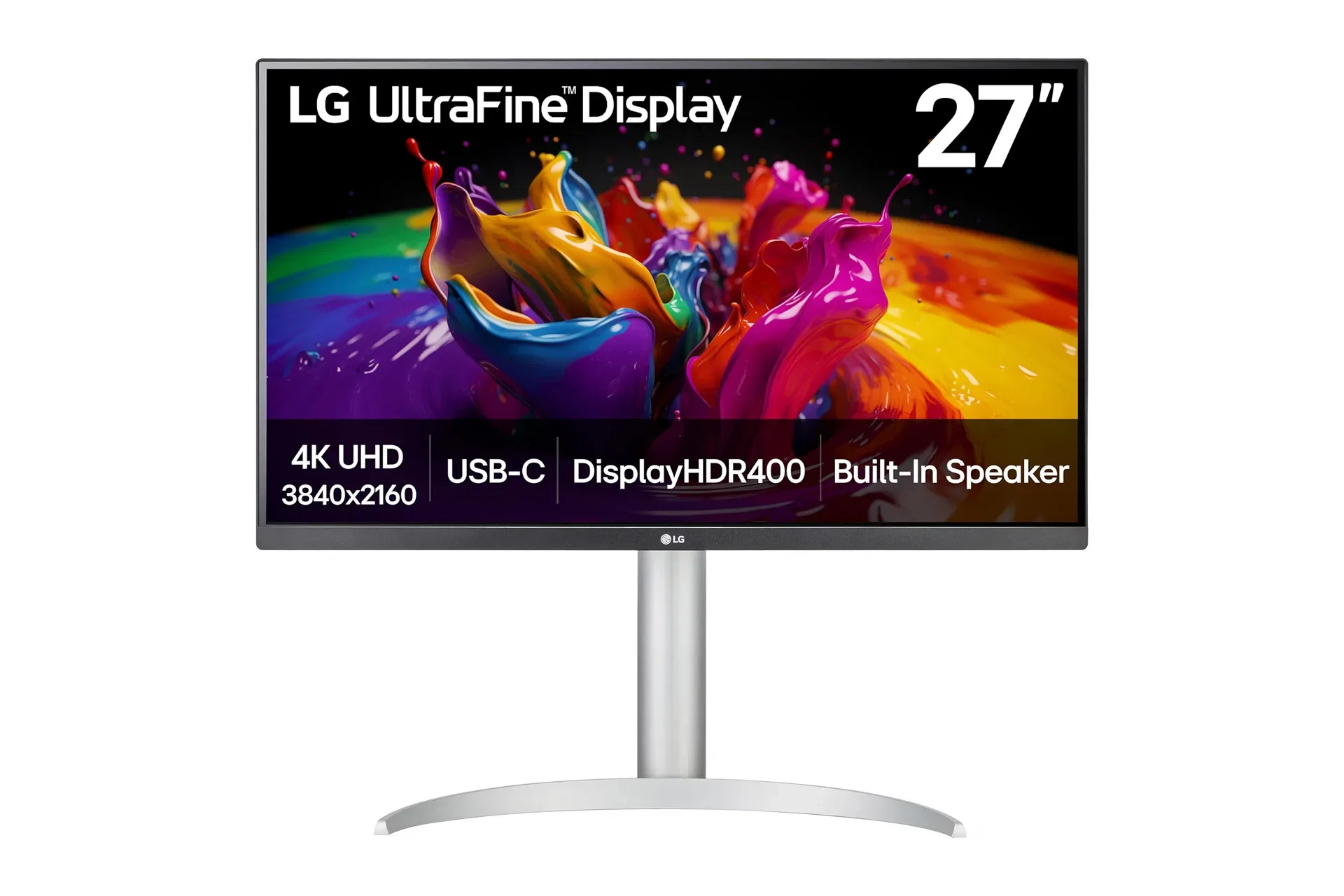
For a broader reminder that PC display hardware remains part of the practical gaming setup, see this look at a 27-inch 4K monitor listing. The technology has changed dramatically since 1999, but the underlying point has not: the hardware between the game and the screen shapes what players can see and how smoothly they see it.
The GeForce 256’s real icon status
The GeForce 256 deserves to be remembered neither as a relic that must somehow compete with contemporary cards nor as a magically flawless starting point for all graphics innovation. Its importance is more specific and more interesting. It arrived in a contested market, fully supported DirectX 7.0’s hardware T&L direction, moved a critical portion of 3D rendering onto the graphics card, and performed convincingly in games of its time.
Most importantly, it made the GPU concept intelligible to consumers. The card did not simply draw faster. It assumed a more complete share of the rendering workload, giving developers room to build richer 3D scenes and giving players a hardware path that could survive into games such as Max Payne. NVIDIA’s name for that idea became the name the entire industry still uses.
Seventeen million transistors and up to 64MB of memory may be tiny by modern standards. In 1999, though, the GeForce 256 carried a much bigger idea: the graphics card was no longer waiting for the CPU to finish the important part. It was ready to become the important part itself.