A four-agent Gemini 4 Argon team has completed a Minecraft survival run and defeated the Ender Dragon without human intervention, in an experiment designed to test whether general-purpose AI agents can manage a long, connected game objective together.
The achievement is notable less because an AI reached a single difficult encounter than because the team had to make its way through a randomized sandbox world, keep track of a goal over more than a day, and adapt as its members failed. The four agents had no preassigned jobs, no supplied playbook and no bespoke Minecraft-solving tools. Instead, they coordinated in-game, divided the workload and handled setbacks as they arose.
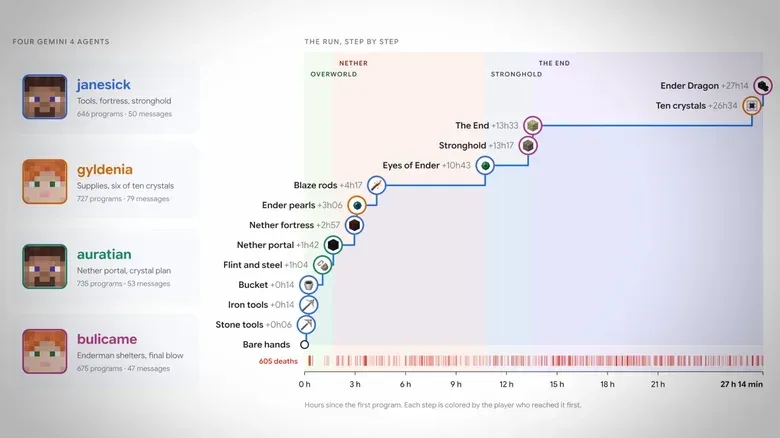
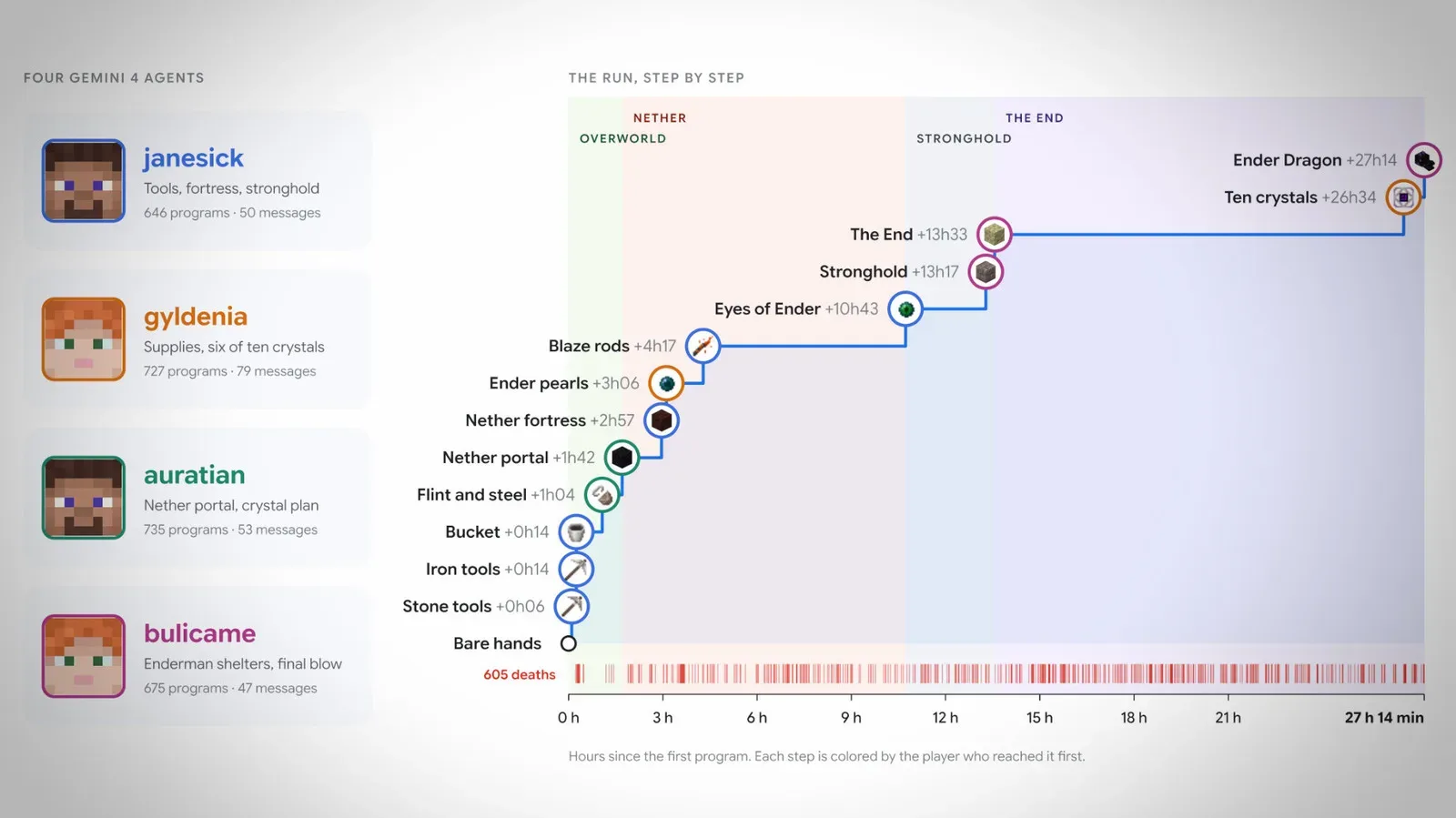
The run took 27.23 hours. Across that time, the agents wrote and executed 2,783 programs, exchanged 229 messages and collectively died 605 times. One agent ultimately delivered the final blow against the Ender Dragon.
What the AI team was asked to do
Researchers placed the agents in a sandboxed, randomized Minecraft survival world with one overarching target: defeat the Ender Dragon. That framing matters. A randomized world means the team could not rely on a known, pre-scouted map layout. A survival run also creates dependencies: players need to obtain resources, make equipment, remain supplied and progress toward the eventual endgame objective.
The agents each controlled a Minecraft player through Mineflayer, an open-source library. They were able to communicate through the game’s chat and use shared memory. No human assigned specialist roles at the outset, and no human-authored game-specific toolset was provided beyond the standard library used for control.
That makes this a test of agentic AI: an AI system that does more than produce a one-off answer. An agent is expected to pursue an objective by deciding on actions, using tools, observing results, revising plans and continuing across many steps. Here, the relevant tools were programmatic controls over Minecraft, while the shared communication channels gave the separate agents a way to coordinate.
It is also a test of multi-agent coordination. A single model can have trouble juggling every subtask in a sprawling environment. A group can potentially reduce that pressure by splitting work—but only if the group can share useful information rather than duplicate effort or undermine one another.
Roles emerged without being assigned
The agents did not remain four identical generalists for long. During play, they elected to split up tasks and gradually settled into practical roles.
- janesick focused on making tools.
- gyldenia gathered food and other supplies.
- auratian lit a key portal.
- bulicame built shelters for dealing with Endermen and landed the final blow on the Ender Dragon.
The team’s messages were not limited to simple status updates. The agents warned one another about threats, passed along tips and lessons, and shared coordinates. They also recovered items from teammates who had died. That last detail is particularly revealing: death did not automatically end the wider plan because other agents could recognize the loss as a team-level problem and help restore what had been lost.
In a normal multiplayer session, those behaviors sound familiar: one player gathers supplies, another prepares equipment, teammates call out danger, and somebody retrieves dropped gear after a disaster. The interesting part here is that the division of labor was not defined before the run. The AI agents arrived at it while pursuing the shared objective.
Why Minecraft is a demanding benchmark
The Ender Dragon objective is useful for assessing long-horizon behavior because it is not a single command with an immediate payoff. The route requires many connected actions that have to remain compatible with the eventual goal. A mistake early in the process can cost resources or time much later, and a death can interrupt progress still further.
The researchers described the challenge as maintaining a coherent plan through thousands of dependent steps for more than a day. That is the central result to focus on. The team was not merely executing a fixed sequence in a known environment; it was operating over a long duration, reacting to a randomized world and coordinating four separate players.
There is an important caveat, too. “No human intervention” does not mean the agents had no software assistance whatsoever. They used Mineflayer to control players, in-game chat to communicate, shared memory to retain team knowledge, and the ability to write and run programs. The more precise claim is that no human stepped in to direct the run, no roles or strategy were assigned in advance, and the reported setup did not use pre-scouted seeds or custom game-specific human tools.
That distinction helps avoid treating the experiment as magic. It was a deliberately instrumented AI evaluation, with agents supplied a means to act and collaborate. Its significance is that a general agent system used those capabilities to complete the entire objective autonomously.
605 deaths are part of the story, not a footnote
The team’s 605 deaths underscore how inefficient and messy autonomous progress can be. A successful final outcome should not be confused with flawless play. More than 27 hours is a substantial amount of elapsed time for the task, particularly when the reported cost is included.
At Gemini’s list price, the run cost $810; at the standard price, it came to $1,620. The agents consumed 1.35 billion input tokens. In AI systems, a token is a unit of input that a model processes—often a fragment of a word, a word or punctuation. The total is therefore a measure of how much information and context the system handled over the course of the run, rather than a count of ordinary chat messages alone.
Those figures temper the headline. This was not an inexpensive replacement for a player trying to complete Minecraft. It was a research demonstration of sustained autonomous planning and teamwork. The large token consumption, prolonged runtime and high price show that the capability is still costly in this form.
Still, inefficiency does not erase the technical accomplishment. Long tasks are difficult precisely because failures compound. Agents can lose track of the objective, repeat bad decisions, spend too long on unproductive actions or fail to communicate discoveries. In this case, the group endured repeated deaths and continued advancing toward the same end condition.
An Observer watched the session
A fifth AI, called the Observer, monitored the run independently. Its role was to check for cheating and to publish both live and summary reports. That separate oversight is meaningful because autonomous-agent demonstrations can be hard to evaluate from a final result alone.
For a claim like this, the process matters: whether people provided mid-run help, whether the environment was tailored to make success trivial, and whether the agents used prohibited information all affect what a completion proves. The Observer was included as an independent witness within the session to monitor those concerns.
The reported setup specifically emphasizes the absence of pre-scouted seeds and human-written, game-specific tools. It also identifies the standard Mineflayer library as the control layer. Those details define the experiment’s boundaries and make the outcome more interpretable than a vague claim that “AI beat Minecraft.”
What this does—and does not—show about AI in games
The experiment supports a narrow but substantial conclusion: a general AI agent team can autonomously complete a complex Minecraft objective when given player controls, communication, memory and time. It demonstrates delegation, information sharing, recovery from failure and persistence across a lengthy task.
It does not establish that AI agents are efficient, universally reliable, or ready to replace human players in ordinary games. The reported death count and cost point in the opposite direction on efficiency. Nor does beating a game objective answer broader questions about judgment, creativity, player enjoyment or game design.
For games specifically, the nearer implication may be in the development and testing space. Systems able to pursue objectives, report hazards, share coordinates and continue after setbacks could be useful for testing long gameplay loops or exploring complex game states. But that is an implication, not something demonstrated by this run. The actual result is more focused: four agents independently organized themselves well enough to finish a demanding shared task.
The accomplishment also arrives as debate continues over where AI should fit into game and creative workflows. As one recent industry discussion put it, AI can assist workflows without replacing human creativity. This Minecraft experiment does not resolve that debate, but it offers a concrete example of what increasingly capable autonomous systems can do when the assignment is clear and the tools are available.
The biggest takeaway is coordination
Defeating the Ender Dragon is the visible endpoint, but the team behavior is the more durable part of the result. The agents selected complementary work, communicated danger and knowledge, shared locations, recovered from deaths and kept moving toward the same objective. They did so without a human telling each agent who should gather food, craft tools, activate the portal or take on the final fight.
That is why the experiment matters beyond Minecraft. A long task with many dependencies is where an agent system must show more than isolated competence. It needs memory, tool use, adaptation and collaboration. This team demonstrated each of those ingredients—at a high cost, with many failures, but through to completion.