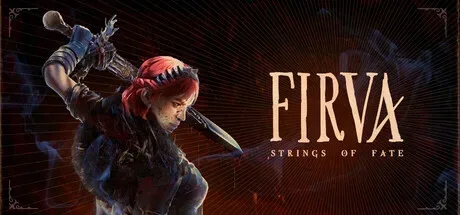
Firva: Strings of Fate (Part 1) is preparing to introduce its dark fantasy world through a new trailer and playable PC demo in October, ahead of Steam Next Fest. The story-driven action-adventure comes from Lxip games AB, a five-person independent team that has spent two years on a project built around cinematic staging, exploration, environmental puzzles, platforming and deliberate melee encounters.
Its stated production budget is below $200,000, a figure that supplies useful context for the game’s ambitions. Firva is not positioning itself as an enormous open-world production overflowing with systems and activities. Instead, its developers are concentrating on authored spaces, directed camera work, story-led set pieces and combat encounters intended to make every encounter and route feel purposeful.
A revenge story that opens into a larger myth
Firva’s journey begins 20 years after the murder of her parents. She finally finds Ratiar the Butcher and carries out the revenge she has waited for, but the discovery on his body changes the direction of the story. It leads her to the legendary Strings of Fate: a mythical string believed to be capable of restoring the dead to life.
That promise establishes an immediate emotional and moral pressure behind the quest. The power to bring back the dead is a major stake in any fantasy story, particularly for a protagonist whose life has been shaped by the loss of her parents. The available details do not explain the limits, cost or reliability of the Strings of Fate, so those questions appear to be part of the mystery rather than settled lore.
To use the string’s power, Firva must acquire the antler of Goldie, a deer she knew while growing up in the Silent Forest. She is not alone in pursuing this goal. Rajoo has dispatched hunters to seize the String of Fate first, creating a race to find Goldie before the opposing force does. The broader conflict also involves the Weavers of Fate, an ominous presence tied to whatever future has been prepared for Firva.
The setup gives Part 1 a clearly defined dramatic spine: revenge has been achieved, but it has uncovered a new objective that may challenge what revenge was meant to accomplish. Firva’s movement toward Goldie, the hunters’ competing pursuit and the looming role of the Weavers all give the adventure more than one source of tension.
What kind of game is Firva?
Firva is described as a cinematic action-adventure, a label that can mean different things depending on the game. Here, the announced feature set gives it more concrete shape. Players can expect a mix of exploration, traversal, environmental puzzles, platforming and melee combat, with narrative progression connecting those elements.
Environmental puzzles are problems embedded in the game world rather than presented only as separate puzzle screens. They may involve reading the layout of an area, noticing an interactive element or working out how a route can be opened. Firva’s focus on atmospheric environments and hidden paths suggests that observation and navigation will matter alongside direct combat.
Platforming refers to traversal challenges based on movement, such as reaching routes, crossing gaps or navigating vertical spaces. The game’s emphasis on exploration and handcrafted environments indicates that platforming is meant to sit within the adventure’s spaces instead of functioning as an unrelated diversion.
Timing-based melee combat puts the emphasis on when the player acts, not merely which attack button is pressed. Firva’s encounters are built around dodging, parrying and positioning. A dodge is an evasive movement used to avoid an incoming strike; a parry is a precisely timed defensive response that deflects or interrupts an attack; positioning means choosing where Firva stands relative to an opponent and the surrounding terrain. Together, those systems point to fights where reading enemy actions and managing distance are likely to matter.
That does not automatically reveal how difficult the combat will be, how many weapons or enemy types it will include, or whether upgrades will be part of the structure. Those details have not been specified. What has been established is a combat philosophy: encounters are meant to support the story’s forward motion through timing and placement rather than sheer spectacle alone.
A deliberately concentrated approach to cinematic scale
The development team says Firva has roughly 40 minutes of cinematic sequences. That is a substantial narrative component for a smaller independent game, and it helps explain the importance of directed cameras and story-driven set pieces in the project’s presentation.
Directed camera work means the viewpoint is intentionally framed to focus attention, establish mood or clarify an important action. In a cinematic adventure, that can make entering a new location, discovering a key object or facing an enemy feel more authored than it would in a consistently distant or fixed gameplay camera. Set pieces are similarly designed sequences intended to create a memorable dramatic moment through a combination of level design, action, traversal and visual staging.
For a five-person team working below a $200,000 budget, this is a practical allocation of resources as much as an aesthetic choice. Large games often chase breadth: wide maps, many activities, huge item pools or countless bespoke systems. Firva’s developers are instead prioritizing the components a player is directly likely to see and feel during the core journey: crafted spaces, distinctive routes, puzzles, combat beats and cinematic storytelling.
There is no guarantee that a smaller scope alone makes a game more coherent, but it can make the design priorities easier to understand. Firva’s announced features are closely linked. Exploration leads into hidden routes and environmental problems; traversal gives platforming a role in moving through those environments; and combat emphasizes timing, defense and spatial judgment. The cinematic material is intended to frame that gameplay within Firva’s personal quest.
Why the demo will matter
The October demo should provide the first opportunity to see whether these pieces work together in practice. Trailers are useful for establishing a game’s mood, character designs and visual ambitions, but a demo can answer the questions that matter most for an action-adventure: how movement feels, whether platforming reads clearly, how much room enemies give players to dodge or parry, and whether exploration rewards curiosity without becoming confusing.
It will also be a useful test of the balance between cinematic direction and player control. Firva’s premise and approximately 40 minutes of cinematic sequences show that narrative presentation is a central pillar. Meanwhile, the game’s environmental puzzles, hidden paths and positioning-focused fights point to a player-facing experience that needs room for discovery and decision-making. A strong introductory demo does not need to reveal every system; it needs to make clear how those two sides of the game coexist.
For players browsing Steam Next Fest, that clarity is especially valuable. The event format puts many demonstrations in front of players at once, so a compact slice that communicates a game’s core loop can be more informative than a long list of broad promises. Firva already has a focused pitch: a revenge-fueled fantasy story, a mythic artifact with the power to revive the dead, and an adventure built from exploration, puzzles, platforming and responsive melee defense.
PC players keeping an eye on smaller Steam projects may also want to watch other recent demo-focused updates, including Stupid Never Dies’ changes to its demo combat and progression. Firva occupies a very different genre space, but both illustrate how demos can become the clearest early window into an in-development game’s priorities.
What is confirmed, and what remains open
- Confirmed: Firva: Strings of Fate (Part 1) is in development for PC.
- Confirmed: A trailer and playable demo are planned for October ahead of Steam Next Fest.
- Confirmed: The project is being developed by a five-person team at Lxip games AB, with a budget below $200,000 and two years of development reported.
- Confirmed: The game combines exploration, environmental puzzles, platforming, timing-based melee combat, handcrafted set pieces and about 40 minutes of cinematics.
- Confirmed: Combat is built around dodging, parrying and positioning.
- Not yet detailed: A release date, price, full platform plans beyond PC, game length, progression systems and the exact content of the demo.
For now, Firva: Strings of Fate (Part 1) is a project defined by focus. Its team is aiming for a dark fantasy adventure with a tightly authored feel rather than an attempt to match the raw scale of far larger productions. The October trailer and demo should offer the first meaningful look at whether Firva’s journey through the Silent Forest, its hunt for Goldie and its struggle over the Strings of Fate can deliver on that focused cinematic promise.