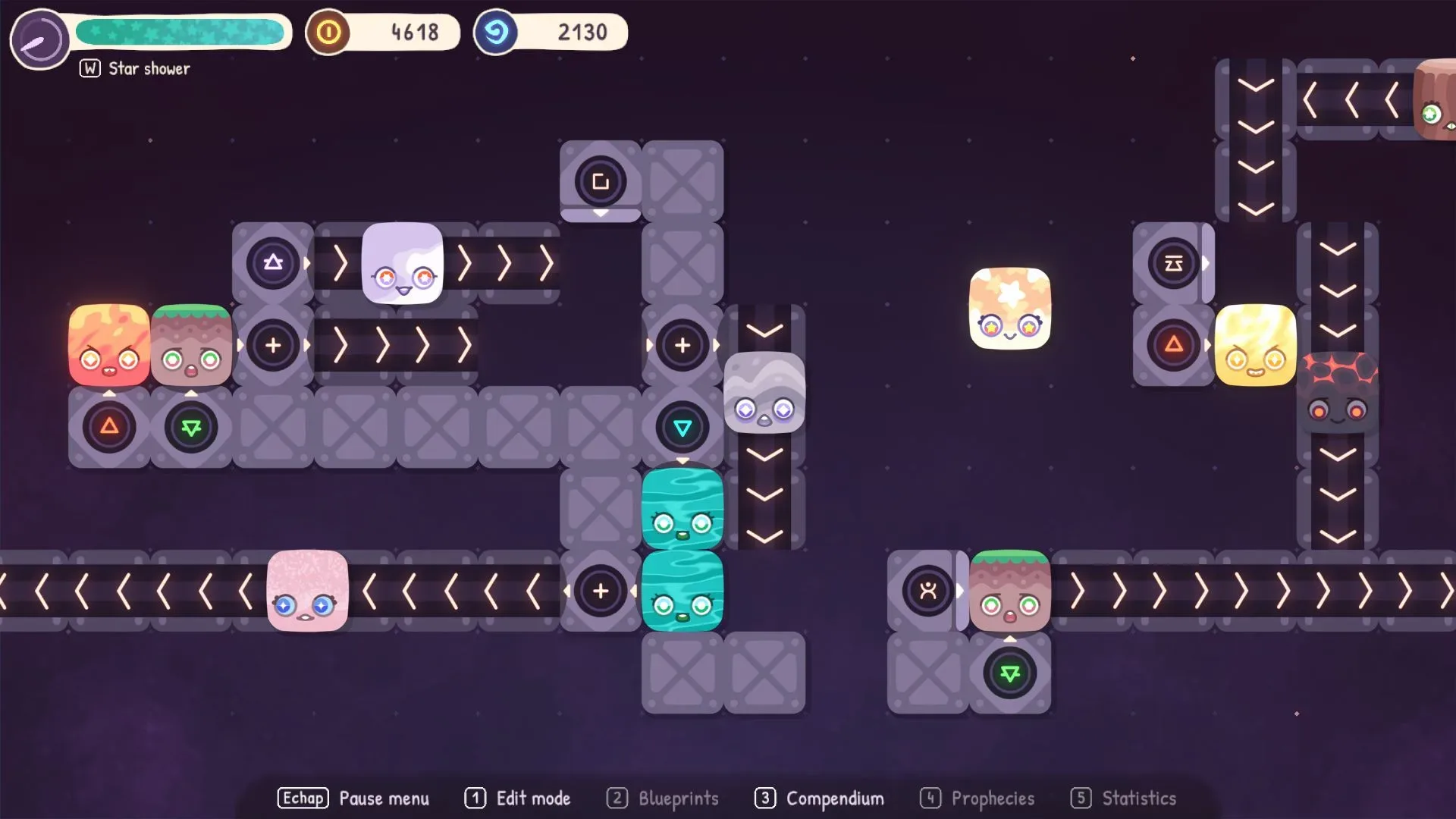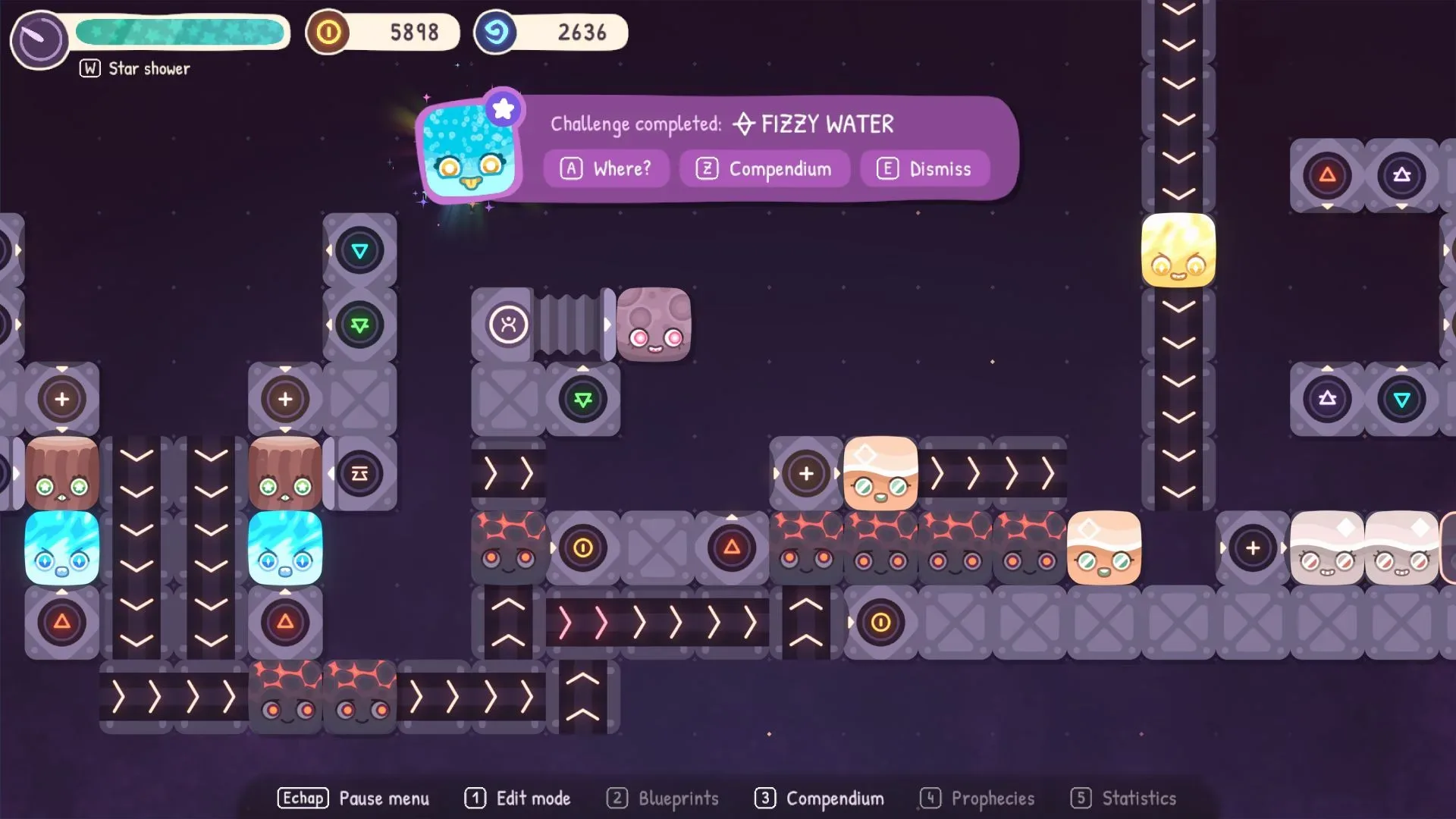
Fakutori, a laid-back factory-building puzzle game built around elemental experimentation, is scheduled to launch on Steam on December 16. Developed by Antoine Latour and published by Mythwright, the game begins with Earth, Fire, Water and Air, then asks players to turn those fundamentals into an increasingly strange industrial discovery project.
Its central pitch is not merely to place machinery efficiently. Players combine materials to reveal new blocks, log those discoveries in a compendium and use automation tools to expand production across an infinite world. More than 100 elements are advertised, with the possible results ranging from relatively recognizable phenomena such as Rainbows and Shooting Stars to Ectoplasm, Legendary Blocks, mystical magic blocks, the concept of time and, apparently, the occasional black hole.
A demo is available now, and Fakutori can also be wishlisted on Steam.
From four elements to a much stranger production line
Fakutori’s starting set is deliberately simple: Earth, Fire, Water and Air. That familiar elemental vocabulary gives the game an approachable first step, but its stated discovery list makes clear that the destination is fantasy rather than a strict scientific simulation. The relevant question for players is not whether a result fits real-world chemistry. It is which combinations create a new useful block, and how that block can enter a larger chain of production.
That distinction matters because the game appears to join two related puzzle loops. The first is experimentation: arranging and combining known materials to see what new outcome can be uncovered. The second is automation: once a process is understood, building a system that performs it repeatedly without requiring the player to manually manage every individual conversion.
Those loops can reinforce each other nicely in factory games. A discovery has more weight when it is not simply added to a list, but becomes an ingredient or building block for another production route. Likewise, an automated line becomes more meaningful when it supports the next unanswered entry in a compendium rather than existing only to make a number rise.
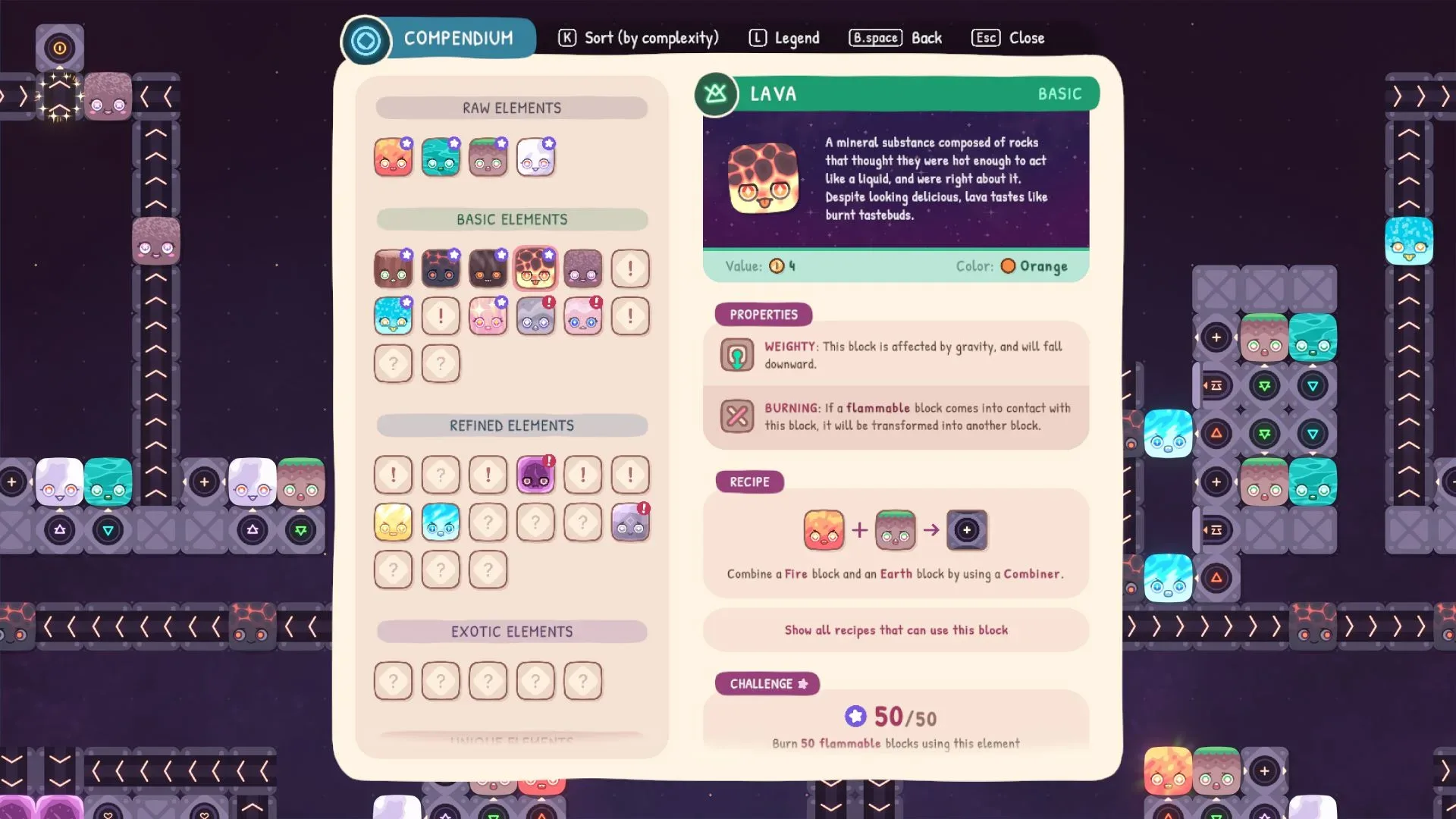
Fakutori’s advertised compendium puts that second goal in plain view. Completing it gives experimentation a visible structure: players can measure progress by the materials they have uncovered, while remaining discoveries encourage further combinations. The game advertises over 100 elements, so the initial quartet is intended as the beginning of a sizable search space rather than the full extent of its crafting vocabulary.
What the factory tools suggest
The game names three key automation tools: conveyors, combiners and programmable pushers. Together, they point toward a factory design process based on moving blocks, bringing inputs together and controlling where items go next.
Related coverage includes Fakutori Brings Elemental Factory Puzzles to Steam on December 16.
- Conveyors are the transport layer: they move materials between parts of a factory. In practical terms, they let a player separate where a resource is made from where it is needed.
- Combiners are the production layer: they bring materials together to create a result. They are likely to sit at the heart of elemental recipes, since combining materials is the stated route to new blocks.
- Programmable pushers are the logic-oriented tool. “Programmable” indicates that they should offer more player-directed behavior than a simple always-on belt, making them potentially important for routing, timing or other conditional factory arrangements.
The exact limits of those systems have not been detailed, so it would be premature to assume a particular level of complexity or any specific logic functions. Still, their inclusion signals that Fakutori is aiming beyond a purely manual combination game. The intended progression appears to be: discover a process, automate it, use the output to pursue harder discoveries, then reorganize or extend the factory as the chain grows.
An infinite world supports that expansion-focused design. It removes a stated boundary on physical building space, allowing sprawling layouts instead of forcing every production chain into a compact predefined plot. For players, the trade-off in games of this kind is often organizational rather than territorial: a line can keep growing, but keeping its inputs, outputs and transport routes understandable becomes part of the puzzle.
A puzzle game with room for improvisation
The word “laid-back” is important to Fakutori’s framing. Factory construction can be exacting, especially once several dependencies converge on one output. Here, however, the discovery theme gives the game a more playful identity. Finding a Rainbow, creating time or triggering a black hole is a very different motivation from optimizing an ordinary industrial material chain.
That does not mean the building side is necessarily shallow. Rather, the available details suggest a game whose technical tools exist in service of curiosity. Conveyors and combiners make repeatable processes possible; programmable pushers suggest opportunities for more deliberate setups; the compendium provides a reason to keep testing unusual arrangements. The spectacle of the results can be the reward for solving the logistics problem.
The examples also establish a deliberately broad tonal range. Shooting Stars and Rainbows evoke natural phenomena, Ectoplasm takes the game into supernatural territory, while Legendary and magical blocks imply more overt fantasy. “Time” and black holes push further into conceptual or cosmic outcomes. This makes the elemental premise feel less like a conventional periodic table and more like a playful catalogue where the next discovery may be physical, mystical or abstract.
Who should keep an eye on Fakutori?
Fakutori looks most immediately suited to players who enjoy making systems from simple parts, but want a discovery-driven reason to do it. The appeal is likely to be strongest for anyone who likes the moment when an improvised setup finally produces an unexpected result, followed by the satisfaction of turning that one-off success into a dependable line.
It may also suit players who prefer self-directed goals. A compendium offers a concrete target without changing the central activity: experiment, learn a new combination and decide how much infrastructure it deserves. The infinite-world format further suggests that players can prioritize a tidy compact operation, a sprawling network, or a mixture of temporary experiment stations and more permanent production lines.
Because the supplied details do not describe combat, survival pressures, multiplayer, story structure or resource scarcity, none of those should be assumed to be part of the package. The confirmed focus is elemental discovery and factory automation. Anyone evaluating the game before launch can use the demo to see how the combination rules and building tools feel in practice.
Fakutori’s Steam arrival also lands among a continuing stream of PC releases and demos; for another upcoming Steam project with a progression-focused loop, see Melvor Idle 2’s planned Early Access debut.
Confirmed details at a glance
- Release: December 16 on Steam.
- Developer: Antoine Latour.
- Publisher: Mythwright.
- Core premise: Combine elements, discover new blocks and build automated factories.
- Starting materials: Earth, Fire, Water and Air.
- Automation tools named: Conveyors, combiners and programmable pushers.
- Scale: An infinite world and more than 100 elements advertised for the compendium.
- Pre-release option: A demo is available, and the game can be wishlisted on Steam.
For now, Fakutori’s most appealing promise is the link between absurdly imaginative outputs and understandable factory inputs. It starts with four classic elements, then hands players the machinery to find out just how far those ingredients can be pushed.