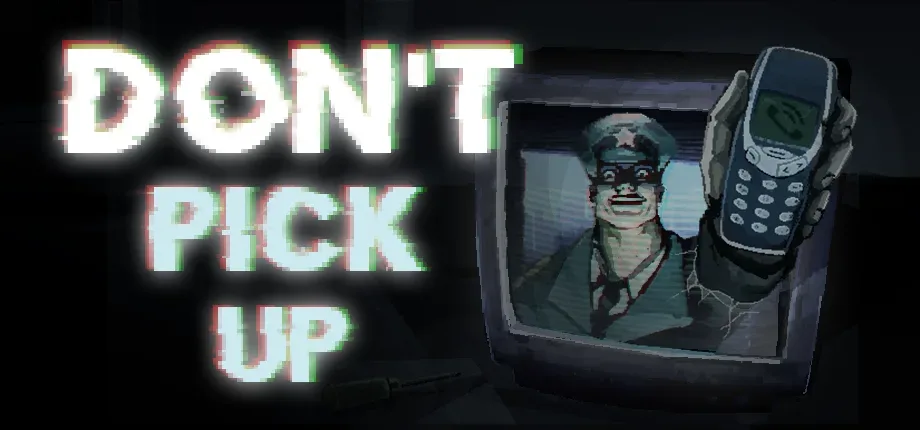
Don’t Pick Up, the narrative-led psychological horror game from developer Quarter Games and publisher Clover Bite, now has a free demo on Steam. Its premise turns a modest technical job into a pressure cooker: players are a technician in a government-certified shop repairing phones and other communication devices in an alternate early-2000s dystopia.
The looming problem is that the rules do not stay still. Government policies and restrictions change from day to day, determining which devices may be serviced, which components are legal to use, and even which customers can be accepted. What could ordinarily be a practical repair task becomes an exercise in compliance, judgment and self-preservation.
That setup places Don’t Pick Up firmly in the kind of horror built around uncertainty rather than a simple monster encounter. A device may be an object to diagnose, but it is also a container for personal information, evidence and political risk. The player’s workbench is therefore not merely a workspace; it is where private lives meet an authoritarian system’s demands.
A repair shop where every job carries a consequence
The game is played from a first-person perspective and centers on inspecting and repairing customers’ devices. The supplied details identify phones and communication hardware as the objects under examination, with the player handling both the physical job and the information that emerges from it.
In plain terms, the repair loop is not presented as separate from the story. The act of looking through a device exposes information about individuals, factions and conspiracies amid a broader political collapse. That makes the central question more complicated than whether a repair can be completed successfully. It also asks what the technician should do after learning something sensitive.
The available choices include deciding who to serve, what to report and what to keep secret. Those decisions shape the narrative and can lead to multiple endings. The game’s branching structure gives weight to knowledge that might otherwise be treated as background lore. If a player finds something consequential in a customer’s device, the finding is not simply there to be read and forgotten; it can become part of the player’s responsibility.
What “multiple endings” means here
Multiple endings means that the story can conclude in different ways based on player decisions. The information available does not specify how many endings there are, nor does it detail the precise conditions that lead to each one. What is established is the type of choices that matter: service decisions, reporting choices and decisions to conceal information.
That is an especially suitable structure for this setting. Changing restrictions can create a gap between what a technician can physically do and what the state allows them to do. The game’s tension appears to live in that gap. A customer may need help, but helping them could carry a cost. Reporting them may satisfy a directive, but could deepen the human consequences of the job. Silence may protect someone, or expose the player to another danger.
Daily directives turn routine work into a moving target
The most distinctive element outlined for Don’t Pick Up is its changing daily government direction. These policies can alter three practical parts of the job:
- what the technician is legally permitted to repair;
- which parts may be used in a repair; and
- which customers the shop can accept.
These restrictions matter because they make the game’s rules part of its fiction. Rather than treating the dystopian setting as decoration around an ordinary repair simulation, the political environment intervenes directly in the player’s options. A player may need to reassess the day’s rules before deciding how to handle an incoming device or customer.
The alternate early-2000s setting also frames the premise around phones and communications technology from a period before today’s always-connected devices became the default cultural reference point. The supplied information does not specify particular hardware, repair procedures or interface systems, so players should not assume a detailed simulation of any named device. The confirmed focus is broader: examining and repairing communications equipment while navigating the information and restrictions attached to it.
For PC players looking for other hardware-oriented coverage alongside Steam releases, Joking Joystick has also covered the GMKtec M6 Ultra mini PC.
Psychological horror through pressure and information
Psychological horror generally emphasizes unease, paranoia, moral stress or uncertainty over straightforward action-driven scares. In Don’t Pick Up, the confirmed ingredients supporting that label are the first-person perspective, an authoritarian dystopia, shifting legal rules, sensitive information and an escalating political crisis outside the shop.
That last point is important. The larger crisis is unfolding beyond the player’s workplace, while the technician encounters its effects through people and devices that arrive for service. This is a small-scale viewpoint on a large-scale collapse. Players are not described as political leaders, soldiers or investigators. They are workers whose access to communications hardware gives them an unexpected view into a deteriorating society.
The result is a premise in which ordinary professional tasks can become morally loaded. A part replacement is no longer only a part replacement if the device’s owner, its contents or the legality of the work has changed under a new directive. An inspection can be a discovery. A report can be an intervention. Choosing not to disclose something can be a decision with consequences of its own.
What the Steam demo establishes
The free Steam demo gives players a chance to sample the game’s core concept: first-person device examination and repair, daily restrictions, customer decisions and a narrative shaped by what the player does with sensitive material. The announcement confirms that the demo is available now.
It does not provide a release date for the full game, a price, a list of supported platforms beyond Steam, the demo’s length or a detailed breakdown of its repair mechanics. It also does not name the factions or conspiracies players may uncover. Those omissions are worth keeping in mind for anyone trying to determine the eventual scope of the complete release.
Still, the demo’s premise is clear. Don’t Pick Up asks players to work under rules that can change without warning, sift through information that may be dangerous to possess, and decide how far their obligations to customers, government policy and personal conscience extend. For a game about fixing communication devices, its tension comes from the possibility that every successful repair may connect the player to a problem that cannot be neatly put back together.